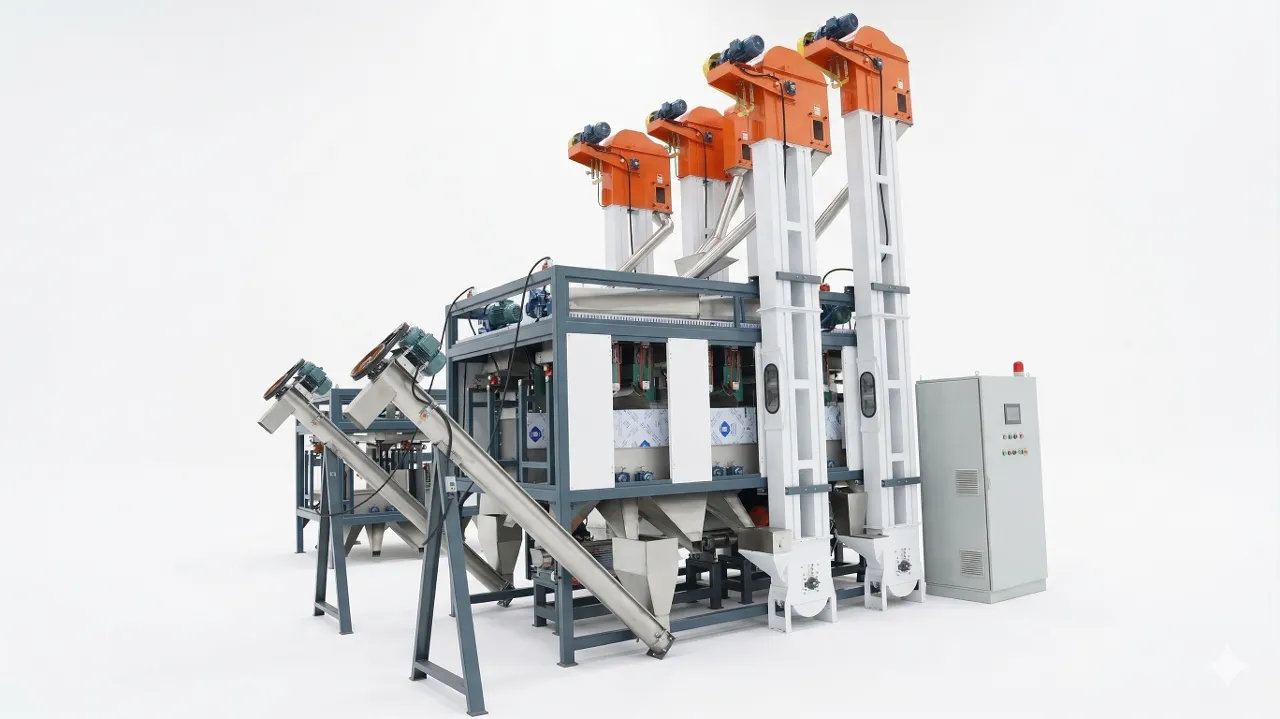
Equipos Auxiliares

Separador Electrostático de Plástico para Purificación Seca de Plásticos Mezclados

Un separador electrostático utiliza un campo eléctrico de alta tensión — con carga corona o triboeléctrica — para separar escamas plásticas mezcladas en fracciones puras, sin agua, productos químicos ni sensores NIR. Rumtoo diseña la máquina según su mezcla real de alimentación (PVC en PET, PE/PP/PS, ABS/PS/HIPS, cable/RAEE), su ppm objetivo y el caudal de línea.

Scroll
Plastic Electrostatic Separator main unit

How Electrostatic Separator Selection Should Actually Work

Throughput and voltage alone never predict real-world purity. The separator must be matched to the material pair, feed moisture, particle size, and upstream process — here is the selection path that actually works.

1

Define the target material pair and ppm

State which plastics you need to split — PVC-from-PET, PE/PP, ABS/PS, rubber/plastic, or wire-copper/plastic — and the maximum acceptable contamination in ppm. Different pairs need corona, triboelectric, or a hybrid stage.

2

Confirm feed conditioning (moisture, size, dust)

Electrostatic fields are blocked by moisture and fines. The feed must be dry (<0.5% moisture), size-classified to 2–10 mm, and largely free of dust. Rumtoo specifies the pre-dryer, air classifier and screener upstream if they are missing.

3

Size the voltage, drum speed and number of passes

Rumtoo calculates the required high-voltage stage count based on the near-density or near-resistivity of the pair. Near-pairs such as PET/PVC typically need one pass plus middling recirculation; PE/PP may require triboelectric pre-charging.

4

Integrate with cyclone, dust collection and grounded enclosure

The final configuration adds grounded safety enclosure, transparent inspection doors, dust extraction on the charger inlet, and a middling recycle conveyor so the separator operates as a stable, safe production stage — not a lab curiosity.

Lo Que los Compradores Necesitan de un Separador Electrostático

La razón real para instalar un separador electrostático no es la tecnología — es el aumento del precio de venta del rPET/rHDPE, la menor tasa de rechazo en extrusión y un proceso seco sin permiso de aguas residuales.

Purificación Seca y Sin Productos Químicos

Sin agua, sin detergente, sin tratamiento de efluentes. Consumo 30–50 kWh por tonelada, sensiblemente menor que el hundido/flotado o la flotación por espuma para pares difíciles.

Alcanzar <50 ppm PVC en PET

Reducción típica del PVC del 95–99 % en un solo paso, con recirculación de la fracción intermedia hasta el umbral bottle-to-bottle.

Lo Que el NIR No Puede Hacer

Los clasificadores NIR fallan en plástico negro, escamas pequeñas, material húmedo y pares químicamente similares. El electrostático separa por carga superficial — independiente del color.

Una Máquina, Múltiples Pares de Materiales

Ajustando voltaje, velocidad del tambor y placas separadoras, una sola unidad pasa de PET/PVC a PE/PP a ABS/PS en el mismo turno.

Problemas Comunes de la Separación Electrostática y Soluciones Reales

La mayoría de las caídas de pureza provienen de cuatro condiciones — no del electrodo mismo. Esto es lo que falla en producción y cómo lo corrige Rumtoo en la puesta en marcha.

Problem

La pureza cae en días húmedos o época de lluvias.

Rumtoo Solution

Rumtoo instala un precalentador o secador térmico aguas arriba y fija un límite de humedad <0,5 %. Un sensor de humedad ambiente avisa antes de que la separación se degrade.

Problem

Finos y polvo se pegan al tambor y cortocircuitan el campo.

Rumtoo Solution

Rumtoo añade un clasificador zig-zag y criba vibratoria antes del separador para eliminar finos <2 mm, más un cepillo de cerdas suaves en cada cambio de turno.

Problem

Escamas buenas de PET terminan en el rechazo de PVC — pérdida de rendimiento.

Rumtoo Solution

Rumtoo ajusta la posición de las placas, baja la velocidad del tambor y recircula la fracción intermedia para un segundo paso — recuperando 2–5 % de rendimiento.

Problem

Fallos y disparos de alta tensión tras algunos meses de operación.

Rumtoo Solution

Rumtoo suministra aisladores cerámicos, armario HV sellado y un protocolo de limpieza programado. Los hilos corona son consumibles — parte del kit de mantenimiento.

Machine Reference and Separation Principle

Charged flakes move through a high-voltage field where conductive, positively-charged, and negatively-charged particles travel on different trajectories into dedicated collection chambers — all without water or chemicals.

Electrostatic separator rotating drum and adjustable splitter plates

Machine View: high-voltage electrode, rotating drum and splitter plates

Pre-dried flakes feed onto a grounded rotating drum. A corona electrode or triboelectric charger transfers surface charge; the rotating drum then carries flakes through the electric field where they deflect at different angles based on resistivity and charge polarity. Adjustable splitter plates divide the falling stream into conductor, middling, and non-conductor fractions.

  • Adjustable 0–35 kV high-voltage supply for fine cut-point control
  • Rotating drum speed and splitter plate angles tuned per material mix
  • Middling fraction can be recirculated for second-pass purification to <50 ppm

Process View: PVC-in-PET purification and mixed plastic flake separation

In a PET washing line, the electrostatic separator sits after hot wash, air classification, and drying. It captures PVC contamination that survives sink-float and label removal — the last stage before extrusion that protects rPET from the yellowing and gels caused by PVC decomposition above 180 °C.

  • Reduces PVC contamination in PET flakes from ~1000 ppm down to <50 ppm
  • Also separates PE/PP, ABS/PS, rubber/plastic and cable insulation mixes
  • Fully dry — no wastewater, no detergent, no drying step downstream
PVC contamination separated from PET flakes by electrostatic field

Separador Electrostático de Plástico en Operación

Vea cómo el tambor rotativo, el electrodo de alta tensión y las placas separadoras dividen las escamas plásticas mezcladas en fracciones puras, de forma seca y continua.

Typical Electrostatic Separator Use Cases

Electrostatic separation earns its place in plastic recycling lines when the material pair is chemically similar, color-contaminated, or too wet or fine for NIR sorting.

  • PVC-in-PET Purification (Bottle-to-Bottle)

    Removes residual PVC, PLA and silicone from washed PET flakes after hot wash and air classification — the stage that brings rPET from ~1000 ppm to <50 ppm for food-grade extrusion.

  • PE/PP Fraction Separation

    Splits polyethylene and polypropylene flakes from rigid packaging regrind where density difference is too small for reliable sink-float separation.

  • ABS/PS/HIPS Engineering Plastic Split

    Sorts WEEE, automotive shredder residue (ASR) and toy regrind into recyclable ABS, PS and HIPS fractions for compounders that demand single-polymer feedstock.

  • Cable & E-Waste Plastic/Metal Split

    Recovers copper, aluminum and precious metal particles from PVC and PE cable jacket regrind — a dry alternative to water tables for shredded cable.

  • Rubber/Plastic from ELT & ASR

    Separates rubber fines from plastic regrind in end-of-life tire and automotive shredder residue streams where density-based separation misses overlapping fractions.

  • Black Plastic & Mixed Color Regrind

    Handles black and dark-pigmented regrind that NIR sorters cannot see — an essential complement to optical sorting lines dealing with WEEE and automotive feedstock.

Reference Configurations

These are sizing references. Actual purity and throughput depend on the specific polymer pair, feed moisture, particle shape and number of passes — Rumtoo confirms the final specification after reviewing your material data.

ModelThroughputHV SupplyPowerKey Features
RT-ES300100–300 kg/h0–30 kV adjustable3.5 kWCompact single-drum, corona electrode, suits lab/R&D and low-volume bottle-to-bottle
RT-ES500300–800 kg/h0–35 kV adjustable5.5 kWDual-drum cascade with middling recirculation, standard for PET washing lines
RT-ES1000800–1500 kg/h0–35 kV adjustable7.5 kWTriboelectric pre-charger + corona stage, PE/PP and ABS/PS split capability
RT-ES20001500–2000 kg/h0–40 kV adjustable11 kWTriple-drum, middling recycle conveyor, WEEE and cable-recycling grade

Typical energy consumption is 30–50 kWh per ton of clean product. Throughput is reduced by ~20% when running near-pair separations (PET/PVC, PE/PP). Rumtoo will size the unit after reviewing your feed analysis and ppm target.

Electrostatic Separator Checklist Before RFQ

Bring these data points to the RFQ and Rumtoo can size the separator, pre-conditioning train, and commissioning protocol in the first reply — avoiding weeks of back-and-forth.

Material Pair and ppm Target

State the polymers you need to split and the maximum acceptable contamination in ppm (e.g. <50 ppm PVC in PET, <1000 ppm PE in PP). This determines charging method and pass count.

Feed Particle Size and Shape

Share the flake size distribution (target 2–10 mm), shape (flake vs granule vs fiber) and any fines content under 2 mm. Particle size directly controls separation sharpness.

Feed Moisture and Upstream Process

Specify the moisture content at the separator inlet (target <0.5%) and the upstream train — hot wash, thermal dryer, zig-zag air classifier. Rumtoo adds pre-conditioning if the train is incomplete.

Throughput, Shift Pattern and Utility Limits

Provide target kg/h, shift hours, and available electrical supply. HV supply is low-current but needs stable three-phase input; ambient humidity in the workshop also matters.

Downstream Use of Each Fraction

Tell Rumtoo where the conductor, non-conductor and middling fractions will go — direct to extrusion, second-pass recirculation, or separate bagging. This drives the discharge and conveyor layout.

Safety, Grounding and Compliance Requirements

State the local electrical code (CE, UL, GB), grounding requirements, and whether an interlocked safety enclosure or ATEX-rated build is required for your plant.

Electrostatic Separation vs Alternative Purification Methods

Electrostatic separation is not a universal answer — it is the right answer when the pair is chemically similar, the feed is dry, and water-based processes are uneconomical. This table shows where it wins and where another technology fits better.

Decision CriteriaSink-Float TankNIR Optical SorterFroth FlotationRumtoo Electrostatic Separator
PVC-in-PET purificationUnreliable — similar densityFails on thin/colored PVCWorks but wet and chemicalProven to <50 ppm in one line
Black and dark plasticsWorksFails — no NIR signalWorksWorks — color-independent
Wastewater generationHigh — needs treatmentNoneHigh + chemicalsNone — fully dry
Energy per ton~20–30 kWh + water10–15 kWh40–60 kWh + reagents30–50 kWh, no reagents
Capacity for near-pairs (PE/PP, ABS/PS)LimitedGood if colors differWorks but slowGood with triboelectric stage
Capex vs operating costLow capex, high opexHigh capex, low opexMedium capex, high opexMedium capex, low opex

Preguntas Frecuentes

¿Qué es un separador electrostático de plástico y cómo funciona?

Utiliza un campo eléctrico de 0–35 kV para separar escamas plásticas mezcladas. Un cargador corona o triboeléctrico transfiere carga superficial; un tambor giratorio las lleva a través del campo, donde los distintos polímeros se desvían hacia cámaras separadas.

¿Puede separar PVC de PET hasta pureza bottle-to-bottle?

Sí. Un paso reduce típicamente el PVC de ~1000 ppm a 50–100 ppm. Con recirculación de la fracción intermedia, el PET alcanza <50 ppm, el umbral exigido para rPET alimentario.

¿Cuál es el consumo energético por tonelada?

30–50 kWh por tonelada de producto limpio. La alta tensión consume muy poca corriente; la mayor parte de la energía va al transportador, al tambor y a la extracción de polvo.

¿Puede reemplazar un clasificador óptico NIR?

Para algunas tareas, sí — plástico negro, escamas pequeñas, pares químicamente similares (PE/PP, ABS/PS) y PVC en PET. El NIR sigue siendo mejor para flujos multicolor de botellas. Ambas tecnologías suelen complementarse.

¿Necesita alimentación seca? ¿Qué humedad tolera?

El material debe estar por debajo de 0,5 % de humedad. La humedad disipa la carga y colapsa la separación. Rumtoo añade un secador térmico si la línea anterior solo termina en centrífuga.

¿Qué tamaño de partícula funciona mejor?

El rango probado es 2–10 mm. Los finos <2 mm se pegan al tambor; las escamas >10 mm no llevan suficiente carga por unidad de masa para desviarse.

¿Qué mantenimiento requiere la máquina?

Diario: cepillado del tambor, inspección de la entrada del cargador, vaciado del polvo. Semanal: limpieza de electrodos y aisladores, engrase de rodamientos. Mensual: inspección de cables HV. Trimestral: reemplazo de hilos corona (consumible).

¿Cómo estimo el ROI y el periodo de retorno?

El retorno depende del precio premium de la fracción limpia. Para rPET, pasar de ~1000 ppm a <50 ppm PVC suele desbloquear precios alimentarios USD 150–300/tonelada por encima del grado técnico. En una línea de 1000 kg/h a 16 h/día, eso son ~USD 0,5–1,0 M/año. Rumtoo construye un modelo específico antes de firmar.

¿Listo para Calcular el Retorno de Su Flujo PVC, PE/PP o RAEE?

Envíe a Rumtoo un análisis de su alimentación (mezcla de polímero, humedad, tamaño de escama) y su ppm objetivo. Devolveremos una máquina dimensionada, un tren de preacondicionamiento, un plan de puesta en marcha y un modelo ROI específico — normalmente en 24 horas.

Solicitar Propuesta
Respuesta de expertos en 24 horas. Cotizacion sin compromiso.