Hulpapparatuur

Plastic Elektrostatische Separator voor Droge Zuivering van Gemengde Kunststoffen

Een elektrostatische separator gebruikt een hoogspanningsveld — met corona- of triboelektrische lading — om gemengde kunststofvlokken droog te scheiden in zuivere fracties zonder water, chemie of NIR-sensoren. Rumtoo dimensioneert de machine op uw werkelijke materiaalmix (PVC in PET, PE/PP/PS, ABS/PS/HIPS, kabel/AEEA), ppm-doel en lijncapaciteit.

Scroll
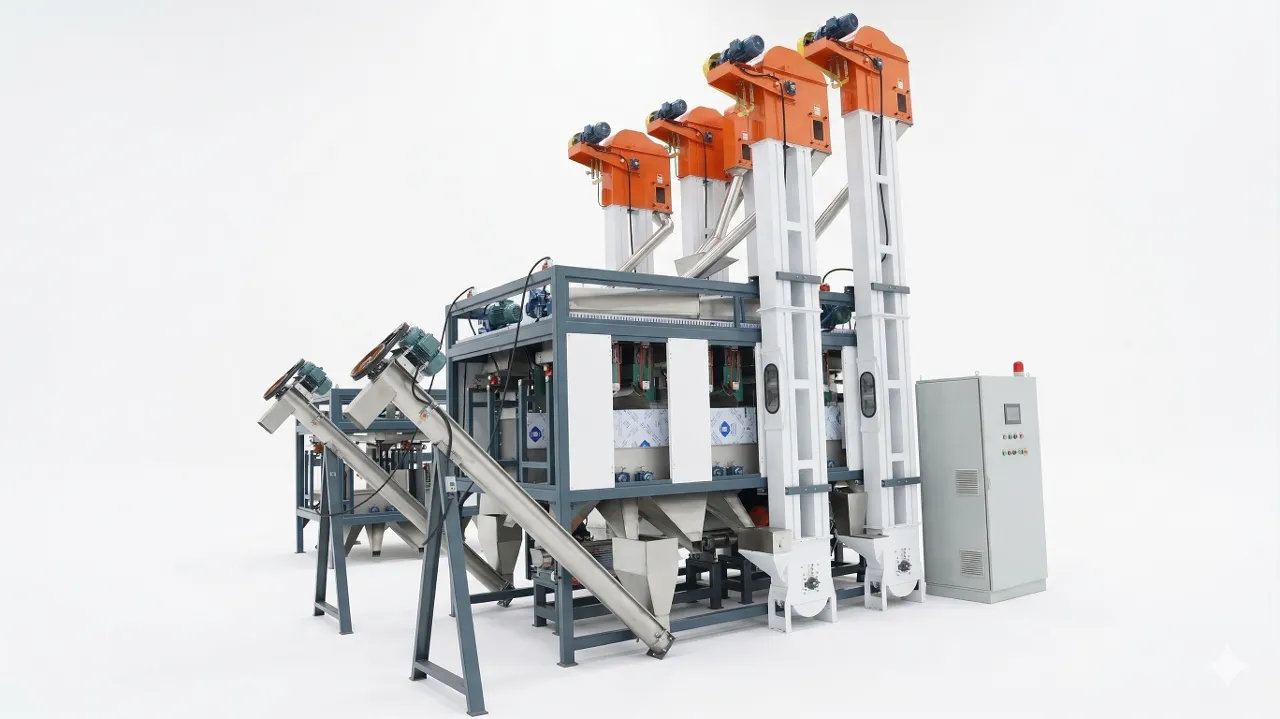
Plastic Electrostatic Separator main unit

How Electrostatic Separator Selection Should Actually Work

Throughput and voltage alone never predict real-world purity. The separator must be matched to the material pair, feed moisture, particle size, and upstream process — here is the selection path that actually works.

1

Define the target material pair and ppm

State which plastics you need to split — PVC-from-PET, PE/PP, ABS/PS, rubber/plastic, or wire-copper/plastic — and the maximum acceptable contamination in ppm. Different pairs need corona, triboelectric, or a hybrid stage.

2

Confirm feed conditioning (moisture, size, dust)

Electrostatic fields are blocked by moisture and fines. The feed must be dry (<0.5% moisture), size-classified to 2–10 mm, and largely free of dust. Rumtoo specifies the pre-dryer, air classifier and screener upstream if they are missing.

3

Size the voltage, drum speed and number of passes

Rumtoo calculates the required high-voltage stage count based on the near-density or near-resistivity of the pair. Near-pairs such as PET/PVC typically need one pass plus middling recirculation; PE/PP may require triboelectric pre-charging.

4

Integrate with cyclone, dust collection and grounded enclosure

The final configuration adds grounded safety enclosure, transparent inspection doors, dust extraction on the charger inlet, and a middling recycle conveyor so the separator operates as a stable, safe production stage — not a lab curiosity.

What Buyers Actually Need From an Electrostatic Separator

The business reason to install an electrostatic separator is not the technology — it is a measurable jump in rPET/rHDPE sale price, a lower reject rate at the extruder, and a dry process that avoids wastewater permits.

Dry, Chemical-Free Purification

No water, no detergent, no flocculant, no wastewater treatment. The separator runs at 30–50 kWh per ton — significantly lower total cost than sink-float tanks or froth flotation for difficult pairs like PVC-in-PET.

Reach <50 ppm PVC-in-PET

Typical one-pass PVC reduction is 95–99% with middling recirculation bringing PET flake purity below the 50 ppm threshold required by bottle-to-bottle extrusion. That purity jump is what unlocks food-grade rPET pricing.

Handles What NIR Cannot

Near-infrared sorters fail on black plastics, small flakes, wet material, and chemically similar pairs. An electrostatic separator splits by surface charge — it does not care about color, printing, or optical transparency.

Same Machine, Multiple Material Pairs

By adjusting voltage, drum speed, charger type and splitter angles, one unit can be re-tuned from PET/PVC to PE/PP to ABS/PS within a shift — removing the need for multiple specialist machines.

Common Electrostatic Separation Problems and Real Fixes

Most poor-separation reports trace back to four conditions — not the electrode itself. This table shows what actually goes wrong in production and how Rumtoo corrects it during commissioning.

Problem

Purity suddenly drops on humid days or after monsoon season.

Rumtoo Solution

Rumtoo installs a pre-heater or thermal dryer before the separator and specifies a feed moisture limit of <0.5%. Ambient humidity is tracked by a sensor that warns the operator before separation degrades.

Problem

Fines and dust stick to the drum surface and short the field.

Rumtoo Solution

Rumtoo adds a zig-zag air classifier and vibrating screen ahead of the separator to remove fines under 2 mm, and specifies a soft-bristle drum cleaner on every shift change.

Problem

Good PET flakes end up in the PVC reject stream — yield loss.

Rumtoo Solution

Rumtoo adjusts the splitter plate position, lowers drum speed, and routes the middling fraction back for a second pass instead of discarding it — recovering 2–5 % of yield lost in single-pass setups.

Problem

High-voltage faults and trips after a few months of running.

Rumtoo Solution

Rumtoo supplies ceramic insulators, sealed HV cabinet, and a scheduled cleaning protocol for electrodes and insulators. Corona wires are consumables — part of the maintenance kit rather than a field failure.

Machine Reference and Separation Principle

Charged flakes move through a high-voltage field where conductive, positively-charged, and negatively-charged particles travel on different trajectories into dedicated collection chambers — all without water or chemicals.

Electrostatic separator rotating drum and adjustable splitter plates

Machine View: high-voltage electrode, rotating drum and splitter plates

Pre-dried flakes feed onto a grounded rotating drum. A corona electrode or triboelectric charger transfers surface charge; the rotating drum then carries flakes through the electric field where they deflect at different angles based on resistivity and charge polarity. Adjustable splitter plates divide the falling stream into conductor, middling, and non-conductor fractions.

  • Adjustable 0–35 kV high-voltage supply for fine cut-point control
  • Rotating drum speed and splitter plate angles tuned per material mix
  • Middling fraction can be recirculated for second-pass purification to <50 ppm

Process View: PVC-in-PET purification and mixed plastic flake separation

In a PET washing line, the electrostatic separator sits after hot wash, air classification, and drying. It captures PVC contamination that survives sink-float and label removal — the last stage before extrusion that protects rPET from the yellowing and gels caused by PVC decomposition above 180 °C.

  • Reduces PVC contamination in PET flakes from ~1000 ppm down to <50 ppm
  • Also separates PE/PP, ABS/PS, rubber/plastic and cable insulation mixes
  • Fully dry — no wastewater, no detergent, no drying step downstream
PVC contamination separated from PET flakes by electrostatic field

Plastic Electrostatic Separator in Operation

Watch how the rotating drum, high-voltage electrode and splitter plates separate mixed plastic flakes into pure conductor and non-conductor fractions in a dry, continuous process.

Typical Electrostatic Separator Use Cases

Electrostatic separation earns its place in plastic recycling lines when the material pair is chemically similar, color-contaminated, or too wet or fine for NIR sorting.

  • PVC-in-PET Purification (Bottle-to-Bottle)

    Removes residual PVC, PLA and silicone from washed PET flakes after hot wash and air classification — the stage that brings rPET from ~1000 ppm to <50 ppm for food-grade extrusion.

  • PE/PP Fraction Separation

    Splits polyethylene and polypropylene flakes from rigid packaging regrind where density difference is too small for reliable sink-float separation.

  • ABS/PS/HIPS Engineering Plastic Split

    Sorts WEEE, automotive shredder residue (ASR) and toy regrind into recyclable ABS, PS and HIPS fractions for compounders that demand single-polymer feedstock.

  • Cable & E-Waste Plastic/Metal Split

    Recovers copper, aluminum and precious metal particles from PVC and PE cable jacket regrind — a dry alternative to water tables for shredded cable.

  • Rubber/Plastic from ELT & ASR

    Separates rubber fines from plastic regrind in end-of-life tire and automotive shredder residue streams where density-based separation misses overlapping fractions.

  • Black Plastic & Mixed Color Regrind

    Handles black and dark-pigmented regrind that NIR sorters cannot see — an essential complement to optical sorting lines dealing with WEEE and automotive feedstock.

Reference Configurations

These are sizing references. Actual purity and throughput depend on the specific polymer pair, feed moisture, particle shape and number of passes — Rumtoo confirms the final specification after reviewing your material data.

ModelThroughputHV SupplyPowerKey Features
RT-ES300100–300 kg/h0–30 kV adjustable3.5 kWCompact single-drum, corona electrode, suits lab/R&D and low-volume bottle-to-bottle
RT-ES500300–800 kg/h0–35 kV adjustable5.5 kWDual-drum cascade with middling recirculation, standard for PET washing lines
RT-ES1000800–1500 kg/h0–35 kV adjustable7.5 kWTriboelectric pre-charger + corona stage, PE/PP and ABS/PS split capability
RT-ES20001500–2000 kg/h0–40 kV adjustable11 kWTriple-drum, middling recycle conveyor, WEEE and cable-recycling grade

Typical energy consumption is 30–50 kWh per ton of clean product. Throughput is reduced by ~20% when running near-pair separations (PET/PVC, PE/PP). Rumtoo will size the unit after reviewing your feed analysis and ppm target.

Electrostatic Separator Checklist Before RFQ

Bring these data points to the RFQ and Rumtoo can size the separator, pre-conditioning train, and commissioning protocol in the first reply — avoiding weeks of back-and-forth.

Material Pair and ppm Target

State the polymers you need to split and the maximum acceptable contamination in ppm (e.g. <50 ppm PVC in PET, <1000 ppm PE in PP). This determines charging method and pass count.

Feed Particle Size and Shape

Share the flake size distribution (target 2–10 mm), shape (flake vs granule vs fiber) and any fines content under 2 mm. Particle size directly controls separation sharpness.

Feed Moisture and Upstream Process

Specify the moisture content at the separator inlet (target <0.5%) and the upstream train — hot wash, thermal dryer, zig-zag air classifier. Rumtoo adds pre-conditioning if the train is incomplete.

Throughput, Shift Pattern and Utility Limits

Provide target kg/h, shift hours, and available electrical supply. HV supply is low-current but needs stable three-phase input; ambient humidity in the workshop also matters.

Downstream Use of Each Fraction

Tell Rumtoo where the conductor, non-conductor and middling fractions will go — direct to extrusion, second-pass recirculation, or separate bagging. This drives the discharge and conveyor layout.

Safety, Grounding and Compliance Requirements

State the local electrical code (CE, UL, GB), grounding requirements, and whether an interlocked safety enclosure or ATEX-rated build is required for your plant.

Electrostatic Separation vs Alternative Purification Methods

Electrostatic separation is not a universal answer — it is the right answer when the pair is chemically similar, the feed is dry, and water-based processes are uneconomical. This table shows where it wins and where another technology fits better.

Decision CriteriaSink-Float TankNIR Optical SorterFroth FlotationRumtoo Electrostatic Separator
PVC-in-PET purificationUnreliable — similar densityFails on thin/colored PVCWorks but wet and chemicalProven to <50 ppm in one line
Black and dark plasticsWorksFails — no NIR signalWorksWorks — color-independent
Wastewater generationHigh — needs treatmentNoneHigh + chemicalsNone — fully dry
Energy per ton~20–30 kWh + water10–15 kWh40–60 kWh + reagents30–50 kWh, no reagents
Capacity for near-pairs (PE/PP, ABS/PS)LimitedGood if colors differWorks but slowGood with triboelectric stage
Capex vs operating costLow capex, high opexHigh capex, low opexMedium capex, high opexMedium capex, low opex

Veelgestelde Vragen

Wat is een plastic elektrostatische separator en hoe werkt hij?

Hij gebruikt een 0–35 kV elektrisch veld om gemengde kunststofvlokken te scheiden. Een corona- of triboelektrische lader brengt oppervlaktelading aan; een draaiende geaarde trommel voert de vlokken door het veld waar verschillende polymeren in aparte kamers vallen.

Kan hij PVC uit PET scheiden tot bottle-to-bottle zuiverheid?

Ja. Eén pass brengt PVC-verontreiniging van ~1000 ppm terug naar 50–100 ppm. Met recirculatie van de middenfractie haalt PET <50 ppm — de drempel voor voedselkwaliteit rPET.

Wat is het energieverbruik per ton?

30–50 kWh per ton schoon product. De hoogspanning trekt weinig stroom; de meeste energie gaat naar transportbanden, trommelaandrijving en stofafzuiging.

Kan hij een NIR optische sorteerder vervangen?

Voor sommige taken ja — zwart kunststof, kleine vlokken, chemisch vergelijkbare paren (PE/PP, ABS/PS) en PVC in PET. NIR blijft beter voor gekleurde flessenstromen. De technologieën vullen elkaar meestal aan.

Moet het voedermateriaal droog zijn? Hoeveel vocht is toegestaan?

Het materiaal moet onder 0,5 % vocht zijn. Vocht laat de oppervlaktelading weglekken en doet de scheiding instorten. Rumtoo voegt een thermische droger toe als de lijn alleen eindigt met een centrifuge.

Welke deeltjesgrootte werkt het best?

Het bewezen bereik is 2–10 mm. Fijnstof <2 mm plakt aan de trommel; vlokken >10 mm dragen niet genoeg lading per eenheid massa.

Welk onderhoud vraagt de machine?

Dagelijks: trommelborstel, inspectie laderingang, stofbak legen. Wekelijks: elektrodes en isolatoren reinigen, lagers smeren. Maandelijks: HV-kabels inspecteren. Per kwartaal: corona-draden vervangen (verbruiksartikel).

Hoe schat ik ROI en terugverdientijd?

Terugverdientijd wordt bepaald door de prijspremie van de schone fractie. Voor rPET levert <50 ppm PVC meestal USD 150–300 per ton boven technische kwaliteit op. Op een 1000 kg/u lijn met 16 uur/dag draait dat uit op ~USD 0,5–1,0 M/jaar. Rumtoo bouwt een specifiek model vóór ondertekening.

Klaar om de Cijfers Door Te Rekenen voor Uw PVC, PE/PP of AEEA Stroom?

Stuur Rumtoo een voedinganalyse (polymeermix, vocht, vlokgrootte) en uw ppm-doel. Binnen 24 uur ontvangt u een gedimensioneerde machine, voorbehandelingstrein, commissioningsplan en een specifiek ROI-model.

Offerte Aanvragen
Reactie van een expert binnen 24 uur. Vrijblijvende offerte.