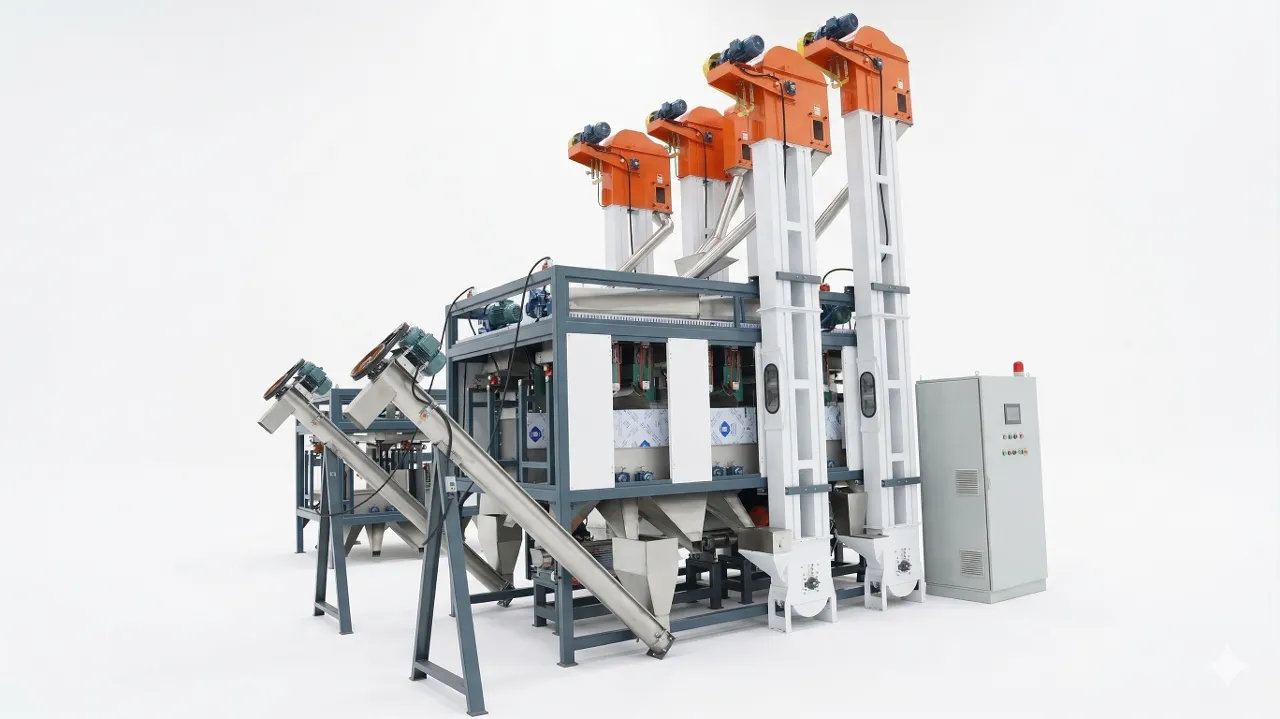
Équipements Auxiliaires

Séparateur Électrostatique Plastique pour Purification à Sec des Plastiques Mélangés

Un séparateur électrostatique utilise un champ électrique haute tension — avec chargement corona ou triboélectrique — pour séparer les paillettes de plastique mélangées en fractions pures, sans eau, produits chimiques ni capteur NIR. Rumtoo dimensionne la machine selon votre mélange réel (PVC dans PET, PE/PP/PS, ABS/PS/HIPS, câbles/DEEE), la cible ppm et le débit de ligne, pour que le séparateur offre un vrai retour sur investissement.

Scroll
Plastic Electrostatic Separator main unit

How Electrostatic Separator Selection Should Actually Work

Throughput and voltage alone never predict real-world purity. The separator must be matched to the material pair, feed moisture, particle size, and upstream process — here is the selection path that actually works.

1

Define the target material pair and ppm

State which plastics you need to split — PVC-from-PET, PE/PP, ABS/PS, rubber/plastic, or wire-copper/plastic — and the maximum acceptable contamination in ppm. Different pairs need corona, triboelectric, or a hybrid stage.

2

Confirm feed conditioning (moisture, size, dust)

Electrostatic fields are blocked by moisture and fines. The feed must be dry (<0.5% moisture), size-classified to 2–10 mm, and largely free of dust. Rumtoo specifies the pre-dryer, air classifier and screener upstream if they are missing.

3

Size the voltage, drum speed and number of passes

Rumtoo calculates the required high-voltage stage count based on the near-density or near-resistivity of the pair. Near-pairs such as PET/PVC typically need one pass plus middling recirculation; PE/PP may require triboelectric pre-charging.

4

Integrate with cyclone, dust collection and grounded enclosure

The final configuration adds grounded safety enclosure, transparent inspection doors, dust extraction on the charger inlet, and a middling recycle conveyor so the separator operates as a stable, safe production stage — not a lab curiosity.

Ce Que les Acheteurs Attendent d un Séparateur Électrostatique

La vraie raison d installer un séparateur électrostatique n est pas la technologie — c est l augmentation du prix de vente du rPET/rHDPE, un taux de rejet réduit à l extrusion et un procédé sec sans autorisation eaux usées.

Purification Sèche et Sans Produits Chimiques

Pas d eau, pas de détergent, pas de traitement des effluents. Consommation 30–50 kWh par tonne, nettement plus bas que le tri densimétrique ou la flottation par mousse pour les paires difficiles.

Atteindre <50 ppm PVC dans PET

Réduction typique du PVC de 95–99 % en un passage, avec recirculation de la fraction intermédiaire pour descendre sous le seuil bottle-to-bottle.

Ce Que le NIR ne Peut Pas Faire

Les trieurs NIR échouent sur le plastique noir, les petites paillettes, le matériau humide et les paires chimiquement similaires. L électrostatique sépare par charge de surface — indépendamment de la couleur.

Même Machine, Plusieurs Paires de Matériaux

En ajustant la tension, la vitesse du tambour et les plaques séparatrices, une seule unité passe de PET/PVC à PE/PP à ABS/PS sur le même shift.

Problèmes Courants de Séparation Électrostatique et Vraies Solutions

La plupart des baisses de pureté viennent de quatre conditions — pas de l électrode elle-même. Voici ce qui déraille en production et comment Rumtoo corrige lors de la mise en service.

Problem

La pureté chute brutalement les jours humides ou en saison des pluies.

Rumtoo Solution

Rumtoo installe un préchauffeur ou un sécheur thermique en amont et fixe un seuil d humidité <0,5 %. Un capteur d humidité ambiante alerte avant la dégradation.

Problem

Les fines et poussières collent au tambour et court-circuitent le champ.

Rumtoo Solution

Rumtoo ajoute un classificateur zig-zag et un tamis vibrant avant le séparateur pour retirer les fines <2 mm, plus un racleur souple à chaque changement de shift.

Problem

Des bonnes paillettes PET finissent dans le rejet PVC — perte de rendement.

Rumtoo Solution

Rumtoo ajuste la position des plaques, réduit la vitesse du tambour et recircule la fraction intermédiaire pour un second passage — récupérant 2–5 % de rendement.

Problem

Défauts et coupures haute tension après quelques mois de fonctionnement.

Rumtoo Solution

Rumtoo fournit des isolateurs céramique, une armoire HT scellée et un protocole de nettoyage programmé. Les fils corona sont des consommables — intégrés au kit de maintenance.

Machine Reference and Separation Principle

Charged flakes move through a high-voltage field where conductive, positively-charged, and negatively-charged particles travel on different trajectories into dedicated collection chambers — all without water or chemicals.

Electrostatic separator rotating drum and adjustable splitter plates

Machine View: high-voltage electrode, rotating drum and splitter plates

Pre-dried flakes feed onto a grounded rotating drum. A corona electrode or triboelectric charger transfers surface charge; the rotating drum then carries flakes through the electric field where they deflect at different angles based on resistivity and charge polarity. Adjustable splitter plates divide the falling stream into conductor, middling, and non-conductor fractions.

  • Adjustable 0–35 kV high-voltage supply for fine cut-point control
  • Rotating drum speed and splitter plate angles tuned per material mix
  • Middling fraction can be recirculated for second-pass purification to <50 ppm

Process View: PVC-in-PET purification and mixed plastic flake separation

In a PET washing line, the electrostatic separator sits after hot wash, air classification, and drying. It captures PVC contamination that survives sink-float and label removal — the last stage before extrusion that protects rPET from the yellowing and gels caused by PVC decomposition above 180 °C.

  • Reduces PVC contamination in PET flakes from ~1000 ppm down to <50 ppm
  • Also separates PE/PP, ABS/PS, rubber/plastic and cable insulation mixes
  • Fully dry — no wastewater, no detergent, no drying step downstream
PVC contamination separated from PET flakes by electrostatic field

Séparateur Électrostatique Plastique en Fonctionnement

Voyez comment le tambour rotatif, l électrode haute tension et les plaques séparatrices divisent les paillettes mélangées en fractions pures, à sec et en continu.

Typical Electrostatic Separator Use Cases

Electrostatic separation earns its place in plastic recycling lines when the material pair is chemically similar, color-contaminated, or too wet or fine for NIR sorting.

  • PVC-in-PET Purification (Bottle-to-Bottle)

    Removes residual PVC, PLA and silicone from washed PET flakes after hot wash and air classification — the stage that brings rPET from ~1000 ppm to <50 ppm for food-grade extrusion.

  • PE/PP Fraction Separation

    Splits polyethylene and polypropylene flakes from rigid packaging regrind where density difference is too small for reliable sink-float separation.

  • ABS/PS/HIPS Engineering Plastic Split

    Sorts WEEE, automotive shredder residue (ASR) and toy regrind into recyclable ABS, PS and HIPS fractions for compounders that demand single-polymer feedstock.

  • Cable & E-Waste Plastic/Metal Split

    Recovers copper, aluminum and precious metal particles from PVC and PE cable jacket regrind — a dry alternative to water tables for shredded cable.

  • Rubber/Plastic from ELT & ASR

    Separates rubber fines from plastic regrind in end-of-life tire and automotive shredder residue streams where density-based separation misses overlapping fractions.

  • Black Plastic & Mixed Color Regrind

    Handles black and dark-pigmented regrind that NIR sorters cannot see — an essential complement to optical sorting lines dealing with WEEE and automotive feedstock.

Reference Configurations

These are sizing references. Actual purity and throughput depend on the specific polymer pair, feed moisture, particle shape and number of passes — Rumtoo confirms the final specification after reviewing your material data.

ModelThroughputHV SupplyPowerKey Features
RT-ES300100–300 kg/h0–30 kV adjustable3.5 kWCompact single-drum, corona electrode, suits lab/R&D and low-volume bottle-to-bottle
RT-ES500300–800 kg/h0–35 kV adjustable5.5 kWDual-drum cascade with middling recirculation, standard for PET washing lines
RT-ES1000800–1500 kg/h0–35 kV adjustable7.5 kWTriboelectric pre-charger + corona stage, PE/PP and ABS/PS split capability
RT-ES20001500–2000 kg/h0–40 kV adjustable11 kWTriple-drum, middling recycle conveyor, WEEE and cable-recycling grade

Typical energy consumption is 30–50 kWh per ton of clean product. Throughput is reduced by ~20% when running near-pair separations (PET/PVC, PE/PP). Rumtoo will size the unit after reviewing your feed analysis and ppm target.

Electrostatic Separator Checklist Before RFQ

Bring these data points to the RFQ and Rumtoo can size the separator, pre-conditioning train, and commissioning protocol in the first reply — avoiding weeks of back-and-forth.

Material Pair and ppm Target

State the polymers you need to split and the maximum acceptable contamination in ppm (e.g. <50 ppm PVC in PET, <1000 ppm PE in PP). This determines charging method and pass count.

Feed Particle Size and Shape

Share the flake size distribution (target 2–10 mm), shape (flake vs granule vs fiber) and any fines content under 2 mm. Particle size directly controls separation sharpness.

Feed Moisture and Upstream Process

Specify the moisture content at the separator inlet (target <0.5%) and the upstream train — hot wash, thermal dryer, zig-zag air classifier. Rumtoo adds pre-conditioning if the train is incomplete.

Throughput, Shift Pattern and Utility Limits

Provide target kg/h, shift hours, and available electrical supply. HV supply is low-current but needs stable three-phase input; ambient humidity in the workshop also matters.

Downstream Use of Each Fraction

Tell Rumtoo where the conductor, non-conductor and middling fractions will go — direct to extrusion, second-pass recirculation, or separate bagging. This drives the discharge and conveyor layout.

Safety, Grounding and Compliance Requirements

State the local electrical code (CE, UL, GB), grounding requirements, and whether an interlocked safety enclosure or ATEX-rated build is required for your plant.

Electrostatic Separation vs Alternative Purification Methods

Electrostatic separation is not a universal answer — it is the right answer when the pair is chemically similar, the feed is dry, and water-based processes are uneconomical. This table shows where it wins and where another technology fits better.

Decision CriteriaSink-Float TankNIR Optical SorterFroth FlotationRumtoo Electrostatic Separator
PVC-in-PET purificationUnreliable — similar densityFails on thin/colored PVCWorks but wet and chemicalProven to <50 ppm in one line
Black and dark plasticsWorksFails — no NIR signalWorksWorks — color-independent
Wastewater generationHigh — needs treatmentNoneHigh + chemicalsNone — fully dry
Energy per ton~20–30 kWh + water10–15 kWh40–60 kWh + reagents30–50 kWh, no reagents
Capacity for near-pairs (PE/PP, ABS/PS)LimitedGood if colors differWorks but slowGood with triboelectric stage
Capex vs operating costLow capex, high opexHigh capex, low opexMedium capex, high opexMedium capex, low opex

Questions Fréquentes

Qu est-ce qu un séparateur électrostatique plastique et comment fonctionne-t-il ?

Il utilise un champ électrique 0–35 kV pour séparer des paillettes plastiques mélangées. Un chargeur corona ou triboélectrique transfère la charge ; un tambour tournant conduit les particules à travers le champ, où les différents polymères sont déviés dans des chambres distinctes.

Peut-il séparer le PVC du PET jusqu à la pureté bottle-to-bottle ?

Oui. Un passage ramène typiquement la contamination PVC de ~1000 ppm à 50–100 ppm. Avec recirculation de la fraction intermédiaire, le PET atteint <50 ppm, le seuil exigé pour le rPET alimentaire.

Quelle est la consommation énergétique par tonne ?

30–50 kWh par tonne de produit propre. L alimentation haute tension tire très peu de courant ; la majeure partie va au convoyeur d alimentation, à l entraînement du tambour et à l aspiration.

Peut-il remplacer un trieur optique NIR ?

Pour certaines tâches, oui — plastique noir, petites paillettes, paires chimiquement similaires (PE/PP, ABS/PS) et PVC dans PET. Le NIR reste meilleur pour les flux de bouteilles multicolores. Les deux technologies se complètent.

L alimentation doit-elle être sèche ? Quelle humidité tolère la machine ?

Le matériau doit être sous 0,5 % d humidité. L humidité dissipe la charge et effondre la séparation. Rumtoo ajoute un sécheur thermique si la ligne amont ne se termine que par un centrifuge.

Quelle granulométrie fonctionne le mieux ?

La plage éprouvée est 2–10 mm. Les fines <2 mm collent au tambour ; les paillettes >10 mm ne portent pas assez de charge par unité de masse pour dévier correctement.

Quel entretien demande la machine ?

Quotidien : brossage du tambour, inspection de l entrée chargeur, vidage du bac à poussière. Hebdomadaire : nettoyage des électrodes et isolateurs, graissage des roulements. Mensuel : inspection des câbles HT. Trimestriel : remplacement des fils corona (consommable).

Comment estimer le ROI et la période de retour ?

Le retour dépend du prix premium de la fraction propre. Pour le rPET, passer de ~1000 ppm à <50 ppm PVC débloque typiquement un prix alimentaire USD 150–300/tonne au-dessus du grade technique. Sur une ligne 1000 kg/h en 16 h/jour, cela représente ~USD 0,5–1,0 M/an. Rumtoo construit un modèle de payback spécifique avant signature.

Prêt à Calculer le Retour sur Votre Flux PVC, PE/PP ou DEEE ?

Envoyez à Rumtoo une analyse de votre alimentation (mix polymère, humidité, taille des paillettes) et votre cible ppm. Nous renvoyons une machine dimensionnée, un train de préconditionnement, un plan de mise en service et un modèle ROI spécifique — généralement sous 24 heures.

Demander une Proposition
Reponse d expert sous 24 heures. Devis sans engagement.