

Plastic Ancillary Equipment
Hydraulic Bale Cutter for Rubber, Purge Lumps, and Film Rolls
A hydraulic bale cutter for buyers comparing pre-cutting with feeding the shredder whole. The wide blade and 40–160 t of force slice rubber bales, purge cakes, fiber bales, and full film rolls into shredder-ready blocks.
- 40–160 t cutting force
- 600–1,600 mm blade width
- 400–700 mm maximum opening
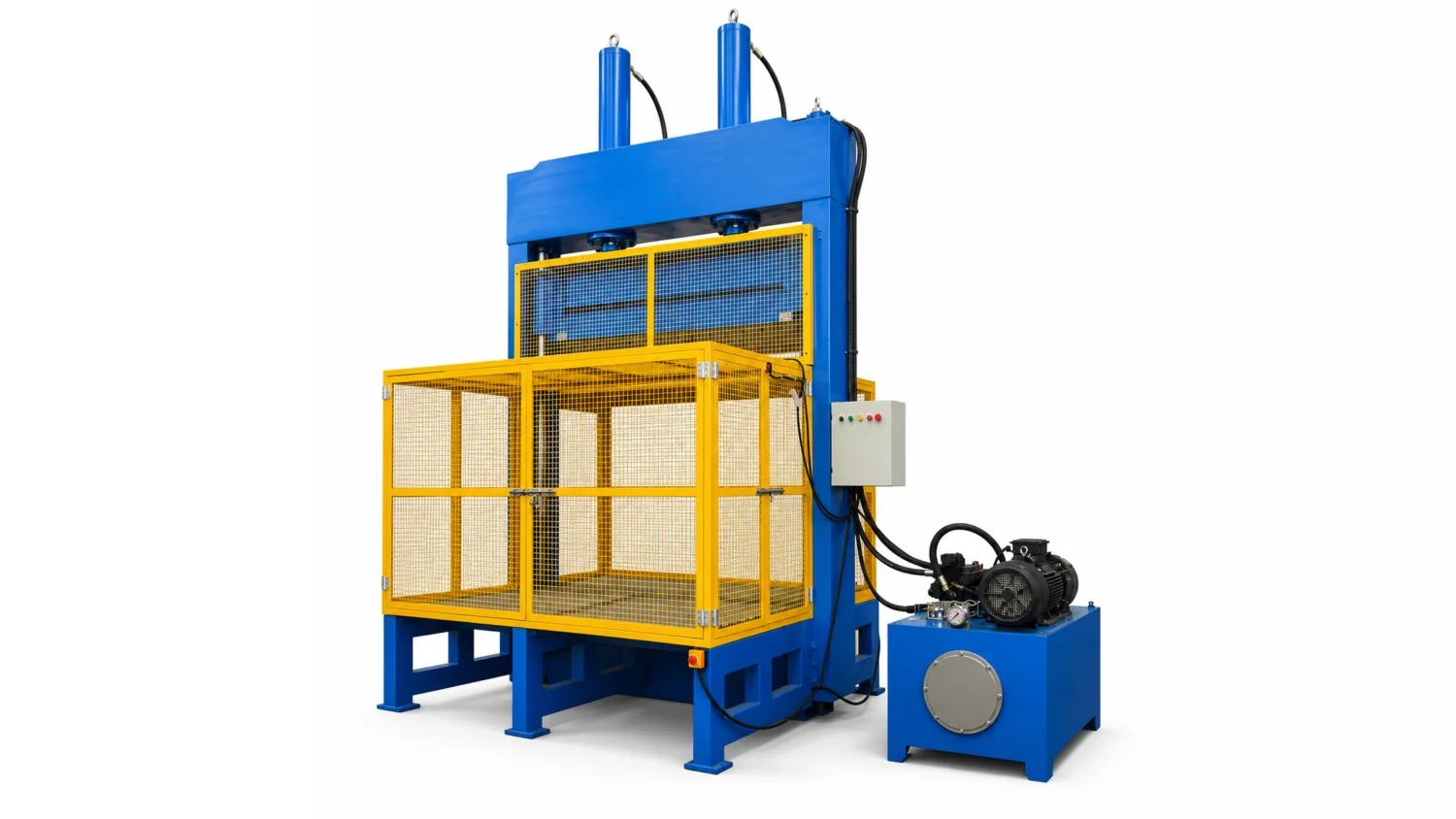
- 40–160 t cutting force
- 600–1,600 mm blade width
- 400–700 mm maximum opening
Backed by Documented Performance Targets
How a Hydraulic Guillotine Cutter Works
A controlled four-step cycle turns oversized bales, lumps, and rolls into feed that downstream shredders can accept.
Position the feedstock
Place the bale, lump, or roll on the feed table and align the intended cut with the blade.
Secure the material
A hydraulic hold-down clamp limits movement so dense or elastic feedstock stays controlled.
Complete the blade stroke
The hydraulic cylinder drives the wide blade through the material with 40–160 t of cutting force.
Index and discharge
The blade retracts and the material advances for the next cut or transfers to the downstream conveyor.
Why Pre-Cutting Beats Force-Feeding
Protects the Shredder
Pre-cut blocks reduce shock loading and prevent oversized feed from striking the rotor or hopper.
Stabilizes Feeding
More consistent pieces enter conveyors and shredder hoppers with less bridging, surging, and wrapping.
Handles Difficult Feedstock
One machine can pre-cut rubber bales, purge lumps, fiber bales, carpet rolls, film rolls, and similar bulky materials.
Common Problems Solved
Compressed rubber or fiber bales stall the shredder or overload the drive.
Pre-cut the bale into blocks matched to the hopper and rotor opening.
Solid extrusion purge lumps are too thick for rotating cutters to grip.
The straight blade applies force through the cross-section without relying on rotor bite.
Continuous film, carpet, or nonwoven rolls wrap around the shredder rotor.
Segmenting the roll removes the continuous web before it reaches the rotor.
Manual saws or torches create slow, inconsistent, operator-dependent preparation.
A guarded hydraulic cycle provides a repeatable cutting route with less manual handling.
Hydraulic Guillotine Cutter in Action
Watch the hydraulic blade pre-cut dense, oversized feedstock into manageable pieces for downstream shredding.
Applications
Rubber Bales and Blocks
Natural and synthetic rubber bales sliced for feeding to shredders or mills.
Plastic Purge and Lump Material
Extruder purge cakes and solidified polymer blocks cut into accepted pieces.
Film, Nonwoven, and Carpet Rolls
Full rolls and reel ends segmented before shredding to prevent wrapping.
Technical Specifications
| Model | Cutting Force | Blade Width | Maximum Opening |
|---|---|---|---|
| RT-GC-40 | 40 t | 600 mm | 400 mm |
| RT-GC-63 | 63 t | 1,000 mm | 500 mm |
| RT-GC-100 | 100 t | 1,300 mm | 600 mm |
| RT-GC-160 | 160 t | 1,600 mm | 700 mm |
Cutting force and blade width are configured based on feedstock dimensions. Reversible tool steel blade.
How to Select the Right Guillotine Cutter
Model selection should be based on the hardest and largest feedstock—not only the average material.
Define the material and feed form
Confirm polymer or fiber type, hardness, reinforcement, bale density, and whether the feed arrives as a bale, lump, roll, or pipe.
Measure the maximum dimensions
Provide the largest width, height, length, and weight so the blade width, opening height, table, and clamp can be sized correctly.
Set the required cut size
Match the slice length to the downstream hopper opening, conveyor width, rotor geometry, and target handling method.
Confirm duty and feeding method
State the operating hours, target throughput, manual or conveyor feeding, and whether automatic indexing is required.
Review safety and line integration
Confirm guarding, interlocks, emergency stops, discharge conveyor, controls, utilities, and available maintenance space.
Hydraulic Guillotine vs. Manual Cutting vs. Direct Shredder Feeding
The best route depends on feed size, operating frequency, safety controls, and the downstream shredder opening.
| Criterion | Hydraulic Guillotine | Manual Saw or Cutting | Direct Shredder Feeding |
|---|---|---|---|
| Best suited feed | Dense bales, large lumps, and full rolls | Occasional small or irregular pieces | Loose or already pre-sized material |
| Cut-size control | Repeatable slice length with controlled indexing | Depends heavily on the operator | No pre-cut control before the hopper |
| Operator exposure | Guarded hydraulic cutting zone with interlocked controls | High manual handling and direct tool exposure | Less cutting work, but higher jam-clearing risk with oversized feed |
| Downstream impact | Reduces shock loading, bridging, and rotor wrapping | Variable results can still overload the shredder | Oversized material may stall, wrap, or damage the shredder |
Practical answers for model selection, integration, operation, and maintenance.
Frequently Asked Questions
How do I choose the required cutting force?
Selection is based on the hardest material, largest cross-section, temperature, reinforcement, and cut frequency. A material test is recommended when the feed is highly elastic, reinforced, or unusually dense.
What materials can a hydraulic guillotine cutter process?
Typical feeds include natural and synthetic rubber bales, PE/PP/PA/ABS purge lumps, compressed fiber bales, film and nonwoven rolls, carpet rolls, and selected pipes or profiles. Metal-reinforced material must be reviewed before selection.
What is the maximum feed size?
It is limited by blade width and opening height. Standard reference models cover 600–1,600 mm blade widths and 400–700 mm openings; custom tables, clamps, and openings can be evaluated for larger feedstock.
Can the cutter integrate with an existing shredder line?
Yes. It can be configured with feed and discharge conveyors, automatic indexing, interlocked controls, and a cut length matched to the existing shredder hopper.
What routine maintenance is required?
Inspect and rotate or resharpen the reversible blade, check hydraulic oil and filters, inspect seals and guide clearances, and test guards, interlocks, and emergency stops on schedule.
What information should I send for a quotation?
Send material photos or video, composition, maximum dimensions and weight, target cut size, required throughput, downstream hopper opening, feeding method, operating hours, site power, and available layout space.
Send Your Material Details for Model Selection
Share the largest and hardest feedstock—not only the average piece—so we can recommend blade width, cutting force, opening, controls, and conveyor interfaces.