
Injection Molding Scrap & Regrind Pelletizing
For prepared PP, HDPE, ABS and PS sprues, runners and rejected parts. Compare direct regrind reuse with extrusion, filtration and pelletizing for factory recovery.

Products and solutions
Products and solutions onlyNo matching products or solutions found.
Recycling Pelletizing Hub
Compare plastic pelletizing line routes before requesting a quote: cutter-compactor systems for film, single-screw routes for rigid regrind, PET flake pelletizing, foam densifying, and compounding-driven lines.
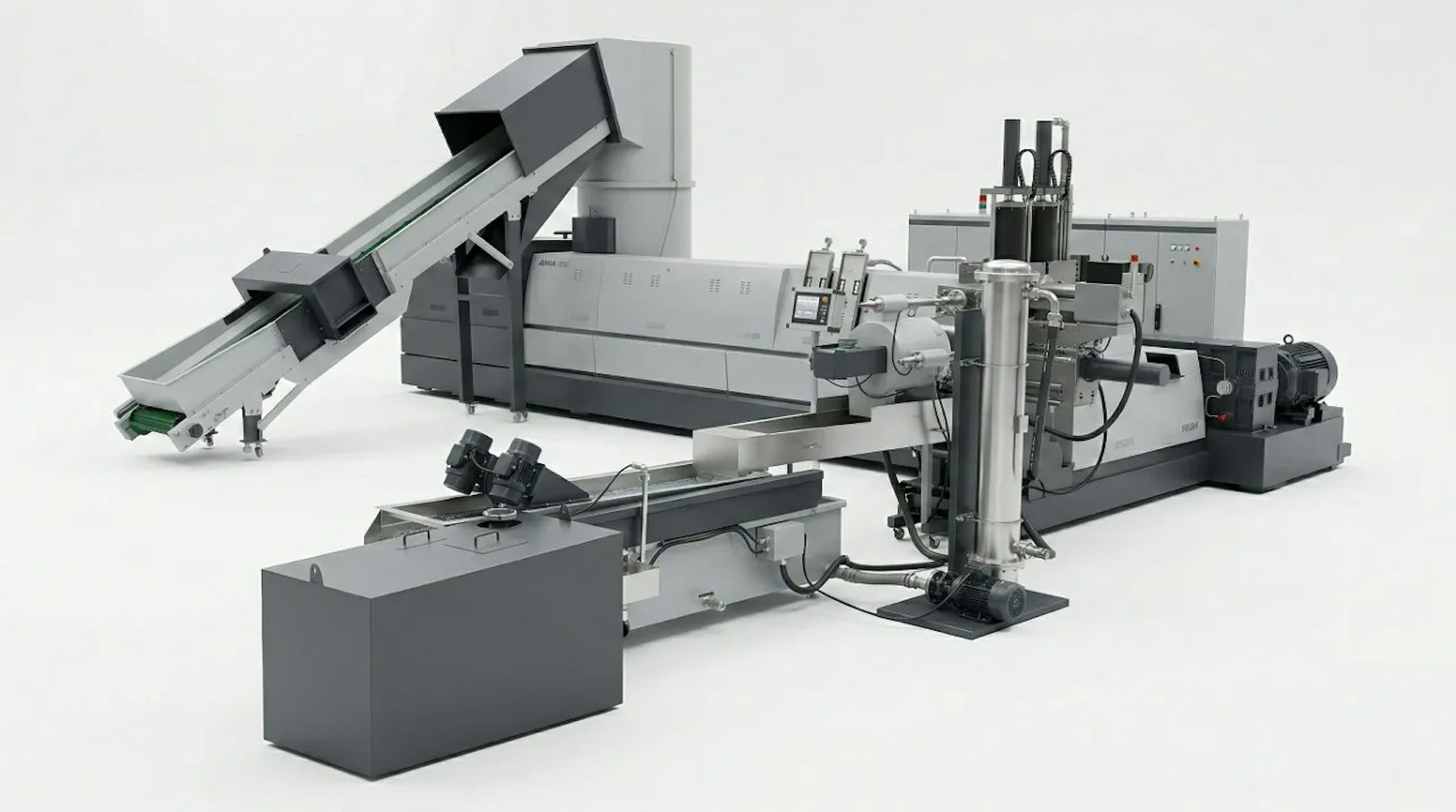
Choose a focused route for dense regrind, PE packaging film scrap, or a project that needs a custom configuration.
For prepared PP, HDPE, ABS and PS sprues, runners and rejected parts. Compare direct regrind reuse with extrusion, filtration and pelletizing for factory recovery.
For LLDPE stretch film, LDPE packaging offcuts and collected edge trim. Match preparation, compaction and filtration to factory scrap or used pallet wrap.
For projects that still need engineering guidance on stage count, degassing, filtration, pelletizing method, and future capacity expansion.
Every route follows the same four process decisions, but each feedstock needs a different level of conditioning.
Sort, wash, dry, squeeze, or densify until the extruder receives a stable material form.
Match the feeder and screw design to bulk density so melt pressure does not surge.
Remove moisture, volatiles, paper, gels, and solid contamination before pellet formation.
Select water-ring, strand, or underwater cutting and size cooling, drying, screening, and conveying together.
Start with the system family that matches the physical form of the feedstock and the required pellet specification.
Cuts and compacts washed PE/PP film, raffia, and woven bags before extrusion to stabilize low-bulk-density feeding.
Processes denser HDPE, PP, ABS, and PS regrind with feeding, filtration, and venting matched to rigid flakes.
Uses die-face water-ring cutting for continuous polyolefin pellet production and compact downstream handling.
Combines strict drying, vacuum, residence-time, and screw control for moisture-sensitive PET bottle flakes.
Pre-crushes and densifies EPS, EPE, or XPS so low-density foam can enter the melt section consistently.
Provides stronger mixing, additive dispersion, side feeding, and devolatilization for compounding-driven projects.
Use the closest material scenario as a starting point, then confirm it with a material test and pellet target.
Usually needs cutter-compactor feeding, strong venting, and stable water-ring or strand cutting.
Often needs additional degassing and filtration for ink, coatings, and volatile residue.
Uses steadier rigid-flake feeding with filtration sized to labels, fines, and mixed wall sections.
Requires strict drying, vacuum performance, and residence-time control for sheet, strap, or fiber feed.
Must reduce volume and trapped gas before the material can form a stable melt.
Usually points to a twin-screw route when dispersion, dosing, and formulation control matter.
These four inputs are more useful than comparing installed motor power alone.
State whether the feed is film, raffia, rigid flake, PET, foam, or a compoundable blend.
Quantify water, ink, paper, metal, fines, adhesives, and other volatiles after preparation.
Define pellet geometry and whether output is for resale, internal reuse, sheet, strap, or compounding.
Confirm single or double stage, filtration duty, utilities, maintenance access, and future capacity.
Use this matrix to identify the process route before selecting machine size.
| Decision Input | Route Signal | Confirm Before Quotation |
|---|---|---|
| Material form | Film needs compaction; rigid flake needs stable metering; foam needs densifying | Bulk density, particle size, and hourly mass |
| Moisture and volatiles | Higher load points to stronger vacuum or a second extrusion stage | Measured moisture and type of ink, adhesive, or coating |
| Melt contamination | Contamination drives screen changer area and filtration strategy | Paper, metal, fines, gels, and acceptable pressure rise |
| Pellet specification | Polymer and end use determine water-ring, strand, or underwater cutting | Pellet geometry, MFI, cooling duty, and buyer specification |
Single-stage layouts suit cleaner or denser feedstocks with moderate venting needs. Double-stage routes are usually chosen when washed film, printed scrap, or higher contamination demand extra degassing and melt stabilization.
Water-ring pelletizing is common for PE and PP recycled polyolefins when rounded pellets and continuous cutting matter. Strand pelletizing is often preferred for stiffer materials or jobs where off-die cooling and cut separation are easier to control.
Sometimes, but only within a narrow material window. A shared line usually forces compromises in feeding, screw design, and filtration, so separate film and rigid routes are often more stable at production scale.
PET usually needs stricter drying and venting than polyolefins. Dedicated PET layouts or twin-screw systems become relevant when moisture sensitivity, IV control, or formulation demands are higher than a general-purpose line can comfortably manage.
There is no universal number because resin type, line design, and pellet target change the limit. The correct starting point is to define residual moisture, paper, metal, and fines after washing and then size filtration and vacuum around the real feedstock.
Start by fixing the feedstock family and pellet quality target, then leave room for larger drives, stronger filtration, and downstream cooling or conveying upgrades. Expansion works better when the process logic stays consistent across future stages.
Send material photos, hourly target, contamination level, and desired pellet application. Rumtoo can recommend the system family, stage layout, and pelletizing method that fit the job.