
· Rumtoo Engineering Team · Buying Guides · 11 min read
Vertical vs. Horizontal Water Ring Pelletizer Guide
Compare vertical and horizontal water ring pelletizers by layout, service access, drive arrangement, material trials, and total line cost before your RFQ.

A horizontal water ring pelletizer and a vertical water ring pelletizer can use the same basic hot die-face cutting principle, yet occupy very different spaces around an extruder. The better choice is not decided by the machine label alone. It depends on the cutter-drive arrangement, die-center height, service access, material behavior, and the equipment included after the cutting chamber.
This guide compares the two layouts without assuming that every supplier uses the terms “vertical” and “horizontal” in the same way. If you first need an overview of the process, read our water ring plastic pelletizer guide. Buyers planning a complete plant can also compare Rumtoo’s recycling pelletizing lines.
The short answer
Choose a vertical water ring pelletizer as a starting point when floor space beside the die is tight, overhead clearance is available, and the supplier’s opening mechanism gives operators safe access to the knives and die plate.
Choose a horizontal water ring pelletizer as a starting point when the plant has enough length beside the extruder, ceiling height is limited, or an in-line drive and sliding cutter assembly make maintenance easier for your layout.
Neither orientation automatically produces better pellets. Pellet consistency still depends on melt stability, die-hole design, knife condition, knife pressure, cooling-water control, dewatering, and the match between the polymer and the complete extrusion line.
What both water ring pelletizers have in common
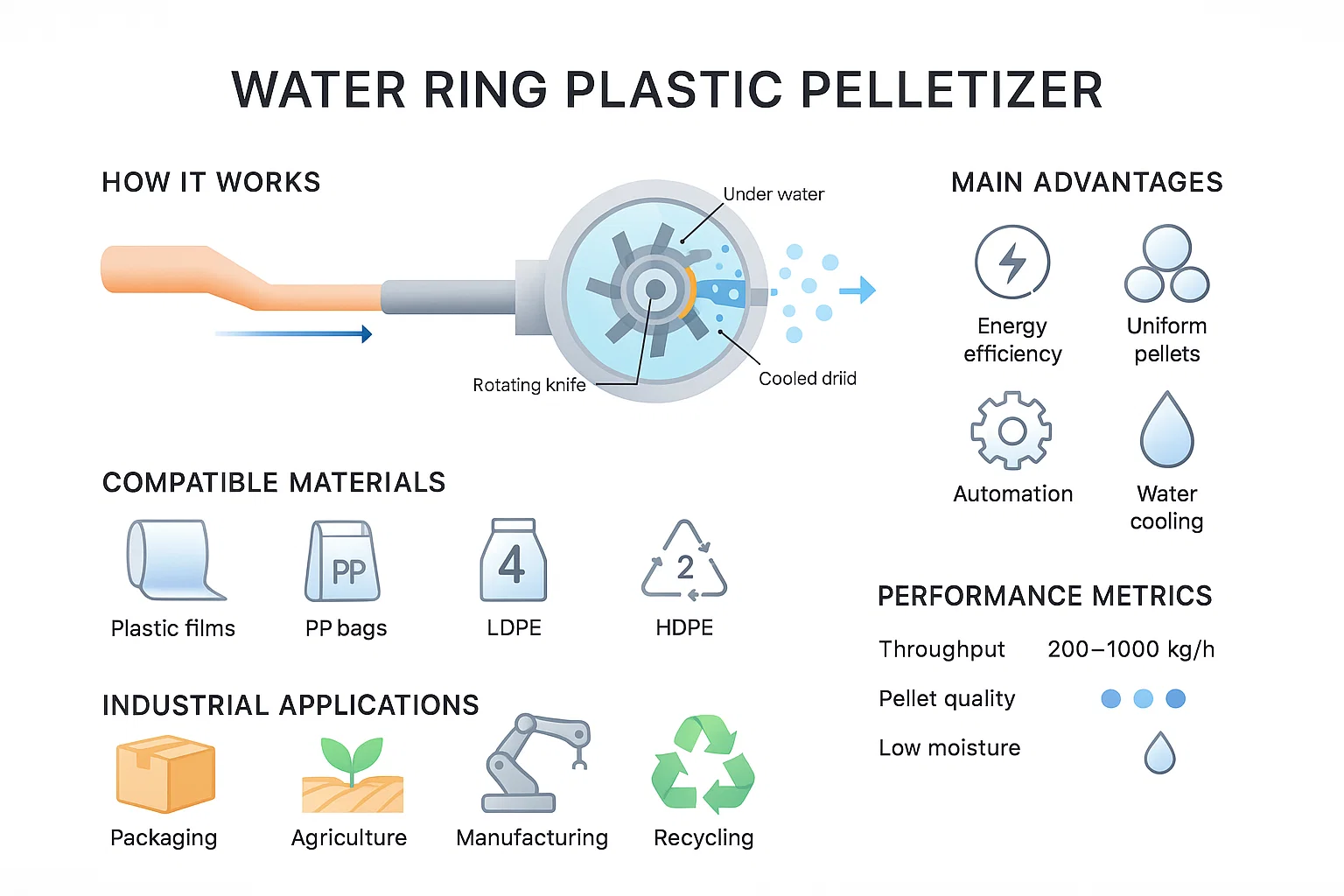
Both layouts are forms of hot die-face pelletizing. Molten polymer passes through the die holes, rotating knives cut it at or near the die face, and circulating water cools and carries the pellets toward a centrifugal dryer or another dewatering stage.
This cut-first, cool-immediately sequence avoids the long water trough used in conventional strand pelletizing. It is one reason water ring systems are widely considered for PE and PP film, raffia, woven bags, and other recycled polyolefin streams that can be troublesome to pull as stable strands.
The water should cool and convey the pellets without flooding the die face during normal operation. For example, Coperion describes its WRG system as using water for cooling and transport while keeping it away from the die plate. The exact chamber geometry and startup sequence, however, differ by manufacturer.
In either orientation, a complete system normally needs more than the cutter:
- A heated die plate matched to the melt and target output.
- A cutter head, knife holder, and speed-controlled drive.
- A closed cutting chamber with controlled water flow.
- A water tank, pump, piping, and heat-management method.
- A centrifugal dryer or comparable pellet-water separator.
- A vibrating screen, fines collection, or product transfer system when required.
Comparing only the cutter price can therefore hide a large part of the installed cost.
How a vertical water ring pelletizer is arranged

In a typical vertical layout, the cutter drive is mounted above the cutting chamber. The polymer still enters through a die connection aligned with the extruder, while the drive and transmission occupy vertical space over the chamber.
This arrangement can reduce the equipment length extending away from the die. It may work well in a plant where aisles, platforms, nearby piping, or another machine restrict the horizontal service envelope.
The trade-off is height. Operators may need overhead clearance for the motor, lifting points, guards, and removal of the cutter assembly. A vertical motor does not prove that the design is harder or easier to maintain; the answer depends on how the supplier transfers power to the knife shaft and how the chamber opens.
Before selecting this design, verify:
- total installed height, including the lifting path
- whether routine knife adjustment can be completed from floor level
- the number of guards and fasteners removed during cleaning
- where water drains when the chamber opens
- how the cutter aligns with the die after reassembly
How a horizontal water ring pelletizer is arranged

In a typical horizontal layout, the cutter drive and withdrawal mechanism extend along a horizontal axis. The assembly may slide or retract from the die to expose the knives and cutting surface.
This design keeps the machine profile lower and may make the drive train easier to inspect from an aisle. It can also fit plants with low roofs, overhead ducts, cranes, or mezzanines. The cost is a longer floor envelope beside the extruder, especially when the full withdrawal distance and operator standing area are included.
A photograph of the closed machine is not enough for layout approval. Ask the supplier to show the cutter in its fully open service position on the general-arrangement drawing. Include the control cabinet doors, hoses, water connections, safety guarding, and the space needed to pull the longest component.
Vertical vs. horizontal water ring pelletizer comparison
| Decision factor | Vertical layout | Horizontal layout | What the buyer should verify |
|---|---|---|---|
| Main space demand | More height, often less projection beside the die | More floor length, usually a lower profile | Installed and fully open service envelope |
| Cutter-drive position | Commonly mounted above the chamber | Commonly aligned beside or behind the chamber | Direct drive, belt, gearbox, coupling, and bearing arrangement |
| Maintenance access | Can be compact but may place components higher | Can offer waist-height access but needs withdrawal room | Knife-change demonstration and safe lifting method |
| Retrofit suitability | Useful where side space is restricted | Useful where overhead space is restricted | Existing die centerline, platform, piping, and aisle |
| Water drainage | Depends on chamber opening and drain location | Depends on chamber opening and hose routing | Where residual water goes during service |
| Alignment after opening | Supplier-specific | Supplier-specific | Repeatable location features and alignment procedure |
| Material range | Determined by die, knives, melt, and water circuit | Determined by die, knives, melt, and water circuit | Trial with the buyer’s actual feedstock |
| Pellet quality | Not guaranteed by orientation | Not guaranteed by orientation | Size distribution, fines, tails, moisture, and agglomerates |
| Purchase price | Depends on scope and drive design | Depends on scope and drive design | Compare identical auxiliary equipment and services |
This table is intentionally cautious. Some manufacturers use “vertical” and “horizontal” to describe the motor position; others refer to the knife shaft, die-face arrangement, or the way the cutter opens. Request a section drawing before treating two quotations as technically equivalent.
Does orientation determine the suitable plastic?
No universal material rule separates the two layouts. A supplier may recommend its vertical design for LDPE film and PP raffia while another supplier handles the same material with a horizontal design. That difference can come from die heating, knife geometry, melt filtration, water control, or feeding stability rather than orientation alone.
Start with these material and process inputs:
- resin family and approximate blend ratio
- MFR or MFI at the stated test condition
- feed form: film, flakes, regrind, agglomerate, or compacted material
- residual moisture and contamination after washing
- filler, pigment, paper, metal, and incompatible-polymer content
- required net output, pellet size, bulk density, and end use
For washed PE and PP film, the feeding and densifying stages often decide whether the melt reaches the die consistently. Review the film compacting pelletizing line before attributing unstable output to the cutter. For clean rigid flakes, compare the proposed cutter with the configuration of a hard plastic pelletizing line.
Which layout is easier to maintain?
The easier machine is the one an operator can open, clean, inspect, and realign safely within the available service space. Orientation is only one part of that answer.
Ask each supplier to demonstrate five routine tasks:
- Open the cutting chamber after a normal shutdown.
- Remove and reinstall the knife holder.
- Set or confirm knife contact according to the supplier’s procedure.
- Inspect and clean the die face and water passages.
- Close the assembly, confirm alignment, and restart.
Record the tools, lifting equipment, number of operators, and elapsed time. A short service video from the proposed machine model is more useful than a generic maintenance claim.
Also compare the wear parts included in the quote. Knife material, number of knife edges, die-plate surface treatment, seals, bearings, and spare-part lead time can change the real maintenance cost. Use our plastic pelletizer maintenance checklist to build the inspection schedule after commissioning.
How to compare total cost instead of cutter price
A low cutter quotation can become an expensive installation when the water circuit, dryer, screen, control integration, or startup service is excluded. Build a scope table with the same line items for every vendor.
At minimum, compare:
- cutter, chamber, die plate, knives, and drive
- diverter or startup-discharge arrangement
- water tank, pump, valves, filters, and cooling provision
- centrifugal dryer and vibrating screen
- electrical controls, speed control, sensors, and interlocks
- structural frame, platforms, guarding, and drain collection
- recommended startup spares for the first operating year
- installation supervision, commissioning, and operator training
The broader pelletizing industry also treats capital cost, throughput, automation, and operating flexibility as separate selection factors. Plastics Technology’s pelletizing-system guidance provides useful context, although the final choice must be based on the proposed machine and material trial.
A 100-point RFQ scorecard
Use the following weighting to stop a small price difference from dominating the decision:
| Evaluation item | Suggested weight |
|---|---|
| Trial results on representative material | 30 points |
| Maintenance access and safe service procedure | 20 points |
| Complete installed scope and utility demand | 15 points |
| Layout fit, including the open service envelope | 15 points |
| Pellet-quality acceptance criteria | 10 points |
| Spare parts, commissioning, and support | 10 points |
| Total | 100 points |
For the material trial, agree on measurable acceptance criteria before the test. Record stable net output, pellet-size distribution, fines, twins or agglomerates, residual pellet moisture, screen-change frequency, and the duration of uninterrupted operation. Do not accept a short video of clean prime resin as proof for contaminated post-consumer feedstock.
Four practical selection scenarios
Choose vertical as the first candidate when floor space is tight
A vertical layout deserves priority when another extruder, a wall, an aisle, or product-transfer equipment limits the distance beside the die. Confirm that the roof height and lifting path still allow the motor and cutter assembly to be removed.
Choose horizontal as the first candidate when overhead clearance is limited
A horizontal layout may fit better below pipe racks, low roofs, mezzanines, or ventilation ducts. Reserve the full retraction length and operator zone; the closed-machine footprint understates the space needed for maintenance.
Compare opening mechanisms when changeovers are frequent
If operators clean the die and knives often, a quick, repeatable opening system may matter more than orientation. Ask for a timed demonstration using the exact chamber size in the quotation.
Let a material trial decide when pellet quality is the priority
When both machines fit the building, compare them with the same feedstock and acceptance criteria. Orientation alone cannot predict fines, pellet tails, moisture, or die-hole stability.
Questions to include in your RFQ
Send these questions with the material data and plant drawing:
- What does “vertical” or “horizontal” describe in your design: motor, knife shaft, die face, or opening direction?
- Can you provide front, side, plan, and fully open service views?
- What die-center height and connection standard are required?
- Which polymers, MFR range, fillers, and contamination levels have been run on this exact model?
- What pellet-quality limits will the supplier accept during the trial?
- What water temperature, flow, pressure, and cooling duty does the system require?
- Which items are excluded from the quoted water circuit and dewatering section?
- How are knife position, cutter speed, and die-face condition monitored?
- Which parts require lifting, and what is the heaviest service component?
- Which wear and startup spares are included?
Frequently asked questions
What is the main difference between vertical and horizontal water ring pelletizers?
The main difference is the physical arrangement of the cutter drive, chamber, and service movement around the die. A vertical design usually consumes more overhead space, while a horizontal design usually needs more floor length. Supplier terminology varies, so confirm the arrangement on a drawing.
Is a vertical water ring pelletizer better for LDPE or PP film?
Not automatically. Some suppliers recommend their vertical design for these materials, but feed stability, melt filtration, die heating, knife design, water control, and dewatering can be more important than drive orientation. Require a trial with representative material.
Does a horizontal water ring pelletizer produce better pellets?
No orientation guarantees better pellets. Compare both proposals against the same targets for pellet size, fines, agglomerates, moisture, stable output, and uninterrupted run time.
Which design takes up less space?
A vertical pelletizer can reduce horizontal projection but needs more height. A horizontal pelletizer can keep the installation lower but needs room for the cutter assembly to retract. Compare the fully open service envelope, not only the shipping dimensions.
Which water ring pelletizer costs less?
There is no reliable rule based on orientation. Compare the cutter, die plate, water tank, pump, dryer, screen, controls, guarding, spares, commissioning, and installation work as one system.
Final recommendation
Treat vertical and horizontal water ring pelletizers as two packaging options for a larger process, not as two fixed grades of pellet quality. First eliminate any layout that cannot be serviced safely. Then compare complete scope, maintenance tasks, and material-trial results with the same acceptance criteria.
If you send Rumtoo your feedstock details, target output, pellet specification, and plant drawing, our engineering team can prepare a side-by-side layout review. Contact Rumtoo before issuing the RFQ so the cutter, water circuit, dewatering section, and upstream extrusion line are evaluated together.
- horizontal water ring pelletizer
- vertical water ring pelletizer
- water ring pelletizing
- die-face pelletizer
- plastic recycling equipment