

Magnetic Separation Equipment

Suspended Magnetic Separator

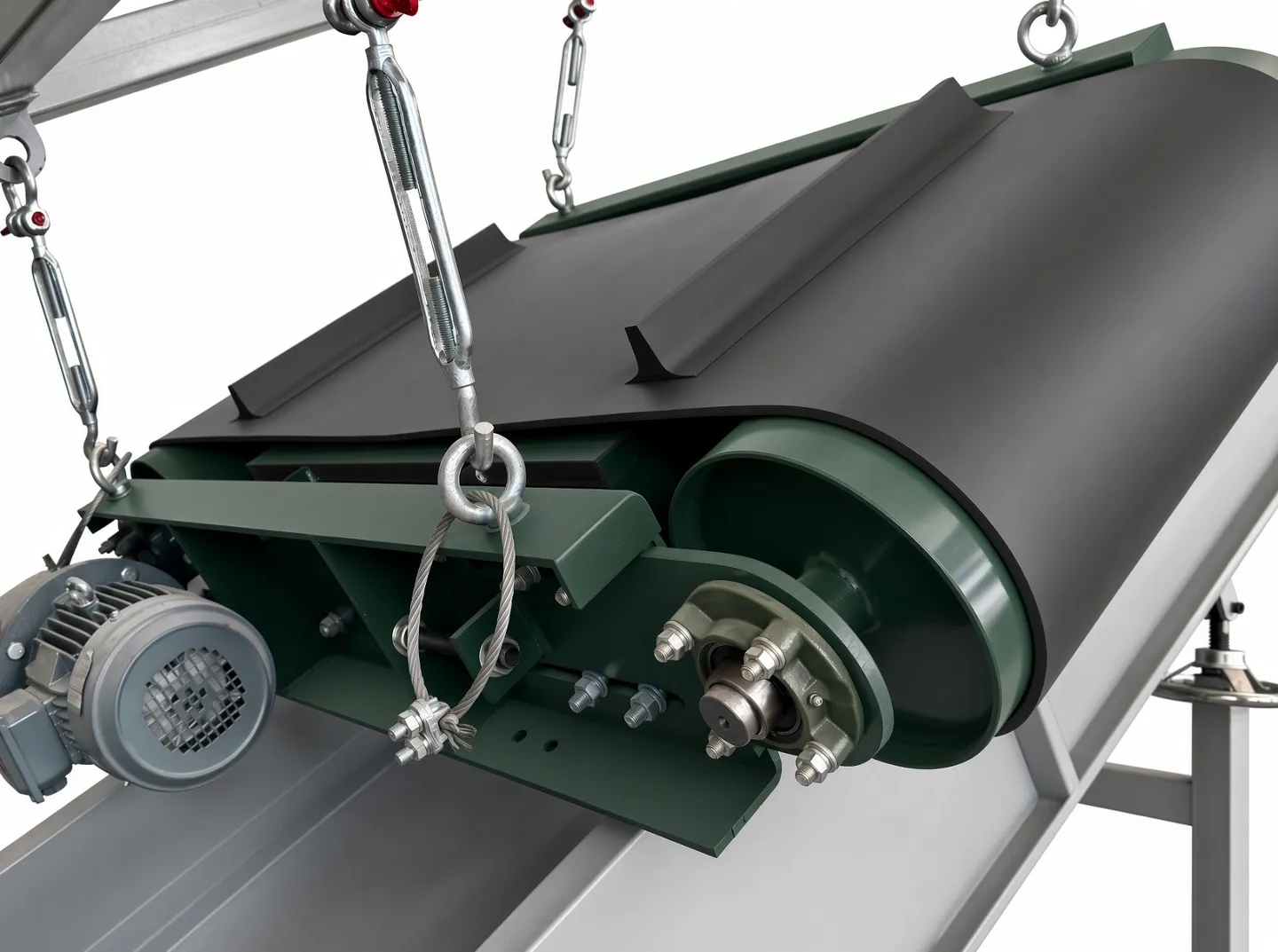
Installed above a conveyor, the RCDD suspended magnetic separator lifts tramp iron from moving material and carries it away automatically on a self-cleaning belt. It protects crushers and granulators, reduces metal contamination, and keeps recycling lines running without manual magnet cleaning.

  • Self-cleaning cross-belt discharge for continuous production
  • 800–1600 mm conveyor belt widths across five RCDD models
  • ≥70 mT at each model’s rated 250–450 mm suspension height
View Specifications
Scroll
RCDD suspended magnetic separator installed above a recycling conveyor
  • Self-cleaning cross-belt discharge for continuous production
  • 800–1600 mm conveyor belt widths across five RCDD models
  • ≥70 mT at each model’s rated 250–450 mm suspension height

Backed by Documented Performance Targets

CE Certified Manufacturing
24/7 Global Technical Support
12-Month Comprehensive Warranty
Turnkey Installation & Training

How a Suspended Magnetic Separator Works

The magnetic circuit and discharge belt work together to remove ferrous contamination without interrupting the main conveyor.

1

Material passes beneath the separator

Mixed material travels in a controlled layer on the plant conveyor. The separator is suspended at the rated height above the belt, with its working area centered over the material stream.

2

The magnetic field lifts ferrous metal

Iron and steel pieces are attracted upward out of the conveyed material while non-magnetic plastics, glass, wood, and other fractions continue along the main belt.

3

The self-cleaning belt carries metal away

A continuously moving belt with cleats transports captured metal across the magnet face and beyond the effective magnetic field.

4

Recovered metal drops into a collection point

Once outside the magnetic field, the ferrous fraction releases into a chute or collection bin for recycling, inspection, or safe disposal.

Built for Reliable In-Line Metal Protection

The separator is selected around conveyor width, burden depth, tramp-metal size, and the equipment that must be protected downstream.

Continuous Self-Cleaning

The discharge belt removes captured iron automatically, reducing manual cleaning and keeping high-throughput lines moving.

Downstream Equipment Protection

Removing bolts, tools, wire, and other ferrous pieces before size reduction helps prevent damage to crusher and granulator components.

Matched to Your Conveyor

Five reference models cover conveyor widths from 800 to 1600 mm, with suspension height and drive power scaled to the installation.

Working Principle and Installation Position

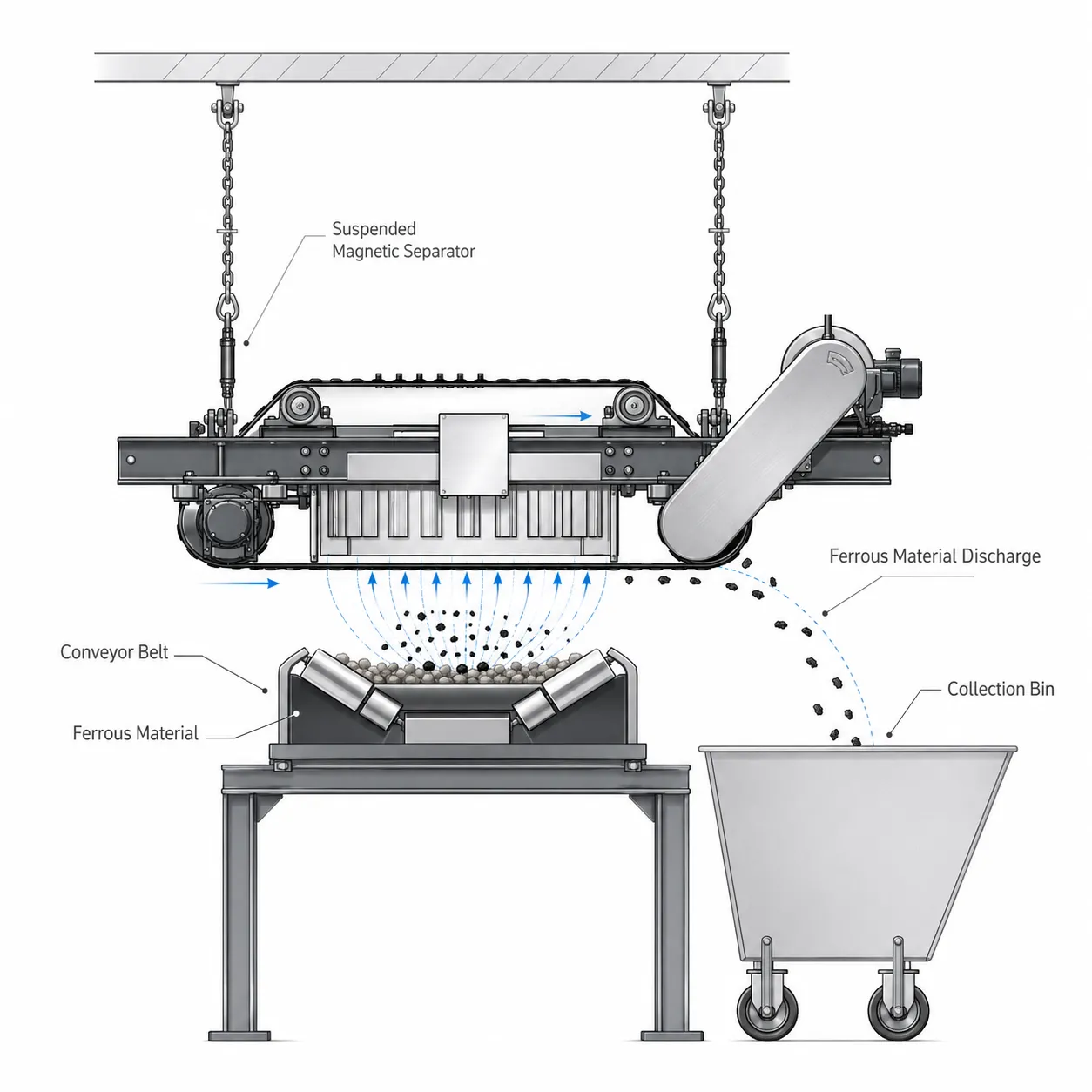
The separator hangs above the main conveyor. Its magnetic field pulls iron upward, while the cross belt moves the captured fraction sideways into a dedicated collection bin.

Suspended magnetic separator working principle diagram showing ferrous metal removal from a conveyor belt

Automatic Ferrous Material Discharge

Correct suspension height is critical: the magnet must be close enough to generate the specified field at the material bed, while leaving safe clearance for the deepest burden and occasional oversized pieces.

  • Center the magnetic working zone over the full material stream
  • Keep the burden depth stable for repeatable separation
  • Provide a guarded discharge chute and accessible collection area

Suspended Magnetic Separator in Operation

Watch the self-cleaning overband unit capture ferrous material above the conveyor and carry it beyond the magnetic field for automatic discharge.

Typical Applications

Use an overband magnetic separator wherever ferrous contamination must be removed before processing or from a recovered product stream.

  • Plastic Recycling Lines

    Removes iron and steel before shredding, crushing, washing, electrostatic separation, or pelletizing stages.

  • WEEE and E-Waste Processing

    Extracts ferrous housings, screws, brackets, and other magnetic metals from shredded electronic waste.

  • Municipal and Commercial Waste

    Recovers magnetic metal from mixed dry waste, refuse-derived fuel preparation, and sorting operations.

  • Wood and Biomass Processing

    Captures nails, screws, wire, and tools before chippers, grinders, or fuel preparation equipment.

  • Foundry and Slag Recovery

    Separates magnetic metal from foundry sand, slag, and crushed industrial residues on conveyor lines.

  • Aggregate and Mineral Handling

    Protects crushers and screens by removing tramp iron from stone, ore, and other bulk material streams.

Pre-Select a Model by the Real Conveyor Conditions

Enter the operating values, not just the nominal conveyor size. The result chooses the smallest model that covers both belt width and required suspension height, then flags belt-speed or burden-depth conditions that need engineering review.

Pre-selection result

RCDD-80Inside reference envelope
Rated suspension height
250 mm
Field at rated height
≥70 mT
Reference burden limit
≤200 mm
Self-cleaning drive
3 kW

Width and height fit, and the entered speed and burden are inside the comparable RCDD pre-selection envelope. This is not yet proof of pickup: confirm the smallest, deepest tramp-iron piece by magnetic-force calculation or sample testing.

Pre-selection only. Belt-speed and burden-depth limits are comparable RCDD-series reference values, not confirmed values from the supplied table. Final pickup depends on air gap, trough angle, material density, and the size, shape, orientation, and depth of the ferrous piece.

RCDD Model Selection Matrix

Use belt width and required suspension height as hard gates. Speed and burden depth are pre-selection checks; liftability still has to be verified against the smallest and deepest tramp-iron target.

ModelSelect for Belt WidthRated Suspension HeightField at Rated HeightCompatible Belt Speed*Recommended Burden Depth*Self-Cleaning DriveEquipment WeightOverall DimensionsCooling / Duty
RCDD-80≤800 mm250 mm≥70 mT≤4.5 m/s*≤200 mm*3 kW1,760 kgGA drawing requiredSelf-cooled; duty to confirm
RCDD-100≤1,000 mm300 mm≥70 mT≤4.5 m/s*≤250 mm*3 kW2,850 kgGA drawing requiredSelf-cooled; duty to confirm
RCDD-120≤1,200 mm350 mm≥70 mT≤4.5 m/s*≤300 mm*3 kW4,020 kgGA drawing requiredSelf-cooled; duty to confirm
RCDD-140≤1,400 mm400 mm≥70 mT≤4.5 m/s*≤350 mm*4 kW5,500 kgGA drawing requiredSelf-cooled; duty to confirm
RCDD-160≤1,600 mm450 mm≥70 mT≤4.5 m/s*≤400 mm*5.5 kW7,790 kgGA drawing requiredSelf-cooled; duty to confirm

Confirmed from the supplied table: model, belt width, rated suspension height, field, self-cleaning drive power, and weight. The source field value has been converted and this page uses mT throughout. *Belt speed and burden depth are comparable RCDD-series pre-selection references. Exact L × W × H, lifting points, center of gravity, cooling design, and continuous/intermittent duty must be stated on the project GA and datasheet before order.

Selection basis: comparable RCDD parameter table, air-gap and burden selection factors, suspended-magnet selection guide

From Model Number to “Will It Actually Lift?”

A model is approved only after these checks. Belt width starts the selection; the magnetic-force check finishes it.

  1. Gate 1 — Cover the actual conveyor width

    Choose the smallest model whose rated belt width is not below the usable conveyor width. Also provide the trough angle because the material edges can sit closer to the magnet than the belt center.

  2. Gate 2 — Check suspension height against the burden

    Measure from the magnet face to the conveyor belt and record the maximum material-bed depth. The relevant pickup distance is to the iron location inside the burden, not simply to the top of the material.

  3. Gate 3 — Define the hardest iron piece to lift

    Give the minimum target size, weight, shape, orientation, and worst-case depth. A flat plate or rod is easier to lift than a compact cube or sphere of the same weight.

  4. Gate 4 — Correct for belt speed and mounting position

    Higher speed gives the magnetic field less time to capture iron. Confirm cross-belt or inline mounting, head-pulley position, headroom, and the discharge-side clearance.

  5. Gate 5 — Verify thermal duty and the GA drawing

    State hours per shift, starts per hour, ambient temperature, dust/water exposure, voltage, and frequency. For 24/7 or hot-duty service, verify temperature rise and whether self-cooling is sufficient before freezing dimensions and support loads.

Approval Rules for Reliable Ferrous Pickup

The left column can pre-select a catalog model. Any condition in the right column requires engineering confirmation before the separator is promised to lift the target iron.

Decision PointPre-Selection PassEngineering Review Trigger
Belt widthActual belt width is within the model ratingBelt is wider than 1,600 mm or material stream exceeds the rated working width
Air gap / burdenRequired height and burden are inside the reference envelopeDeep burden, large lump clearance, or iron located near the belt surface
Belt speedOperating speed is at or below the reference valueSpeed exceeds 4.5 m/s, accelerates, or varies sharply under load
Target ironLarge plate, rod, rebar, tool, or bolt near the top of the burdenSmall, compact, spherical, deeply buried, or weakly magnetic target
Cooling and dutyConfirmed shift duty within the self-cooled thermal design24/7 operation, high ambient temperature, restricted airflow, or hazardous area

Frequently Asked Questions

What is a suspended magnetic separator?

It is a magnetic separation unit installed above a conveyor to lift iron and steel from a moving material stream. A self-cleaning model uses a separate discharge belt to carry the captured metal away automatically.

How do I choose between RCDD-80 and RCDD-160?

Start with conveyor width, then confirm burden depth, bulk density, iron-piece size, installation clearance, and the required suspension height. A wider belt alone does not determine magnetic performance.

What does a magnetic intensity of 70 mT mean?

It is the minimum center field specified at the model’s rated suspension height. This page uses mT throughout. Field strength decreases with distance, so this value alone does not guarantee that a particular buried iron piece will be lifted.

Should the separator be installed cross-belt or inline?

Cross-belt mounting is common and discharges metal to the side. Inline mounting can be effective near a head pulley when the layout allows it. The best arrangement depends on material trajectory, available space, and discharge access.

Can it protect a plastic shredder or crusher?

Yes. Installed upstream, it can remove magnetic tramp metal that could damage knives, screens, shafts, or other downstream components. The largest expected metal piece should be included in the model review.

What information should I send for a quotation?

Send conveyor width and speed, material photos, burden depth, bulk density, throughput, iron-piece size, installation drawing, voltage, and preferred discharge direction.

Configure a Suspended Magnetic Separator for Your Conveyor

Send your conveyor width, material type, burden depth, throughput, iron size, and installation drawing. Rumtoo will recommend the suitable RCDD model and mounting arrangement.

Expert response within 24 hours. No obligation quote.