
· Rumtoo Process Team · Buying Guides · 14 min read
Large-Diameter Plastic Pipe Shredder Guide: Whole-Pipe Processing Without Pre-Cutting
Select a large-diameter plastic pipe shredder by pipe geometry, weight, material, output target, and line layout—not a fixed diameter, motor size, or shaft count.
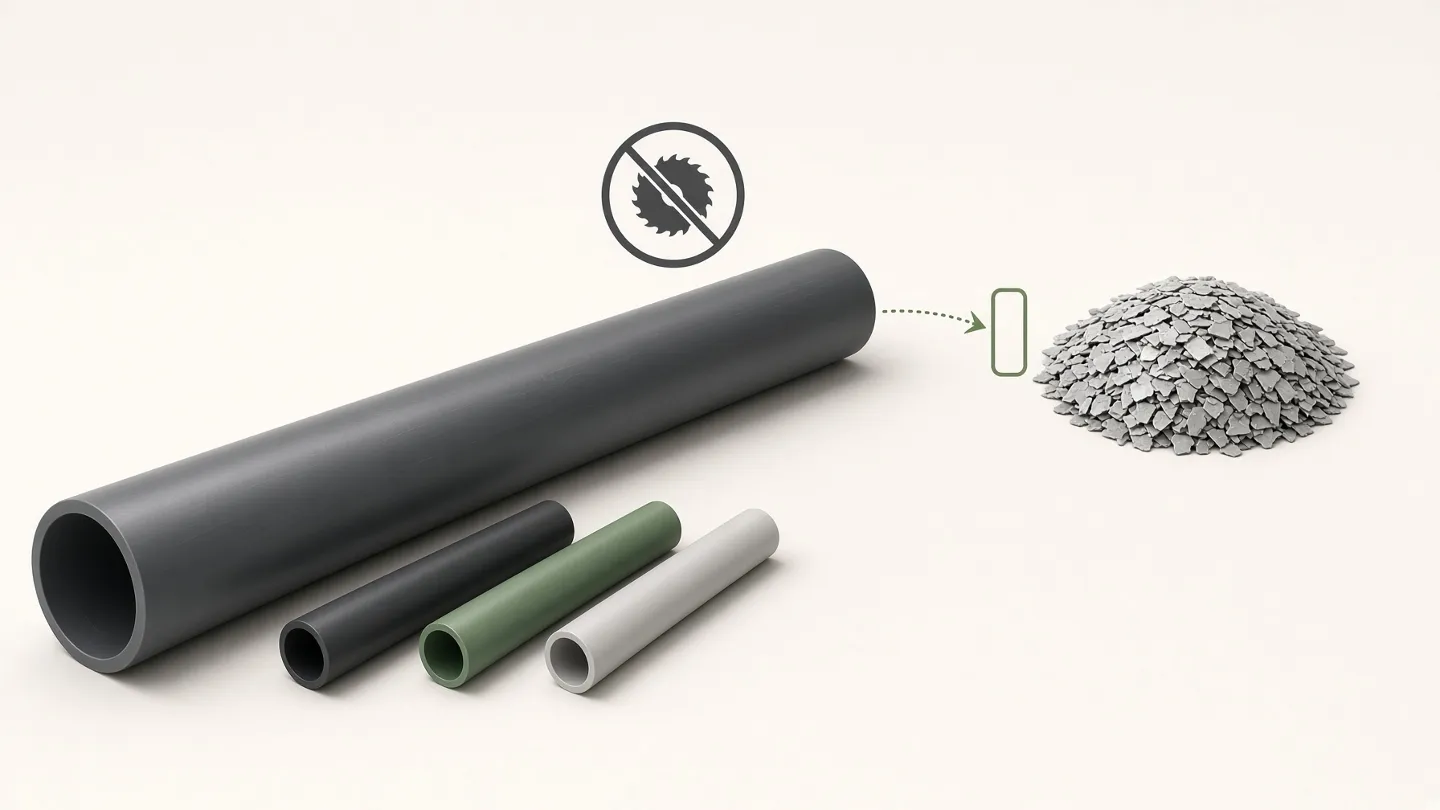
A large-diameter plastic pipe shredder should be selected around the heaviest pipe the line must accept, not a fixed outside diameter, motor rating, or shaft count. The correct system depends on pipe length, wall section, mass, polymer, loading method, required output, and the machine that receives the shredded material.
This guide gives recycling managers, pipe manufacturers, and project engineers a geometry-first selection method. It compares horizontal single-shaft, dual-shaft, and multi-shaft routes without treating one design as the universal answer. It also explains when a crusher, granulator, washing line, or metal-control stage must be included in the complete layout.
If you already have pipe drawings, photos, and a target capacity, use the decision tables below before requesting a machine quotation. They will help you separate a real project configuration from a catalogue rating.
Quick answer: how should you select a plastic pipe shredder?
Select a plastic pipe shredder by matching the largest pipe envelope and highest pipe mass to a feeding system that can load, support, grip, and meter that pipe safely. Then choose the cutting architecture according to the required primary output and the downstream process.
- Choose a horizontal single-shaft system when the pipe fits a controlled trough and screen-controlled primary output is important.
- Choose a dual-shaft system when rough reduction of mixed, bulky, or irregular pipe scrap matters more than uniform discharge.
- Choose a multi-shaft system when a very large hollow section is difficult to grip from one cutting line or the project needs load distributed across independent drive paths.
- Choose pre-cutting plus crushing when the scrap is clean, short, predictable, and already small enough for a crusher.
- Add a secondary crusher or granulator when the next process needs smaller, more uniform regrind than a primary shredder should produce.
The shaft count is a result of this selection process. It should not be the starting requirement.
Why large plastic pipe is difficult to shred
Large plastic pipe combines difficult geometry with variable cutting load. A hollow pipe may look light compared with a solid purge, but its round surface rolls, its wall can collapse away from the cutter, and its length creates a separate handling problem outside the cutting chamber.
Two pipes with the same outside diameter can require very different machines. A thin-wall drainage pipe may deform and tear quickly, while a pressure pipe at the same diameter can carry several times more wall mass into the rotor.
| Pipe characteristic | What happens at the machine | Selection consequence |
|---|---|---|
| Large outside diameter | Pipe cannot enter a standard hopper or crusher throat | Size the complete feed envelope, not only the rotor |
| Long pipe section | Unsupported pipe rolls, bridges, or needs manual cutting | Use a trough, powered feed, or planned pre-cutting stage |
| Thick wall or low SDR/DR | More polymer enters the cutting line per rotor engagement | Check torque, cutter geometry, shaft support, and drive protection |
| Hollow or corrugated profile | The pipe can flex away from a single contact point | Test grip and consider multi-directional engagement |
| Fittings or metal inserts | Local impact load can damage cutters and screens | Sort, detect metal, and define an acceptance policy |
| Soil, stones, or water | Wear, weight, and downstream contamination rise | Include cleaning, drainage, and wear allowance |
This is why a proposal based only on “pipe diameter and kg/h” remains incomplete. The supplier must know what fills the diameter.
Start with the pipe envelope, wall section, and actual weight
The pipe data sheet should define the mechanical design before anyone selects motor power. Record the maximum—not average—value for each input below.
- Outside diameter: Include sockets, flanges, couplers, and oval deformation.
- Overall length: State whether the machine must accept whole pipe or pre-cut sections.
- Wall thickness or SDR/DR: Provide the thickest wall in the feed schedule.
- Single-pipe weight: Weigh representative pipes when possible.
- Material: HDPE, MDPE, PP, PVC, PPR, multilayer, or a controlled mixture.
- Profile: Solid-wall, double-wall corrugated, spiral-wound, conduit, or sleeving pipe.
- Condition: Loose, nested, bundled, wet, dirty, or fitted with metal.
Standards such as ASTM F714 define PE pipe around outside-diameter sizing systems, but a shredder RFQ still needs the actual wall, length, and mass. A standard designation alone does not describe contamination, deformation, fittings, or how the pipe will be loaded.
A planning calculation for solid-wall pipe mass
For a solid-wall pipe, the following estimate helps check whether a quoted pipe weight is plausible:
Pipe mass per metre (kg/m) ≈ π × wall thickness × (outside diameter − wall thickness) × density × 10⁻⁶
Use millimetres for diameter and wall thickness, and kg/m³ for material density. For example, a 1,200 mm OD pipe with a 50 mm wall and a planning density of 950 kg/m³ gives an estimated mass of about 172 kg/m, or roughly 1,030 kg for a 6 m section.
Use this only as a project check. Corrugated, foamed, reinforced, socketed, or multilayer pipe requires a supplier weight table or a scale reading. For those profiles, outside diameter alone can be especially misleading.
Which shredder architecture fits the pipe?
No shaft arrangement wins every pipe project. The best architecture is the one that feeds the worst-case pipe repeatedly while producing an output the next machine can accept.
| Architecture | Best-fit pipe condition | Primary strength | Main limitation | Typical next step |
|---|---|---|---|---|
| Pre-cutter + crusher | Clean production offcuts already manageable in length | Small final chips with fewer machines | Adds cutting labour or a separate cutter | Storage, pulverizing, or extrusion preparation |
| Horizontal single-shaft shredder | Long pipe with a predictable feed envelope | Controlled hydraulic feed and screen-selected primary output | One cutting line may struggle to grip some very large hollow sections | Crusher, washing, or storage |
| Dual-shaft shredder | Mixed pipe, fittings, irregular bulky scrap | Coarse high-torque volume reduction | Output is usually less uniform | Crusher or granulator |
| Multi-shaft pipe shredder | Oversized hollow pipe needing engagement from several directions | More complete cross-section grip and distributed drive load | Higher equipment and control complexity | Matched crusher for final sizing |
When a horizontal single-shaft pipe shredder makes sense
A horizontal single-shaft shredder makes sense when long pipe can be supported in a trough and advanced toward one low-speed cutting rotor. A bottom screen can keep oversized pieces in the chamber, which gives the downstream line a more predictable primary shred window.
This route often suits standard large-diameter HDPE, PE, PP, and PPR pipe projects where controlled output matters. Review the horizontal HDPE pipe shredder when the maximum pipe fits the selected trough and the line benefits from screen-controlled primary reduction.
When dual-shaft rough reduction is useful
A dual-shaft shredder is useful when the feed contains short pipe sections, fittings, bends, mixed rigid scrap, or demolition material that does not justify a long dedicated pipe trough. Two counter-rotating shafts can pull irregular pieces into the cutting zone and reduce bulk volume at low speed.
The trade-off is discharge control. Many dual-shaft machines produce strips and irregular pieces rather than final regrind, so the proposal should show how the output enters a secondary crusher. The broader industrial plastic shredder guide explains where dual-shaft and other shredder types fit outside dedicated pipe lines.
When multi-shaft engagement becomes valuable
Multi-shaft engagement becomes valuable when a large hollow section rolls, deflects, or escapes a single cutting line. Intermeshing shafts can grip the pipe wall from several directions, while independent drives can split the cutting load across separate drive paths.
This does not mean every large pipe needs four shafts. The extra shafts, gearboxes, drives, bearings, controls, and service points must solve a real feeding or load-distribution problem. For oversized whole-pipe projects, compare the documented multi-shaft large-diameter pipe shredder configuration with a horizontal single-shaft proposal using the same pipe schedule.
Whole-pipe processing starts with the feeding system
Whole-pipe processing is primarily a material-handling problem. The cutting chamber cannot perform consistently if the site cannot load, support, and meter the pipe into it.
Trough length and pusher travel are not the same value
The trough must physically support the longest accepted pipe, while pusher travel must move the pipe through the useful feed stroke. Check both dimensions on the general arrangement drawing. A long outer frame with insufficient usable stroke can still leave material outside the controlled feed zone.
The loading method must be designed with the machine
State whether the site will load pipe by crane, forklift, excavator, side conveyor, or production-line transfer. The supplier should show the loading direction, operator exclusion zone, pipe restraints, maintenance access, and maximum lifted unit on the layout.
Nested pipe bundles require special attention. A bundle can carry much more mass than one pipe and may release smaller pipes unpredictably as the outer pipe opens.
Hydraulic support affects feed stability
A hydraulic pusher should apply steady force without bending its cylinder under off-centre pipe load. Independent cylinder support, guided structures, and load-based feed control help the pusher pause or reverse when rotor torque rises.
Ask how the PLC coordinates feed pressure, shaft current, reversal, jam recovery, conveyor interlocks, and downstream crusher status. “Full automatic control” is not enough unless the sequence is described.
Do not select capacity from motor power alone
Plastic pipe shredder capacity depends on how much pipe mass reaches the cutting zone and how long the complete cycle takes. Motor power is one input; it is not a throughput guarantee.
A useful planning relationship is:
Hourly throughput = accepted mass per cycle × completed cycles per hour × operating availability
Each term changes with the feedstock. Pipe loading time, pusher return, rotor reversals, bridge clearing, screen recirculation, conveyor limits, and secondary-crusher demand all reduce the theoretical cutting rate.
Ask suppliers to separate three capacity statements:
- Nominal capacity: A catalogue or reference value under stated assumptions.
- Demonstrated capacity: A measured result with a named pipe, screen, and line layout.
- Guaranteed capacity: A contract value tied to an agreed acceptance-test feed schedule.
The acceptance test should use the heaviest and most difficult pipe the contract requires. Testing only thin-wall average feed can hide the condition that determines real production.
Match primary shred size to the downstream process
A primary pipe shredder should make the pipe safe and stable for the next stage. It should not be forced to produce final extrusion flake if a crusher can do that job with better size control.
| Required next step | Primary shredder objective | Equipment implication |
|---|---|---|
| Transport or temporary storage | Reduce pipe volume and eliminate long pieces | Coarse, free-flowing primary output may be enough |
| Secondary crushing | Produce pieces that enter the crusher without bridging | Match discharge conveyor and crusher opening |
| Wet washing | Open the pipe and expose contamination | Confirm washer feed size and metal-removal points |
| Dry grinding or pulverizing | Protect the fine-size machine from whole pipe | Use staged shredding and crushing first |
| Pelletizing | Supply clean, dry, consistent regrind | Plan the complete shred–crush–wash–dry route |
For projects that need controlled final flakes, the common route is whole-pipe shredder → conveyor → crusher or granulator. The plastic crusher and granulator range should be sized from the primary shred distribution, not only the final screen opening.
For PVC specifically, read the PVC pipe crusher vs. shredder comparison before deciding whether the project needs one machine or a two-stage line.
Protect the line from metal and unsafe intervention
Pipe scrap can carry clamps, flange bolts, wire, reinforcement, valves, or buried fittings. Define what the machine may accept and where rejected metal will be removed. Visual inspection, handheld detection, conveyor metal detection, suspended magnets, or downstream separation may be combined according to the feed condition.
In the United States, OSHA 29 CFR 1910.212 addresses guarding at points of operation, nip points, rotating parts, and flying material. OSHA 29 CFR 1910.147 covers control of hazardous energy during servicing. The final machine and site procedure must follow the rules that apply in the installation country.
Do not make manual jam clearing part of normal production. The design should include guarded access, zero-energy service procedures, overload response, reversible drives where appropriate, and a way to remove rejected material without reaching into the cutting zone.
How to read an oversized-pipe reference project
A reference project proves that one defined configuration was engineered for one defined pipe schedule. It does not create a universal maximum diameter or a guaranteed capacity for every polymer and wall section.
For example, Rumtoo documents an oversized whole-pipe project with a 2,000 mm reference OD, 6 m pipe length, a 7.5 m pusher stroke, and four independently driven 75 kW shafts. The proposal stated 2,000 kg/h together with a matched downstream crusher. Those figures belong together: pipe geometry, feed system, cutting architecture, drives, capacity, and secondary sizing were specified as one line.
Use the oversized whole-pipe project page as evidence of an available engineering route, not as a fixed series boundary. A smaller but heavier pipe may require equal or greater torque, while a larger thin-wall profile may be limited first by loading and grip.
RFQ checklist for a large-diameter plastic pipe shredder
A useful RFQ allows two suppliers to quote against the same duty. Send the following data in a table, supported by photos and drawings.
- Polymer and pipe construction.
- Minimum, typical, and maximum outside diameter.
- Minimum, typical, and maximum wall thickness or SDR/DR.
- Maximum pipe length and whether pre-cutting is permitted.
- Actual single-pipe and bundle weight.
- Pipe shape, sockets, fittings, flanges, and metal inserts.
- Contamination, water, soil, stones, and residual contents.
- Required operating hours and target monthly tonnage.
- Required primary and final particle size.
- Downstream crusher, washing, storage, or pelletizing process.
- Loading equipment and preferred infeed direction.
- Available floor length, width, height, and maintenance clearance.
- Voltage, frequency, connected-power limit, and local safety standard.
- Acceptance-test material and capacity definition.
Ask each supplier to mark assumptions directly in the quotation. If pipe weight, wall, contamination, or final size remains “to be confirmed,” the capacity and drive selection should remain provisional too.
Common selection mistakes
Treating maximum diameter as the whole specification
Diameter sets the feed envelope, but wall mass sets much of the cutting load. Always pair maximum OD with wall thickness and unit weight.
Choosing the number of shafts before testing grip
More shafts add cost and service points. Specify the pipe problem first, then require the supplier to explain how the proposed arrangement grips and clears the pipe.
Using average feed for the acceptance test
Average pipe proves average production. Contract acceptance should include the heaviest required pipe and any profile that tends to roll, collapse, or bridge.
Expecting the primary shredder to make final regrind
Forcing small output through the first machine can cut throughput and increase recirculation. A dedicated secondary crusher often gives a more stable line.
Ignoring site loading and maintenance space
Whole-pipe systems occupy more floor length than the cutting chamber suggests. Confirm crane or forklift movement, pusher removal, cutter service, conveyor access, and foundation loads before approval.
Frequently asked questions
Can one pipe shredder process HDPE, PVC, PP, and PPR?
One configured system may process several pipe polymers, but the supplier must review cutting behaviour, contamination, dust, downstream separation, and output requirements for each material. Mixed polymers also reduce the value of the recovered material, even if the shredder can cut them.
What is the maximum pipe diameter a shredder can accept?
There is no useful universal maximum. The feed opening must clear the true pipe envelope, while the rotor, drive, pusher, frame, and loading system must handle the pipe wall mass and length. State a project-specific maximum after reviewing the complete pipe schedule.
Is a single-shaft, dual-shaft, or multi-shaft shredder better for pipe?
Single-shaft systems suit controlled horizontal feeding and screen-selected primary output. Dual-shaft systems suit coarse reduction of mixed, bulky feed. Multi-shaft systems become valuable when oversized hollow sections need grip from several directions or distributed drive load. The correct answer depends on the pipe and downstream process.
Can whole pipe be shredded without pre-cutting?
Yes, when the infeed trough, pusher stroke, cutting chamber, and site loading method are designed for the full pipe length and weight. “No pre-cutting” should appear on the acceptance criteria with the exact test pipe.
Does a larger motor always increase pipe shredder capacity?
No. Capacity can be limited by loading time, pipe grip, pusher travel, screen recirculation, discharge conveying, or the secondary crusher. More installed power does not remove those bottlenecks.
When does a pipe recycling line need both a shredder and a crusher?
Use both when whole or bulky pipe must first be reduced safely, but the next process needs smaller, more uniform flakes. The shredder solves feeding and primary reduction; the crusher controls final particle size.
Build the specification around the pipe, not the catalogue model
A large-diameter plastic pipe shredder is a configured system, not a fixed diameter or shaft-count label. Start with the largest OD, thickest wall, heaviest unit, longest section, loading method, and required final output. Those facts determine the feed system, cutting architecture, drive protection, discharge, and downstream equipment.
For standard large pipe with screen-controlled primary output, compare Rumtoo’s horizontal pipe shredder. For oversized whole-pipe projects that need multi-directional grip, review the multi-shaft project configuration. Then send the complete pipe schedule through the project inquiry form so the engineering team can return a duty-specific layout and acceptance-test proposal.
- large diameter plastic pipe shredder
- plastic pipe shredder machine
- whole pipe shredding
- HDPE pipe recycling
- PVC pipe recycling
- pipe recycling equipment