
· Rumtoo Engineering Team · Buying Guides · 7 min read
Agricultural Film Recycling: How to Wash Film That Is Half Dirt
Agricultural film comes off the field carrying 30–50% of its weight in soil, sand, and moisture — the hardest feed in film recycling. This guide explains what that contamination does to a standard wash line, which extra stages an agricultural film recycling line needs, and how to spec one for mulch, greenhouse, and silage film.
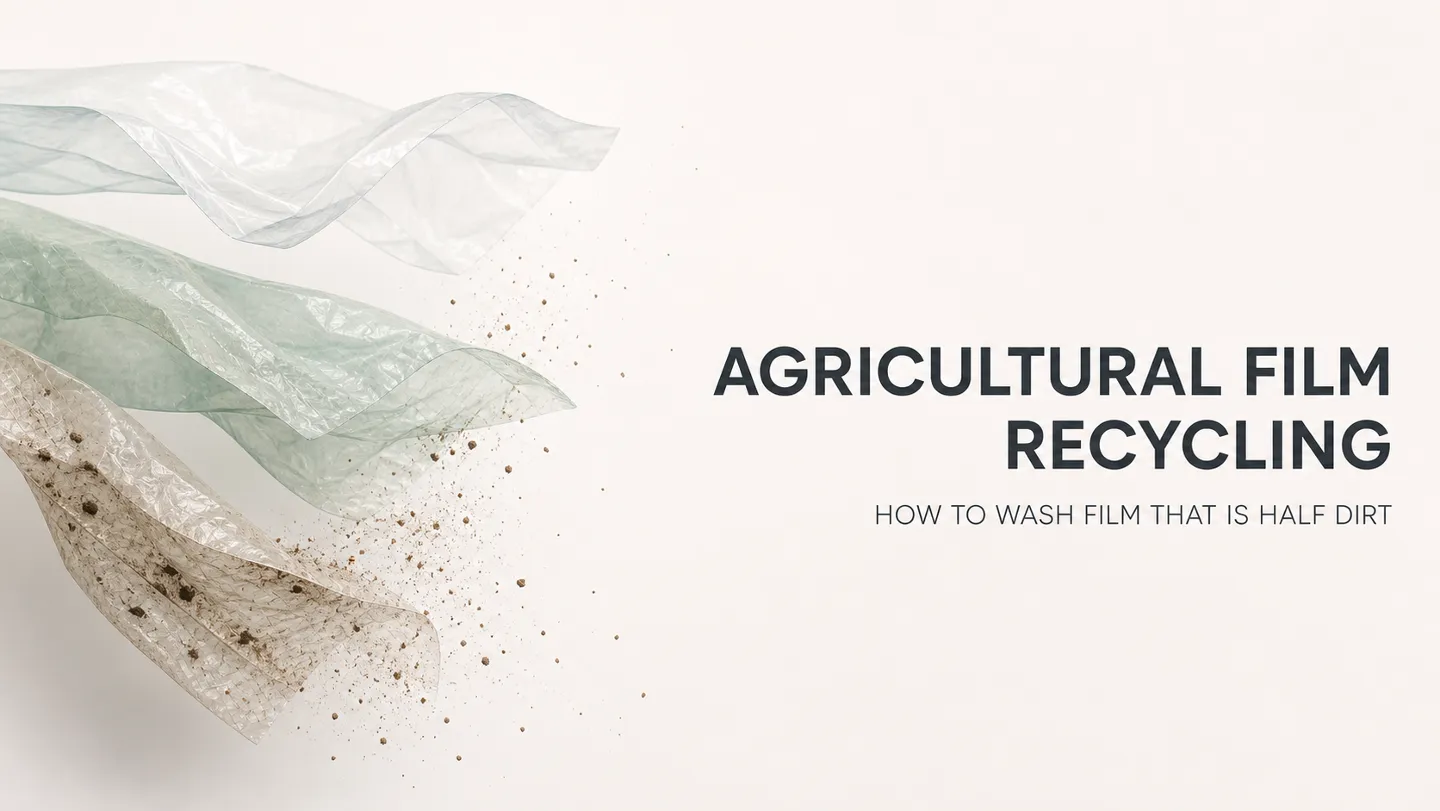
Agricultural film recycling starts with an uncomfortable number: film collected from fields routinely carries 30–50% of its weight in soil, sand, moisture, and crop residue — and heavily used mulch film can exceed that. The polyethylene itself is ordinary LDPE/LLDPE that any film line can pelletize; the dirt is the entire problem. Feed field film into a standard wash line and the sand grinds the blades, the soil overwhelms the water system, and the line chokes within a shift. This guide explains what agricultural film does to equipment, which extra stages a farm-film line needs, and how to specify one for your material.
What counts as agricultural film — and how dirty each type runs
Three film streams dominate farm plastic, and they arrive in very different conditions:
| Film type | Typical material | Contamination on arrival | Main challenge |
|---|---|---|---|
| Mulch film | Thin LDPE/LLDPE (often 15–30 µm) | Highest — up to half its weight in soil and sand, plus crop residue | Thin, torn, embedded grit |
| Greenhouse / tunnel film | Thicker LDPE (aging 1–4 seasons) | Moderate — dust, algae, degraded surface | UV-degraded polymer, brittleness |
| Silage / bale wrap | LLDPE stretch film | Moderate–high — soil, feed residue, moisture | Odor, organics, tape and net |
The ranking matters because the line is specced for the worst stream you accept, not the average. A line built for greenhouse film will not survive a steady diet of mulch film; a mulch-capable line handles everything below it.
What field dirt does to a standard film line
Soil and sand are not just “more washing.” They attack a film line at four points:
- Blades. Sand is an abrasive. In the shredder and granulator it rounds cutting edges in a fraction of the normal blade life, and the dulled blades then smear film instead of cutting it.
- Water system. A standard film wash loop is sized for label glue and surface dust. Kilograms of soil per minute turn the tanks into mud baths, and without continuous sludge removal the wash water stops washing.
- Friction and wear parts. Grit embeds in film folds and travels the whole line, wearing screws, paddles, and screens far ahead of schedule.
- The pellet. Whatever silica survives washing ends up in the melt — visible as specks, felt as die wear on whoever extrudes the recycled granulate.
The design answer is consistent across every serious farm-film line: remove the dirt dry, before the film touches a blade or a wash tank.
The agricultural film line, stage by stage
An agricultural film recycling line is a standard film washing line with a reinforced front end. The full sequence:
- Dry pre-cleaning (the stage standard lines skip). A trommel or shaking screen tumbles the incoming film so loose soil, sand, and stones fall out before size reduction — removing the bulk of the contamination at zero water cost and protecting every stage downstream.
- Wet shredding. The film is shredded with water flushing the cutting chamber, so remaining grit washes away from the blades as they work instead of grinding against them.
- Intensive washing. Friction washers scrub the shredded film; heavy remaining contamination — sand, stones, wet soil — sinks out in the sink-float separation tank while the polyolefin film floats. For farm film this stage runs harder and longer than on packaging film, usually as multiple friction stages.
- Dewatering and squeezing. Washed farm film holds water in every fold. A film squeezer-densifier presses the moisture out mechanically and raises bulk density in the same pass — on agricultural film this is standard equipment, not an option, because the alternative is evaporating that water with heat. The selection logic is covered in what is densifying in PP/PE film recycling.
- Thermal finishing and pelletizing. A thermal dryer brings residual moisture to pelletizing spec, and the dried, densified film feeds the extruder.
Two support systems decide whether the line keeps running: continuous sludge removal from the wash water (the soil has to leave the loop as fast as it enters), and a wear-parts plan — even with dry pre-cleaning, farm film shortens blade and screen intervals, so spares belong in the budget from day one.
The complete stage-by-stage washing logic for film in general is in our PP/PE film washing line process guide; the agricultural version differs in the reinforced front end and water treatment, not in the sequence.
What the recycled granulate is good for
Be realistic about the output. Even well-washed agricultural film yields a granulate with some residual specks and, for greenhouse film, UV-degraded polymer mixed in. It sells — but into the right applications:
- Construction film, garbage bags, and thick-wall film — the standard destinations, tolerant of specks and color.
- Irrigation and drainage pipe — a major buyer of agri-film granulate in farming regions.
- Injection-molded goods — crates, buckets, and pallets where color and cosmetics are secondary.
What it does not make is clear packaging film. Lines that plan for realistic end markets are profitable; lines specced against food-grade expectations are disappointed at the first quality test.
Specifying the line: five questions before the RFQ
- Which film streams, in what shares? Mulch-heavy feed pushes the pre-cleaning and water treatment spec far harder than greenhouse film. State the mix honestly.
- How dirty, measured? Weigh a few incoming bales, wash a sample, weigh the film. A line quoted for 40% contamination behaves very differently from one quoted for 15%.
- What throughput — counted as clean output? 1,000 kg/h of incoming mulch film may be 600 kg/h of actual polymer. Specify which number you mean; the difference is the whole line size.
- What does your water situation allow? Farm-film lines live or die on water treatment. Fresh-water cost, discharge rules, and space for sedimentation and sludge handling belong in the first conversation.
- Where does the granulate go? Pipe, bags, or molded goods set the required melt quality — and therefore how many wash stages and how fine a melt filter the line needs.
Frequently Asked Questions
Can agricultural mulch film actually be recycled?
Yes — the polymer is standard LDPE/LLDPE and pelletizes normally once clean. The economics depend on contamination: film carrying half its weight in soil needs dry pre-cleaning, wet shredding, multi-stage washing, and serious water treatment. With that front end in place, mulch film recycling runs commercially in many farming regions; without it, the line spends its life jammed.
How dirty is agricultural film compared with packaging film?
Post-industrial packaging film typically carries a few percent contamination; post-consumer packaging perhaps 10–20%. Field-collected agricultural film routinely arrives at 30–50% by weight — soil, sand, moisture, and crop residue — which is why a standard film wash line cannot simply take it. The line is not “stronger”; it has additional stages that exist only because of the dirt.
What equipment does an agricultural film washing line need that a normal film line does not?
Three additions: a dry pre-cleaning stage (trommel or shaking screen) that drops soil out before shredding; wet shredding that flushes grit away from the blades; and expanded water treatment with continuous sludge removal. The rest of the line — friction washing, sink-float separation, squeezing, thermal drying — is the standard film sequence, run at a harder duty point.
Is a film squeezer necessary on an agricultural film line?
Effectively yes. Washed farm film traps large amounts of water in its folds, and pressing it out mechanically costs a fraction of evaporating it. The squeezer also densifies the fluffy film so the pelletizer feeds steadily — on agricultural film lines it is standard equipment rather than an upgrade.
What can recycled agricultural film be made into?
Construction and garbage-bag film, irrigation and drainage pipe, and injection-molded goods like crates and pallets. The granulate carries some residual specks and, from greenhouse film, UV-aged polymer, so it suits applications where mechanical performance matters more than cosmetics — not clear packaging.
Spec the line for the dirt, not the film
Agricultural film recycling succeeds or fails on one design decision: treating the soil as the primary material stream. Remove it dry before the blades, keep removing it from the water continuously, and the LDPE underneath behaves like any other film. If you collect or process mulch, greenhouse, or silage film, send Rumtoo your film mix, a measured contamination figure, and your target output. We will configure the film recovery line around your dirt level — and tell you honestly what the granulate will and will not sell into. Contact our engineering team for a tested recommendation.
- agricultural film recycling
- agricultural film washing line
- mulch film recycling
- greenhouse film recycling
- plastic film recycling