
· Rumtoo Engineering Team · Buying Guides · 7 min read
Eddy Current Separator Buyer's Guide: Price, Sizing, and How to Vet Manufacturers
What drives eddy current separator price, why quotes for the same belt width differ by a factor of five, how to size between small and full-scale units, which manufacturer claims you can actually verify, and when a used machine is worth the risk.
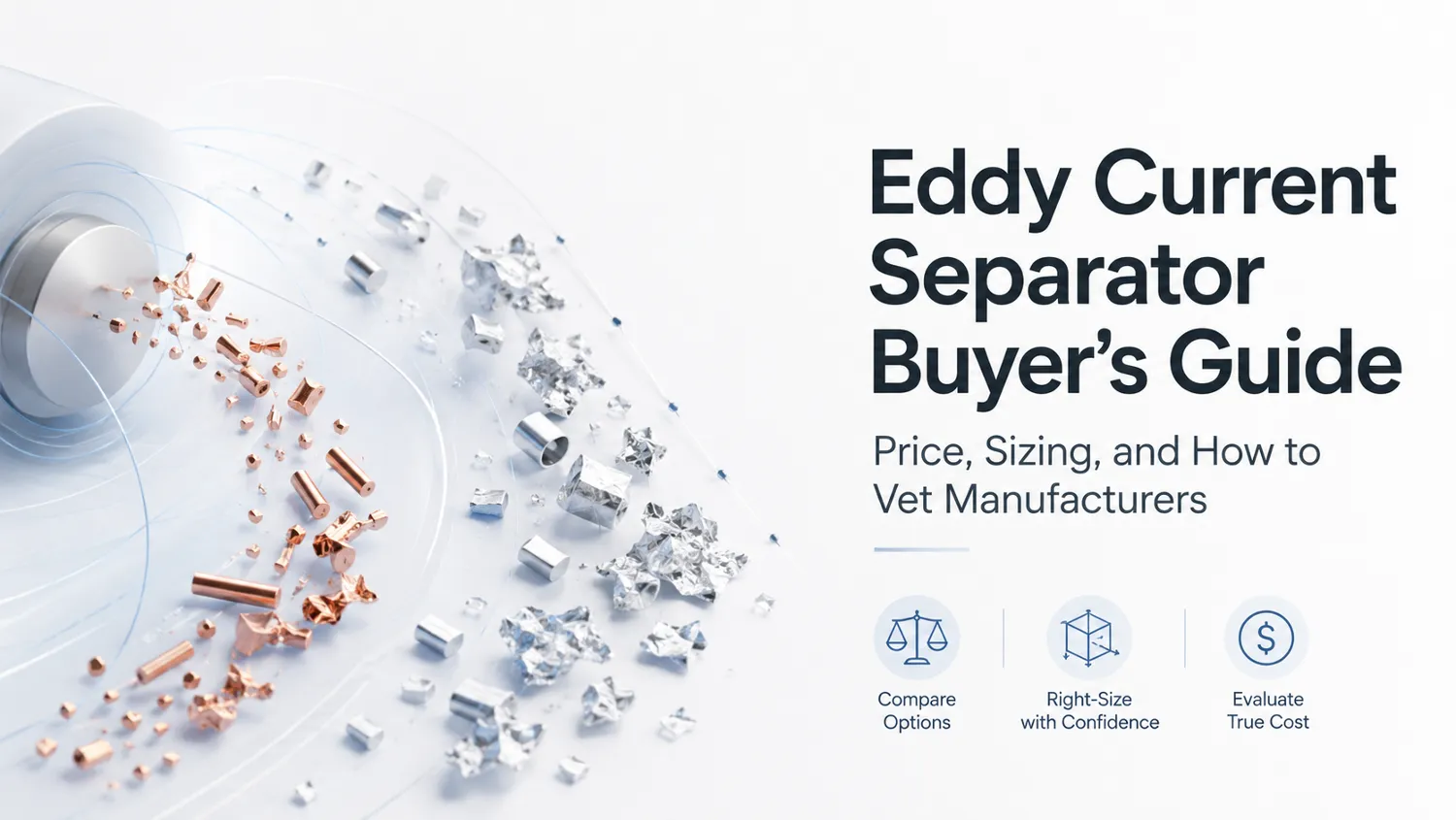
Shopping for an eddy current separator starts with a confusing discovery: quotes for what looks like the same machine — say, a 1,000 mm belt — can range from $20,000 to $100,000+. The spread is not noise. It reflects real differences in rotor design, magnet grade, and build quality that decide whether you recover 95% of your aluminum or 70% of it. This guide explains what actually drives eddy current separator price, how to size between small and full-scale units, which manufacturer claims you can verify before paying, and when a used machine makes sense.
What drives eddy current separator price
Four components account for most of the cost difference between machines of the same belt width:
| Cost driver | Cheap end | Expensive end | Why it matters |
|---|---|---|---|
| Rotor design | Concentric, 8–12 poles | Eccentric, up to 22 poles, high frequency | Eccentric high-pole rotors recover fine particles down to ~5 mm; basic rotors miss them |
| Magnet grade | Lower-grade ferrite/NdFeB mix | High-grade neodymium, temperature-stable | Field strength sets throwing force — and how long it lasts before the rotor needs replacing |
| Rotor speed & drive | Fixed ~2,000 RPM | Variable up to 4,000 RPM | Fine aluminum chips need 3,500+ RPM; coarse cans separate at 2,000–2,500 |
| Belt, splitter, frame | Thin belt, fixed splitter | Wear-cover belt, calibrated adjustable splitter | The splitter position is where recovery is won or lost daily |
The pattern to understand: price follows the particle size you need to recover. A machine that only has to throw aluminum cans out of coarse waste is legitimately cheap. A machine recovering 5–25 mm fines from shredded WEEE needs the eccentric high-frequency rotor, the stronger magnets, and the finer control — and that is what the upper half of the price range buys.
Why quotes for the “same” machine differ so much
When two quotes for a 1,000 mm separator are far apart, ask each supplier three questions and the difference usually explains itself:
- Concentric or eccentric rotor? The eccentric (off-centered) design concentrates the magnetic field at the discharge point and is the standard for fine WEEE fractions. It costs more to build. A concentric rotor at an eccentric price is margin, not value.
- What recovery, on what feed size, in writing? “95% recovery” means nothing without a particle-size band. A serious quote states recovery by fraction — for example, 90%+ aluminum on 5–25 mm fines, 95%+ on 20–60 mm — and commits to it after testing your sample.
- What is in the scope? Feeder, vibrating tray, splitter calibration, commissioning, spare belt — the low quote often excludes what the high quote includes. Compare delivered systems, not machine prices.
Small vs. full-scale: which size fits your line
Belt width and throughput scale together, and oversizing wastes capital as surely as undersizing chokes the line. Reference points from our own range:
| Class | Belt width | Throughput | Typical use |
|---|---|---|---|
| Small | 600 mm | 1–3 t/h | Cable granulation residue, PCB fines, pilot lines |
| Mid | 1,000 mm | 3–6 t/h | Typical shredded WEEE line |
| Large | 1,200–1,500 mm | 5–15 t/h | SDA, ASR, bulk recycling plants |
A small eddy current separator is not a compromise — for cable regrind or a granulation line running 1–2 t/h, the 600 mm class with a high-frequency rotor outperforms a wider machine running half-empty, because feed depth stays mono-layered where separation actually works. Size to your real hourly rate and your particle size, not to the biggest number in the budget.
The full specification logic — feed preparation, rotor matching, splitter setup — is on our eddy current separator page, and where the machine sits among other sorting technologies is covered in plastic sorting methods.
How to vet eddy current separator manufacturers
Most manufacturer claims are hard to check from a brochure. These five are verifiable — ask for the evidence, not the adjective:
- Rotor balancing certificate. High-speed magnetic rotors should be balanced to ISO 1940 G0.4 at operating RPM. Unbalanced rotors vibrate, eat bearings, and fail early. Ask for the balancing report, not the claim.
- Magnetic field measurement. A gaussmeter reading at the rotor surface, documented at commissioning, gives you the baseline to detect field decay later. A manufacturer who provides it expects the field to last.
- Written recovery commitment after a material test. Reputable makers test your actual sample and commit to recovery-by-fraction numbers in the contract. “Up to 95%” in a brochure is not a commitment.
- Maintenance schedule with thresholds. Bearing temperature limits, rotor-to-shell gap wear limit, belt inspection intervals — with numbers. A machine shipped with “inspect regularly” will be run to failure.
- Spare parts and response. Belt covers, bearings, and splitters are consumables. Ask what is stocked, and the lead time to your region — a $20,000 saving evaporates in one month of waiting for a belt.
Factory-direct manufacturers can usually answer all five faster than trading companies, because the answers come from their own workshop rather than a supplier chain.
Used vs. new: is a used eddy current separator worth it?
Sometimes — but the risk sits in the one component you cannot inspect visually: the magnetic rotor. Permanent magnets lose strength when overheated, and a rotor that spent years next to a failing bearing may read 70% of its original field. That machine separates coarse cans fine and quietly misses the fine aluminum that carries the value.
If you evaluate a used machine, three checks are non-negotiable:
- Gaussmeter reading on the rotor surface, compared with the manufacturer’s original specification — walk away without it.
- Bearing history and vibration test at operating speed; rotor replacement costs approach a new machine.
- Total cost math: used price + new belt + bearings + freight + no recovery guarantee, against a new machine with a written recovery commitment and warranty. On mid-size machines the gap is often smaller than it looks.
Used machines make sense as coarse-fraction workhorses bought cheap from a known line. For fines recovery — where the money is — the field-strength risk usually kills the economics.
Frequently Asked Questions
How much does an eddy current separator cost?
Small 600 mm units for cable regrind and fines start in the low tens of thousands of dollars; mid-size 1,000 mm machines for shredded WEEE sit higher depending on rotor type; large 1,200–1,500 mm plant machines with eccentric high-frequency rotors and full feed systems occupy the upper range. The rotor design and magnet grade — not the belt width — are the main price drivers, so quotes only compare once the rotor specification and the recovery commitment match.
Why are some eddy current separators so much cheaper?
Usually a concentric low-pole rotor, lower-grade magnets, a fixed-speed drive, and a bare-machine scope without feeder or commissioning. That machine genuinely costs less to build — and recovers less fine metal. Cheap is correct for coarse can sorting; it is expensive for WEEE fines because the missed aluminum was the revenue.
What size eddy current separator do I need?
Match belt width to your throughput and rotor type to your particle size: 600 mm for 1–3 t/h fines lines, 1,000 mm for typical 3–6 t/h WEEE lines, 1,200–1,500 mm for 5–15 t/h plants. Fine particles (5–25 mm) need an eccentric high-frequency rotor regardless of width; coarse fractions run well on standard rotors.
Is a used eddy current separator a good buy?
Only with a gaussmeter reading proving the rotor still holds its original field strength, plus a bearing and vibration check. Magnet degradation is invisible and irreversible — a weakened rotor quietly cuts fine-metal recovery, and replacing it costs close to a new machine. For coarse sorting, a verified used unit can work; for fines recovery, buy new with a written recovery commitment.
Eddy current separator vs magnetic separator — do I need both?
Yes, in sequence. A magnetic separator removes ferrous metal first — mandatory, because iron entering the eddy current rotor damages it. The eddy current separator then ejects the non-ferrous metals (aluminum, copper, brass) that magnets cannot touch. The full comparison is in our eddy current vs magnetic separator guide.
Get a quote you can actually compare
The honest way to buy an eddy current separator: send your feed type, particle size band, metal content, and hourly rate to two or three manufacturers, and require the same three things from each — rotor specification, recovery-by-fraction in writing after a sample test, and the maintenance schedule with thresholds. Quotes become comparable the moment the claims become verifiable.
Send Rumtoo your fraction details and we will return exactly that: a configured eddy current separator proposal with the rotor type, written recovery targets from your sample, and the maintenance schedule we ship with every machine. Contact our engineering team for a tested recommendation.
- eddy current separator price
- eddy current separator manufacturers
- eddy current separator for sale
- small eddy current separator
- metal recovery