· Rumtoo Engineering Team · Buying Guides · 8 min read
Single Shaft vs Double Shaft Shredder: Which One for Plastic Recycling?
Single-shaft shredders cut against a screen for defined flake; double-shaft shredders tear at low speed for coarse volume reduction. This guide compares the two designs by output size, feed tolerance, wear cost, and energy use — and explains why the feeding system matters as much as the shaft count.
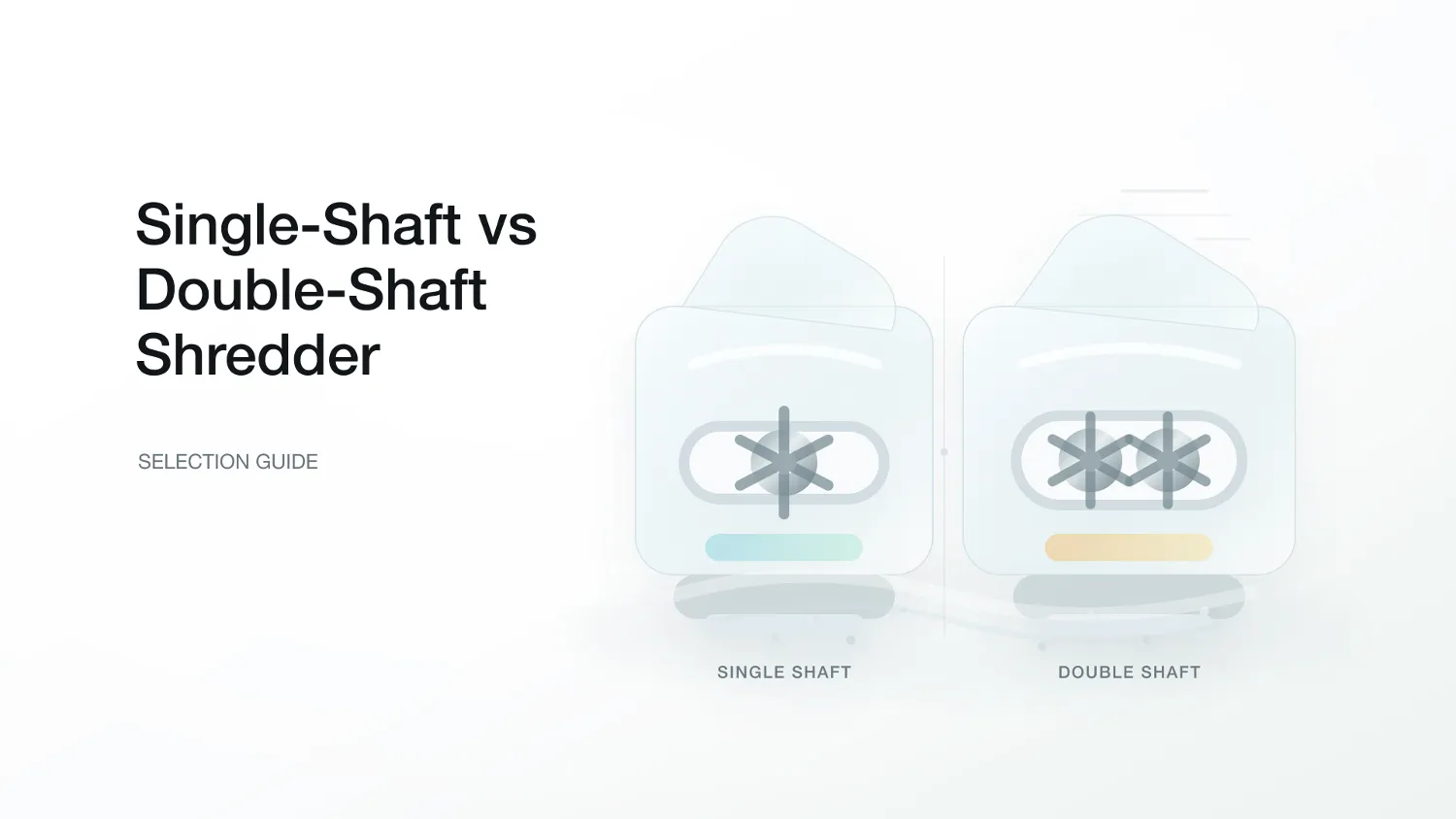
Single shaft vs double shaft shredder is the first decision in any size-reduction project, and picking wrong is expensive in both directions: a double-shaft machine cannot produce the defined flake a washing line needs, and a single-shaft machine chokes on the dirty, bulky feed a double-shaft handles without complaint. The good news is that the choice follows from two questions — what does your material look like coming in, and what size must it be going out. This guide answers both, then covers the third factor most comparisons skip: the feeding system.
The core difference: cutting against a screen vs tearing between shafts
A single-shaft shredder has one rotor with indexable knives cutting against fixed counter-knives, with a screen underneath. Nothing leaves until it passes the screen, so the output is a defined flake size — typically 20–80 mm. A ram or swing arm presses material onto the rotor.
A double-shaft shredder has two slow-turning shafts with hooked cutters that grip and tear material between them. There is usually no screen: output size is set by cutter width and comes out as coarse, irregular strips. The shafts pull material in by themselves, so no pusher is needed.
That single design difference drives everything else in the comparison:
| Factor | Single-shaft shredder | Double-shaft shredder |
|---|---|---|
| Output size | Defined by screen, 20–80 mm, uniform | Coarse strips, 50–200+ mm, irregular |
| Output use | Washing line, granulator, extruder — direct | Pre-shredding; needs a second stage for fine size |
| Feed tolerance | Needs reasonably clean, sorted feed | Forgiving of dirt, metal, mixed waste |
| Shaft speed | Medium (60–150 rpm) | Low (10–40 rpm), high torque |
| Feeding | Ram, swing arm, or gravity pushes material to the rotor | Shafts self-feed by gripping |
| Noise and dust | Moderate | Lower (slow speed) |
| Knife maintenance | Indexable inserts, rotate 4×, adjustable counter-knives | Larger hook cutters, weld-repair or replace |
Key takeaway: Single-shaft = one stage to washing-line-ready flake, but it wants clean feed. Double-shaft = eats almost anything, but its output is coarse and usually needs a second machine.
When a single-shaft shredder is the right choice
Choose a single-shaft machine when the output specification matters — which in plastic recycling is most of the time. If the flake feeds a washing line, a granulator, or an extruder, the screen-defined size of a single-shaft shredder does in one stage what a double-shaft machine needs two stages to reach.
Typical single-shaft feeds: purge lumps and start-up cakes, pipe and profile sections, film and nonwoven rolls, crates, drums, pallets, and post-industrial rigid scrap. These are exactly the applications the hydraulic drawer single-shaft shredder is configured for — and its swing-arm ram addresses the classic single-shaft weakness, which we cover below.
The single-shaft trade-off is feed sensitivity. Tramp metal damages knives, so post-consumer streams want a magnet upstream, and material must be pressed onto the rotor by a feeding system — which is where designs differ sharply.
When a double-shaft shredder is the right choice
Choose a double-shaft machine when the input is hostile and the output spec is loose. The low-speed, high-torque tearing action tolerates dirt, stones, and incidental metal that would wreck a single-shaft rotor, and the self-feeding shafts grip bulky items without a ram.
Typical double-shaft feeds: mixed post-consumer bales, bulky rigid waste, tires, cables, WEEE, and municipal streams headed for coarse volume reduction, RDF, or a sorting plant. Fiber-rich material also favors twin shafts: a textile waste shredder uses the dual-shaft, low-speed format because fabric wraps a fast single rotor.
The double-shaft trade-off is the output: irregular strips. If your process needs sized flake, the double-shaft is a pre-shredder, and a granulator or single-shaft machine follows it — the standard two-stage configuration for dirty or demanding streams.
The factor most comparisons skip: the feeding system
Two single-shaft shredders with identical rotors and motors can differ by half their real-world throughput, and the difference is the feeding system. A single-shaft rotor only cuts material that is pressed against it.
- Horizontal ram — the standard design. A hydraulic pusher slides material sideways into the rotor. Works well on dense, blocky feed; but light or springy material rides up over the ram and floats above the rotor, so the machine spins without cutting.
- Swing-arm ram — a pivot-mounted arm presses the charge down onto the rotor from above at controlled pressure, usually combined with a drawer-style chamber floor. Light material cannot float, hollow parts cannot bounce, and load-dependent control meters the feed pressure against rotor amp draw. This is the design behind the hydraulic drawer single-shaft shredder with swing arm.
- Gravity / hopper feed — material falls onto the rotor. Simple and cheap, fine for free-flowing regrind, unreliable for bulky or springy scrap.
If your feed includes film rolls, hollow blow-molded parts, big-bag scrap, or mixed shapes, the ram design decides whether the nameplate throughput is real. Ask about it before comparing motor sizes.
Cost comparison: purchase, energy, and wear
Neither design is uniformly cheaper — the costs sit in different places.
- Purchase price. Comparable-throughput machines are in a similar range; double-shaft units trend higher at the heavy, mixed-waste end because of the twin drives.
- Energy. Single-shaft machines cut efficiently but spend energy pushing material through a screen. Double-shaft machines run at lower speed with high torque and often lower specific energy — but if a second stage is needed to reach final size, count the energy of both machines, not one.
- Wear parts. Single-shaft knives are small indexable inserts — rotate four times, replace cheaply, and adjust the counter-knife to restore the cutting gap. Double-shaft hook cutters last long on soft feed but are costlier to repair after metal strikes.
- The hidden cost is a mismatch. A single-shaft machine on dirty feed eats knives; a double-shaft machine feeding a washing line needs a second shredding stage nobody budgeted. Matching the machine to the material outweighs any list-price difference.
Decision framework: four questions
- What output size does the next stage need? Defined flake under ~80 mm → single-shaft. Coarse strips acceptable → double-shaft.
- How clean is the feed? Sorted post-industrial → single-shaft. Dirty, mixed, metal-contaminated → double-shaft (or double-shaft first, single-shaft second).
- What shape is the feed? Blocky and dense → single-shaft with horizontal ram. Bulky, springy, rolls, hollow parts → single-shaft with swing arm, or double-shaft if output is loose.
- Is anything oversize for the chamber? Compressed bales and oversized lumps are cheaper to pre-cut with a hydraulic guillotine than to force through either shredder type.
Answer those four and the machine type picks itself; the remaining work is sizing rotor width, motor power, and screen — which is a sample-testing conversation, not a catalog one.
Frequently Asked Questions
What is the difference between a single-shaft and double-shaft shredder?
A single-shaft shredder cuts material with one knife-fitted rotor against a screen, producing uniform flake of 20–80 mm in one stage. A double-shaft shredder tears material between two slow, high-torque shafts without a screen, producing coarse irregular strips. Single-shaft suits defined output for washing or pelletizing; double-shaft suits dirty, bulky, or mixed feed where coarse output is acceptable.
Which shredder is better for plastic recycling?
For most plastic recycling — where the flake feeds a washing line, granulator, or extruder — a single-shaft shredder is the better fit because the screen delivers the defined size those processes need in one stage. A double-shaft machine fits as a pre-shredder for dirty or mixed streams, followed by a finer stage.
Does a single-shaft shredder need clean feed?
Reasonably, yes. The knives are precision inserts and tramp metal damages them, so post-consumer feed should pass a magnet first. Dirt and fines accelerate wear but are manageable; heavy contamination is a reason to put a double-shaft pre-shredder in front instead.
Why does the ram design on a single-shaft shredder matter?
Because the rotor only cuts material pressed against it. A horizontal ram lets light or springy feed float above the rotor, collapsing real throughput. A swing-arm ram presses the charge down from above at load-controlled pressure, keeping film rolls, hollow parts, and mixed shapes engaged with the knives — the difference between nameplate and actual output on difficult feed.
Can one shredder handle both dirty waste and produce fine flake?
Not well. Machines that try to do both compromise on knife protection or output size. The standard solution for dirty feed with a fine-output requirement is two stages: a double-shaft pre-shredder for volume reduction and contaminant tolerance, then a single-shaft shredder or granulator for the defined final size.
Match the shafts to the material
The choice is rarely about which machine is better — it is about which failure you are avoiding. Single-shaft gives you washing-line-ready flake but asks for clean feed and a feeding system matched to your material’s shape. Double-shaft forgives the feed but hands the sizing problem to the next machine. Answer the four framework questions honestly, and check the ram design before trusting any throughput figure.
If you are choosing between the two, send Rumtoo your material type, contamination level, largest piece dimensions, and target output size. We will recommend single-shaft, double-shaft, or a two-stage line — including whether your feed needs the swing-arm single-shaft design or a simpler machine will do. Contact our engineering team for a tested recommendation.
- single shaft shredder
- double shaft shredder
- plastic shredder
- shredder comparison
- plastic recycling