· Rumtoo Engineering Team · Buying Guides · 9 min read
Density Separation in Plastic Recycling: How Sink-Float Sorts Plastics by Weight
Density separation sorts mixed plastics by whether they float or sink in a liquid, and it is the cheapest way to split polyolefins from heavier resins. This guide explains how a sink-float tank works, which plastics float and which sink, what density separation can and cannot do, and how it compares with electrostatic and eddy-current sorting.
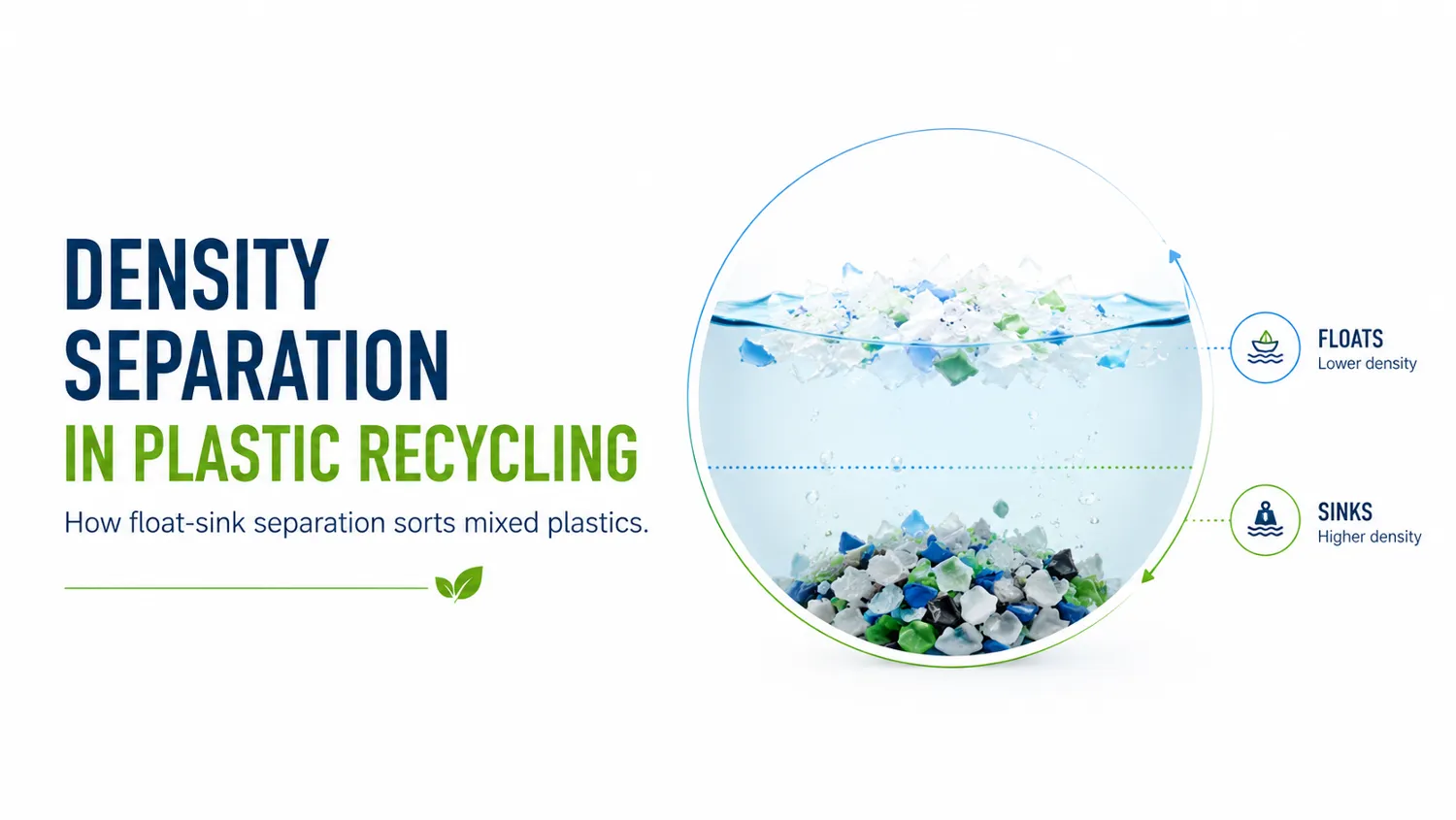
Density separation sorts a mixed stream of plastic by one property only: whether each piece floats or sinks in a liquid. Drop shredded plastic into water and the light polyolefins rise while the heavier resins go to the bottom — a clean split that costs almost nothing per ton. This is the workhorse sorting step on most wash lines, and the machine that does it is the sink-float separation tank. This guide explains how it works, exactly which plastics separate, where the method hits its limits, and when you need a different sorting technology instead.
What is density separation?
Density separation is a sorting method that splits materials by their density relative to a liquid, usually water. A piece of plastic less dense than the liquid floats; a piece denser than the liquid sinks. By choosing the liquid’s density, a recycler decides exactly where the cut line falls.
The principle is buoyancy, not chemistry. Water has a density of 1.0 g/cm³, so it separates everything below that line (floaters) from everything above it (sinkers) in a single pass. No sensors, no electricity beyond the agitator and pumps, no consumables — which is why density separation is the lowest-cost-per-ton sorting step in plastic recycling.
You will also see it called sink-float separation, float-sink separation, gravity separation, or hydro-sorting. They all describe the same physics: a density difference doing the sorting work for free.
Which plastics float and which sink?
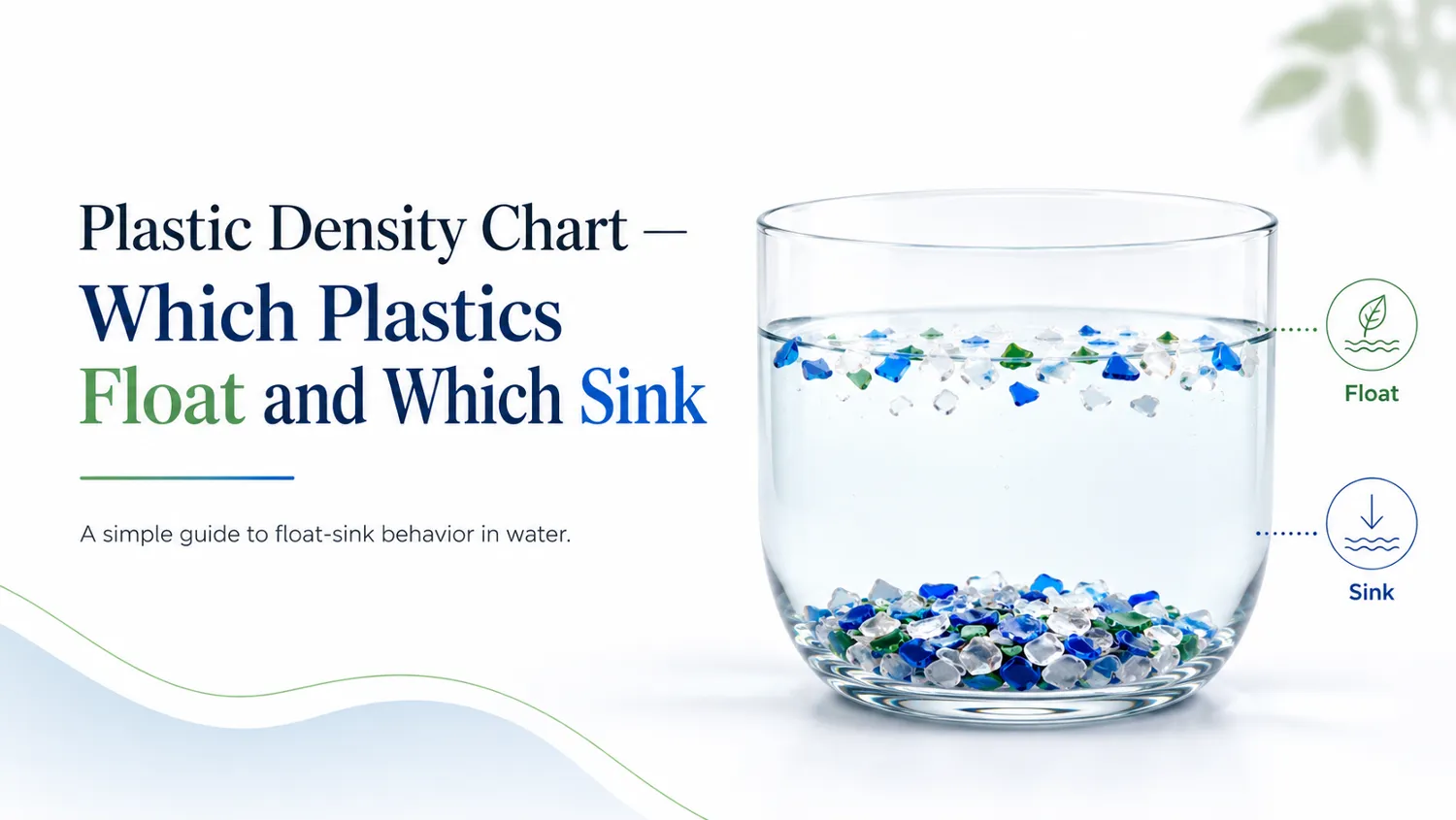
In plain water, the polyolefins float and almost everything else sinks. The dividing line is water’s density of 1.0 g/cm³ — plastics lighter than that rise, plastics heavier sink.
| Plastic | Density (g/cm³) | In water |
|---|---|---|
| PP (polypropylene) | 0.90–0.92 | Floats |
| LDPE | 0.91–0.93 | Floats |
| HDPE | 0.94–0.97 | Floats |
| PS (polystyrene, solid) | 1.04–1.07 | Sinks |
| ABS | 1.04–1.07 | Sinks |
| PET | 1.34–1.39 | Sinks |
| PVC | 1.30–1.45 | Sinks |
| PC (polycarbonate) | 1.20–1.22 | Sinks |
The figures above are standard specific-gravity ranges for these resins — see the full plastic density chart for more resins and how fillers shift the numbers. The same float-sink behavior is how the industry rates recyclability: the Association of Plastics Recyclers Design Guide treats a component that floats away from the target resin very differently from one that sinks with it, because that is exactly what a density tank will or will not separate.
Key takeaway: In water, PP, LDPE, and HDPE float; PET, PVC, PS, ABS, and PC sink. That single split — polyolefins versus the rest — is what a sink-float tank delivers in one pass.
This is why density separation pairs so naturally with PET and polyolefin recycling. PET bottle recycling depends on it: the bottle is PET (sinks) while its caps and labels are PP or PE (float), and float-sink is the step that parts them — which is why NAPCOR and bottle-recycling design rules call for caps and labels that separate by density. In a float tank the PET flake sinks and the cap/label fragments float off the top, giving washed PET flake without a hand-sort. The same logic cleans an HDPE or PP stream by floating the target resin away from heavier PET, PVC, or rubber contamination.
How a sink-float separation tank works
A sink-float separation tank is a long water-filled basin that moves floaters and sinkers to two different outlets continuously. Shredded, pre-washed plastic enters at one end, and the tank does the sorting as the material travels its length.
The sequence is mechanical and continuous:
- Infeed and wetting. Shredded flake drops into the tank and is wetted so trapped air escapes — air bubbles can make a sinker float briefly and corrupt the sort.
- Separation by buoyancy. Light flake rises to the surface; heavy flake settles toward the bottom. Gentle agitation or a current keeps material moving and stops floaters from trapping sinkers.
- Floaters skimmed off. Surface paddles or a screw conveyor skim the floating fraction over a weir at the far end and out to dewatering.
- Sinkers raked from the bottom. A bottom screw or scraper collects the sunk fraction and carries it up an inclined section to its own discharge.
The two fractions then go to separate centrifugal dryers and onward processing. Throughput is set by tank length, water volume, and how cleanly the two streams need to part — a longer tank gives flake more residence time and a sharper cut.
What density separation can and cannot do
Density separation is excellent at one job and useless at several others. Knowing the boundary keeps you from buying the wrong machine.
It separates well when:
- The two plastics sit on opposite sides of the liquid’s density (PP/PE versus PET/PVC) — a wide, reliable gap.
- The material is clean shredded flake, not whole items that trap air.
- You only need a two-way split (float versus sink), not a resin-by-resin sort.
It struggles or fails when:
- Two plastics have similar density — PVC (1.30–1.45) and PET (1.34–1.39) overlap, so plain water cannot tell them apart. This is the classic PVC-in-PET problem, and it needs a sensor sorter, not a float tank.
- A material traps air (foamed PS, hollow fibers, un-shredded bottles) and floats when it should sink.
- Fillers change density — mineral-filled or glass-filled plastic can sink even when the base resin would float.
For overlapping densities, recyclers reach for other methods covered below, or they adjust the liquid. Adding salt or another agent raises water density above 1.0 g/cm³, which shifts the cut line and can float a resin that sinks in plain water — but it adds cost and a recovery step, so most operations stay with water unless the separation demands more.
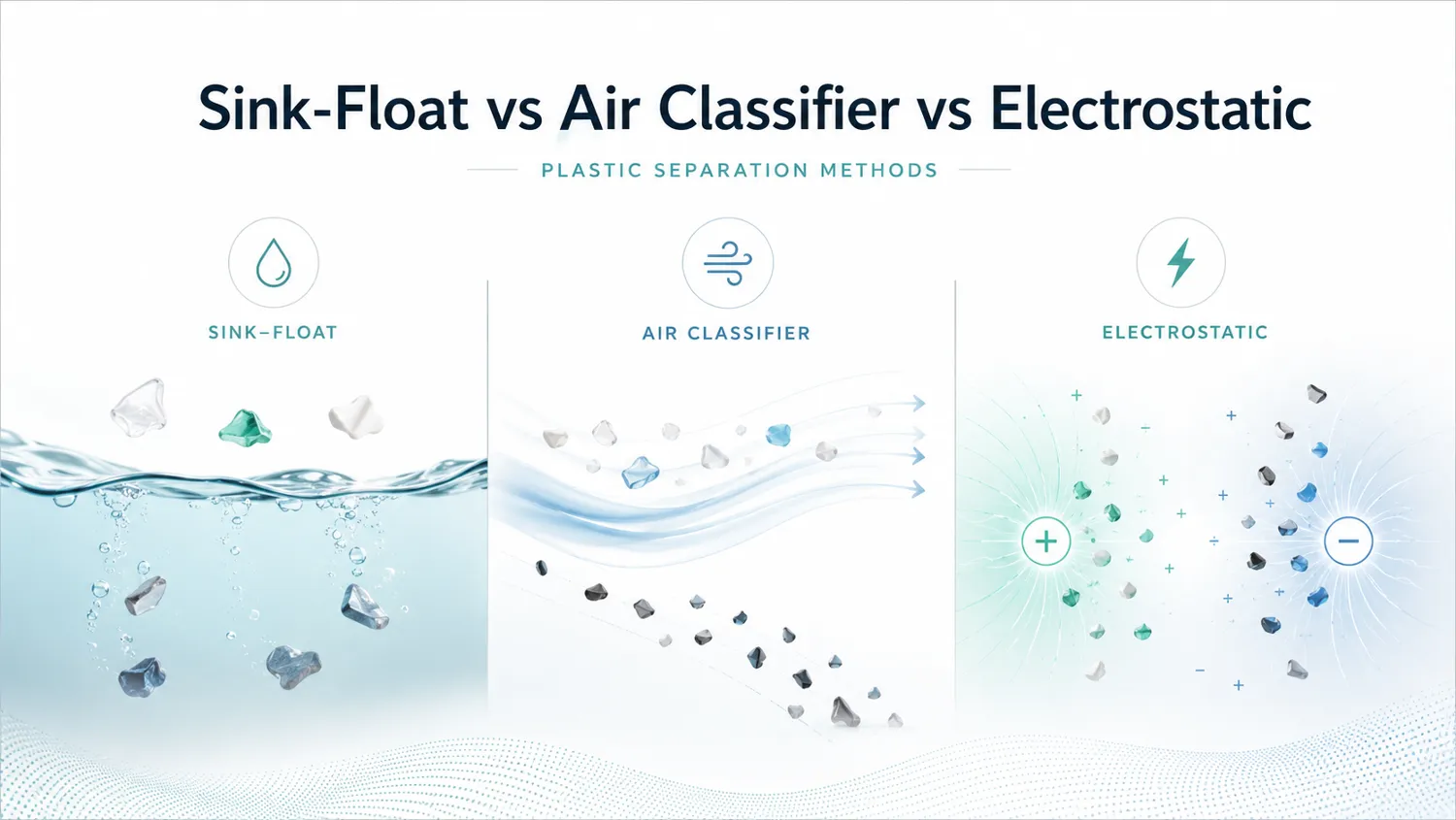
Density separation vs other plastic sorting methods
Density separation is one of several ways to sort plastic, and it wins on cost while losing on selectivity. The right choice depends on what your contamination actually is.
| Method | Sorts by | Best for | Limit |
|---|---|---|---|
| Density (sink-float) | Float vs sink in liquid | PP/PE vs PET/PVC; caps off PET | Cannot split similar densities |
| Air classification | Weight + aerodynamics | Film/dust vs heavy flake | Coarse; not resin-specific |
| Electrostatic separation | Surface charge | Same-density mixes (ABS/PS) | Needs dry, clean, fine flake |
| Eddy-current / magnetic | Conductivity / magnetism | Metals out of plastic | Sorts metal, not plastic-from-plastic |
| Sensor (NIR) sorting | Polymer fingerprint | Resin-by-resin, color | High capital cost |
The practical pattern on a real line is to layer them, not pick one — the full sequencing logic is in our plastic sorting methods guide. Magnetic and eddy-current units pull metal first, density separation makes the cheap bulk polyolefin-versus-heavy split, and a sensor or electrostatic stage cleans up the same-density fractions density separation cannot touch. Each method does the part it is cheapest at. For mixed regrind contaminated with rubber or silicone — where density alone falls short — the dedicated approaches in our plastic separation methods guide take over.
Where density separation fits in a wash line
The sink-float tank sits in the wet section, after size reduction and before drying. A typical post-consumer wash line runs in this order:
- Shredding / granulation — reduce to flake so density can act on each piece.
- Pre-wash / friction wash — strip dirt and loosen labels.
- Sink-float separation — the density split: target resin to one outlet, contamination to the other.
- Rinse — clear residual fines.
- Centrifugal drying — spin off the wash water before pelletizing.
Placing density separation here matters: the flake must be shredded (so air escapes and each piece sorts on its own density) and wet (so the tank’s own water does the work without re-wetting delays). Put it too early and whole items trap air; too late and you have washed contamination you could have removed for free.
Frequently Asked Questions
What is density separation in plastic recycling?
Density separation is a sorting method that splits mixed plastic by floating it in a liquid — usually water. Plastics less dense than the liquid float and are skimmed off; denser plastics sink and are raked out. It is the cheapest way to separate light polyolefins (PP, PE) from heavier resins (PET, PVC, PS, ABS) because buoyancy does the sorting with almost no running cost.
Which plastics float and which sink in water?
In water (density 1.0 g/cm³), PP, LDPE, and HDPE float because they are lighter; PET, PVC, PS, ABS, and PC sink because they are heavier. The single split between floating polyolefins and the sinking heavier resins is exactly what a sink-float separation tank produces in one pass.
What is a sink-float separation tank?
A sink-float separation tank is a water-filled basin that continuously sorts shredded plastic by density. Flake enters at one end; floaters are skimmed off the surface while sinkers are raked from the bottom, sending each fraction to a separate outlet. It is the standard density-separation machine on plastic wash lines.
Can density separation separate PVC from PET?
No — not in plain water. PVC (1.30–1.45 g/cm³) and PET (1.34–1.39 g/cm³) have overlapping densities, so both sink and a water tank cannot tell them apart. Separating PVC from PET requires a sensor-based (NIR) sorter or another resin-specific method, not density separation.
Why is density separation cheaper than other sorting methods?
Density separation uses buoyancy in water to do the sorting, so its only running costs are the agitator, pumps, and water management — no sensors, no high-voltage electrodes, no consumable reagents. That makes it the lowest-cost-per-ton sorting step, which is why most wash lines use it for the bulk split and save sensor sorting for the fractions density cannot separate.
Sort by density first, then clean up the rest
Density separation earns its place on almost every wash line because it makes the biggest, cheapest cut: polyolefins on one side, heavier resins on the other, with water doing the work. Get that split right and every downstream stage — drying, pelletizing, or a finer sensor sort — handles a cleaner, smaller stream. The method’s only real limit is similar-density mixes, and that is a job for electrostatic or sensor sorting, not the float tank.
If you are designing a wash line and want to know whether a sink-float stage will separate your specific material — or whether your contamination needs more than density — send Rumtoo your input mix and target resin. We will tell you what density separation will achieve on your stream and recommend a sink-float separation tank sized to your throughput. Contact our engineering team for a tested recommendation.
- density separation
- sink float separation
- plastic sorting
- float sink tank
- plastic recycling