
· Rumtoo Engineering Team · Buying Guides · 6 min read
Plastic Density Chart: Which Plastics Float and Which Sink in Water
A reference density chart for common recycling plastics — PP, PE, PET, PVC, PS, ABS, and more — with each resin's density in g/cm³ and whether it floats or sinks in water. Includes how fillers shift density, why some resins overlap, and how recyclers use the chart to sort plastic by sink-float.
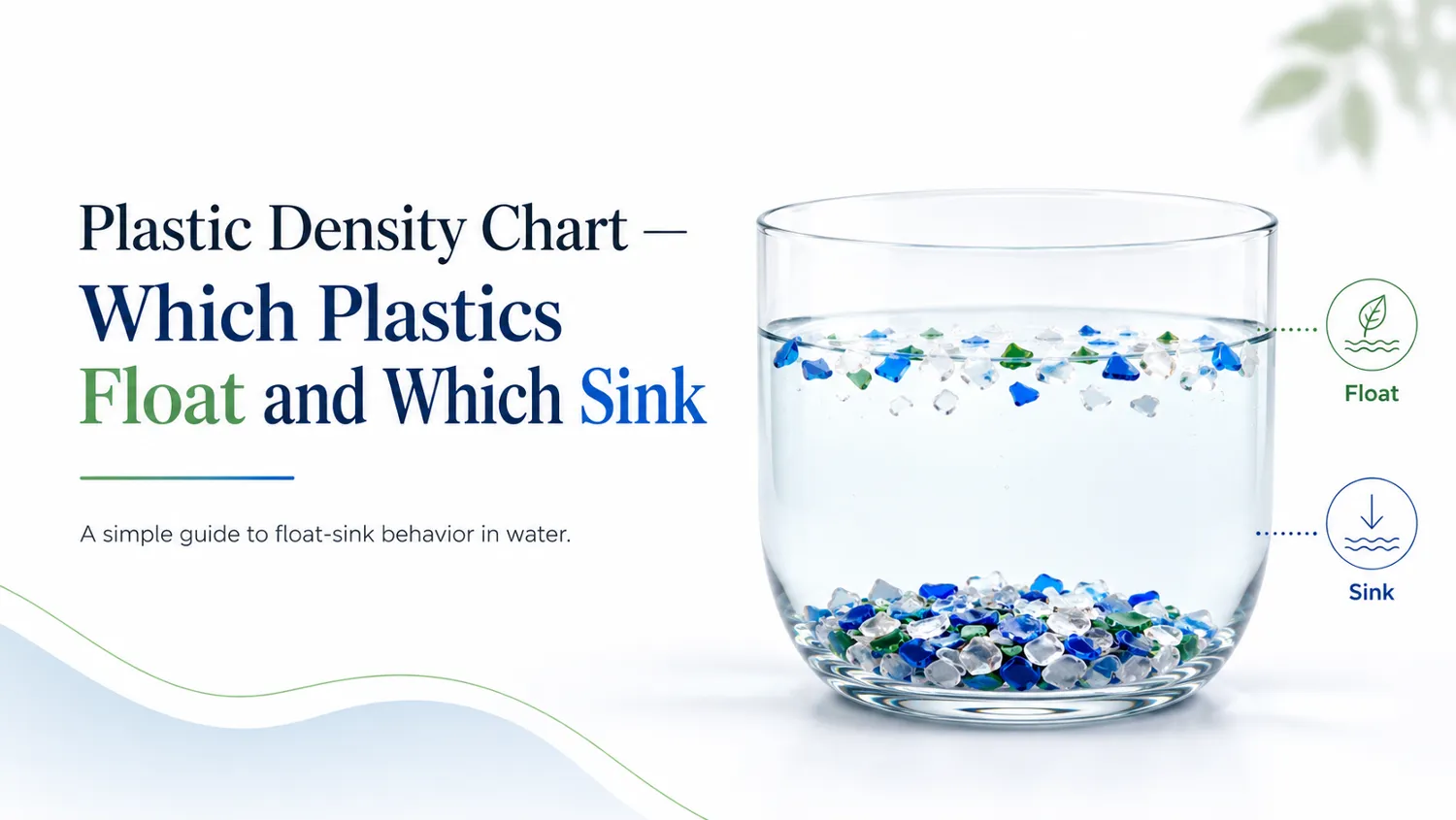
A plastic density chart tells you, at a glance, which plastics float in water and which sink — the single fact that decides whether a sink-float tank can separate them. Density (specific gravity) is measured in grams per cubic centimeter, and water’s 1.0 g/cm³ is the line that splits the floaters from the sinkers. This page is the reference table for common recycling resins, plus how to read it, why a few resins overlap, and how recyclers turn the chart into a sorting step.
Plastic density chart (common recycling resins)
The table below lists the density of the plastics you meet most often in recycling, in g/cm³, and what each does in plain water. Densities below 1.0 float; densities above 1.0 sink.
| Plastic | Code | Density (g/cm³) | In water |
|---|---|---|---|
| PP (polypropylene) | 5 | 0.90–0.92 | Floats |
| LDPE / LLDPE | 4 | 0.91–0.93 | Floats |
| HDPE | 2 | 0.94–0.97 | Floats |
| EPS (expanded PS, foam) | 6 | 0.01–0.05 | Floats |
| PS (polystyrene, solid) | 6 | 1.04–1.07 | Sinks |
| ABS | 7 | 1.04–1.07 | Sinks |
| PMMA (acrylic) | 7 | 1.17–1.20 | Sinks |
| PC (polycarbonate) | 7 | 1.20–1.22 | Sinks |
| PU (polyurethane, solid) | 7 | 1.20–1.26 | Sinks |
| PET | 1 | 1.34–1.39 | Sinks |
| PVC (rigid) | 3 | 1.30–1.45 | Sinks |
| POM (acetal) | 7 | 1.41–1.43 | Sinks |
| PTFE (Teflon) | — | 2.10–2.20 | Sinks |
Key takeaway: The polyolefins — PP, LDPE, HDPE — are the only common rigid resins that float in water. Everything denser than 1.0 g/cm³, from PS and ABS up to PET, PVC, and PTFE, sinks.
The numbers above are virgin-resin ranges. Real recycled flake varies a little with grade, fillers, and trapped air, but the float-versus-sink result holds for clean, shredded material.
How to read the chart
Read the chart against the density of whatever liquid you are using. In plain water (1.0 g/cm³), the rule is simple:
- Density below 1.0 → the plastic floats.
- Density above 1.0 → the plastic sinks.
- Density near 1.0 (solid PS, ABS at ~1.05) → sinks in plain water, but only just, so trapped air or foaming can flip the result.
This is why EPS foam and solid polystyrene sit far apart on the chart even though they are the same polymer. Solid PS is denser than water and sinks; expanded PS (foam) is mostly air at 0.01–0.05 g/cm³ and floats high. The polymer is identical — the air is what moves it on the chart. For the recycling side of that, see our EPS foam recycling guide.
Where the chart breaks down: overlapping densities
Density sorting fails when two plastics have densities that overlap, because water cannot place them on different sides of the line. The chart shows exactly where this happens.
| Overlapping pair | Density (g/cm³) | Problem |
|---|---|---|
| PET vs PVC | 1.34–1.39 vs 1.30–1.45 | Both sink; ranges overlap — water cannot separate them |
| PS vs ABS | 1.04–1.07 vs 1.04–1.07 | Nearly identical — no density gap to sort on |
The PET-versus-PVC overlap is the most costly one in practice: a few PVC fragments in a PET stream degrade the whole batch, and because PVC’s density range sits right on top of PET’s, a float tank cannot pull it out. That separation needs a sensor (NIR) sorter or, for same-density resins like PS and ABS, an electrostatic separator that sorts by surface charge instead of weight.
How fillers and additives shift density
Fillers change a plastic’s density, which can move it across the float-sink line and break a sort that the base resin would pass. This is the chart’s biggest real-world caveat.
- Glass fiber and mineral fillers add weight. A 30% glass-filled PP can climb from 0.91 to well over 1.0 g/cm³ — so a resin that should float will sink, landing in the wrong fraction.
- Blowing agents and foaming subtract weight. Foamed grades (like EPS above) drop far below the base resin and float high.
- Talc, calcium carbonate, and flame retardants raise density in proportion to their loading.
The takeaway for sorting: the chart describes unfilled resin. If your stream carries filled or compounded grades, test the actual flake rather than trusting the headline number, because a filled floater can quietly contaminate your sink fraction.
How recyclers use the density chart to sort plastic
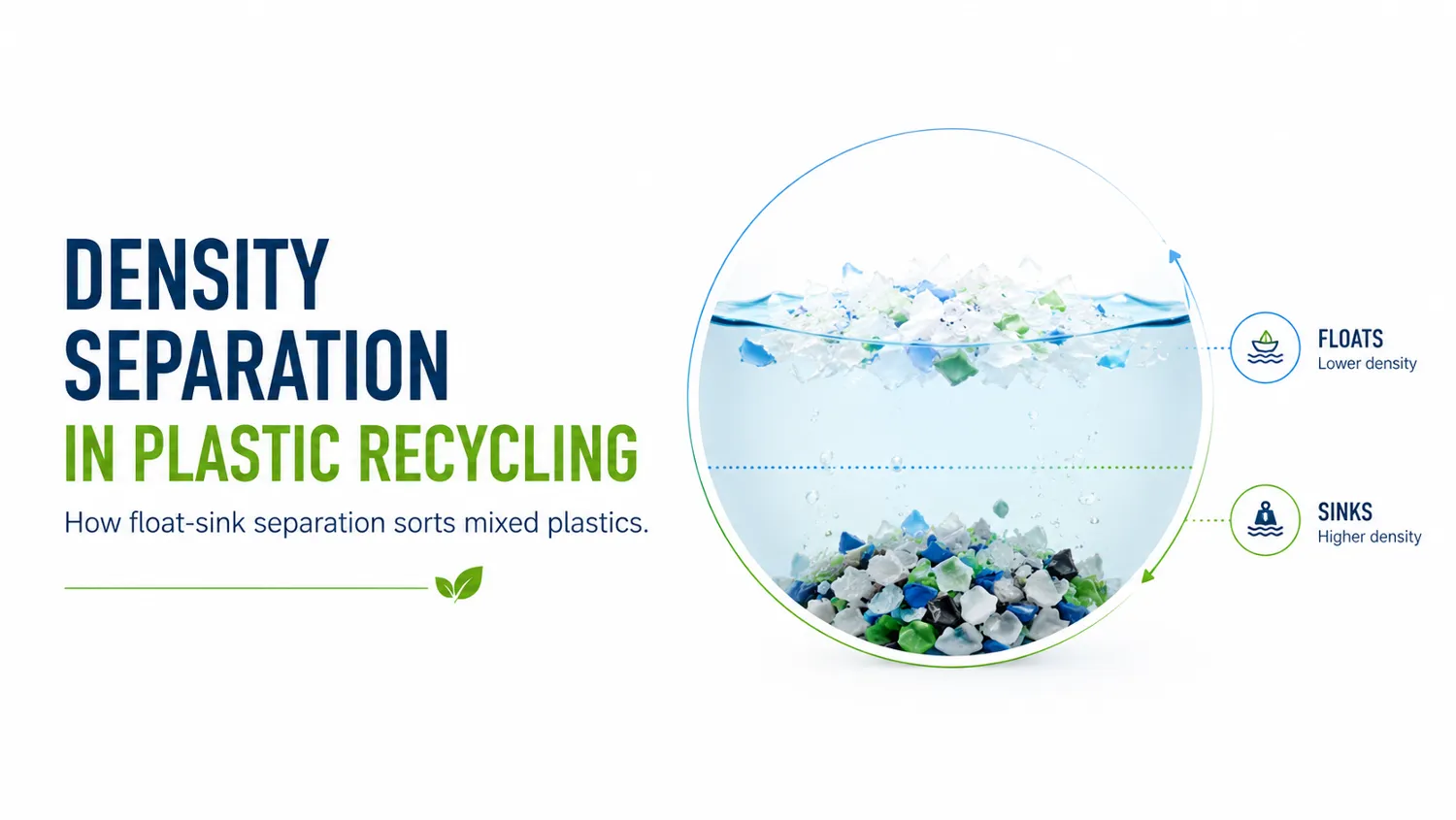
Recyclers turn this chart into a physical sorting step using a sink-float separation tank. The chart tells them, before any machine runs, whether their two target plastics sit on opposite sides of 1.0 g/cm³ — and therefore whether density separation will work at all.
The workflow is direct:
- Find both materials on the chart. Identify the resin you want and the contamination you need gone.
- Check which side of 1.0 each falls on. If one floats and the other sinks, a water tank separates them. If both sink (PET and PVC), it will not.
- Run the float tank if the chart says yes — the floaters skim off the top, the sinkers rake out the bottom, no sensors required.
This is exactly why a PET bottle wash line uses float-sink: PET sinks (1.34–1.39) while its PP/PE caps and labels float (0.90–0.97), a wide and reliable gap. The full method — tank design, throughput, and limits — is covered in our density separation guide.
Frequently Asked Questions
Which plastics float in water?
PP, LDPE, LLDPE, and HDPE float in water because their density (0.90–0.97 g/cm³) is below water’s 1.0 g/cm³. Expanded polystyrene foam also floats because it is mostly air. All other common plastics — PS (solid), ABS, PET, PVC, PC, PMMA, and POM — are denser than water and sink.
What is the density of PET plastic?
PET has a density of about 1.34–1.39 g/cm³, well above water’s 1.0 g/cm³, so PET always sinks in a water sink-float tank. This is the basis of PET bottle recycling: the PET flake sinks while the lighter PP or PE caps and labels float off the top.
Why can’t a sink-float tank separate PET from PVC?
Because PET (1.34–1.39 g/cm³) and PVC (1.30–1.45 g/cm³) have overlapping densities — both sink in water and their ranges cross over. A density tank can only separate plastics that fall on opposite sides of the liquid’s density, so removing PVC from PET needs a sensor-based (NIR) sorter, not density alone.
Does specific gravity mean the same as density for plastics?
For sorting purposes, yes. Specific gravity is a material’s density compared with water, so a plastic with a specific gravity below 1.0 floats and one above 1.0 sinks. The numbers in this chart (g/cm³) and a resin’s specific gravity are effectively the same value because water’s density is 1.0 g/cm³.
Can fillers change whether a plastic floats or sinks?
Yes. Glass fiber, talc, and mineral fillers add weight, so a filled grade of a normally floating resin (like glass-filled PP) can sink. Foaming agents do the opposite and make a resin float. Always test filled or compounded flake rather than relying on the unfilled density in a chart.
Use the chart, then sort by density
A plastic density chart is the quickest way to know whether two materials can be separated by water: if one sits below 1.0 g/cm³ and the other above, a sink-float tank parts them for almost nothing. The chart’s limits — overlapping resins like PET and PVC, and filled grades that shift density — are exactly the cases where you reach for sensor or electrostatic sorting instead.
If you have a mixed stream and want to know whether density separation will clean it, send Rumtoo your resins and contamination. We will check them against the density line and recommend a sink-float separation tank — or tell you when your separation needs more than water. Contact our engineering team for a tested recommendation.
- plastic density chart
- plastic density table
- plastic specific gravity
- density separation
- plastic sorting