
· Rumtoo Engineering Team · Buying Guides · 8 min read
Centrifugal Dryer for Plastic Recycling: How Spin Drying Removes Surface Water from Flake
A centrifugal dryer spins washed plastic flake at high speed to throw off free surface water mechanically, before any heat is applied. This guide explains how a centrifugal drying machine works, where it sits in a wash line, the residual moisture it reaches, how to size one for film versus rigid flake, and when you still need a thermal stage after it.

A centrifugal dryer is the machine that removes most of the water from washed plastic flake before any heat touches it. It spins the wet material at high speed so centrifugal force throws the free surface water outward through a screen, leaving flake damp rather than dripping. On a wet washing line it is the cheapest water you will ever remove, because it uses motion instead of fuel. This guide covers how a centrifugal drying machine works, where it belongs in the process, how much moisture it actually reaches, and how to size one for your material.
What is a centrifugal dryer?
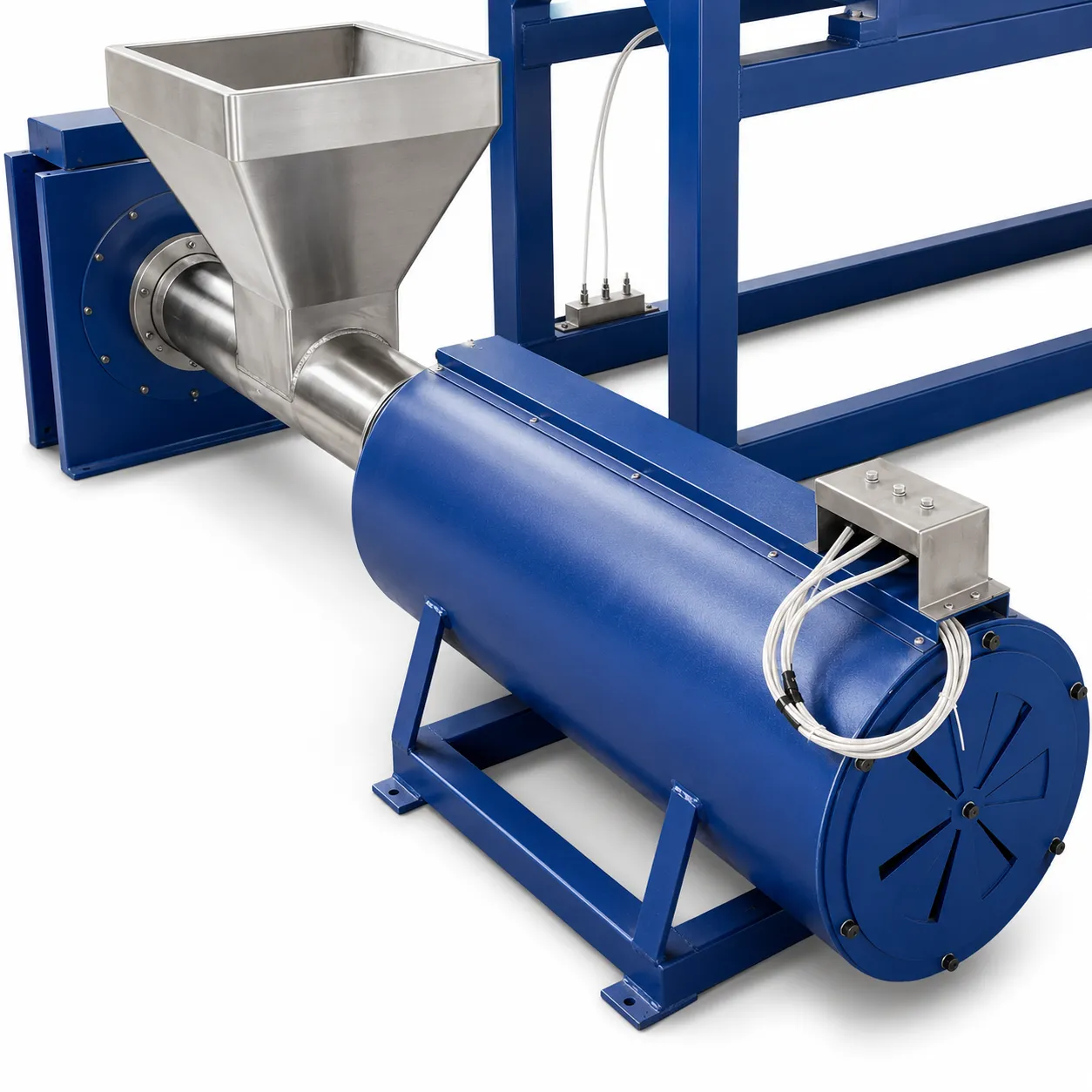
A centrifugal dryer is a mechanical dewatering machine that uses rotational force, not heat, to separate water from plastic flake or film. Washed material enters the bottom of a vertical chamber, a fast-spinning rotor flings it upward against a perforated screen, and the water passes through the screen holes while the plastic climbs to the discharge at the top.
Because it removes water mechanically, a centrifugal dryer costs very little to run compared with any heated stage. The trade-off is its limit: spinning removes the free water clinging to the surface, but it cannot pull out the thin moisture film that surface tension holds onto. That last fraction needs a separate heated step, which is why the two stages work together rather than against each other — a point covered in hot air dryer vs centrifugal dryer.
You will also see this machine called a centrifugal drying machine, a spin dryer, a vertical dewatering centrifuge, or simply a “dewatering machine.” They describe the same principle.
How a centrifugal dryer works
The process is fast and mechanical. Inside the vertical housing, a rotor fitted with paddles or blades turns at roughly 800 to 1,500 RPM, generating centrifugal force many times stronger than gravity. That force does three things in sequence:
- Lift and throw. The rotor pushes incoming wet flake outward and upward against the screen wall.
- Press water through the screen. Centrifugal force drives free water through the perforations — typically 1.5 mm to 6 mm holes sized to the flake — while the plastic is too large to pass.
- Convey to discharge. The paddle angle moves the now-drier flake up the chamber to the top outlet, while drained water exits the bottom.
A full pass takes only a few seconds per particle, so a centrifugal dryer keeps pace with a continuous washing line without becoming a bottleneck. Screen aperture, rotor speed, and paddle geometry are the three settings that decide how dry the output gets and how much fine material you lose through the screen.
Key takeaway: A centrifugal dryer trades electricity for water removal — high force, low running cost, but it only reaches the free surface water, not the bound film.
Where the centrifugal dryer fits in a recycling line
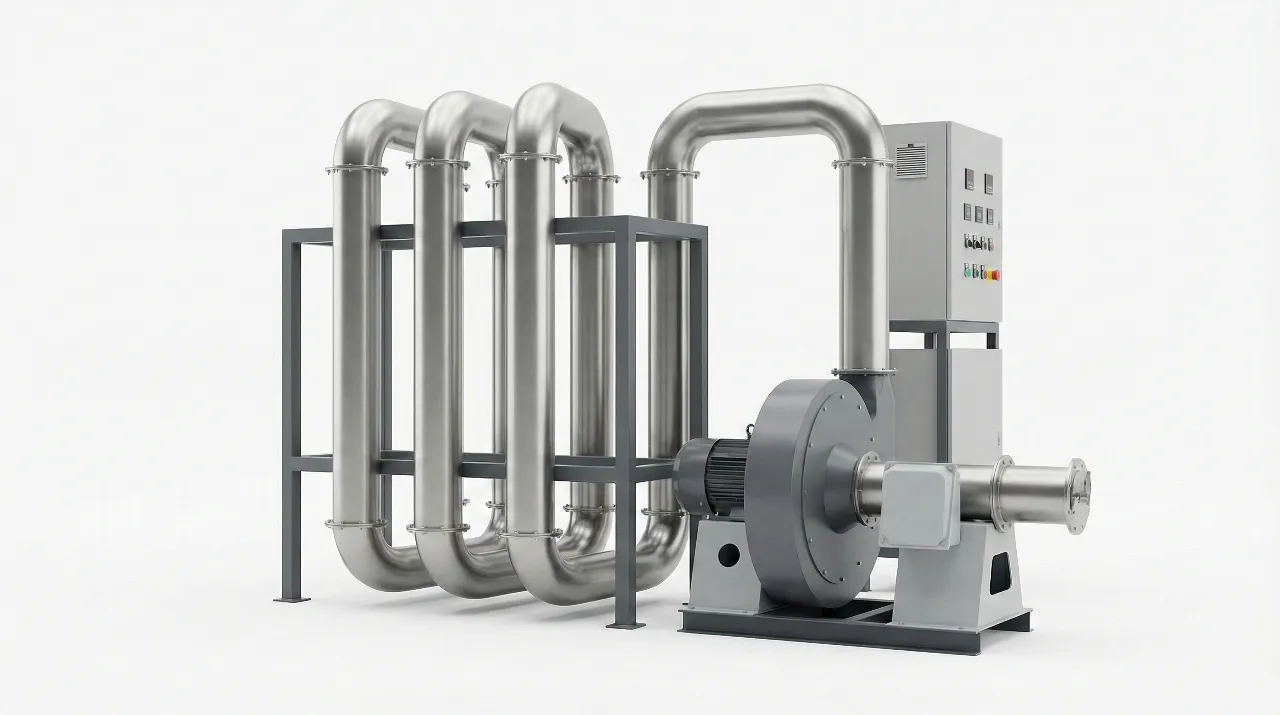
The centrifugal dryer sits after washing and before the thermal dryer. A standard wet line for film or flake runs in this order:
| Stage | Job | Typical outgoing moisture |
|---|---|---|
| Wash / friction wash | Strip dirt, glue, labels | Saturated (dripping) |
| Mechanical pre-dewatering (squeezer) | Squeeze bulk water from film | 8%–20% |
| Centrifugal dryer | Spin off free surface water | 1%–5% |
| Hot air / thermal dryer | Evaporate residual film moisture | under 1% (often under 0.5%) |
For thin film, recyclers often place a mechanical film squeezer ahead of the centrifuge to knock out the bulk water first, because film holds far more water per kilogram than rigid flake. For rigid flake (HDPE, PET, PP regrind), material usually goes straight from washing into the centrifugal dryer.
The rule is simple: every kilogram of water the centrifugal dryer removes is a kilogram the thermal dryer does not have to boil off with energy. Sizing the spin stage correctly is the cheapest way to cut your drying fuel bill.
How much water does a centrifugal dryer remove?
A centrifugal dryer typically brings washed plastic down to 1%–5% surface moisture, depending on the material:
- Rigid flake (HDPE, PET, PP): 1%–3% residual moisture is common straight off the centrifuge. PET flake in particular dewaters well because the chips are dense and non-absorbent.
- Film and fiber: 3%–8% is more realistic, because film traps water in folds and its high surface area holds moisture that force alone cannot reach.
Whether that is dry enough depends on what happens next. Direct extrusion and most flake sales tolerate a few percent moisture. Pelletizing and film blowing usually demand below 1%, which is the boundary where you add a thermal stage. The centrifugal dryer does the heavy lifting; the thermal dryer does the polishing. The full breakdown of which water each stage removes is in hot air dryer vs centrifugal dryer.
Sizing a centrifugal dryer: throughput and material
Match the dryer to your line rate and your material, not just to a headline kilogram-per-hour number. Two lines rated the same on paper behave differently depending on what they dry.
| Selection factor | What to check |
|---|---|
| Throughput | The centrifuge must match or slightly exceed your wash line rate (commonly 300–3,000 kg/h per unit). |
| Material type | Film needs lower rotor speed and wider screen slots; rigid flake handles higher speed for a drier result. |
| Flake size | Screen aperture must be smaller than your smallest flake to avoid losing good material as fines. |
| Rotor and screen wear | Abrasive streams (glass-filled, mineral-filled, dirty post-consumer) wear screens and blades faster — plan for wear parts. |
| Bulk density | Light, fluffy film fills the chamber faster than dense flake at the same mass, so volume, not just weight, sets the limit. |
A centrifuge that is undersized chokes the whole line; one that is oversized wastes capital and can shred fragile film. When the feed varies between film and rigid flake, recyclers often run a dedicated film centrifugal dryer tuned for the gentler, higher-moisture film stream rather than forcing one machine to do both jobs well.
Film versus rigid flake
The two material families ask for different setups:
- Film dewaters worse and tears easily, so it runs at lower rpm with a paddle angle that moves it through quickly. Expect higher outgoing moisture and a near-mandatory thermal stage downstream.
- Rigid flake tolerates higher speed and tighter screens, comes out drier, and sometimes skips thermal drying entirely if it is heading to direct extrusion.
Maintenance: what wears and what to watch
A centrifugal dryer is mechanically simple, but it runs wet and abrasive, so a few parts wear predictably:
- Screens are the first wear item. Abrasive or dirty feed thins and tears them; a worn screen drops drying performance and lets fines escape. Inspect on a fixed schedule.
- Rotor blades / paddles erode at the leading edge and lose conveying efficiency. Reversible or replaceable tips extend their life.
- Bearings and seals take constant load from the high-speed rotor. Watch for rising vibration or temperature as early failure signs.
- Vibration climbing over time usually means imbalance from blade wear, screen damage, or build-up — address it early rather than running to failure.
Keeping spare screens and blades on the shelf is the difference between a 30-minute swap and a half-day line stoppage. Build a wear-part schedule the same way you would for any high-rotation machine in the line.
Frequently Asked Questions
What is a centrifugal dryer used for in plastic recycling?
A centrifugal dryer removes free surface water from washed plastic flake or film using high-speed rotation instead of heat. It is the main dewatering stage on a wet recycling line, taking material from dripping-wet down to roughly 1%–5% moisture before any thermal drying.
What moisture level can a centrifugal dryer reach?
A centrifugal drying machine typically reaches 1%–3% residual moisture on rigid flake and 3%–8% on film. It cannot reliably reach below 1% because spinning removes free surface water but not the bound moisture film, which needs a heated dryer.
Do I need a thermal dryer after a centrifugal dryer?
You need a thermal dryer when your downstream process demands below 1% moisture — pelletizing and film blowing usually do. If you are selling washed flake or feeding direct extrusion, centrifugal drying alone is often enough. See hot air dryer vs centrifugal dryer for the moisture-by-stage breakdown.
Centrifugal dryer vs squeezer dryer — what is the difference?
A squeezer presses bulk water out of film with a compaction screw and is normally a pre-dewatering step. A centrifugal dryer spins off the remaining surface water and reaches a lower moisture level. On film lines they run in sequence: squeezer first, then centrifuge.
How fast does a centrifugal dryer spin?
Most vertical plastic centrifugal dryers run between 800 and 1,500 RPM, with rotor speed set to the material — lower for delicate film, higher for rigid flake that can take the force for a drier result.
How much does a centrifugal dryer cost to run?
Far less than any heated stage, because it removes water with electricity-driven motion rather than fuel. The main running costs are power for the rotor motor and periodic replacement of screens and blades.
Match the dryer to your material
A centrifugal dryer is the workhorse of the drying stage: it strips out the bulk of the water cheaply so any downstream thermal dryer has far less to do. The wins come from sizing it to your actual line rate and tuning it to your material — film and rigid flake are not the same job. Get the spin stage right and you cut both your moisture target and your energy bill.
If you are specifying a drying stage and want it matched to your washing line and material, send Rumtoo your throughput, material, and moisture target. We will recommend a centrifugal dryer — and tell you honestly whether you need a thermal stage after it. Contact our engineering team with your line details for a tested recommendation.
- centrifugal dryer
- centrifugal drying machine
- plastic dewatering
- plastic recycling drying
- washing line