
· Rumtoo Engineering Team · Buying Guides · 8 min read
Thermal Dryer for Plastic Recycling: When You Need One and How to Size It
A thermal dryer is the hot-air stage that takes washed flakes below the moisture floor a mechanical dryer cannot reach. This guide shows exactly when a recycling line needs one — and how to size it from your real inlet moisture, throughput, and final-moisture target instead of buying on a vague kilowatt number.
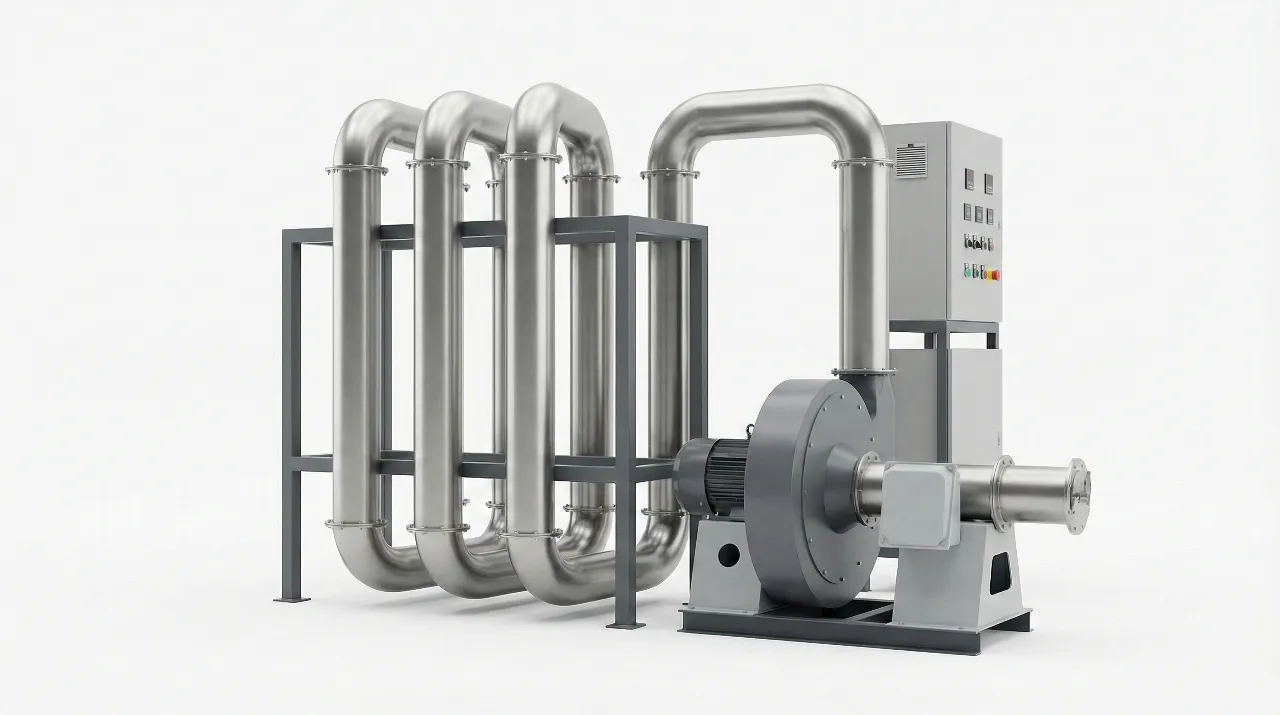
A thermal dryer for plastic recycling is the hot-air stage that evaporates the residual surface moisture a mechanical dryer physically cannot remove — taking washed flakes from the 1–2 % that a centrifugal dryer leaves down to the sub-0.5 % that food-grade and extrusion-grade output demands. The two questions buyers get wrong are whether they need one at all, and how to size it. Most quotes are written against a single kilowatt or kg/h number with no reference to the buyer’s actual moisture gap. This guide fixes both: how to decide if a thermal dryer belongs on your line, and how to size it from your real inlet moisture, throughput, and final-moisture target.
Do You Actually Need a Thermal Dryer?
You need a thermal dryer when your final-moisture target sits below the floor that mechanical dewatering can reach — and not before. A centrifugal dryer removes free and surface water mechanically; it bottoms out around 1–2 % on rigid flake. If your process is fine at that level, a thermal dryer adds capital cost and roughly triples your drying energy for moisture reduction you do not need.
Add a thermal dryer if any of these apply:
- Food-grade rPET — bottle-to-bottle and sheet lines need flakes below 0.5 % moisture going into extrusion or solid-state polycondensation, because residual water drives hydrolytic IV loss in the melt.
- Fine-gauge or moisture-sensitive extrusion — when splay, voids, foaming, or unstable melt pressure trace back to inlet moisture you cannot tune out at the extruder.
- High-spec dry flake sold as feedstock — buyers who write a guaranteed moisture ceiling into the purchase spec.
Skip it if you run rigid HDPE or PP flake straight to pelletizing, where 1–2 % is well inside a vented extruder’s window. For the full mechanical-versus-thermal trade-off, see our companion guide on hot air dryer vs centrifugal dryer.
Key takeaway: A thermal dryer is a polish, not primary dewatering. Specify it only to close the moisture gap your mechanical stage leaves open.
The Five Inputs You Must Define Before Sizing
Sizing fails when it starts from a machine model instead of your numbers. Before any supplier can size a thermal dryer correctly, you need five inputs defined:
- Material and form — rPET flake, HDPE/PP rigid flake, PP woven, or film. Surface area per kilogram changes how fast moisture leaves.
- Inlet moisture after dewatering — the real moisture leaving your centrifugal or squeezer discharge, measured, not assumed. This is the starting point of the whole calculation.
- Throughput in kg/h — the steady production rate the dryer must keep up with, not your line’s peak burst.
- Final-moisture target — the number your extruder, pelletizer, or buyer specifies, tied to a test method such as ASTM D6980.
- Utilities and layout — available power or gas, ambient conditions, and the physical space and duct routing for the dryer and its blower.
Get these five wrong and every downstream number is wrong. Get them right and sizing becomes arithmetic.
How to Size a Thermal Dryer, Step by Step
Sizing a thermal dryer means matching evaporative capacity to the water you actually need to remove per hour. Work through it in this order.
1. Calculate the Moisture Gap
The moisture gap is your inlet moisture minus your target moisture. A line running flake from 2 % down to 0.5 % has a 1.5-point gap. That gap, not the total throughput, is what the thermal stage has to work on — the mechanical dryer already handled everything above 2 %.
2. Convert the Gap into Evaporative Load
Multiply the moisture gap by throughput to get the water you must evaporate per hour. At 1,500 kg/h flake with a 1.5-point gap, that is 1,500 × 1.5 % = 22.5 kg of water per hour. This evaporative load — kilograms of water per hour — is the number a thermal dryer is genuinely sized around.
3. Size the Heat
Evaporating water has a fixed physical cost: roughly 0.63 kWh of energy per kilogram of water at the point of vaporization (the latent heat of water, about 2.26 MJ/kg). Removing 22.5 kg/h of water therefore needs around 14 kWh/h of pure evaporation energy — before adding the sensible heat to warm the flakes and the air, plus duct and surface losses. Real installed heat is higher because no dryer is perfectly efficient; in practice a thermal drying stage runs on the order of 165 kWh per ton of throughput. The point is that heat scales with the water removed, which is why the moisture gap matters more than the headline kg/h.
4. Size Airflow and Residence Time
Heat alone does not dry flakes — moving air does. The dryer needs enough hot-air volume and contact time for evaporated moisture to leave the flake surface and exit the system. As Plastics Today notes in its primer on dryer airflow, too little airflow starves the process and too much wastes energy without improving results. Residence time is the lever you tune against your hardest material: high surface-area film and food-grade rPET need longer contact than coarse rigid flake. Blower capacity and duct length get sized together with residence time, not after it.
5. Decide Single-Heater vs Multi-Heater Stages
A single-heater route handles a general sub-3 % to sub-1 % target on forgiving material. A multi-heater route — staged heating across a longer path — is what you specify when you need a stricter, more stable target such as food-grade rPET below 0.5 %, or when inlet moisture varies and you need margin to hold the spec. Staging also lets you ramp flake temperature gradually instead of shocking it, which matters for heat-sensitive polymers.
Worked Example: 1,500 kg/h Food-Grade rPET
Put the steps together for a realistic food-grade rPET line:
| Input | Value |
|---|---|
| Material | rPET flake (food-grade) |
| Throughput | 1,500 kg/h |
| Inlet moisture (after centrifugal) | 2 % |
| Target moisture | 0.5 % |
| Moisture gap | 1.5 points |
| Evaporative load | 22.5 kg water/h |
| Latent heat (evaporation only) | ~14 kWh/h |
| Indicative full-stage energy | ~165 kWh/t → ~250 kWh/h |
| Heater configuration | Multi-stage (sub-0.5 % target) |
The arithmetic tells you the shape of the machine — evaporative load, heat order of magnitude, and why a sub-0.5 % rPET target points to staged heating. It does not replace a supplier’s detailed design, which accounts for your exact flake geometry, ambient air, and duct layout. Treat these figures as a sanity check on any quote you receive.
Common Sizing Mistakes
Four mistakes show up again and again in thermal dryer specifications:
- Sizing on throughput, ignoring the moisture gap. A 3,000 kg/h line removing 0.3 points of moisture has a smaller evaporative load than a 1,500 kg/h line removing 1.5 points. Headline kg/h alone tells you nothing.
- Assuming inlet moisture instead of measuring it. Pull a sample off your real centrifugal discharge. A wrong inlet number throws off the entire heat and airflow calculation.
- Over-specifying for rigid flake. Buying a thermal dryer for HDPE or PP rigid flake that pelletizes fine at 1–2 % adds capital and triples drying energy for no quality gain.
- Under-specifying for food-grade rPET. A single-heater route that cannot hold sub-0.5 % under moisture swings produces hydrolysis defects and rejected lots — a far costlier failure than the energy bill.
Sizing Checklist: What to Send a Supplier
Send these data points and a supplier can size your thermal dryer on the first pass instead of guessing:
- Material type and flake form (rPET, HDPE/PP rigid, PP woven, film)
- Measured inlet moisture after your dewatering stage
- Required final-moisture target and its test method
- Steady throughput in kg/h
- Available utilities (electric, gas, thermal oil) and ambient conditions
- Current line layout, including the dewatering stage ahead of the dryer and any duct or blower placement constraints
Frequently Asked Questions
When do you need a thermal dryer in a plastic recycling line?
You need a thermal dryer when your final-moisture target is below the 1–2 % floor a mechanical centrifugal dryer can reach — typically food-grade rPET, fine-gauge extrusion, or flake sold against a guaranteed moisture ceiling. Rigid HDPE and PP headed to pelletizing usually do not need one.
How is a thermal dryer sized?
A thermal dryer is sized around evaporative load: the moisture gap (inlet minus target moisture) multiplied by throughput, which gives the kilograms of water to remove per hour. Heat, airflow, and residence time are then sized to evaporate that water for your specific material.
What moisture can a thermal dryer achieve?
A thermal dryer takes mechanically dewatered flake from roughly 1–2 % residual moisture down to below 0.5 %, which is the range food-grade rPET and moisture-sensitive extrusion require.
Does a thermal dryer replace a centrifugal dryer?
No. A centrifugal dryer does the bulk mechanical dewatering first; the thermal dryer polishes the residual moisture afterward. They run in sequence. See hot air dryer vs centrifugal dryer for the full comparison.
How much energy does a thermal dryer use?
A thermal drying stage runs on the order of 165 kWh per ton of throughput — roughly three times a centrifugal dryer — because evaporating water costs far more energy than removing it mechanically. Size the stage to your moisture gap so you spend that energy only where it is needed.
Summary and Next Steps
A thermal dryer earns its place on a recycling line only when your moisture target drops below what mechanical dewatering can deliver — and once it does, size it from your numbers, not a catalog. Define your five inputs, calculate the moisture gap, convert it to evaporative load, then size heat, airflow, and residence time around that load. Rigid flake at 1–2 % rarely needs the stage; food-grade rPET at sub-0.5 % almost always does, usually with staged heating.
Send Rumtoo your material, measured inlet moisture, throughput, and final-moisture target, and we will tell you whether a thermal dryer is justified and how it should be configured. Start from our hot air dryer / thermal dryer page, or review the film dewatering decision if your line runs PE or PP film.
- thermal dryer for plastic recycling
- thermal dryer sizing
- hot air dryer
- residual moisture control
- plastic recycling drying