
· Rumtoo Engineering Team · Buying Guides · 7 min read
Hydraulic Guillotine Cutter Price Guide: What $5,000–35,000 Buys in 2026
New hydraulic guillotine cutters cost $5,000–35,000 depending on cutting force, blade width, and automation. This guide breaks the price down by size class, lists the costs quotes leave out, compares new against used, and shows how to size the machine so you pay for tonnage you actually need.
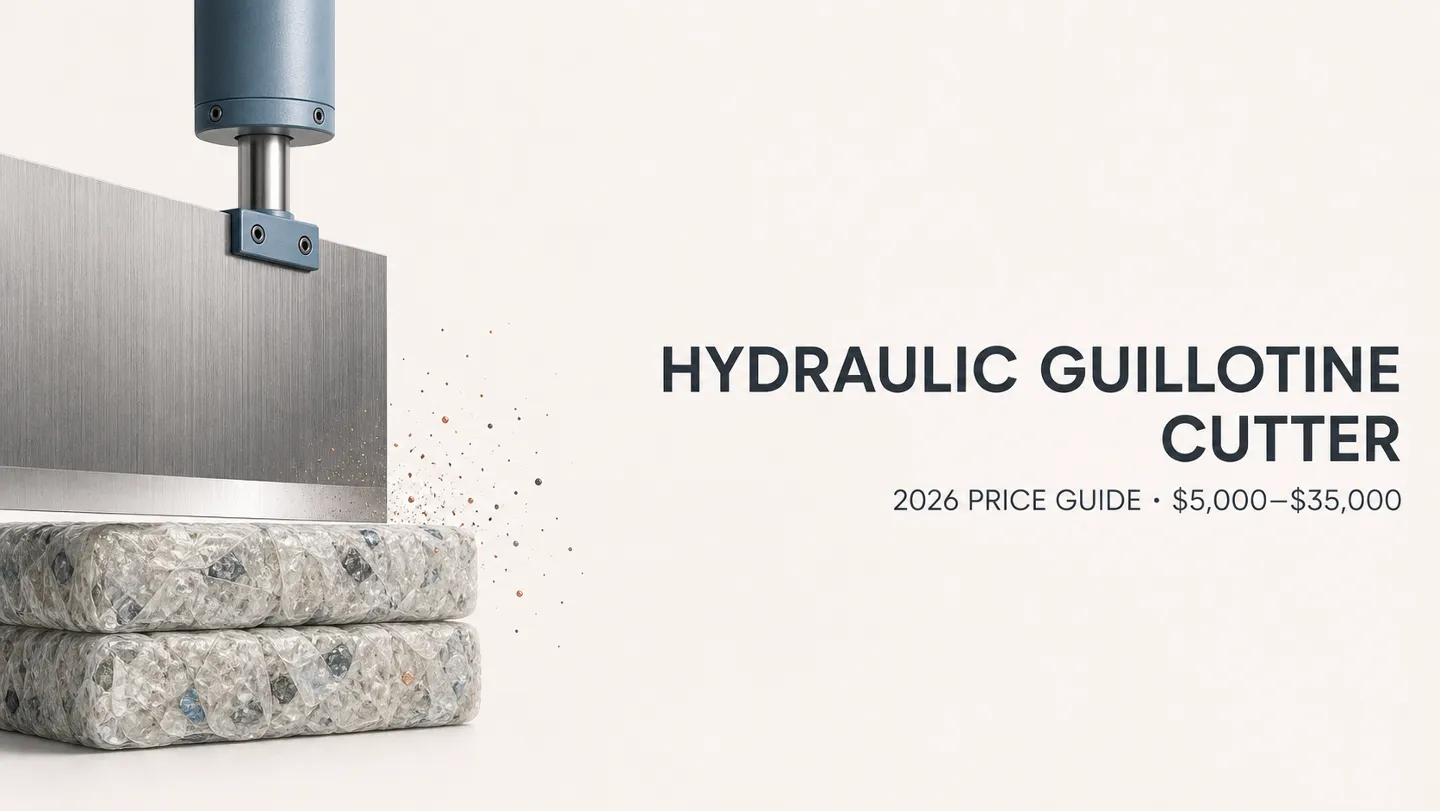
A new hydraulic guillotine cutter costs $5,000 to $35,000 in 2026. Cutting force sets the base price — a 40 t machine for film bales starts near $5,000, while a 160 t machine with a 1,600 mm blade and automatic pusher reaches $35,000. Blade width, clamp design, and feed automation move the number within each tonnage class.
Almost no manufacturer publishes these figures; the standard answer is “send an inquiry.” We price these machines for recycling lines weekly, so here is the breakdown buyers usually have to collect one quote at a time.
Hydraulic guillotine cutter price by size
| Cutting force | Blade width | Motor | Typical price (new) | Typical feed |
|---|---|---|---|---|
| 40 t | 400–600 mm | 5.5 kW | $5,000–9,000 | Film, raffia, woven bag bales |
| 63 t | 700–1,000 mm | 7.5 kW | $8,000–14,000 | PET bottle bales, small purge lumps |
| 100 t | 1,000–1,300 mm | 11–15 kW | $13,000–22,000 | PE/PP purge, dense mixed bales |
| 125–160 t | 1,300–1,600 mm | 15–22 kW | $20,000–35,000 | Nylon purge, full-width film and carpet rolls |
Prices are ex-works for machines with two-hand controls, interlocked guarding, and a hydraulic clamp — the safety configuration OSHA machine-guarding rules effectively require for point-of-operation hazards. Treat a quote far below these ranges as a prompt to ask what was removed.
Key takeaway: Tonnage sets the floor, automation sets the ceiling. The spread inside each class is mostly feed table, pusher, and control options — not the cutting mechanism itself.
The five factors that set the price
- Cutting force. Cylinder bore, pump size, and frame steel all scale with tonnage. The step from 63 t to 100 t adds roughly 40–60% to the base machine.
- Blade width. A wider jaw means a longer blade, a wider frame, and more steel under stress. Width follows your largest piece — the specification tables show how force and width pair by class.
- Feed automation. A manual positioning stop is cheapest. A hydraulic pusher with thickness presets adds $2,000–5,000 and lets one operator run the machine continuously alongside the line.
- Clamp and controls. An independent clamp circuit, PLC cycle control, and stroke-length adjustment add cost and are worth it on strapped bales, which store spring energy.
- Blade steel. Standard tool steel handles plastics and textiles. Upgraded grades for abrasive or engineering-resin feed add a few hundred dollars and double edge life between resharpenings.
Costs the quote leaves out
Budget beyond the ex-works number:
- Freight and rigging. A 100 t guillotine weighs 3–6 tonnes; ocean freight plus inland delivery and offloading typically runs $1,500–4,000 depending on destination.
- Voltage and installation. Confirm the power pack matches your supply (380/415/440 V, 50 or 60 Hz) at order time — a conversion after delivery costs far more than at the factory. Foundations are simple: most machines sit on a flat slab, no special pad.
- Spare blade. Order one with the machine ($300–800). Swapping to the spare while the first is resharpened means the cutter never waits on a grinding shop.
- Commissioning. Straightforward on a guillotine; many buyers self-install with a manual and a video call. Factor on-site commissioning only for automated lines — see our commissioning services.
Together these add roughly 10–20% to the machine price — modest against the 30–50% installation adders common on shredders and washing lines.
New vs used guillotine cutter
Used guillotines list between $3,000 and $15,000 on dealer platforms such as Surplus Record, and the machine’s simplicity works in a used buyer’s favor — a frame, a cylinder, and a blade leave little to hide. Check three things: cylinder seals (the common wear point), frame cracks at the blade guides, and whether the safety circuit — two-hand start, interlocked guard, clamp-before-stroke — is intact and functional. A used machine missing modern guarding is not a bargain; retrofitting compliant controls can cost more than the price difference to new.
Buy new when you need a specific blade width, a pusher, or warranty coverage on the hydraulic pack; buy used when a standard small machine for occasional bale work is all the duty cycle demands.
Pay for the tonnage you need — and not more
The selection method is the same one in our plastic bale cutter guide, applied to price:
- Size force to your densest feed, not your average. Film bales cut at 40–63 t; a nylon purge cake needs 100 t or more. If engineering resins ever appear, buying the 63 t machine means hand-cutting exactly the pieces you bought the machine to eliminate.
- Size width to your largest piece. The jaw must clear your biggest bale or roll. Oversizing width “for the future” is the main way buyers drift from a $9,000 machine to a $22,000 one without added benefit.
- Skip automation below ~20 cuts per day. A manual stop and a forklift driver handle occasional bale work. The pusher pays for itself when the guillotine feeds a line continuously.
A worked example: a film recycling line receiving 450 kg strapped LDPE bales needs 40–63 t of force and about a 1,000 mm jaw — a $10,000–14,000 machine. The same buyer quoted a 160 t, 1,600 mm machine “to be safe” would pay more than double for force the feed never uses.
When the machine pays for itself
The guillotine’s return comes out of the shredder’s maintenance budget. Three numbers we see across commissioned lines:
- A cracked shredder knife set from bale shock-loading costs $1,500–8,000 to replace, plus a day of downtime.
- A rotor-wrap event on rolled film costs 2–6 hours of manual clearing each time it happens.
- Manual bale breakdown with saws runs 15–30 minutes per bale against a 1–2 minute guillotine cycle, and carries the injury risk that two-hand controls exist to remove.
At even two or three bales per day, a $10,000 guillotine typically returns its cost within the first year through avoided knife damage and recovered throughput. The comparison logic is laid out in guillotine cutter vs shredder.
What to send with your RFQ
Five items get you an accurate quote in one round instead of four:
- Material type(s), including the densest resin that ever appears in the feed
- Dimensions and weight of your largest bale, lump, or roll
- Bales, lumps, or rolls per day, and target cycle rhythm
- Feed opening size of the downstream shredder (sets slice thickness)
- Plant voltage and frequency
Send those to any manufacturer — including Rumtoo’s pricing desk — and the quote you get back is comparable machine-for-machine.
Frequently Asked Questions
How much does a hydraulic guillotine cutter cost?
New machines run $5,000–35,000. A 40 t cutter for film bales starts near $5,000; 63 t machines for PET bales run $8,000–14,000; 100 t machines for purge run $13,000–22,000; and 125–160 t machines with wide blades and automatic pushers reach $35,000.
Why do guillotine cutter prices vary so much?
Cutting force sets the base cost through cylinder, pump, and frame size. Within each tonnage class, blade width, hydraulic pusher, PLC controls, and blade steel grade account for the spread. A 63 t machine spans $8,000 manual to $14,000 fully optioned.
Is a used guillotine cutter worth buying?
Often, at $3,000–15,000, because the machine is mechanically simple. Inspect cylinder seals, frame cracks at the blade guides, and the safety circuit. If two-hand controls and interlocked guarding are missing, retrofit cost can erase the saving over new.
What does it cost to run a hydraulic guillotine cutter?
Little. The 5.5–22 kW motor runs on a duty cycle, not continuously; the single blade resharpens in an ordinary workshop for a fraction of a shredder knife set; and routine upkeep is hydraulic oil, filters, and seals. Most operators budget a few hundred dollars per year.
How long does delivery take?
Standard-width machines typically ship in 4–8 weeks from order; custom blade widths or automated feed systems add 2–4 weeks. Confirm voltage and safety-standard requirements at order time to avoid changes that reset the schedule.
Price the feed, then the machine
Every number in this guide traces back to two measurements: how dense your worst material is, and how big your largest piece is. Get those two right and the price range narrows from $5,000–35,000 to a bracket a few thousand dollars wide.
Send Rumtoo the five RFQ items above and we will quote a hydraulic guillotine cutter sized to your feed — and flag it honestly if a smaller class, a used machine, or no guillotine at all serves you better. Contact our engineering team to start.
- hydraulic guillotine cutter price
- bale cutter cost
- guillotine cutting machine
- recycling equipment buyer guide
- plastic recycling