
· Rumtoo Engineering Team · Technical Guide · 7 min read
Guillotine Cutter vs Shredder for Plastic Recycling: Which Do You Need?
A guillotine cutter slices bales, purge, and rolls into blocks; a shredder reduces blocks into flake. This guide compares the two machines on cutting action, feed type, throughput, cost, and maintenance — and gives you a four-question framework to decide whether you need one, the other, or both.
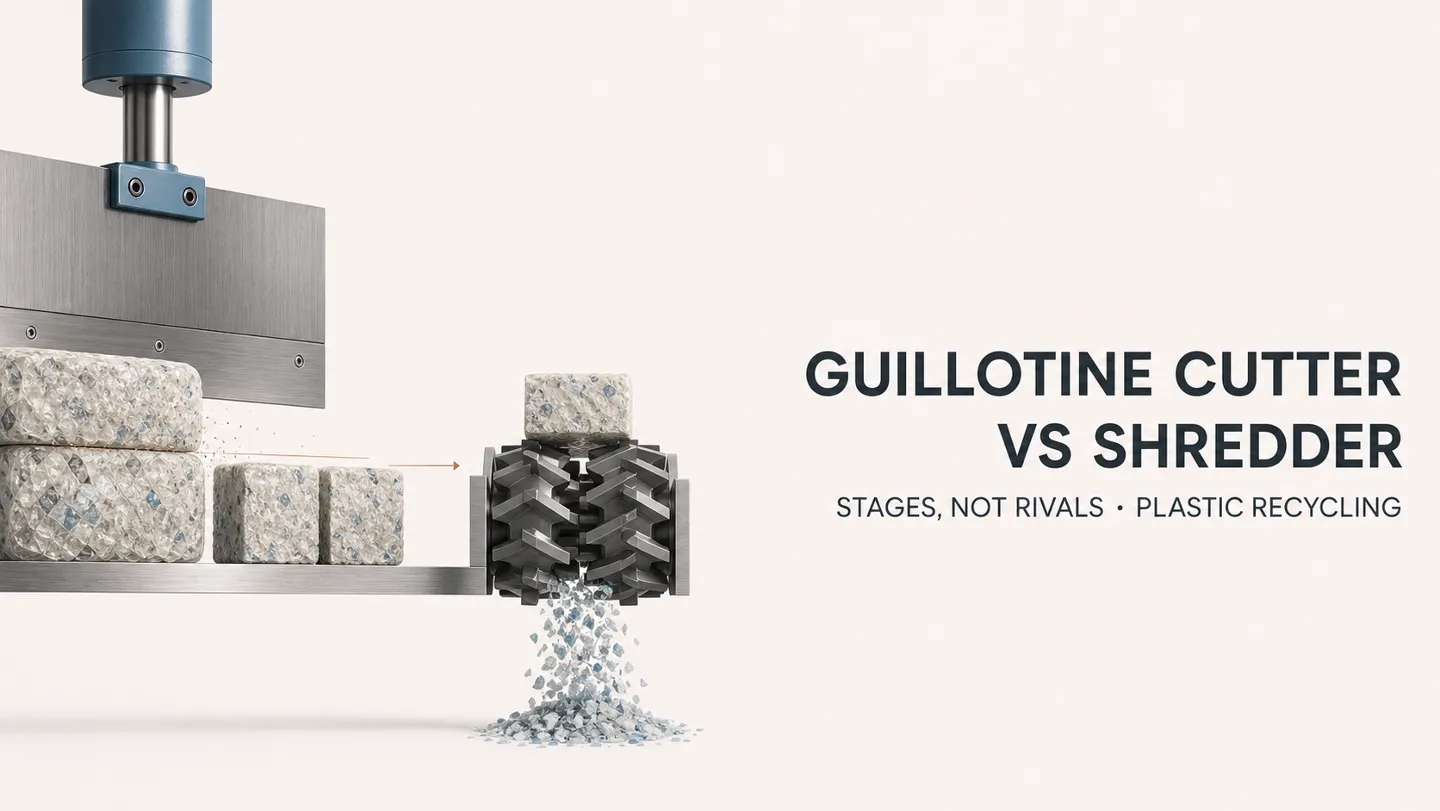
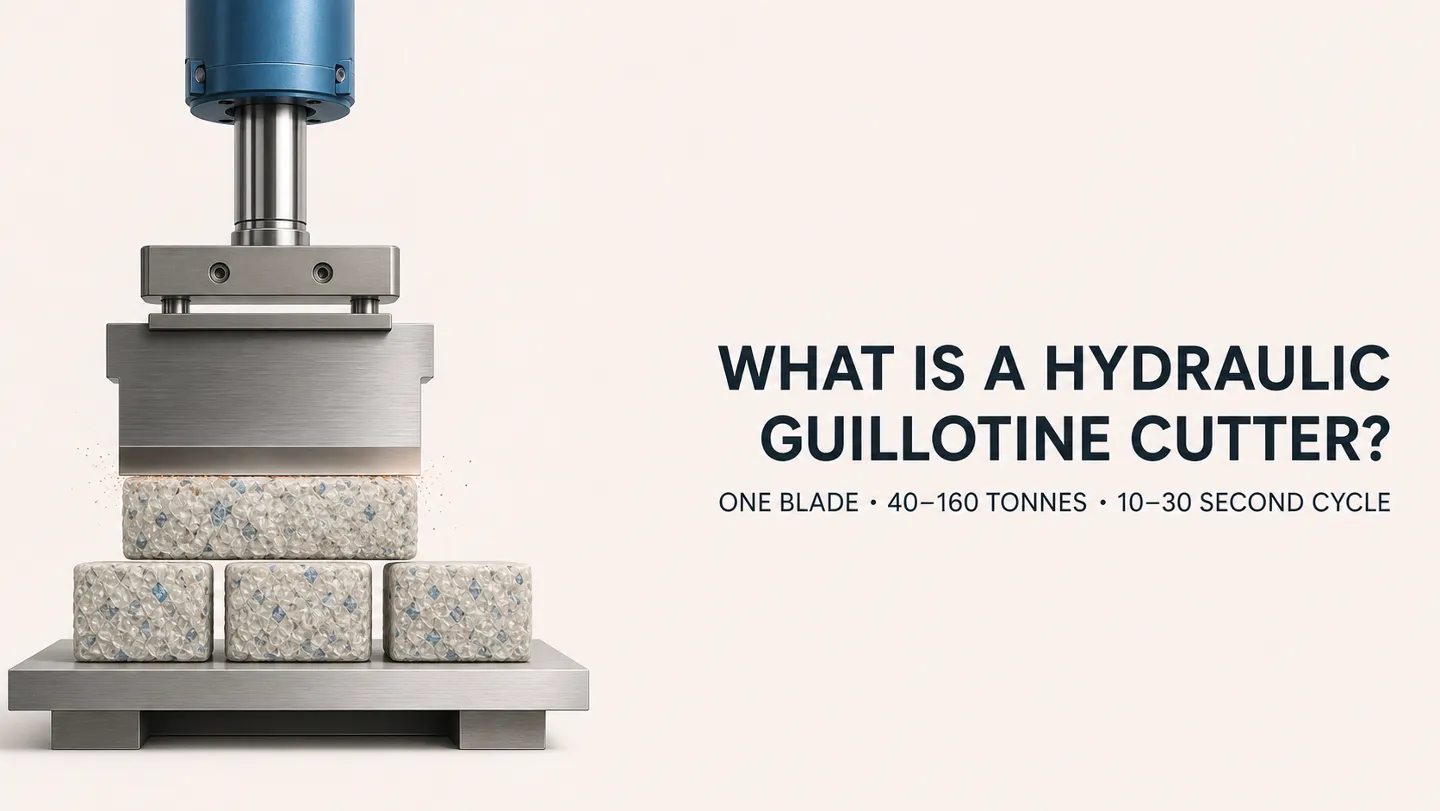
A guillotine cutter and a shredder are not competing machines — they are consecutive stages. The guillotine slices oversized or compressed feed into uniform blocks with a single hydraulic blade; the shredder reduces those blocks into flake or strips with a rotating cutter shaft. The real question is never “which is better” but “does my feed need the first stage before the second.”
We field this question weekly at the RFQ stage, usually from a buyer who has been quoted an oversized shredder to swallow whole bales. This guide gives you the comparison in one table, the engineering reason behind it, and a four-question framework to make the call for your own line.
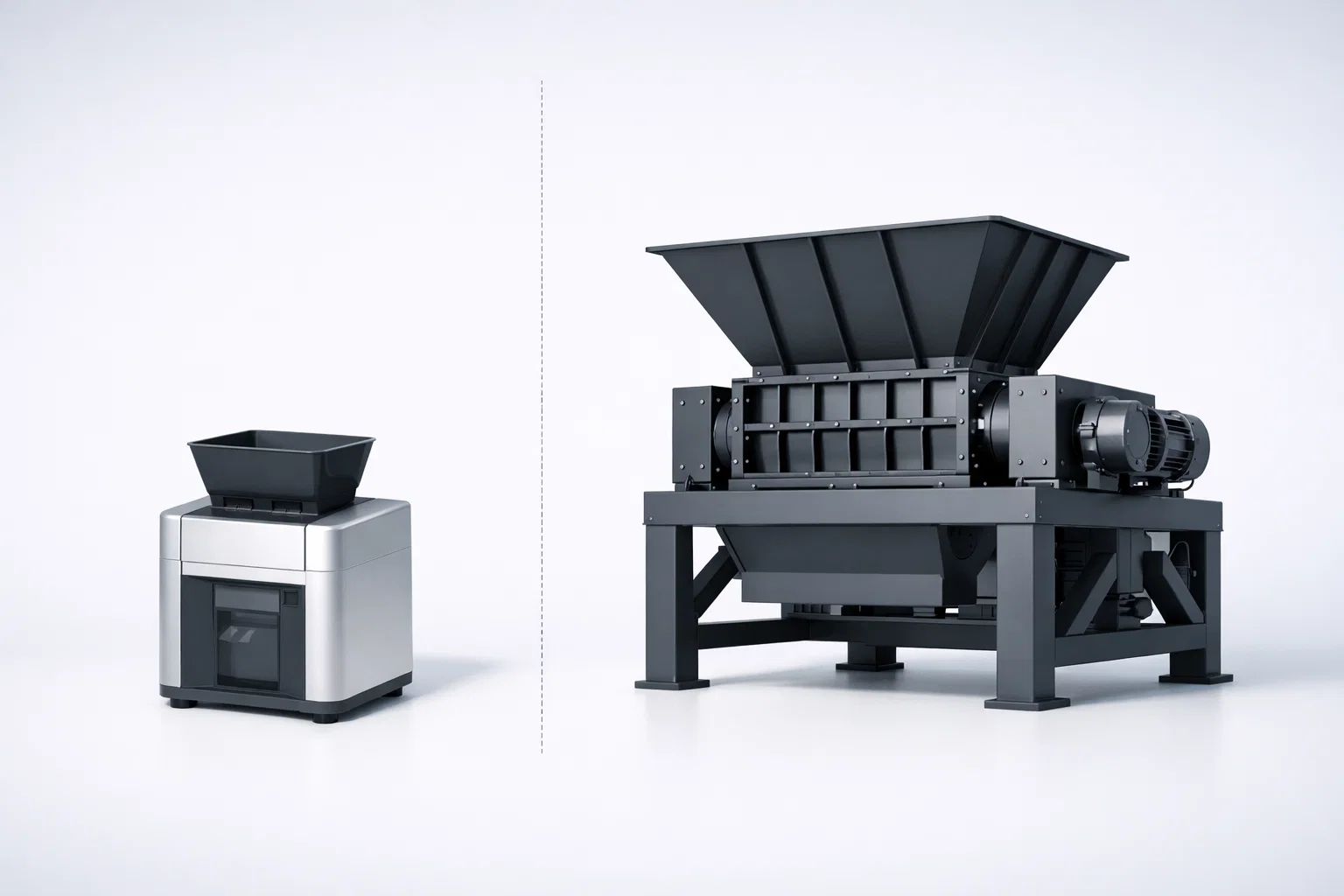
Guillotine cutter vs shredder at a glance
| Guillotine cutter | Shredder | |
|---|---|---|
| Cutting action | Single wide blade, downward hydraulic stroke | Rotating shaft with knives against a screen |
| Cutting principle | Concentrated force on one line | Grip, then tear and shear |
| Input | Bales, purge lumps, rolls, long pipe | Loose material smaller than the feed opening |
| Output | Uniform blocks, 100–400 mm | Strips or flake, 20–100 mm |
| Operation | Cyclic, 10–30 s per cut | Continuous, 300–3,000+ kg/h |
| Drive power | 5.5–22 kW hydraulic pack | 15–90 kW main drive |
| Wear parts | One resharpenable blade | Dozens of rotor and bed knives |
| Typical price | $5,000–35,000 | $15,000–150,000 |
| Role in the line | Pre-cutting stage | Primary size reduction |
Key takeaway: A guillotine makes big things feedable. A shredder makes feedable things small. Neither machine can do the other’s job.
Why the cutting principle decides everything
A shredder must grip material to cut it. The rotor knives bite, pull the material against the bed knife, and shear it. That works superbly on loose rigid scrap, pipe off-cuts, and pallet-fed regrind work — and it fails on exactly three feed types:
- A compressed bale presents a dense strapped mass. The rotor either surges under the shock load or the bale bridges over the hopper without engaging at all.
- A purge lump is too dense and too smooth. Knives skate on the surface, amp draw spikes, and the overload trips.
- A roll feeds a continuous web that wraps the rotor — often hours of manual clearing per event.
A guillotine cutter needs no grip. The blade goes through whatever sits under it because 40–160 tonnes of force on a single line exceeds the shear strength of any plastic, rubber, or textile mass in its jaw. The mechanics are covered step by step in what is a hydraulic guillotine cutter.
The inverse also holds. A guillotine produces blocks, never flake. Washing lines, pelletizers, and extruders need material in the 20–100 mm range, and only a rotor machine with a sizing screen delivers that.
When a guillotine cutter is the right machine
Put a guillotine in the line when feed arrives compressed, dense, or continuous:
- Film, raffia, woven bag, or PET bottle bales — sliced into blocks on 40–63 t machines
- PE/PP purge lumps (63–100 t) and nylon or engineering-resin purge cakes (100 t and up)
- Film, nonwoven, and carpet rolls cut crosswise so no continuous web reaches the rotor
- Bundled pipe and profiles longer than the shredder hopper, cut to length in seconds
Feed-by-feed force requirements are tabulated in our plastic bale cutter guide.
When a shredder is the right machine
Send material straight to the shredder when it arrives loose and smaller than the feed opening: injection molding scrap, blow-molded parts, drums and crates, pipe off-cuts under hopper length, and post-consumer rigids. A hydraulic drawer single-shaft shredder with a sizing screen turns that feed directly into uniform flake for washing or pelletizing — no pre-cutting stage adds anything but cost.
Shredder selection — rotor style, screen size, drive power — is its own decision; our industrial plastic shredder guide walks through it.
When you need both
Any line that receives baled or rolled feed and must output flake needs both machines in sequence:
- Guillotine slices bales or rolls into blocks sized to the shredder opening
- Shredder reduces blocks to screened flake at stable load
- Washing, drying, and pelletizing run downstream on consistent input
The pairing beats the common alternative — one oversized shredder specified to swallow whole bales — on both money and uptime. A 63 t guillotine plus a correctly sized shredder typically costs less than the oversized shredder alone, and the shredder runs at flat amp draw instead of surge-trip-restart. Lines we have commissioned with pre-cutting report higher stable hourly rates despite the added step, because the shredder never leaves its efficient load band.
Cost comparison: purchase and operation
| Cost item | Guillotine cutter | Shredder |
|---|---|---|
| Purchase price | $5,000–35,000 | $15,000–150,000 |
| Blade/knife cost per set | One straight blade, workshop-resharpenable | Dozens of knives, $1,500–8,000 per set |
| Energy draw | 5.5–22 kW, duty-cycle only | 15–90 kW continuous |
| Typical failure cost | Seal or blade edge — routine | Cracked knives, rotor or gearbox damage from shock loads |
The guillotine’s economic case is defensive: it takes the first hit so the expensive machine never does. One set of shredder knives plus one unplanned downtime day usually exceeds the annual operating cost of the guillotine that would have prevented both. Full price breakdowns by size class are in the hydraulic guillotine cutter price guide.
The decision in four questions
- Does any feed arrive as bales, rolls, or purge lumps? No → shredder only. Yes → continue.
- Is that feed more than ~10–15% of volume? Below that, manual breakdown of rare oversize pieces may be tolerable; above it, the guillotine earns its slot.
- What is the densest material you will ever cut? That sets guillotine tonnage — 40–63 t for film and PET bales, 63–100 t for polyolefin purge, 100 t+ for engineering resins and full rolls.
- What does the next machine need? Slice thickness is set to the shredder’s feed opening; shredder screen size is set to what washing or pelletizing needs.
Answer those four and the machine list writes itself.
Frequently Asked Questions
Can a shredder process bales without a guillotine cutter?
Not reliably. A compressed bale surges the rotor, bridges the hopper, and shock-loads the knives and gearbox. Some operators break bales manually instead, but at more than a few bales per day a guillotine is faster, safer, and cheaper than the blade damage it prevents.
Can a guillotine cutter replace a shredder?
No. A guillotine outputs blocks of 100–400 mm, never flake. Washing lines and pelletizers need 20–100 mm material, which only a rotor machine with a sizing screen produces. The guillotine is a pre-cutting stage, not a substitute.
Which is cheaper, a guillotine cutter or a shredder?
The guillotine, in both purchase and upkeep. New guillotines run $5,000–35,000 against $15,000–150,000 for industrial shredders, and the guillotine’s single resharpenable blade costs a fraction of a shredder knife set to maintain.
What order do the machines go in a recycling line?
Guillotine first, shredder second. The guillotine slices bales, purge, or rolls into blocks matched to the shredder’s feed opening; the shredder reduces the blocks to screened flake for washing, drying, and pelletizing.
Do film recycling lines need a guillotine or a cutter-compactor?
Different jobs again. A guillotine pre-cuts baled or rolled film so it can be fed at all; a cutter-compactor densifies loose film for extrusion. Lines receiving baled film often use both — guillotine ahead of the shredder, densification ahead of the extruder.
Stages, not rivals
Feed that arrives compressed, dense, or continuous needs a guillotine. Material that must leave as flake needs a shredder. When both conditions hold — and on most post-consumer lines they do — the machines work in sequence, and the modest guillotine protects the expensive shredder every cycle.
Tell Rumtoo what your feed looks like on arrival and what the next machine needs, and we will configure the hydraulic guillotine cutter, the shredder, or the pair — sized to your material, not to a catalog. Contact our engineering team to run your numbers.
- guillotine cutter vs shredder
- plastic shredder
- bale cutter
- plastic recycling equipment
- equipment selection