
· Rumtoo Engineering Team · Technical Guide · 7 min read
What Is a Hydraulic Guillotine Cutter? How It Works, Specs, and Uses
A hydraulic guillotine cutter drives a single wide blade through compressed bales, purge lumps, and rolls with 40–160 tonnes of force. This guide explains the cutting cycle, the five components that determine machine quality, typical specifications by size class, and the feeds it handles that shredders cannot.
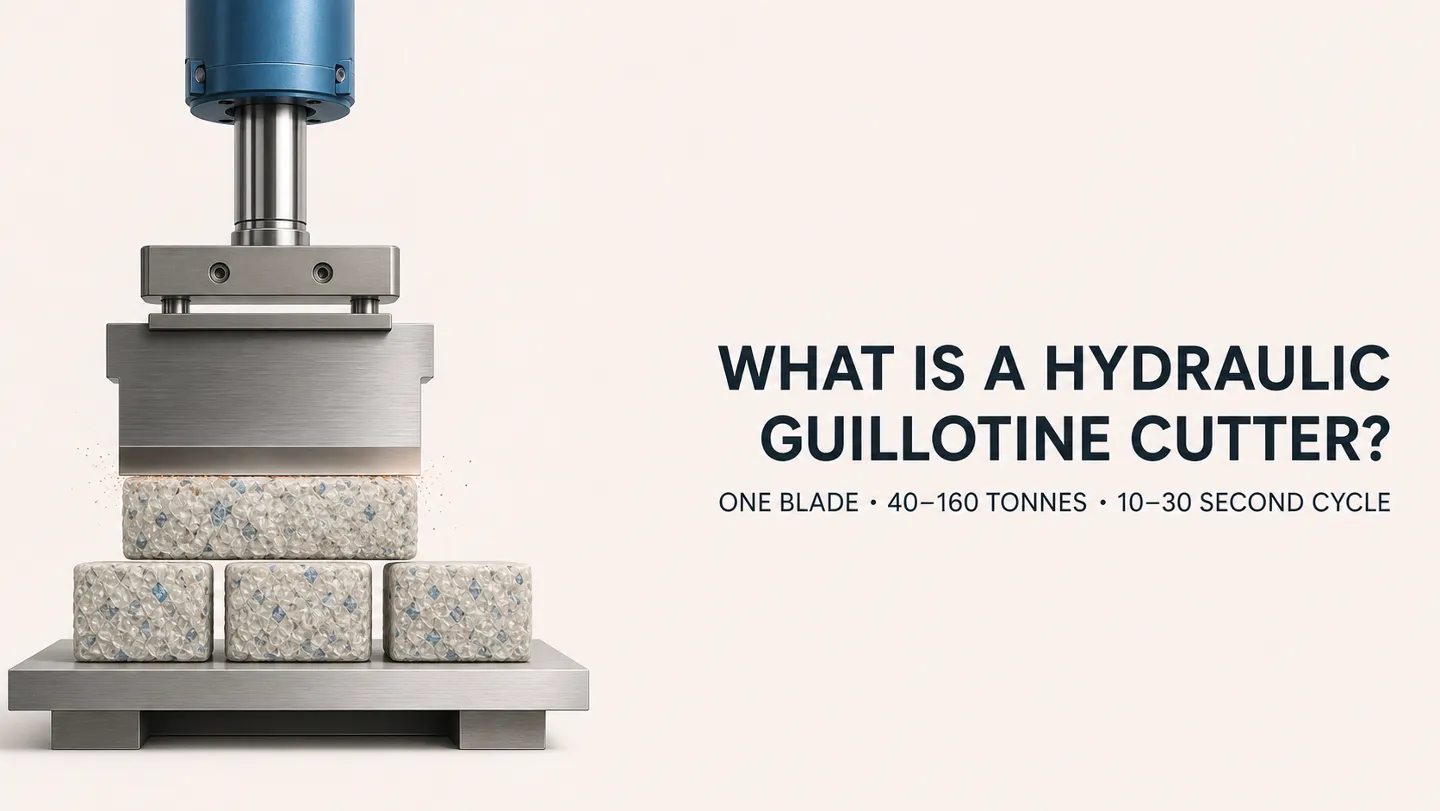
A hydraulic guillotine cutter is an industrial machine that drives a single wide blade straight down through material with 40 to 160 tonnes of hydraulic force. Recycling plants use it to slice compressed bales, extruder purge lumps, film rolls, and long pipe into uniform blocks that a shredder or washing line can accept. It cuts by concentrated force on one line — not by gripping and tearing — which is exactly why it handles the feeds that stall every other size-reduction machine.
This guide covers how the machine works, the components that separate a reliable cutter from a cheap one, and the specifications that matter when you compare models.
What does a hydraulic guillotine cutter do?
The machine does one job: it converts oversized or over-dense material into blocks of a set size. In a plastic recycling line it sits ahead of the industrial shredder as a pre-cutting stage, and the three feeds it exists for are the three that damage shredders most:
- Compressed bales — film, raffia, woven bag, and PET bottle bales arrive strapped at densities a shredder rotor cannot bite into. The guillotine slices them into feedable blocks.
- Purge lumps and cakes — solidified PE, PP, PA, and ABS from extruder start-ups are too smooth and dense for teeth to grip. The blade drives straight through them.
- Rolls and continuous webs — film, nonwoven, and carpet rolls wrap around a shredder rotor. Cut crosswise into segments, the wrapping failure mode disappears.
The same machine cuts bundled pipe and profiles to hopper length, and portions rubber and textile bales where those run alongside plastic feed. For a feed-by-feed breakdown of when pre-cutting pays for itself, see our plastic bale cutter guide.
Key takeaway: A hydraulic guillotine cutter is a pre-cutting machine. It does not produce flake or regrind — it produces uniform blocks sized for the machine that does.
How a hydraulic guillotine cutter works
The cutting cycle has four steps, and a full cycle takes 10–30 seconds depending on material and stroke length:
- Load and position. A forklift or conveyor places the bale, lump, or roll on the feed table. A positioning stop or pusher sets the slice thickness, so every block comes out the same size.
- Clamp. A hydraulic hold-down presses the material against the table before the blade moves. Compressed bales store spring energy; the clamp keeps the bale from shifting or bursting open mid-cut.
- Cut. The main cylinder drives the blade down at controlled speed. The blade cuts the full width of the material in one stroke — a compressed film bale takes seconds.
- Index and repeat. The blade retracts, the pusher advances the material one slice thickness, and the cycle repeats. A standard bale cut into five blocks takes one to two minutes.
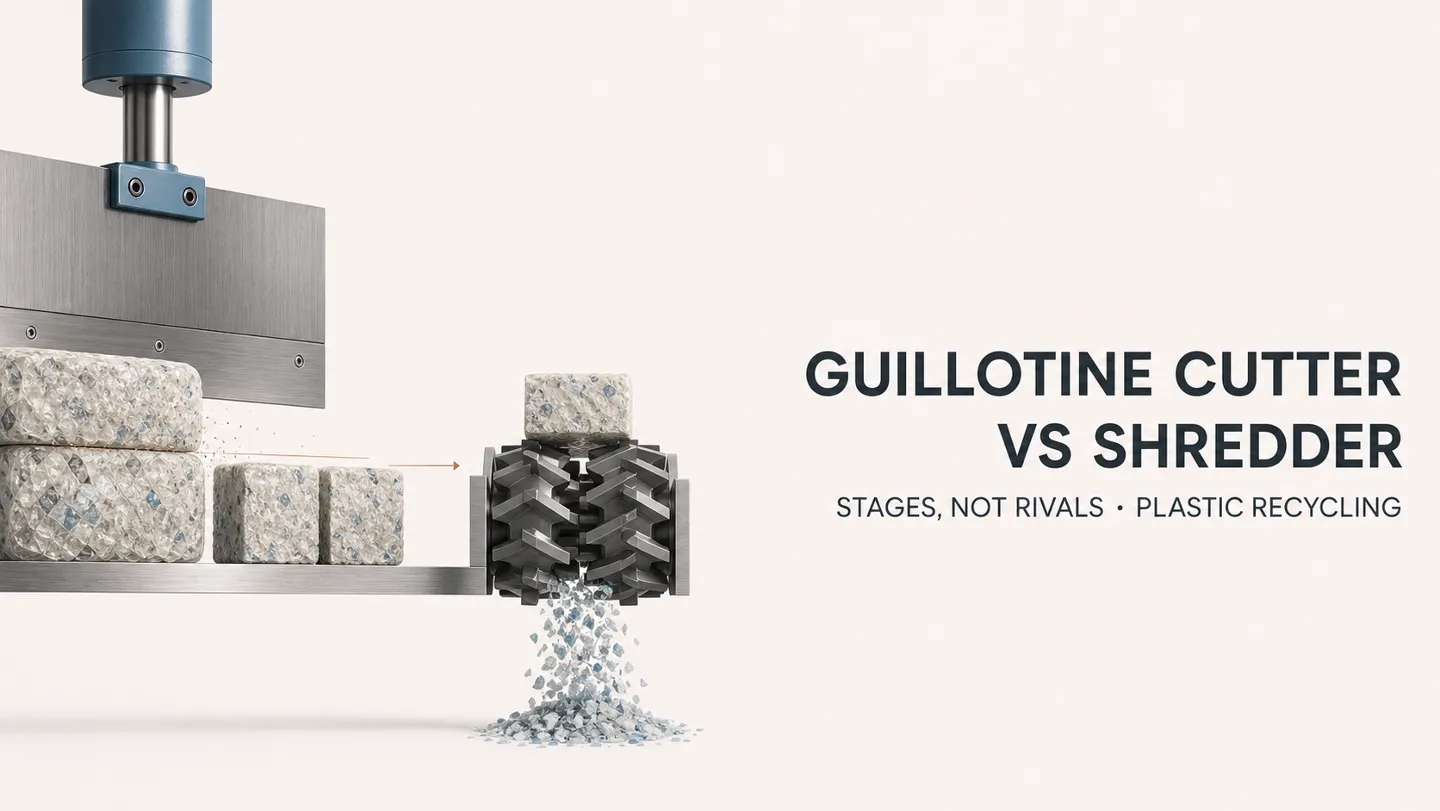
Because force does the cutting, the machine does not care whether the material is slippery, compressed, or abrasive on the surface. That indifference to feed condition is the core engineering difference between a guillotine and every rotor-based machine — we compare the two directly in guillotine cutter vs shredder.
The five components that determine machine quality
Two guillotines with the same tonnage rating can behave very differently in service. These five components are where the difference lives:
| Component | What it does | What to check |
|---|---|---|
| Frame | Absorbs the full cutting force every stroke | Plate thickness and weld quality; a light frame flexes and ruins cut accuracy |
| Hydraulic cylinder and power pack | Generates the 40–160 t cutting force | Cylinder bore, seal brand, motor size (typically 5.5–22 kW) |
| Blade | The single wear part in the cutting path | Tool-steel grade, resharpening allowance, change time |
| Clamp (hold-down) | Secures material before the stroke | Independent hydraulic circuit; must engage before the blade can move |
| Feed table and pusher | Sets slice thickness and cycle rhythm | Manual stop vs hydraulic pusher; a pusher lets one operator run continuously |
The blade deserves the closest look. A guillotine has one straight blade — resharpenable in an ordinary workshop — where a shredder carries dozens of rotor knives. That single-blade design is why guillotine maintenance costs stay flat even on abrasive feed.
Typical hydraulic guillotine cutter specifications
Cutting force and blade width scale together. The table below shows the ranges most plastic recycling installations fall into:
| Size class | Cutting force | Blade width | Motor power | Typical feed |
|---|---|---|---|---|
| Small | 40–63 t | 400–700 mm | 5.5–7.5 kW | Film and raffia bales, small purge |
| Mid | 63–100 t | 800–1,300 mm | 7.5–15 kW | PET bottle bales, PE/PP purge lumps |
| Large | 100–160 t | 1,300–1,600 mm | 15–22 kW | Nylon purge, full-width film and carpet rolls |
Two sizing rules from machines we have specified in practice: size the tonnage to the densest material you will ever cut, not the average — a nylon purge cake needs far more force than a PE lump of the same size — and size the blade width to your largest piece, because anything wider than the jaw goes back to being cut by hand. Model-by-model configurations are on our hydraulic guillotine cutter equipment page, and pricing by size class is covered in the hydraulic guillotine cutter price guide.
What a guillotine cutter cannot do
Knowing the limits saves a wrong purchase:
- It does not make flake. Output is blocks, typically 100–400 mm thick. A shredder or granulator downstream does the actual size reduction to processable regrind.
- It is not continuous. Throughput comes in cycles, not a steady stream. For loose material already smaller than a shredder opening, a guillotine adds a step and no value.
- It does not sort or clean. Metal straps and contamination pass through the cut; debaling and separation happen elsewhere in the line.
If your feed arrives loose and appropriately sized, skip the guillotine and go straight to a correctly sized shredder — our industrial plastic shredder guide covers that selection.
Safety features on a modern guillotine cutter
A machine that drives a blade with 100 tonnes of force is built around keeping hands away from it. A properly specified cutter includes two-hand start controls, an interlocked guard over the cutting zone, and a clamp circuit that must engage before the stroke can begin. These mirror the machine-guarding requirements OSHA sets for point-of-operation hazards, and they replace the genuinely dangerous alternative: operators breaking down bales and purge with chainsaws and torches.
Frequently Asked Questions
What is a hydraulic guillotine cutter used for?
A hydraulic guillotine cutter pre-cuts oversized or over-dense material for recycling lines. It slices compressed plastic bales, extruder purge lumps, film and carpet rolls, and long pipe into uniform blocks with 40–160 tonnes of blade force, so a downstream shredder receives feed it can process at stable load.
How much force does a guillotine cutter need?
Compressed film, raffia, and PET bottle bales cut on 40–63 t machines. Solidified PE and PP purge needs 63–100 t. Nylon and engineering-resin purge cakes and full-width rolls need 100–160 t. Size to the densest material in your feed, not the average.
How thick can a guillotine cutter cut?
Standard machines accept material up to roughly 600–1,000 mm tall depending on jaw opening, and cut slices from about 100 mm to 400 mm thick set by the positioning stop. Slice thickness is chosen to match the downstream shredder’s feed opening.
Is a guillotine cutter the same as a bale cutter?
Yes. Bale cutter, bale cutting machine, bale splitter, guillotine shear, and roll shear all describe the same machine: a hydraulic cylinder driving a single wide blade through material against a fixed table. The names differ by the feed the buyer has in mind.
What maintenance does a hydraulic guillotine cutter need?
Routine work is blade resharpening or rotation, hydraulic oil and filter changes, and seal inspection. The single straight blade is the only wear part in the cutting path and resharpens in an ordinary workshop, which keeps maintenance cost low compared with multi-knife machines.
One blade, one job, done properly
Every machine in this guide’s spec tables exists to solve the same problem: feed that arrives too big, too dense, or too continuous for the machine behind it. A hydraulic guillotine cutter fixes that in 10–30 second cycles with one resharpenable blade.
Send Rumtoo your material type, largest piece dimensions, and target rate, and we will size a hydraulic guillotine cutter to your worst-case feed — or tell you plainly that you do not need one. Contact our engineering team for a tested recommendation.
- hydraulic guillotine cutter
- guillotine cutting machine
- bale cutter
- plastic recycling equipment
- size reduction