
· Rumtoo Process Team · Technical Guide · 11 min read
Container Liner Shredder for Big Bags and Dry Bulk Liners with Metal Residue
A container liner shredder has to handle two awkward materials at once: empty dry bulk container liners the size of a 20-foot box, and FIBC big bags — both carrying residual metal powder. This guide explains the feed, dust, and safety engineering behind shredding contaminated liners and bulk bags on one machine.
A metals operator near Antwerp contacted us about a controlled truck-unloading project. Incoming trucks carried lead and copper matt, lead concentrates, and lead and copper dross, transported inside dry bulk container liners and FIBC big bags. A stationary crane tears the bags and liners open, empties the raw material, then feeds the empty plastic packaging into a shredder. The packaging is never clean — every liner and bag holds residual metal powder.
That single requirement defines the whole machine: a container liner shredder for this project is not a film shredder, and it is not a standard bulk bag shredder either. It has to swallow a folded liner the size of a 20-foot container, grip and cut woven big bags, accept crane-loaded feed, and contain lead-bearing dust the entire time. This guide walks through how each of those constraints changes the equipment, using the Antwerp inquiry as the reference case.
Table of Contents
- What a Dry Bulk Container Liner Is
- Why Liners and Big Bags Shred Differently
- The Real Problem: Residual Metal Powder
- Dust Containment for Lead and Copper Residue
- Crane-Fed Hopper Design
- Configuring One Machine for a Mixed Feed
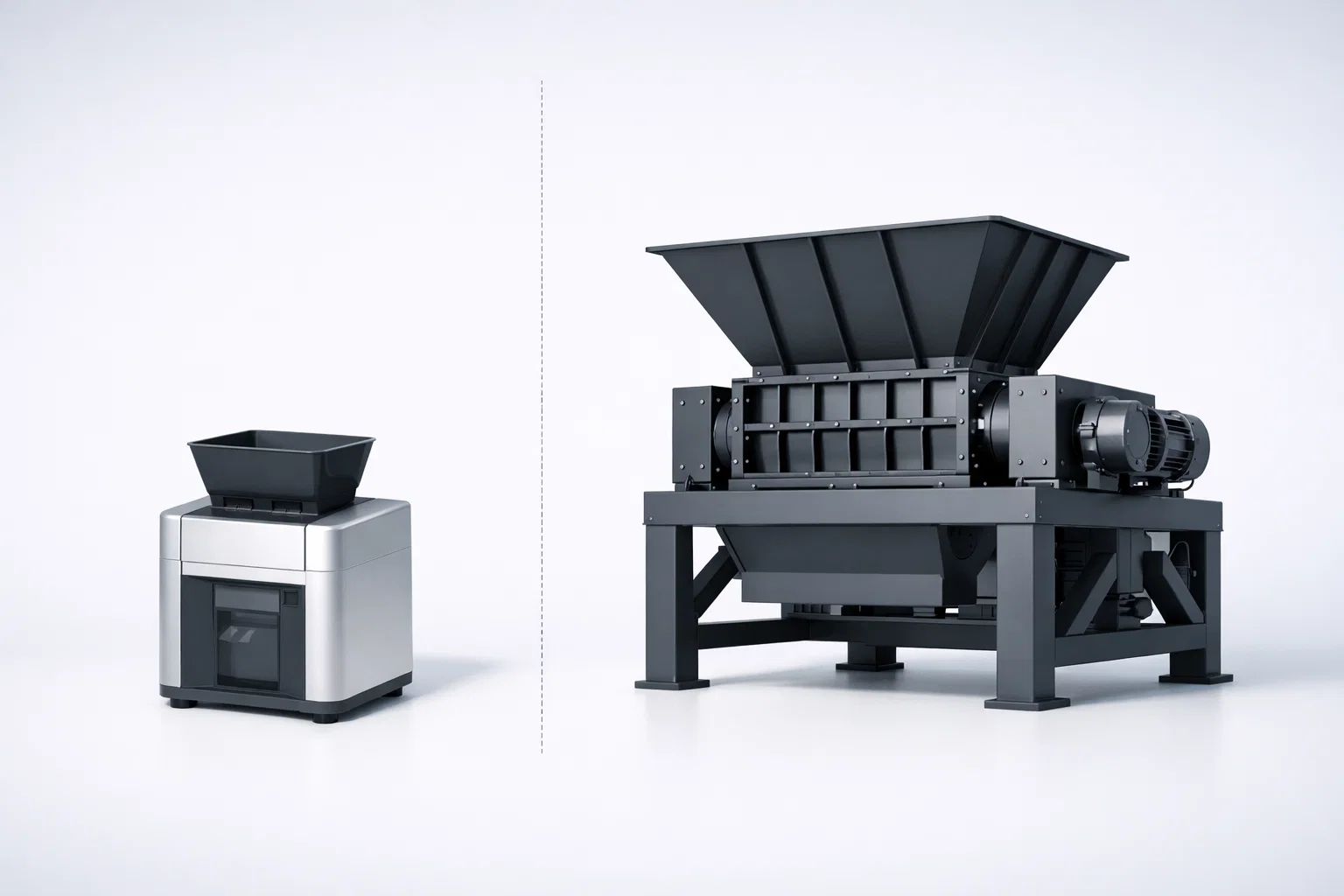
- Throughput and Output Sizing
- Questions to Answer Before Requesting a Quotation
- Frequently Asked Questions
What a Dry Bulk Container Liner Is
A dry bulk container liner is a large woven polypropylene bag that lines the inside of a shipping container or truck box so bulk cargo can travel loose instead of in individual sacks. It turns a standard container into a single sealed compartment for granules and powders — PET resin, grains, minerals, and, in this project, lead and copper materials.
The dimensions are what make it hard to shred. The Antwerp liners measure roughly 5.9 m × 2.35 m × 2.39 m — a full 20-foot footprint — and weigh about 100 kg empty. Folded, one liner is a dense slab of woven PP and film several hundred kilograms per cubic metre. A film shredder built for lightweight stretch wrap has no way to grip or pull a mass like that into the cutting zone.
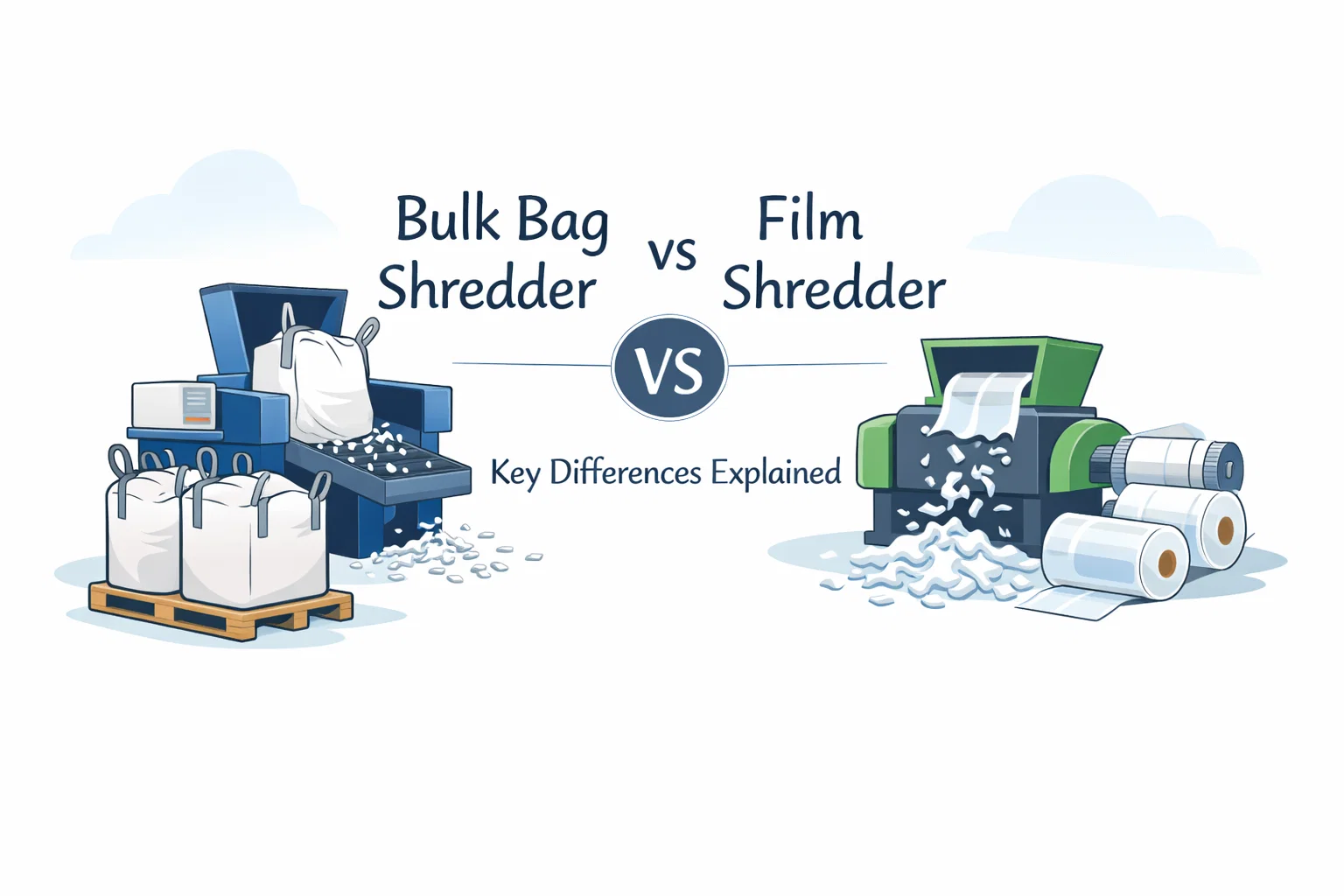
Container liners share their base material with FIBC big bags: both are woven polypropylene, often with an inner film ply. That shared construction is why a single machine can process both — but only when it is built around the heavier, bulkier liner rather than the bag. For the broader material comparison, see our guide on bulk bag shredder vs film shredder differences.
Key Takeaway: A container liner is a 20-foot-sized woven PP bag. Its size and folded density, not its material, are what defeat a standard film shredder.
Why Liners and Big Bags Shred Differently
Container liners and FIBC big bags fail different parts of a shredder, so a machine that handles one well can still stall on the other.
A big bag is compact but tough. Woven PP resists tearing, and the seams, lifting loops, and discharge spouts wrap around a poorly designed rotor. A bulk bag shredder solves this with counter-rotating shafts that grip the woven surface and pull it down rather than letting it spin. Our FIBC bulk bag shredder page covers that rotor and hopper design in detail.
A container liner is the opposite problem: not hard to cut, but hard to feed. One folded liner is large, heavy, and wants to bridge across the hopper mouth instead of dropping into the rotor. The fix is a wider hopper opening, a longer cutting chamber, and enough rotor torque to keep pulling a continuous sheet without stalling.
| Failure Point | Big Bag (FIBC) | Container Liner |
|---|---|---|
| Material toughness | High — woven PP, seams, loops | Moderate — woven PP, large sheet |
| Feeding behaviour | Compact, wraps the shaft | Bulky, bridges the hopper |
| Critical design fix | Counter-rotating grip rotor | Wide hopper + long chamber + torque |
| Residue carried | Powder in folds and seams | Powder across full sheet area |
The shared answer is a dual-shaft shredder sized for the liner’s bulk, fitted with the grip geometry the big bags need. Build only for the bag and the liner bridges; build only for the liner and the bags wrap the shaft.
The Real Problem: Residual Metal Powder
The hardest constraint in this project is not the plastic — it is what the plastic is carrying. Lead and copper matt, lead concentrates, and dross all leave fine, dense, often toxic powder clinging to the woven surface and trapped in folds and seams. Every empty liner and bag entering the shredder is a contaminated item.
This changes three things at once:
- Health and safety. Lead dust is a regulated occupational hazard. Any shredding step that releases it into the working area is a compliance and medical problem, not just a housekeeping one.
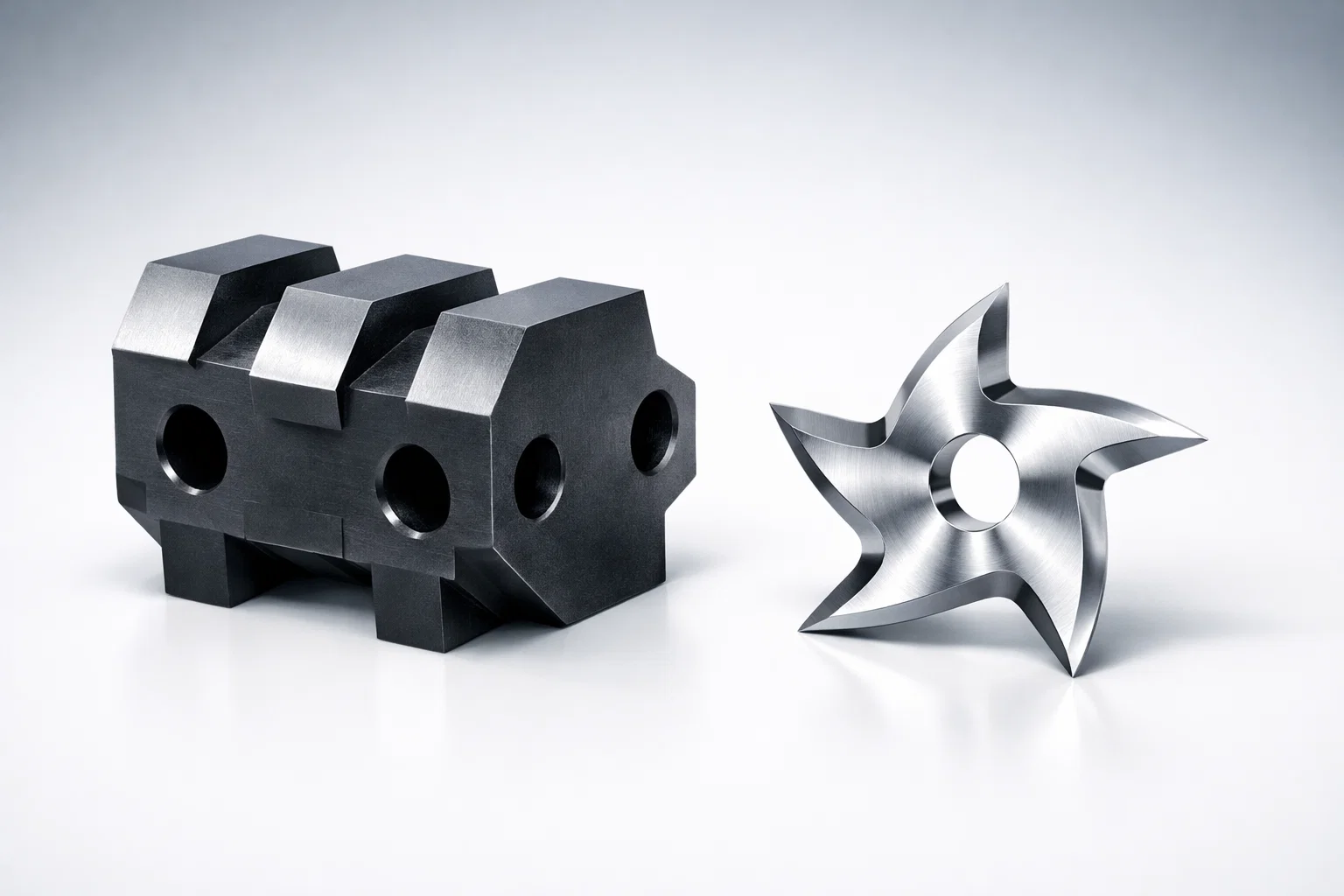
- Abrasion. Metal powder, especially from matt and dross, is abrasive. Rotor blades, screens, and bearings wear faster than they would on clean packaging, so blade steel and maintenance intervals have to account for it.
- Material recovery. The residual metal has value. A shredder that separates dislodged powder from the shredded plastic lets the operator recover both streams instead of contaminating the plastic with metal.
A shredder for contaminated FIBC and liners is therefore an enclosed, dust-managed system — closer to a sealed processing cell than an open-hopper machine. This is the line that separates a generic woven bag shredder from one fit for lead and copper service.
Key Takeaway: The packaging is the easy part. Containing and recovering lead- and copper-bearing dust is what defines this machine.
Dust Containment for Lead and Copper Residue
Dust containment for a lead and copper application starts at the hopper and runs through to the discharge. The goal is simple to state and demanding to build: no visible dust escape into the operator’s breathing zone at any point in the cycle.
The core elements we specify for contaminated-residue shredding:
- Sealed enclosure. The hopper, cutting chamber, and discharge are closed so dust cannot drift out during feeding or cutting.
- Negative-pressure extraction. A dust extraction system keeps the enclosure under slight negative pressure, pulling airborne powder toward a filter rather than out toward people.
- Filtration matched to particle size. For toxic metal dust, the filter stage has to capture fine particles — typically a cartridge or baghouse filter sized for the dust load, with safe-change filter handling.
- Residue collection point. Dislodged powder is collected at a dedicated discharge so the recovered metal stays separate from the shredded plastic.
The crane-fed design helps here. Because a crane — not a person — loads the bags and liners, the operator stays away from the open hopper during the dustiest moment of the cycle. Combine that with the enclosure and extraction, and human exposure drops sharply compared with manual feeding.
According to the US OSHA lead standard (29 CFR 1910.1025), airborne lead exposure must be controlled at the source through engineering controls before relying on respirators — which is exactly what an enclosed, extracted shredder provides. EU operators fall under the equivalent EU Chemical Agents Directive 98/24/EC framework. We design the containment to the operator’s site limits; the final filter and extraction sizing should always be confirmed with the local occupational-hygiene authority.
Crane-Fed Hopper Design
A crane-fed hopper changes the top of the machine. When a stationary crane drops a torn liner or bag from height, the hopper has to accept an irregular, heavy load without jamming and without puffing dust out the opening.
Three design responses matter:
- Oversized, reinforced hopper mouth. Wide enough to take a folded 20-foot liner and strong enough to absorb a crane drop rather than a gentle placement.
- Anti-bridging geometry. Sloped walls and a feed profile that move bulky liners down into the rotor instead of letting them span the opening — the most common stall point on oversized feed.
- Sealing during the drop. Because the crane opening is large, the extraction system has to hold containment even while a load is being released into it.
This is a different hopper from a conveyor-fed or hand-fed shredder. For lighter film and standard woven bag work where manual or conveyor feeding is enough, our PE/PP film and woven bag shredder is the appropriate base — but it is not built for crane-dropped 100 kg liners with metal dust.
Configuring One Machine for a Mixed Feed
One machine can shred both big bags and container liners, but it must be configured for the heaviest and bulkiest item in the stream, not the average. In the Antwerp case that means the 100 kg, 20-foot liner sets the hopper and torque spec, while the woven big bags set the rotor grip pattern.
A workable configuration for this combined, contaminated feed:
| Subsystem | Specification Driver | Configuration |
|---|---|---|
| Hopper | 20-foot folded liner + crane drop | Oversized, reinforced, sealed mouth |
| Rotor | Woven PP bags + continuous liner sheet | Dual-shaft, counter-rotating, high grip |
| Drive | Liner bulk and density | High-torque, anti-stall control |
| Blades | Abrasive metal powder | Wear-resistant alloy, planned change intervals |
| Enclosure | Lead/copper dust | Sealed, negative-pressure |
| Extraction | Toxic fine powder | Filtration sized to dust load |
| Discharge | Plastic + recovered metal | Separated streams |
Tell the supplier the actual proportion of liners to bags. A stream that is mostly liners with occasional bags is sized differently from one that is mostly bags with occasional liners, even though both run on the same machine class. The full range of base machines sits on our industrial shredders page.
Throughput and Output Sizing
Throughput for a contaminated liner and big bag shredder typically lands in the 500–3,000 kg/h range, depending on machine size, the liner-to-bag ratio, and how much the dust extraction has to slow the cycle.
Output size depends on what happens next. If the shredded PP goes to a washing line, a coarse strip is enough. If it feeds a direct pelletizer, a finer and more uniform cut matters, which means a tighter screen and usually lower throughput. Decide the downstream route before fixing the screen, because the screen choice sets the realistic capacity.
For this kind of project the practical throughput is often set by the crane cycle and the dust extraction, not the rotor. A crane can only tear, empty, and load so many bags per hour, and the enclosure has to clear dust between loads. Sizing the rotor far beyond the crane’s pace wastes money.
Questions to Answer Before Requesting a Quotation
Have these answers ready before contacting any supplier — they determine the hopper, rotor, drive, blade steel, and dust system before a proposal is built:
- What is the heaviest, bulkiest item? The 100 kg, 20-foot liner — not the bag — sets the hopper and torque.
- What is the liner-to-bag ratio in the real stream? This sets the rotor and capacity balance.
- What residue, and is it hazardous? Lead and copper dust dictate the enclosure, filtration, and blade wear allowance.
- How is the machine fed? Crane, conveyor, or manual feed each need a different hopper.
- What happens to the shredded plastic and the recovered powder? Downstream route sets the screen size and the discharge separation.
Frequently Asked Questions
Can one shredder process both container liners and FIBC big bags?
Yes. Both are woven polypropylene, so a single dual-shaft shredder can handle both — provided it is sized for the larger, heavier container liner and fitted with the rotor grip geometry the big bags need. Sizing for the bags alone will let the liners bridge the hopper.
How do you shred bags that still contain metal powder safely?
Use an enclosed shredder under negative-pressure dust extraction, with filtration matched to the metal-dust particle size and a separate discharge for the recovered powder. Crane feeding keeps the operator away from the hopper during the dustiest part of the cycle. Final extraction and filter sizing should be confirmed against the site’s occupational exposure limits.
Is a film shredder suitable for container liners?
No. A film shredder is built for lightweight film bales and cannot grip or feed a folded 20-foot liner weighing around 100 kg. It also lacks the sealed enclosure needed for toxic residue. A container liner shredder uses a wider hopper, longer chamber, higher torque, and dust containment.
What throughput can I expect?
Most contaminated liner and big bag shredders run in the 500–3,000 kg/h range. The real limit is often the crane cycle and the dust extraction rather than the rotor, so the achievable rate depends on how fast bags can be torn, emptied, and loaded.
Does the metal residue damage the shredder?
Metal powder from matt and dross is abrasive and wears blades, screens, and bearings faster than clean packaging. The machine is specified with wear-resistant blade steel and planned blade-change intervals so that abrasion is managed rather than a source of unplanned downtime.
Summary
A container liner shredder for a lead and copper operation is defined by three constraints that a standard film or bulk bag machine does not meet: it must feed a 20-foot, 100 kg woven liner alongside FIBC big bags, accept crane-loaded packaging, and contain toxic metal dust from feed to discharge.
The answer is a single dual-shaft machine sized for the liner, gripped for the bags, sealed and extracted for the dust, and built with abrasion-resistant blades. Configure it for the heaviest item in the stream, match the dust system to the residue, and let the downstream route set the screen.
If your project involves shredding container liners or big bags carrying residual powder, contact our process team with your liner and bag dimensions, the residue type, the feed method, and your throughput target. We will recommend the rotor, hopper, enclosure, and dust configuration before building a proposal.
Related pages:
- shredding
- container liner
- bulk bag
- FIBC
- dust containment
- process design