· Rumtoo Process Team · Technical Guide · 8 min read
Bulk Bag Shredder vs Film Shredder: Key Differences and Which Machine You Actually Need
FIBC bulk bags and PE film look similar — both are flexible woven or film plastics. But they require completely different shredding configurations. This guide explains the engineering differences, when each machine fails on the wrong material, and how to match your feedstock to the right shredder.
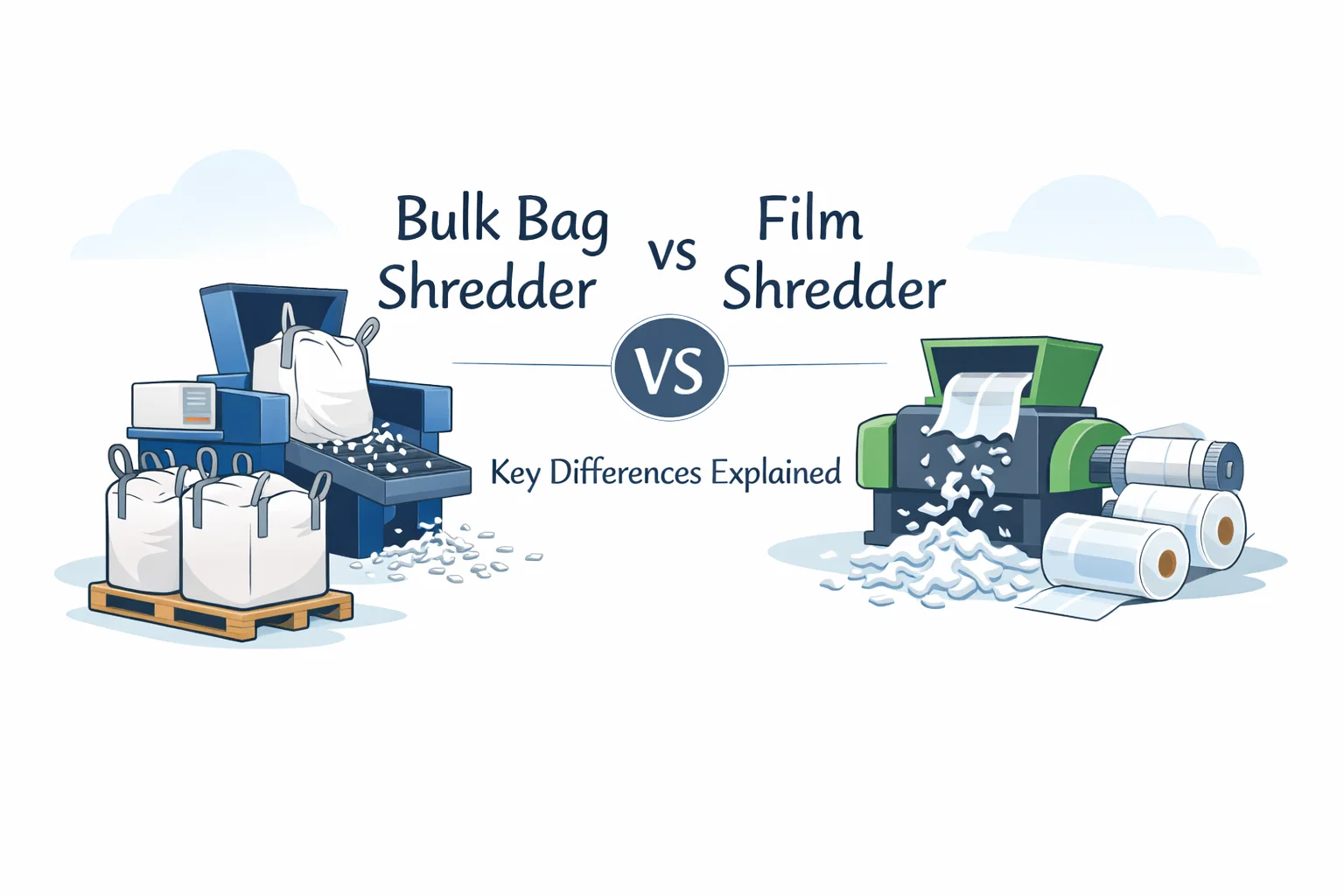
A recycling operator in the Netherlands contacted us after a failed equipment purchase. They had bought a standard PE film shredder to process used FIBC bulk bags — 1-ton woven polypropylene sacks from a fertiliser distributor. The machine stalled within the first shift. The bags bridged the hopper, the rotor slipped on the woven surface, and the anti-wrap sensors triggered emergency stops every few minutes. Within three weeks, they had replaced the film shredder with a bulk bag shredder configured for FIBC feedstock. Throughput went from effectively zero to 800 kg/h.
The assumption that caused the problem was simple and common: flexible plastic bags must all shred the same way. They do not. A 1-ton FIBC woven sack and a PE stretch film bale are as different as a steel I-beam and a roll of aluminium foil — both are metal, but they require completely different cutting tools and feeding methods.
What Makes FIBC Bulk Bags Different from PE Film
Before comparing machines, it helps to understand why the two materials behave so differently during size reduction.
FIBC Bulk Bags: What They Are
A standard FIBC (Flexible Intermediate Bulk Container) — also called a bulk bag, big bag, or jumbo bag — is a large industrial packaging container made from woven polypropylene strips. Key characteristics:
- Weight: Typically 1,000–1,500 kg rated capacity; the bag itself weighs 2–6 kg empty
- Dimensions: Usually 90–110 cm diameter × 90–150 cm tall, but large-format FIBCs can exceed 200 cm
- Construction: Woven PP strips (not film) stitched together, often with a liner, filling spout, and discharge spout
- Residue: Most used FIBC bags contain residual powder, granules, or trace liquids from their contents (fertiliser, cement, food-grade chemicals, mineral powder)
PE Film: What It Is
PE film is a continuous extruded thermoplastic film — agricultural mulch film, greenhouse film, stretch wrap, shrink wrap, and similar materials. Key characteristics:
- Density: Very low bulk density, typically 30–80 kg/m³ in loose form, 250–400 kg/m³ baled
- Dimensions: Comes as bales, rolls, or loose sheets — no defined geometry
- Construction: Thin, uniform film — typically 30–200 microns thick
- Residue: Dirt, organic contamination, moisture — but not dense powder or granule residue
These differences translate directly into opposite engineering requirements for shredding.
How a Film Shredder Is Designed (and Why It Fails on FIBC)
A PE/PP film shredder is designed around one specific challenge: thin plastic film tends to wrap around rotating shafts. The entire machine architecture is built to prevent this.
Key Film Shredder Design Features
Single-shaft anti-wrap rotor: The single shaft has a dense cutting pattern with close blade spacing. This design processes film efficiently but relies on the film being lightweight and flexible enough to flow into the cutting zone without bridging.
Hydraulic pusher ram: Film bales are compressed and pushed into the cutting zone by a hydraulic ram. The ram is sized for bale density (250–400 kg/m³), not for the weight and rigidity of a full 1-ton FIBC bag.
Hopper geometry: Film shredder hoppers are sized for baled film — typically around 800–1,200 mm wide. A standard FIBC bag footprint of 90–110 cm may fit, but the machine cannot grip and pull a rigid woven sack the way it can feed soft film.
Screen selection: Film shredders typically use 30–60 mm screens — optimised for the output size needed before a densifier or friction washer for film.
Why Film Shredders Fail on FIBC
When a standard film shredder is fed a whole FIBC bulk bag:
Bridging: The bag is rigid enough to span the hopper opening without feeding into the rotor. The hydraulic pusher pushes it partially but the bag’s corners wedge against the hopper walls.
Rotor slip: PP woven fabric has a smooth, slippery surface. A single anti-wrap rotor designed for thin film cannot grip the woven structure effectively — the rotor turns, the bag stays put.
Residue contamination: The powder or granule residue inside the bag enters the cutting zone along with the PP. In a film shredder, this residue has nowhere to separate — it mixes into the shredded output and contaminates the recyclate.
Stalling: When the rotor does manage to grip the bag, the dense woven structure can overload the motor. Film shredder motors are sized for low-density flexible film, not multi-layer woven PP at full bag weight.
How a Bulk Bag Shredder Is Designed
A bulk bag shredder (also called a FIBC shredder or big bag shredder) is engineered around the opposite problem: how to grip, tear, and reduce a heavy, rigid, woven sack that is substantially larger and denser than any film bale.
Key Bulk Bag Shredder Design Features
Wide-mouth hopper: The feed opening is sized for full FIBC bags — typically 1,200–2,000 mm wide depending on the model. This eliminates bridging by ensuring the bag fits within the cutting zone geometry.
Dual-shaft counter-rotating rotor: Two shafts rotate in opposite directions, actively gripping the woven PP material from both sides and pulling it into the cutting zone. The dual-shaft design solves the slip problem that defeats single-shaft anti-wrap rotors on smooth woven surfaces.
High-torque gearbox: The gearbox is rated for the weight and density of full FIBC bags, not film bales. This prevents stalling on first-contact loading.
Integrated residue handling: A downstream rotary screen or cyclone separates residual powder and granules from the shredded PP strips. This prevents contamination of the recyclate.
Screen selection: Bulk bag shredders typically use 40–120 mm screens — producing larger strips than film shredders, appropriate for PP recycling through a washing line or direct pelletizer.
Side-by-Side Comparison
| Feature | PE/PP Film Shredder | Bulk Bag (FIBC) Shredder |
|---|---|---|
| Rotor type | Single shaft, anti-wrap | Dual shaft, counter-rotating |
| Feed opening | 800–1,200 mm | 1,200–2,000 mm |
| Feeding method | Hydraulic ram for bales | Wide hopper, gravity/crane/forklift |
| Grip on woven surface | Poor — rotor slips | Effective — dual shafts grip from both sides |
| Hopper bridging on FIBC | Common — bags span the opening | Eliminated by wide-mouth geometry |
| Residue handling | None — residue mixes into output | Rotary screen or cyclone separates residue |
| Motor sizing | Sized for bale density (250–400 kg/m³) | Sized for full bag weight and woven rigidity |
| Typical output screen | 30–60 mm | 40–120 mm |
| Typical capacity | 500–2,000 kg/h on PE film | 500–3,000 kg/h on FIBC |
What About PP Woven Bags in Standard Sizes?
Standard PP woven bags (50 kg cement sacks, 25 kg agricultural sacks) occupy a middle ground. A well-configured film shredder with appropriate screen and hopper setup can process standard-size PP woven bags reliably — this is typically described as a film and woven bag shredder configuration.
The key distinction is bag size and weight:
- Standard PP woven bags (up to ~50 kg): A film/woven bag shredder handles these adequately
- FIBC bulk bags (500 kg to 2,000 kg): Require a dedicated bulk bag shredder configuration
If your operation processes a mix of standard woven bags and occasional FIBC containers, discuss the actual proportion with the equipment supplier. The machine configuration — particularly hopper width, rotor grip strength, and residue handling — must match the largest and heaviest bags in your stream, not the average.
When You Need a Bulk Bag Shredder
You need a dedicated bulk bag shredder configuration when your feedstock includes:
- Standard FIBC bulk bags (rated 500 kg to 2,000 kg)
- Oversized woven PP containers and flexible IBCs
- Bags with significant residual powder, granule, or chemical contamination
- Mixed stream including both standard woven sacks and large FIBC bags
Industries where this is most common:
| Industry | Typical FIBC Contents | Residue Concern |
|---|---|---|
| Chemical manufacturing | Resin pellets, polymer powder | High — often hazardous |
| Agriculture | Fertiliser, seed, pesticide | Medium — density and organic contamination |
| Food processing | Starch, flour, sugar, spices | Medium — hygienic concerns |
| Mining and minerals | Calcium carbonate, silica, pigment | High — abrasive powder |
| Construction | Cement, sand, aggregate | High — abrasive and dense |
When a Film Shredder Is Sufficient
A standard film or film/woven bag shredder is appropriate when:
- Your feedstock is LDPE or LLDPE film bales (agricultural film, stretch wrap, greenhouse film)
- You process standard-size PP woven bags (up to ~50 kg capacity)
- There are no FIBC bulk bags in the stream
- Residue is limited to surface contamination (mud, moisture) rather than internal powder
Selecting the Right Machine: Key Questions
Before contacting any equipment supplier, have answers to these questions:
What is the maximum bag weight you will process? This single number determines whether a film shredder configuration is viable or a bulk bag shredder is required.
What are the bag dimensions (L × W × H)? The hopper configuration must accommodate the bag without bridging.
What is in the bags — and how much residue remains? Residue type and volume determine whether a separation stage is needed and which screen configuration is appropriate.
What is your throughput target? Both machine types have overlapping throughput ranges but arrive at those capacities through different configurations.
What happens after shredding? If output goes to a PP washing line, the strip size requirement is different than if it goes to a direct pelletizer. Screen selection depends on this.
Send these five answers to Rumtoo before requesting a quotation — they determine the model, hopper, rotor type, and residue handling configuration before we build a proposal.
Summary
Bulk bags and PE film are both flexible plastics, but they require opposite engineering solutions for reliable shredding. The woven construction, weight, dimensions, and residue content of FIBC bulk bags defeat every design feature of a standard film shredder — the hopper geometry, rotor grip, motor sizing, and residue handling are all wrong for the application.
A bulk bag shredder is configured from the ground up for FIBC feedstock: wide-mouth hopper, dual-shaft counter-rotating grip, high-torque drive, and integrated residue separation. It is not a modified film shredder — it is a different machine for a different problem.
If your operation includes FIBC bulk bags, contact our process team with your bag specifications, residue type, and throughput target. We will recommend the appropriate configuration and residue separation setup.
Related pages:
- shredding
- bulk bag
- FIBC
- film recycling
- process design