
· Rumtoo Process Team · Technical Guide · 12 min read
Desktop Shredder vs Industrial Shredder: How to Choose the Right Scale for Your Operation
Not every recycling operation needs a 30 kW industrial shredder. This guide compares desktop and industrial plastic shredders across throughput, cost, footprint, noise, and use case — so you can match the right machine to your actual volume and avoid the most common sizing mistake in equipment procurement.
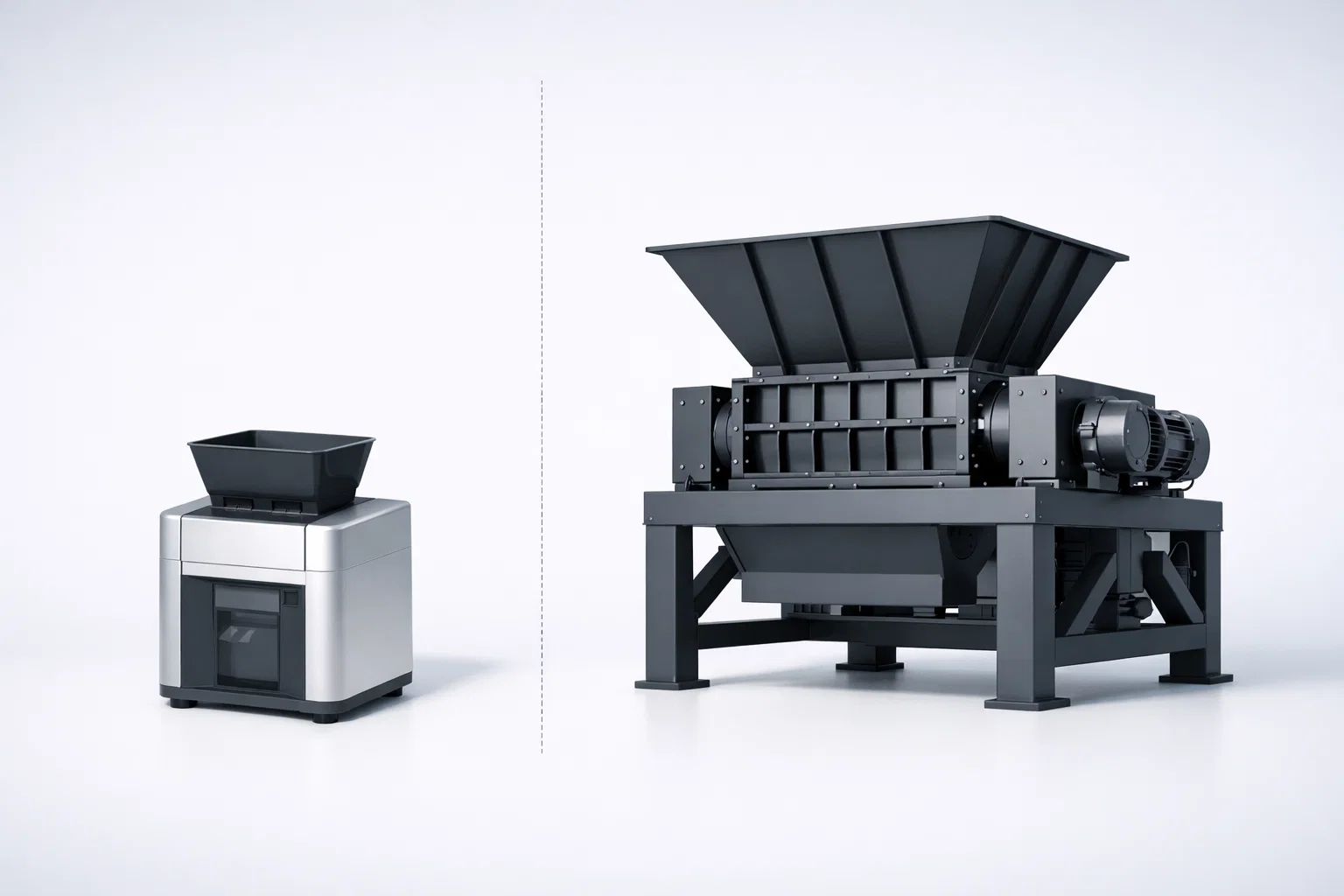
A small injection molding shop in Guadalajara reached out to us in mid-2025 with a straightforward request: they needed a shredder for their production scrap. Monthly waste volume was around 60–80 kg — a mix of PP runner sprues, rejected ABS housings, and occasional short-shot parts. A local equipment dealer had quoted them on a 15 kW single-shaft industrial shredder at roughly $18,000, plus $4,500 for three-phase electrical installation, a concrete foundation pad, and a dust collection hood. Total project cost: nearly $23,000.
We asked one question that changed the entire conversation: How many hours per day do you actually need to shred?
The answer was about 30 minutes. Their daily scrap output was 2–3 kg. A 15 kW industrial shredder processing 2 kg of material per day would run at less than 1% of its rated capacity. It would spend 23.5 hours per day sitting idle on a concrete pad that cost more to pour than the annual scrap volume was worth.
They installed a mini desktop shredder instead. It plugged into a standard 220V wall outlet, sat on an existing workbench beside the injection molding machine, and processed their daily scrap in 20–40 minutes. Total installed cost was a fraction of the industrial quote. The regrind fed back into their molding process as a 15–20% blend with virgin material, closing the loop entirely within their own facility.
The lesson: choosing a shredder is not about buying the most powerful machine you can afford. It is about matching the machine to your actual throughput requirement. Oversizing is the single most expensive mistake in size reduction equipment procurement, and it happens constantly because buyers default to industrial-scale thinking even when their operation is anything but industrial-scale.
The Core Engineering Difference: What Makes a Machine “Desktop” or “Industrial”
The distinction between desktop and industrial shredders is not just about physical size. The machines are engineered around fundamentally different operating assumptions.
Desktop Shredders: Precision at Low Volume
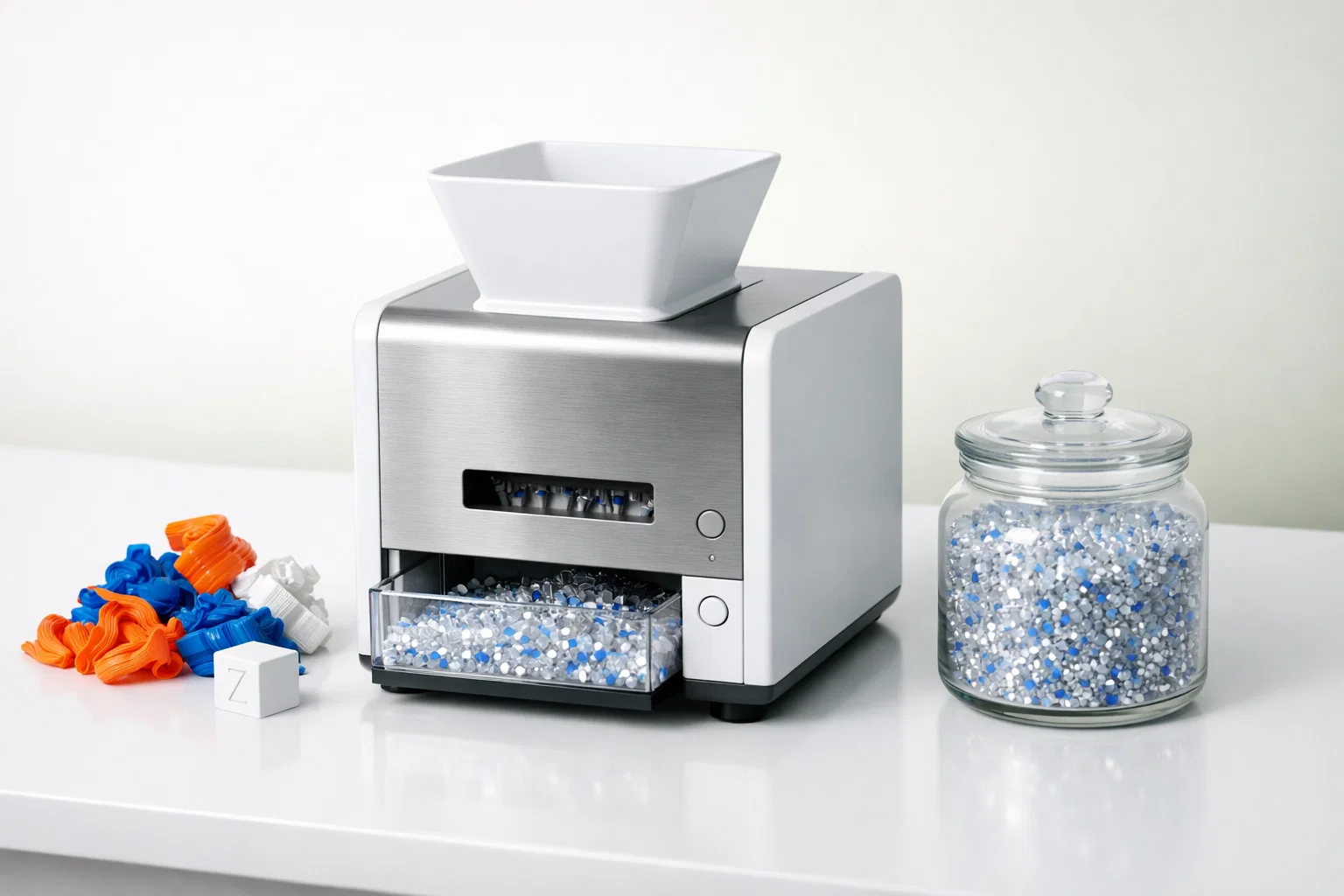
A desktop shredder — like the Rumtoo mini desktop unit — is built for intermittent, low-volume operation in environments where space, noise, and electrical infrastructure are constrained. The defining characteristics:
Low-power geared drive. A typical desktop unit uses a 1.5 kW motor coupled through a reduction gearbox. The gearbox is critical — it converts moderate motor speed into the high torque needed to shear rigid thermoplastics, without requiring the 30–110 kW motors found in industrial machines. This geared approach means the machine runs on single-phase 110V or 220V power from a standard wall outlet.
Compact cutting chamber. The feed opening on a desktop shredder is sized for hand-fed pieces — typically 120–200 mm. This limits maximum input size but enables a machine footprint under 1 m², small enough for a lab bench or a corner of a workshop.
Noise profile designed for shared spaces. Desktop shredders operate below 55 dB — quieter than a normal conversation. This is not a marketing convenience; it is an engineering requirement for machines that operate in university labs, shared makerspaces, and open-plan R&D facilities where industrial noise levels (80–105 dB) would be unacceptable.
Throughput range: 1–5 kg/h, depending on material type and feed preparation.
Industrial Shredders: Continuous High-Volume Processing
An industrial shredder is designed for continuous, unattended operation processing hundreds or thousands of kilograms per hour. The engineering priorities are entirely different:
High-power direct or hydraulic drive. Industrial shredders use 30–110 kW motors per shaft — often two shafts in counter-rotating configurations. These machines are built to accept full bales, entire drums, thick-walled pipe, and other bulky feedstock that would overwhelm any desktop cutting chamber.
Large feed openings with automated feeding. Hopper widths of 800–2,000 mm accommodate conveyor-fed or crane-loaded material. Hydraulic pusher rams compress baled material into the cutting zone without operator intervention.
Robust metal protection. Industrial recycling streams contain tramp metal — screws, bolts, wire, tools. Industrial shredders are built to absorb incidental metal contamination through low-speed, high-torque operation without catastrophic blade failure. Desktop shredders, processing hand-sorted lab material, do not need this level of protection.
Throughput range: 200–3,000+ kg/h, depending on configuration and material.
These are not different sizes of the same machine. They are different machines designed for different problems.
Full Comparison: Desktop vs Industrial Shredder
| Parameter | Desktop Shredder | Industrial Shredder |
|---|---|---|
| Throughput | 1–5 kg/h | 200–3,000+ kg/h |
| Motor power | 1.5 kW (geared) | 30–110 kW per shaft |
| Electrical requirement | 110V / 220V single-phase | 380V / 440V three-phase |
| Feed opening | 120 × 200 mm | 800–2,000 mm |
| Feeding method | Manual hand-feed | Conveyor, crane, hydraulic ram |
| Machine weight | ~100 kg | 2,000–15,000 kg |
| Footprint | < 1 m² (benchtop) | 5–20 m² + ancillary equipment |
| Installation | Plug into wall outlet | Concrete foundation + electrical infrastructure |
| Noise level | < 55 dB | 80–105 dB (enclosure recommended) |
| Typical output size | 3–6 mm | 30–80 mm (shredder) or 8–16 mm (crusher) |
| Operator training | Minimal — basic safety briefing | Formal training + LOTO certification |
| Blade material | H13 tool steel | D2 tool steel or tungsten carbide tipped |
| Blade replacement | Simple hand tools | Specialized technician, 2–4 hour procedure |
| Metal protection | Not required (hand-sorted feed) | Magnetic separator + metal detector |
| Dust collection | Not required | Required for most installations |
The comparison reveals a pattern: every advantage of an industrial shredder comes with an infrastructure cost. Three-phase electrical installation, concrete foundation, acoustic enclosure, dust collection, metal protection, operator training — these are not optional add-ons. They are mandatory requirements that inflate the true cost of an industrial installation far beyond the machine price.
Five Scenarios: Which Machine Fits
The right choice depends on your specific waste volume, material type, facility constraints, and downstream process. Here are five common scenarios with clear recommendations.
Scenario A: University Materials Lab
Profile: 8–12 FDM printers, monthly scrap volume 10–30 kg (PLA, PETG, ABS). Regrind used for student material testing projects and filament extrusion trials.
Recommendation: Desktop shredder.
A lab generating 10–30 kg/month needs roughly 6–15 hours of total shredding time per month — less than one hour per working day. An industrial shredder would process the entire month’s waste in under 10 minutes and sit idle for the remaining 29 days, 23 hours, and 50 minutes. The desktop unit fits on the lab bench beside the printers, runs on building power without electrical modifications, and operates quietly enough for a shared academic environment. The controlled 3–6 mm output feeds directly into lab-scale extruders for student projects.
Read more: How to Recycle 3D Printing Waste with a Desktop Shredder
Scenario B: 3D Print Farm or Prototyping Shop
Profile: 20–50 printers, monthly scrap volume 50–100 kg. Mix of PLA, PETG, and engineering materials. Goal is cost reduction through closed-loop regrind.
Recommendation: Desktop shredder.
Even at 100 kg/month, total shredding time is 20–50 hours per month at desktop throughput rates — roughly 1–2 hours per working day. This is well within the duty cycle of a desktop unit. The critical advantage here is operational simplicity: no infrastructure investment, no dedicated operator, no maintenance contract. One staff member can shred the day’s scrap during a 30-minute end-of-shift routine.
Scenario C: Small Injection Molding or Extrusion Shop
Profile: Monthly scrap volume 200–500 kg. Post-industrial rigid scrap (runners, sprues, rejects). Material is clean and pre-sorted.
Recommendation: Evaluate both — desktop may still be sufficient.
At 500 kg/month, a desktop shredder running 2–3 hours per day can keep up. The deciding factors are: (1) does the scrap fit through a 120 × 200 mm opening without pre-cutting, and (2) is the downstream equipment (extruder or molding machine hopper) compatible with 3–6 mm regrind? If the scrap pieces are consistently small (runner sprues, thin-wall rejects), a desktop unit handles them efficiently. If the scrap includes large or thick-walled parts that require significant pre-cutting, the labor cost of preparation may justify stepping up to a small industrial crusher. See our guide on choosing between crusher and shredder configurations for detailed guidance on this decision point.
Scenario D: Post-Consumer Recycling Operation
Profile: Processing 2+ tons per day of mixed post-consumer plastic (baled bottles, contaminated film, rigid containers). Revenue depends on continuous throughput.
Recommendation: Industrial shredder — no question.
At 2,000+ kg/day, a desktop shredder is completely out of scope. This volume requires a dedicated industrial shredder as the primary size reduction stage, typically followed by a crusher for secondary refinement, integrated into a complete washing and pelletizing line. The infrastructure investment (three-phase power, foundation, conveyors, metal detection, dust collection) is justified because the revenue from continuous operation funds the capital expenditure within the first year of operation.
Scenario E: Corporate R&D or Pilot Line
Profile: Materials research team testing new polymer blends, recycled content formulations, or degradation behavior. Throughput volume is low (5–20 kg/month) but data quality is paramount.
Recommendation: Desktop shredder — and this is where the desktop unit’s advantages are most pronounced.
R&D operations care about repeatability, not volume. A desktop shredder with controlled feed rate and consistent blade geometry produces regrind with a tighter particle size distribution than a large industrial machine running at 5% capacity. More importantly, the data generated on a desktop shredder — particle size, throughput rate, energy consumption — is directly transferable to pilot-scale and production-scale equipment decisions. The desktop unit serves as a screening tool that prevents expensive mistakes at industrial scale.
The Upgrade Path: Desktop Today, Industrial Tomorrow
One concern buyers raise is future-proofing: “If I buy a desktop shredder now and my volume grows, will I need to throw it away and buy an industrial machine?”
The answer is no — for two reasons.
First, the volume threshold is higher than most buyers expect. A desktop shredder comfortably handles operations up to 300–500 kg/month. Many small businesses and labs never exceed this volume. If your current waste is 50 kg/month and you anticipate 200 kg/month in two years, a desktop unit covers both scenarios.
Second, the desktop shredder remains useful even after adding industrial equipment. When volume does grow beyond desktop capacity, the desktop unit transitions into a dedicated R&D and QC tool — preparing small test batches, validating new material streams before committing them to the production line, or providing controlled regrind for laboratory testing. It never becomes obsolete; it changes roles.
Rumtoo’s product line is designed with this progression in mind. The desktop and R&D equipment range covers initial lab and pilot requirements. As operations scale, the transition to industrial shredders, crushers, and complete recycling lines is supported by the same engineering team, with process data from the desktop stage informing the industrial configuration.
The Hidden Costs of Oversizing
Buyers who default to industrial equipment for low-volume applications face costs that extend well beyond the purchase price:
Electrical infrastructure. Three-phase 380V/440V power is not available in most small workshops, labs, or commercial buildings. Running a new three-phase line from the main panel can cost $2,000–8,000 depending on distance and local electrical codes.
Foundation work. Industrial shredders weighing 2,000–15,000 kg require reinforced concrete pads to manage vibration and distribute load. Foundation costs range from $1,500–5,000 for a basic pad.
Acoustic treatment. At 80–105 dB, an industrial shredder in a shared facility requires an acoustic enclosure ($5,000–15,000) or a dedicated room with sound insulation.
Dust collection. Industrial shredding generates airborne plastic dust that requires extraction and filtration for worker safety and regulatory compliance. A basic dust collection system starts at $3,000.
Maintenance contracts. Industrial blade replacement is a 2–4 hour procedure requiring a trained technician. Many buyers commit to annual maintenance contracts ($2,000–5,000/year) to ensure uptime.
Operator training. OSHA requires lockout/tagout (LOTO) training and machine-specific safety certification for industrial shredder operators. Training costs time and creates scheduling constraints.
Total these ancillary costs and an $18,000 industrial shredder becomes a $30,000–45,000 installed system. For an operation generating 50–100 kg of clean, pre-sorted scrap per month, the payback period on that investment stretches to 5–10+ years — if it ever pays back at all.
A desktop shredder eliminates every one of these ancillary costs. It plugs into a wall outlet, sits on a workbench, operates quietly in a shared space, and requires no specialized training beyond a basic safety orientation.
Frequently Asked Questions
What monthly scrap volume is the cutoff for choosing a desktop shredder?
There is no hard cutoff, but as a practical guideline: operations generating up to 300–500 kg/month of clean, pre-sorted thermoplastic scrap can be handled comfortably by a desktop shredder running 1–3 hours per day. Above that volume, the daily shredding time starts to become a significant labor commitment, and an industrial solution should be evaluated. The material type matters too — hard, thick pieces that require pre-cutting before feeding shift the effective cutoff lower.
Can a desktop shredder handle HDPE bottle caps and rigid PP containers?
Yes. The Rumtoo mini desktop shredder processes HDPE and PP effectively. These materials are softer and less brittle than PLA or ABS, so the output particle shape tends to be slightly more irregular, but the regrind is fully usable for downstream processing. Throughput on HDPE/PP is typically at the higher end of the 1–5 kg/h range because the material feeds and shears easily.
If my volume grows later, is my desktop shredder investment wasted?
No. Desktop shredders transition naturally into R&D and quality control roles when production volume outgrows their capacity. They are ideal for testing new material streams, preparing small controlled batches, and generating particle size data before committing material to an industrial line. Many facilities that have upgraded to industrial equipment retain their desktop units specifically for these purposes.
Can an industrial shredder be installed in an office building or shared workshop?
Generally no, due to three constraints: electrical requirements (three-phase power is rarely available in commercial office buildings), noise (80–105 dB requires acoustic isolation), and weight (most office and workshop floors are not rated for 2,000+ kg point loads). Industrial shredders are designed for factory floors with appropriate infrastructure.
Is the regrind from a desktop shredder compatible with industrial-scale extruders?
The 3–6 mm regrind from a desktop shredder is compatible with most extruder feed systems. Industrial extruders with large-diameter screws and gravity-fed hoppers accept this particle size range without modification. The only consideration is bulk density — regrind from a desktop shredder may have lower bulk density than commercial pellets, which can affect volumetric feed rate. Gravimetric feeders compensate for this automatically.
Next Steps
Before contacting any equipment supplier, answer one question: How many kilograms of plastic scrap does your operation actually produce per month? Weigh your waste bins for two weeks and extrapolate. That number — not your aspirations, not your five-year plan, but your current actual volume — determines whether a desktop or industrial solution is the right starting point.
For operations producing up to 300–500 kg/month of sorted thermoplastic scrap, a desktop shredder is almost certainly the more cost-effective, practical, and operationally simpler choice. For higher volumes or contaminated post-consumer streams, industrial configurations are the appropriate tool.
Contact the Rumtoo process team with your material type, monthly volume, and downstream use case. We will recommend the right equipment scale — desktop, industrial, or a phased approach — matched to your operation.
Related pages:
- desktop shredder
- industrial shredder
- equipment selection
- lab equipment
- process design