
Disc Pulverizer Systems
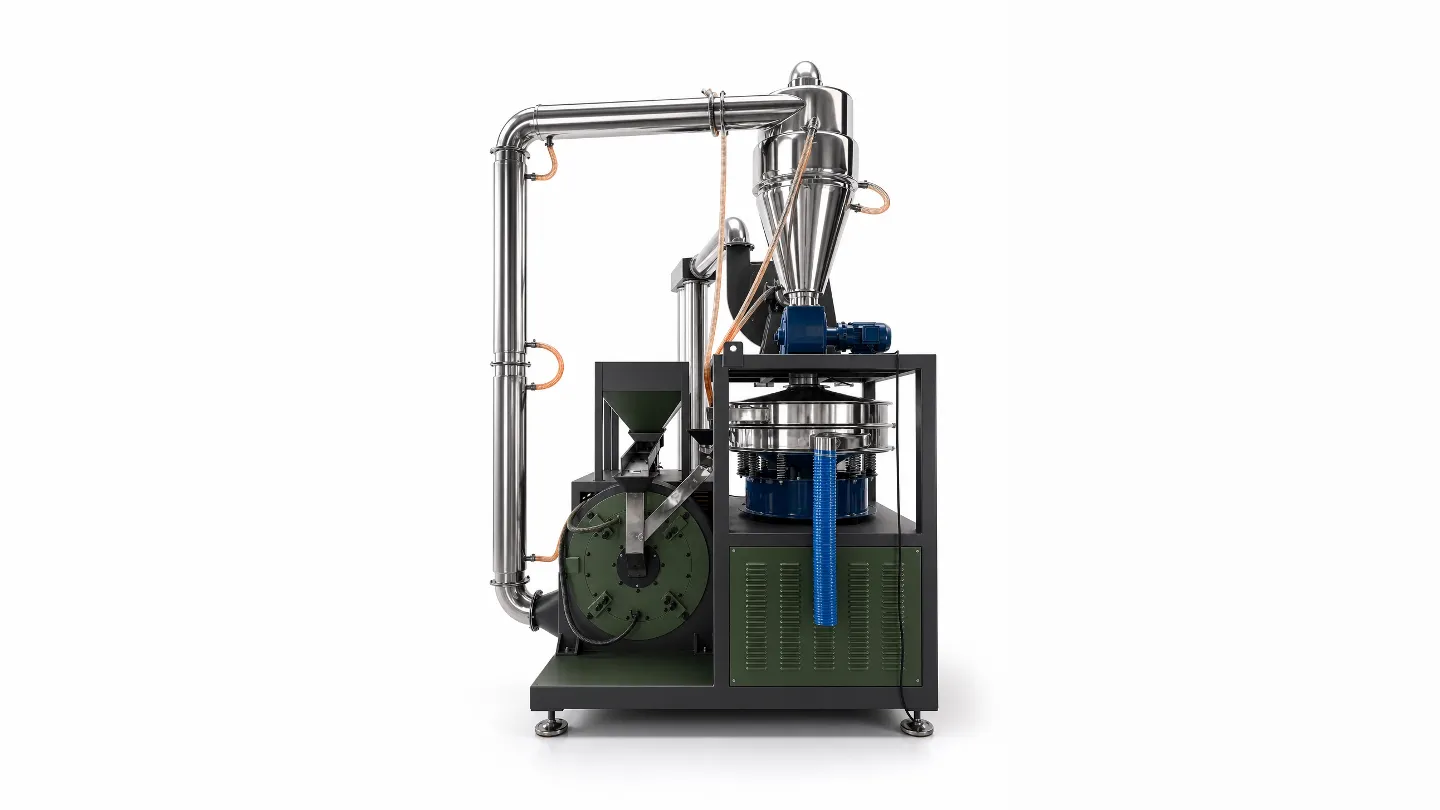
Plastic Pulverizer
Industrial disc pulverizer for fine plastic powder grinding from 20–120 mesh. PE/HDPE rotomolding powder, PVC rework, plus PP, PS, ABS, EVA and PA at 150–800 kg/h.
- Matched to your feedstock and output target
- Stable throughput with controlled discharge size
- Layout, controls, and service support customized
- Matched to your feedstock and output target
- Stable throughput with controlled discharge size
- Layout, controls, and service support customized
Backed by Documented Performance Targets
Why Disc Milling — Not Just Granulation
A practical four-step process focused on stable operation and consistent output.
Metered Feed
Pre-crushed granules enter through a vibratory feeder that controls the load rate.
Direct-Drive Grinding
Material passes between high-speed rotating discs with micrometer-adjustable gaps.
Temperature Control
Integrated water jacket and air cooling keep the chamber below critical thresholds.
Why Rumtoo Disc Pulverizers
Direct Drive — No Belts
Eliminates belt slippage and replacement downtime for higher efficiency.
Temperature Protection
Sensors monitor bearing temperature with automatic shutoff to prevent damage.
Segment Disc Design
Grinding discs use modular segments that are individually replaceable.
Problem-Solution Fit
Unstable feedstock conditions reduce production consistency.
Engineering configuration is matched to material variability and throughput targets.
Inconsistent quality creates downstream process risk.
Process design focuses on output stability for downstream stages.
Frequent intervention increases labor and maintenance pressure.
Service-friendly structure supports efficient operation and maintenance.
Scaling capacity can disrupt existing line performance.
Modular integration supports phased expansion and retrofit planning.
Video Demonstration
View the machine workflow under real operating conditions.
Typical Applications
HDPE Rotomolding Powder
LLDPE/HDPE powder at 35–60 mesh for pickleballs, tanks, kayaks and other rotomolded parts with uniform wall thickness.
PVC Rework
Rigid PVC pipe, profile, sheet and floor scrap converted to fine reusable powder for extrusion blending — the most mature pulverizer application.
PP / PS / ABS Recycle Compounding
GPPS, HIPS, ABS and PP regrind milled into compounding feed. PP requires dedicated discs and stronger cooling due to its toughness.
EVA & PA Specialty Powder
EVA foam scrap and PA6/PA66 reduced to powder for adhesives, rotomolding and 3D printing feedstock with the optional cryogenic cooling package.
Supported Plastics
A direct-drive disc pulverizer handles a wide range of thermoplastics. Best-fit depends on toughness, thermal sensitivity, and target mesh.
Primary Markets
Best FitThe workhorse applications — proven feedstocks and the largest share of installed pulverizers.
PE — Polyethylene
- HDPE
- LDPE
- LLDPE
- PE pipe off-cuts
- PE hollow ware
- PE rotomolding stock
The single largest pulverizer application — PE makes up the majority of the global rotomolding powder market.
PVC — Polyvinyl Chloride
- PVC pipe
- PVC profile
- PVC sheet
- PVC flooring
- PVC off-cuts
The most mature pulverizer application — rigid PVC rework powder feeds extrusion blending at near-virgin properties.
Standard Capability
Processable on most models with standard discs. Throughput and mesh range may differ from PE/PVC benchmarks.
PP — Polypropylene
- PP injection scrap
- PP sheet
- PP blocks
Tougher than PE — requires dedicated discs, tighter gap, and stronger cooling.
PS — Polystyrene
- GPPS
- HIPS
Brittle and easy to grind — high throughput at fine mesh.
ABS
- ABS injection scrap
- ABS sheet
Workable, with throughput typically below PE.
EVA
- EVA off-cuts
- EVA foam waste
Processable on selected models — confirm cell density before quoting.
Specialty (Optional Package)
Dedicated Discs + CoolingPossible with a specialty configuration. Tell us the polymer grade and we will spec the right disc geometry and cooling package.
PA — Nylon
- PA6
- PA66
Requires dedicated grinding discs and an enhanced cooling system to control thermal pickup.
Technical Specifications
| Parameter | Specification | Notes |
|---|---|---|
| PM-400 | 150-300 kg/h | 20-120 mesh |
| PM-600 | 300-600 kg/h | 20-120 mesh |
| PM-800 | 500-800 kg/h | 20-80 mesh |
Output depends on polymer, feed size, target mesh, and cooling configuration.
Why Choose Rumtoo
| Criteria | Conventional Setup | Rumtoo Solution |
|---|---|---|
| Process Stability | More fluctuation under feed variation | Designed for stable operation across variable feedstock |
| Output Consistency | Higher variation in downstream quality | Process control focused on consistent output |
| Integration | Higher retrofit complexity | Practical integration with existing lines |
| Lifecycle Support | Limited startup optimization support | Engineering support from planning to commissioning |
Frequently Asked Questions
What is the difference between a pulverizer and a granulator?
A granulator makes flakes; a pulverizer grinds flakes into fine, flour-like powder typically between 20 and 120 mesh.
Which plastics can this pulverizer process?
PE (LDPE/LLDPE/HDPE) and PVC are the primary markets. PP, PS (GPPS/HIPS), ABS and EVA run on most models; PA6/PA66 requires dedicated discs and enhanced cooling. PET and PC are generally not recommended.
What mesh size is typical for HDPE rotomolding powder?
Rotomolding for products like pickleballs, tanks and kayaks usually targets 35–60 mesh to achieve uniform wall thickness without bubbles.
Why is PP harder to pulverize than PE?
PP is tougher and more thermally sensitive, so it benefits from dedicated grinding discs, a tighter gap setting and stronger water/air cooling to prevent softening.
Why is cooling important?
High-speed disc grinding generates heat that can soften or degrade polymers. The integrated water jacket and air cooling keep the chamber below critical thresholds for each material.
Need a Pulverizer Proposal?
Share your material type, expected throughput, and project location for a tailored proposal.