Industrial Shredders Overview
Full range of single-shaft and dual-shaft industrial shredders for plastics, wood, rubber, and mixed waste streams.

Industrial Shredders
Purpose-built dual-shaft shredders that handle wrapping, tangling, and bridging where standard machines fail — processing garments, carpet, nonwoven, and mixed fiber scrap reliably.

Explore other Rumtoo shredders and size reduction machines for different material streams.
Full range of single-shaft and dual-shaft industrial shredders for plastics, wood, rubber, and mixed waste streams.
High-speed granulators for rigid plastics, PET bottles, HDPE crates, and injection molding runners.
Compact shredder for lab samples, small-batch testing, and low-volume waste reduction.
Material behavior — not just motor size — determines how textile shredders are designed and selected.
Garments, carpet tiles, woven sacks, and fiber bundles are loaded through an open hopper or conveyor. The dual-shaft rotor pair grabs and pulls material downward through the cutting zone.
Interlocking shaft blades tear fiber-rich material at low rotational speed to prevent frictional heat buildup and control fiber length. Auto-reverse activates if rotor load spikes.
Output fiber length depends on blade configuration and optional screen use. No screen is typically used for coarse volume reduction; screens are added where a target fiber length range is defined.
Shredded fiber is conveyed to bagging, baling, densifying, or downstream fiber-processing equipment depending on the end use of the recovered material.
Fiber behavior, wrap risk, and blade wear in textile shredding differ enough from plastic or paper that machine design choices matter before motor size.
Low-speed counter-rotating shafts and anti-wrap geometry reduce the most common failure mode in textile shredding: fiber wrapping around the main shaft that requires hours to clear manually.
Post-consumer garments, mixed fibers, wet carpet, and soiled textiles are common inputs. The dual-shaft design tolerates feed variability better than single-shaft or granulator-type machines.
Whether the shredded output goes to insulation batting, automotive filling, nonwoven processing, or waste-to-energy, fiber length and bulk density can be adjusted within the machine configuration range.
Most textile shredder failures come from wrong machine type selection, not insufficient motor power alone.
Fiber wraps around the rotor shaft and requires hours of manual cutting to clear.
Rumtoo textile shredders use anti-wrap geometry, raised splines, and low shaft speed to significantly reduce wrapping frequency and duration, though routine inspection remains necessary.
Standard single-shaft shredders generate friction heat on synthetics and fuse low-melting-point fibers.
Low-speed dual-shaft design reduces friction heat. Synthetic fibers and low-melting-point materials are processed at lower rpm to avoid fusing and blade glazing.
Carpet backing (latex, PVC, bitumen) dulls blades rapidly and causes unexpected downtime.
Blade material, geometry, and maintenance intervals are selected for carpet-grade abrasion. Rotatable square knives can be turned four times before replacement, extending consumable life.
Buyers select textile shredders by hp rating alone without asking about rotor type, shaft speed, or anti-wrap features.
Rumtoo selection starts with material type, contamination level, feed form, and target output use before specifying motor power and shaft configuration.
Visual references for textile shredder design and the shredded fiber output that determines downstream application options.

The counter-rotating dual-shaft design is the most common selection for post-consumer garments, carpet, and mixed textile waste where wrapping and entangling are the primary failure risks.
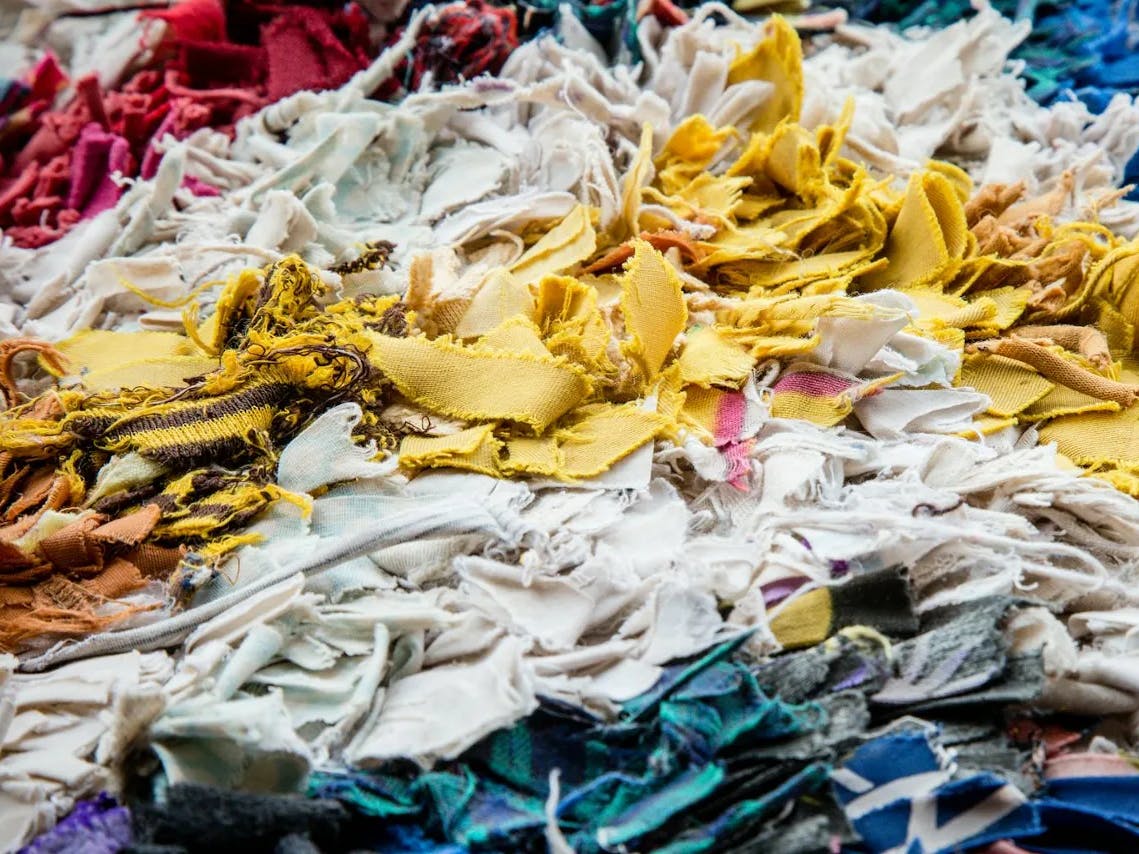
The shredded output is a loose, fibrous material ready for downstream use. Fiber length, bulk density, and contamination level determine viable end applications.
Watch how the dual-shaft textile shredder processes garments, carpet, and fiber-rich scrap.
These are the main feed categories where a textile-specific shredder route is preferred over a general-purpose machine.
Denim, cotton blends, polyester, mixed fiber garments, and off-spec production shredded for insulation, padding, or fiber recovery.
Tufted carpet, loop pile, tile backing, and rolled carpet scrap processed into fiber for automotive, construction, and padding applications.
Factory trimmings, roll ends, and production rejects from weaving and knitting operations reduced for fiber recycling or RDF.
Spunbond, meltblown, and needlepunch nonwoven scrap from hygiene, filtration, and packaging industries shredded for reclaim or waste-to-energy.
Foam-backed fabric, upholstery panels, mattress covers, and filling materials processed for volume reduction and fiber recovery.
Oil-soaked rags, wiping cloths, and mixed industrial textile scrap shredded for thermal recovery or secondary fiber use.
| Model | Typical Feed | Throughput | Motor Power | Feed Opening | Shaft Speed | Blade Type |
|---|---|---|---|---|---|---|
| TW-500 | Light garments, fabric scraps, nonwoven rolls | 200–500 kg/h | 2 × 11 kW | 600 × 500 mm | 15–25 rpm | Rotatable square knives |
| TW-800 | Garments, woven bags, carpet tiles, mixed textiles | 400–800 kg/h | 2 × 18.5 kW | 900 × 700 mm | 15–25 rpm | Rotatable square knives |
| TW-1200 | Carpet, upholstery, heavy woven, industrial rags | 700–1,200 kg/h | 2 × 30 kW | 1,200 × 900 mm | 12–20 rpm | Heavy-duty alloy steel |
| TW-2000 | High-volume carpet, industrial textile, mixed fiber waste | 1,500–2,000 kg/h | 2 × 45 kW | 1,500 × 1,000 mm | 12–20 rpm | Tungsten carbide insert |
Throughput figures are planning references for clean, loosely packed feed. Wet material, dense carpet backing, and heavily contaminated feeds reduce effective throughput. Blade maintenance intervals depend on carpet abrasive content and synthetic fiber ratio. All models feature dual-shaft counter-rotating design with auto-reverse and overload protection.
Material type, contamination level, and output use are more important inputs than requesting a motor size.
Specify whether the primary feed is garments, carpet (tufted or hard-back), woven sacks, nonwoven rolls, upholstery, or mixed post-consumer textile. This determines rotor type, shaft speed, and blade configuration.
Wet, oil-contaminated, or mixed-material feeds require different blade intervals and may affect shaft sealing requirements. Describe contamination levels clearly before RFQ.
If output goes to insulation, spinning, automotive stuffing, or thermal recovery, specify the target fiber length range. If volume reduction alone is the goal, state that so screens can be omitted or sized accordingly.
State target kg/h and whether shredded fiber goes to bagging, baling, conveying, or a fiber-processing line. Downstream equipment determines discharge height, opening size, and transfer method.
| Decision Criteria | Standard Single-Shaft Shredder | Rumtoo Textile Shredder |
|---|---|---|
| Rotor Design | Single rotor with screen, prone to wrapping on fiber-rich feed | Dual-shaft counter-rotation with anti-wrap geometry |
| Shaft Speed | Higher rpm creates friction heat on low-melting synthetics | Low-speed design reduces heat buildup on polyester, nylon, and blends |
| Feed Form | Works best on rigid, loose, or pre-cut feed | Handles loose bundles, rolls, tangled garments, and bagged textile |
| Blade Selection | Standard selection for plastics or general waste | Material-matched blade and maintenance intervals for carpet abrasion and fiber types |
Not always. Screens can be added to target a defined fiber length range, but many textile shredding applications do not require one. Volume reduction, bulk density improvement, and downstream handling are often the primary goals, which do not require tight particle size control.
Some single-shaft machines can process lighter textile waste under controlled conditions, but they are generally more prone to wrapping, synthetic fusing, and overload on dense carpet or woven feed. Dual-shaft machines are more commonly selected for textile-specific lines.
Hardened alloy steel blades are standard. For carpet with high calcium carbonate or PVC backing content, blades with tungsten carbide wear inserts are recommended to extend blade life. Maintenance intervals depend on the specific carpet abrasive profile.
Wet textiles can be processed, but moisture affects throughput and may require attention to shaft sealing and drainage. State moisture level and feed form when requesting machine sizing so the configuration accounts for wet conditions.
The machine is configured with auto-reverse and overload protection. Hard contaminants should be removed upstream. A metal detector or magnetic separator before the shredder is strongly recommended for post-consumer garment or carpet streams.
Blade maintenance intervals vary by feed type. Light garments and clean nonwoven may allow 500–800 operating hours between blade service. Carpet with calcium carbonate or PVC backing can reduce this to 200–400 hours. Rotatable square knives can be turned four times before replacement, extending consumable life significantly.
The TW-500 requires approximately 2.5 × 2 m of floor space including maintenance clearance. The TW-2000 requires approximately 4.5 × 3 m. Hopper height and discharge conveyor routing should be planned in addition to the machine footprint. Contact Rumtoo with your facility layout for integration recommendations.
In some cases, yes, but it depends on fiber length control and contamination level. If the target is spinning or nonwoven reprocessing, a screen should be specified to control output fiber length within the required range. A secondary cleaning or dedusting step may also be needed for post-consumer feeds with high contamination.
Send your textile type, carpet type, contamination level, target fiber length or output use, and throughput target. Rumtoo will recommend a shaft configuration, blade type, and line interface suited to your feed stream.
Request Textile Shredder Proposal