· Rumtoo Process Team · Technical Guide · 12 min read
Setting Up a Circular Economy Lab for Universities: Equipment, Layout, and Curriculum Guide
A practical guide for university lab managers and sustainability directors who want to build a functional plastic recycling lab on campus. Covers equipment stations, three budget-tier configurations, space and safety requirements, curriculum integration, and funding strategies.
The polymer science department at a mid-sized European university was spending €4,200 per year on raw pellets and filament for student lab exercises — injection molding samples, tensile test specimens, 3D printing projects. At the same time, the department was paying a waste contractor to haul away roughly 320 kg of plastic scrap annually. The same material, moving in two opposite directions at the department’s expense.
In the autumn 2025 semester, two faculty members proposed a different arrangement. Instead of buying virgin material and discarding used material, they would process the department’s own plastic waste back into usable feedstock on-site. They needed three things: a shredder to reduce scrap to regrind, an extruder to compound or reshape the material, and a structured workflow that students could operate safely as part of their coursework.
Eight months later, the lab is processing roughly 25 kg of plastic per month, their virgin material purchases have dropped by 40%, and four courses across two departments now use the recycling stations as teaching infrastructure. The total equipment investment was under €9,000.
This guide explains how to replicate that kind of setup — or a smaller or larger version of it — at your university. It covers the core equipment stations, three budget configurations from minimal to comprehensive, how to connect the lab to existing courses, and the practical details of space, power, ventilation, and safety that university procurement offices actually ask about.
Why Universities Are Investing in On-Campus Recycling Labs
University sustainability offices report that plastic waste from STEM labs, makerspaces, and fabrication workshops accounts for 5–15% of total campus solid waste by volume. A 2024 survey by the Association for the Advancement of Sustainability in Higher Education (AASHE) found that 68% of member institutions have active waste reduction targets — but fewer than 12% have operational infrastructure to recycle plastics on-site.
Three forces are pushing that number upward:
Student demand is concrete and measurable. Sustainability-related course enrollment has increased 34% across US universities since 2020, according to the National Center for Education Statistics. Students want hands-on experience with circular economy principles, not just theory. A functioning recycling lab gives departments a tangible answer to the question “What are we actually doing about sustainability?”
Research funding favors circular economy projects. The NSF’s Partnerships for Innovation (PFI) program, the EU’s Horizon Europe Cluster 6, and multiple national-level green transition funds explicitly prioritize circular economy research. A working lab with established processes strengthens grant applications by demonstrating institutional capability.
Campus green certifications require measurable outcomes. STARS (Sustainability Tracking, Assessment & Rating System) awards credit for waste diversion infrastructure. LEED v4.1 for Existing Buildings includes materials management credits. A recycling lab produces documentable metrics — kg diverted, energy saved, material reused — that feed directly into certification applications.
Core Equipment Stations for a University Recycling Lab
A functional circular economy lab requires between one and four processing stations, depending on your goals and budget. Each station handles a specific step in the material recovery process.
Station 1 — Size Reduction (Shredding)
Every recycling workflow starts with size reduction. Plastic parts — failed 3D prints, injection molding sprues, cut-off samples, packaging waste collected from campus — must be reduced to uniform particles (typically 3–8 mm) before any further processing.
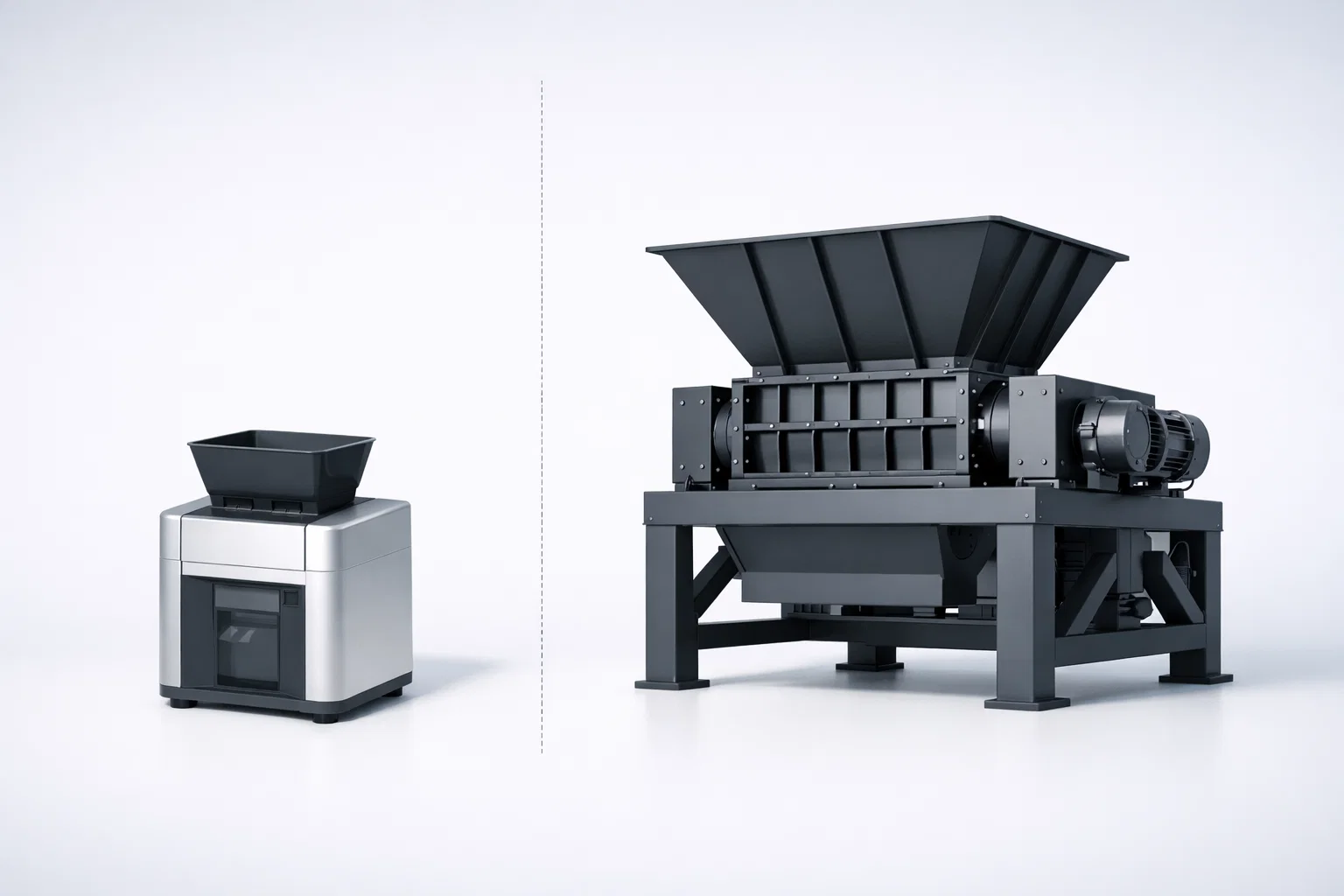
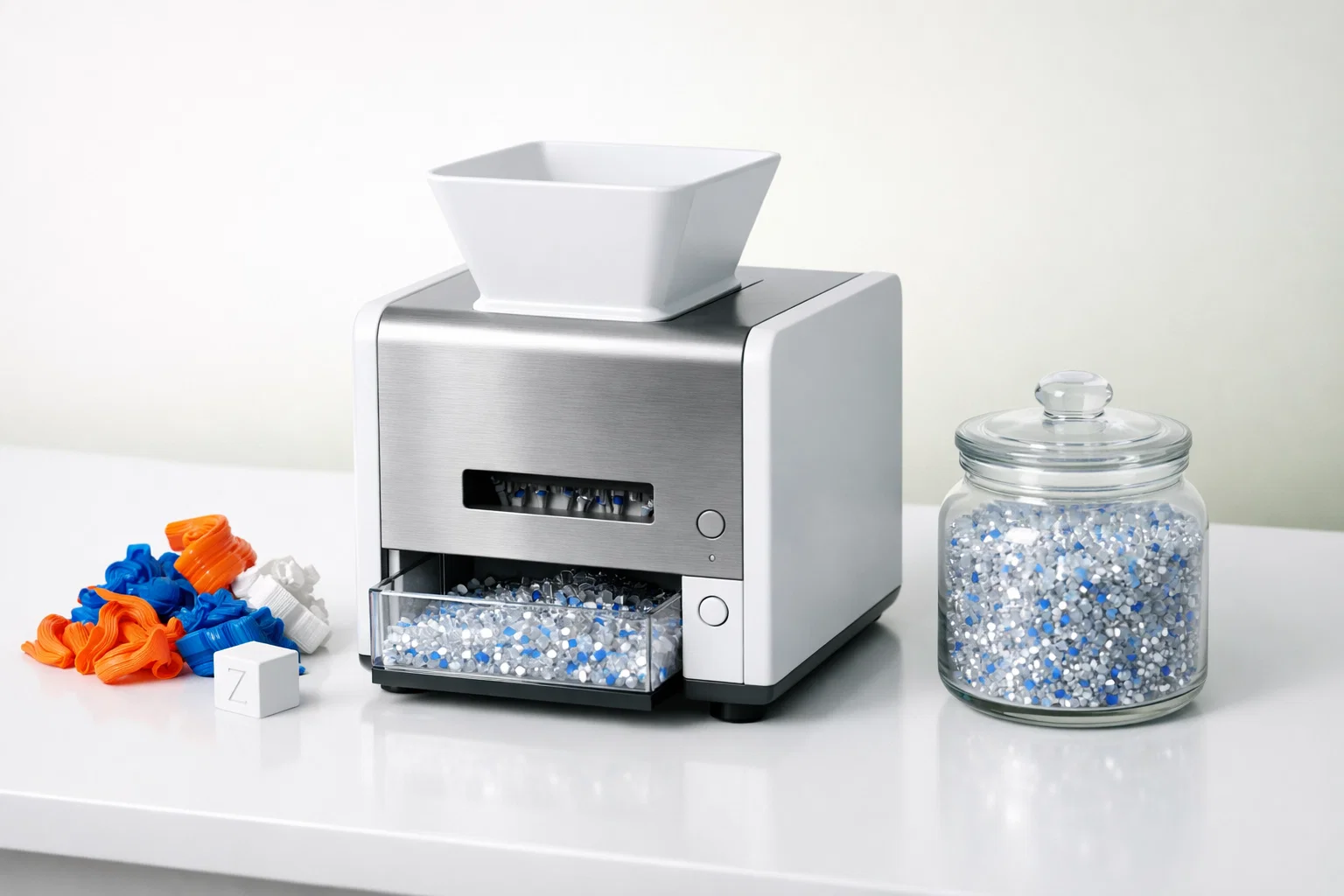
A mini desktop plastic shredder is the right scale for most university labs. At 1–5 kg/h throughput, it handles the waste volumes that campus facilities actually generate (typically 10–50 kg/month) without the noise, electrical requirements, or safety overhead of industrial equipment. Operating at under 55 dB — roughly the volume of a normal conversation — it runs comfortably in shared lab spaces and classrooms without acoustic enclosures or hearing protection.
Key features to look for in a lab-grade shredder: forward/reverse motor control (for clearing jams without opening the cutting chamber), interchangeable knife sets (to adjust output particle size for different downstream processes), and single-phase 220V power (to avoid costly three-phase electrical upgrades in existing lab buildings).
Station 2 — Material Compounding and Extrusion
Once plastic is shredded, the regrind can be melted and reshaped. For university labs, a laboratory twin-screw extruder is the most versatile option at this station. Twin-screw extruders handle blending, compounding, and pelletizing — allowing students and researchers to mix recycled regrind with additives, colorants, or virgin polymer to create custom material formulations.
This station transforms the lab from a simple waste-reduction operation into a materials research facility. Students can study melt flow behavior, measure the effect of recycling passes on mechanical properties, test filler loading ratios, and produce standardized pellets for downstream testing — injection molding, film blowing, or 3D printing.
Station 3 — Filament Production (Closed-Loop Output)
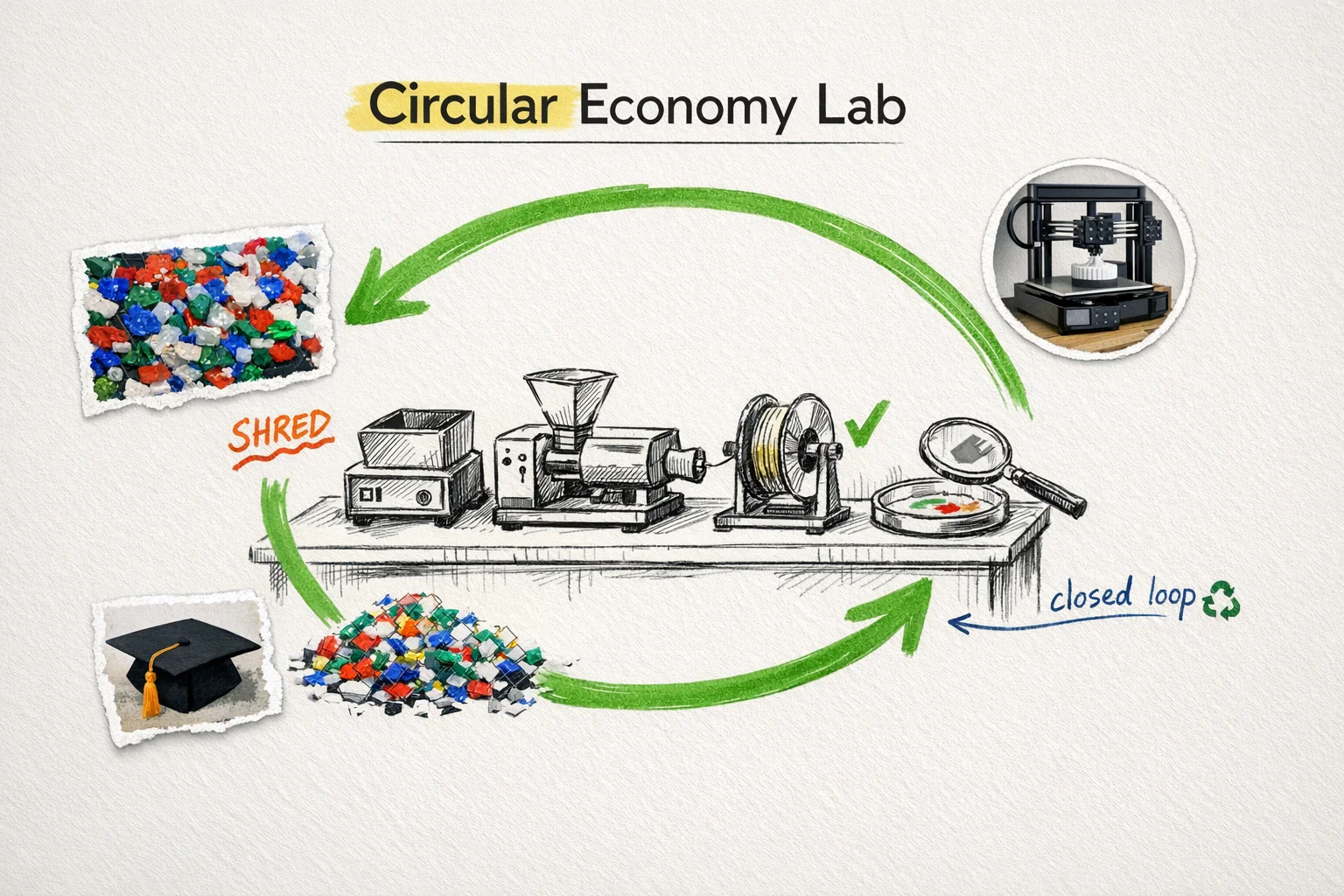
For labs connected to 3D printing operations, a desktop filament extruder closes the loop entirely: campus plastic waste becomes printable filament that feeds back into the same printers that generated the waste.
The complete shred-to-spool workflow is covered in detail in our filament recycling workflow guide. In brief: shredded regrind feeds into the filament extruder hopper, gets melted and drawn through a precision die, passes through a diameter control system, and winds onto a spool. The output is 1.75 mm or 2.85 mm filament ready for FDM printing.
Station 4 — Quality Testing and Sorting
The final station is not a single machine but a workbench equipped for material identification and quality control. At minimum, this includes:
- A digital caliper and micrometer for measuring particle size and filament diameter
- A basic moisture meter or lab oven for drying verification
- Sorting bins labeled by polymer type (PLA, PETG, ABS, PP, PE)
- A simple melt flow indexer if budget allows (useful for research-grade work)
For labs that process mixed campus waste streams, a handheld NIR (near-infrared) plastic identifier eliminates guesswork in polymer sorting — though at $3,000–8,000, this is a later-stage investment.
Three Lab Configurations by Budget and Space
Not every university needs a full four-station setup from day one. The table below shows three practical configurations, each matched to a specific budget range, physical footprint, and use case.
| Configuration | Equipment | Footprint | Budget Range | Best For |
|---|---|---|---|---|
| Starter | Mini desktop shredder + sorting bins + drying station | ~1–2 m² bench space | $2,000–4,000 | Sustainability demos, waste auditing, producing regrind for external use |
| Standard | Shredder + filament extruder + QC bench | ~3–5 m² | $5,000–9,000 | Closed-loop 3D printing labs, makerspace recycling programs |
| Research | Shredder + lab twin-screw extruder + filament extruder + QC bench | ~8–10 m² | $12,000–22,000 | Materials science R&D, compounding research, grant-funded programs |
The Starter configuration is a low-risk entry point. A single shredder processes campus plastic waste into clean regrind that can be used for injection molding exercises, donated to local makerspaces, or stockpiled until the lab expands to include extrusion capability.
The Standard configuration suits departments that operate 3D printing facilities and want to close the material loop. The combination of shredder and filament extruder fits on a single lab bench and produces filament from campus waste within the same day.
The Research configuration adds compounding and pelletizing capability through the twin-screw extruder. This is the setup that supports funded research projects, graduate thesis work, and multi-department use. Our desktop & R&D units page lists the full equipment range available for this tier.
All three configurations run on single-phase 220V power and require no special foundations, compressed air, or cooling water — a meaningful advantage in university buildings where infrastructure modifications need facility committee approval and can delay projects by 6–12 months.
Integrating the Lab into University Curricula
A recycling lab that only runs when a sustainability coordinator remembers to process the week’s scrap will not survive the first budget review. The labs that endure are the ones embedded into teaching — where student enrollment creates a recurring, defensible use case.
Materials Science and Engineering — Students process recycled polymers through multiple thermal cycles and measure tensile strength, elongation at break, and melt flow index after each pass. This directly teaches polymer degradation kinetics with physical data students generate themselves rather than read from a textbook.
Environmental Science and Sustainability Studies — The lab becomes a life cycle assessment (LCA) case study. Students weigh incoming waste, measure energy consumption at each processing station, quantify material yield, and calculate the carbon footprint delta between recycling on-campus and landfilling. The output is a publishable LCA dataset, not a hypothetical exercise.
Mechanical and Industrial Engineering — Design-for-recycling projects challenge students to design parts that are easier to disassemble, sort, and reprocess. Testing their designs on actual recycling equipment — shredding their own prototypes and attempting to re-extrude the material — creates feedback loops that pure CAD-based coursework cannot replicate.
Business and Entrepreneurship — Circular economy business model courses can use the lab to prototype product-service systems. Students have modeled campus filament-as-a-service programs, calculated break-even points for small-scale recycling operations, and pitched campus waste-to-product ventures in university accelerator competitions.
A single lab installation can serve 4–6 courses per semester across multiple departments, making the per-student equipment cost comparable to a standard chemistry or physics lab.
Funding Your Lab: Grants, Budgets, and ROI
University recycling labs occupy a rare overlap between facilities budgets, academic budgets, and sustainability budgets — which means they can be funded from multiple sources simultaneously.
Internal funding routes include campus sustainability fees (now collected at over 100 US universities), green revolving funds, departmental equipment budgets, and provost-level strategic initiative funds tied to sustainability goals.
External grants targeting circular economy research include NSF’s Partnerships for Innovation (PFI-TT and PFI-RP tracks), EPA’s Pollution Prevention grants, the EU Horizon Europe Cluster 6 “Food, Bioeconomy, Natural Resources, Agriculture and Environment” calls, and national-level green transition funds in many countries.
ROI calculation for procurement justification:
| Factor | Starter Config | Standard Config | Research Config |
|---|---|---|---|
| Equipment cost | $2,000–4,000 | $5,000–9,000 | $12,000–22,000 |
| Annual filament/pellet savings | $500–1,200 | $1,500–3,600 | $3,000–6,000 |
| Waste hauling cost avoided | $200–600 | $200–600 | $400–1,200 |
| Courses served per year | 1–2 | 2–4 | 4–8 |
| Equipment payback (savings only) | 2–4 years | 2–3 years | 2–4 years |
When educational value and grant eligibility are factored in, most departments justify the investment within one academic year. Several universities have reported that the lab’s existence was cited as supporting infrastructure in successful grant applications worth 10–50× the equipment cost.
Safety, Compliance, and Daily Operations
University health and safety committees will review any new lab equipment. The approval process is straightforward for desktop-scale recycling equipment because the risk profile is far lower than the industrial machinery that safety committees are accustomed to reviewing.
Noise: The mini desktop shredder operates below 55 dB — quieter than a typical fume hood. No acoustic enclosures needed. Compare this to industrial shredders at 80–105 dB that require dedicated rooms and hearing protection.
Electrical: Single-phase 220V, standard lab outlet. No three-phase upgrades, no dedicated circuit breakers beyond what a normal lab bench provides.
Ventilation: Processing ABS or other styrene-containing polymers requires local exhaust ventilation — a standard benchtop fume extraction arm is sufficient. PLA and PETG processing can run in normally ventilated lab spaces.
Operator training: Students operating the shredder and extruder need a 30–60 minute safety orientation covering: material sorting (no metal inserts), proper feed rate, emergency stop location, and PPE requirements (safety glasses, close-toed shoes). This is comparable to the training required for a bandsaw or drill press — equipment already common in engineering workshops.
Waste classification: Plastic regrind produced in the lab is classified as processed material, not waste, provided it is being used as feedstock in a downstream process. This distinction matters for campus waste reporting metrics.
For a deeper look at the processing workflow for 3D printing waste specifically, see our guide to recycling 3D printing waste with a desktop shredder.
Frequently Asked Questions
What types of plastic can a university recycling lab process?
The most commonly processed materials in university labs are PLA (from 3D printing), PETG, ABS, PP, and PE. A mini desktop shredder handles all of these with standard blade sets. Materials to avoid include fiber-filled composites (carbon fiber PLA causes rapid blade wear), flexible TPU (wraps around rotors), and any parts with embedded metal inserts. Detailed material compatibility information is available in our 3D printing waste recycling guide.
How much space does the lab actually need?
A single shredder station requires roughly 1 m² of bench space plus clearance for the operator. A complete shredder + extruder setup fits in 3–5 m². The full research configuration with compounding, filament production, and QC needs 8–10 m². All equipment sits on standard lab benches — no floor-mounted foundations or bolting required.
Can students operate the equipment safely?
Yes. Desktop-scale recycling equipment carries a risk profile comparable to common workshop tools like bandsaws and drill presses. A 30–60 minute safety orientation covers proper operation, material sorting rules, and emergency procedures. Universities including Lapland UAS in Finland and multiple US engineering programs have successfully run student-operated recycling stations as part of credited coursework.
How does this differ from Precious Plastic or other DIY setups?
The Precious Plastic project provides open-source plans for building recycling machines from scratch — a valuable educational exercise in itself. The trade-off is build time (40–100+ hours), variable build quality, and ongoing maintenance challenges. Purpose-built equipment like the Rumtoo desktop & R&D series is designed for institutional daily use: consistent output, swappable blade sets, rated duty cycles, and manufacturer support. Most universities that start with DIY machines eventually transition to commercial equipment once the lab moves from proof-of-concept to regular curricular use.
What throughput can we expect from desktop equipment?
The mini desktop shredder processes 1–5 kg/h depending on material type and particle size setting. For a university generating 15–40 kg of plastic waste per month, that translates to 3–8 hours of shredding time per month — easily scheduled into one lab session per week. A desktop filament extruder produces 0.5–1.5 kg/h of finished filament, matching the shredder’s output rate.
What funding sources specifically support university recycling labs?
In the US, NSF PFI grants, EPA P2 grants, and institutional green revolving funds are the most common sources. In the EU, Horizon Europe Cluster 6 and national circular economy transition funds apply. Many universities have also funded labs through campus sustainability fees, alumni donations earmarked for sustainability, and equipment-sharing arrangements between departments.
Getting Started
If you are evaluating a circular economy lab for your university, the most productive first step is an inventory of your current plastic waste streams — material types, monthly volumes, and which departments generate them. That data determines which configuration makes sense, what the payback timeline looks like, and whether you can justify the equipment on waste savings alone or need to build the case around educational and research value.
Send your material list, estimated volumes, and target use case (teaching, research, or both) to the Rumtoo process team. We will recommend a specific equipment configuration matched to your throughput, space, and curriculum requirements — from a single desktop shredder to a full research-grade recycling line.
Related pages:
- Mini Desktop Plastic Shredder — Specifications & Configuration
- Laboratory Twin-Screw Extruder
- Desktop Filament Extruders
- Desktop & R&D Units — Full Range
- How to Recycle 3D Printing Waste with a Desktop Shredder
- From Scrap to Spool: Filament Recycling Workflow
- Desktop Shredder vs Industrial Shredder
- 3D Printing Waste Circularity
- circular economy
- university recycling lab
- lab equipment
- desktop shredder
- sustainability education