
· Rumtoo Engineering Team · Buying Guides · 6 min read
EPS Foam Recycling: How to Turn Styrofoam Waste into Dense, Sellable Blocks
EPS foam is almost all air, so the cost of recycling it is the cost of moving that air. This guide explains why expanded polystyrene is hard to recycle, how cold-press and hot-melt densifiers shrink it 40 to 90 times, what the compacted blocks are worth, and how to choose the right machine for your volume.
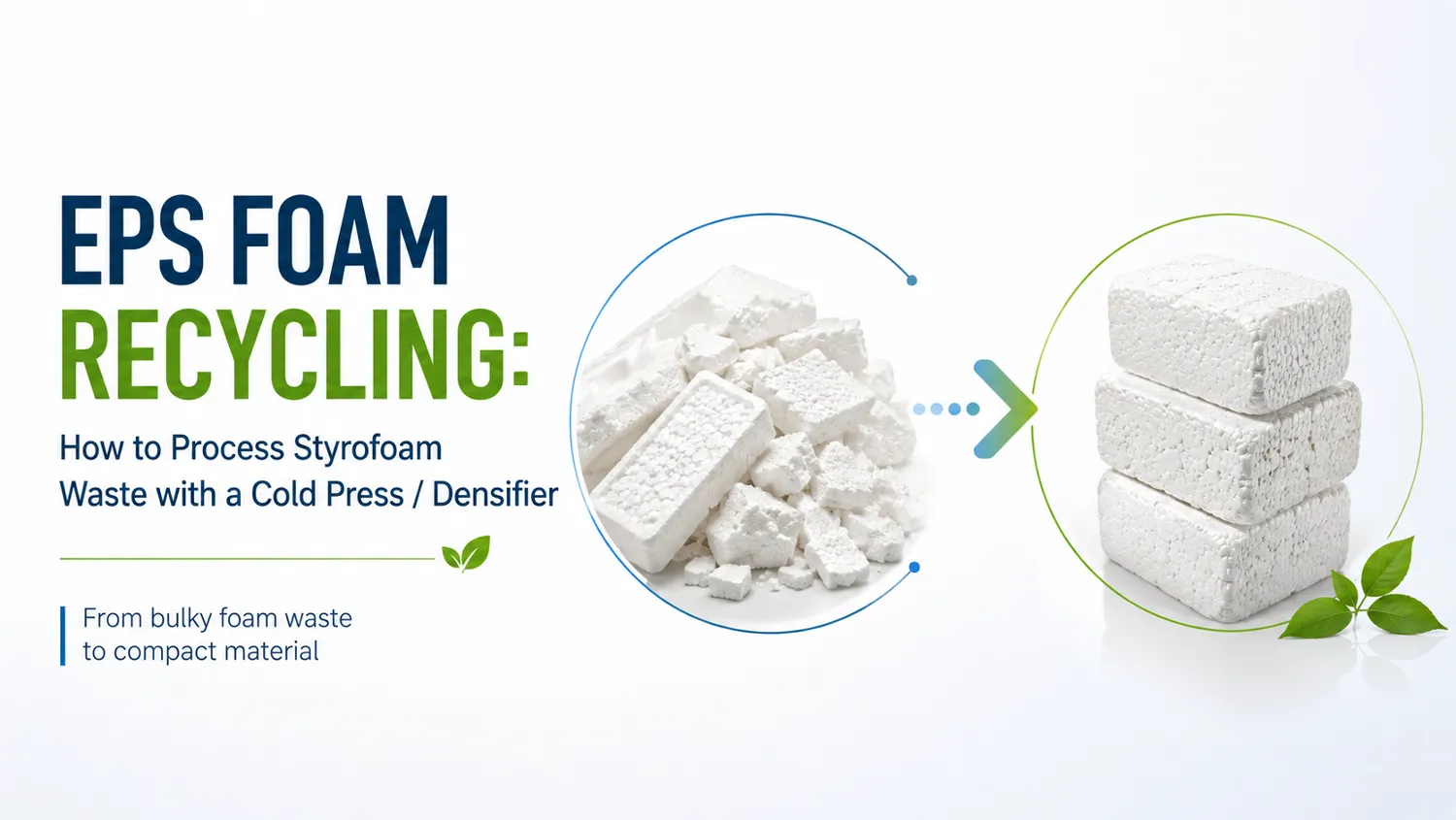
EPS foam recycling comes down to one problem: expanded polystyrene is roughly 98% air, so a truckload of loose foam carries almost no plastic. You cannot ship air economically, which is why most EPS ends up in landfill even though the polystyrene inside it is fully recyclable. The fix is volume reduction — compacting the foam into dense blocks or ingots before it leaves your site. This guide explains how that works, what the output is worth, and how to pick the machine that matches your volume.
Why is EPS foam hard to recycle?
EPS foam is hard to recycle because of its density, not its chemistry. Loose expanded polystyrene weighs only about 10–30 kg per cubic meter — the rest is trapped air. The polystyrene itself recycles well, but a 40-cubic-meter trailer of loose foam might hold only a few hundred kilograms of actual plastic, so freight cost per kilogram of recovered material is impossible to justify.
That single fact shapes the whole process. Before EPS can move to a pelletizer or a buyer, you have to drive the air out and pack the polystyrene tight. Recyclers that solve the volume problem at source turn a waste-disposal cost into a sellable commodity; those that do not keep paying to landfill clean, recoverable plastic.
EPS shows up as packaging foam, fish boxes, appliance protectors, and construction insulation offcuts. All of it is the same material — the question is only how to compress it cost-effectively.
How EPS densification works
Densification removes the air and fuses the polystyrene into a transportable form. Two methods dominate, and they produce different output at different cost.
| Method | How it works | Compression ratio | Output |
|---|---|---|---|
| Cold press / compaction | Mechanical screw or ram compresses foam under pressure, no heat | 40:1 to 50:1 | Dense compressed blocks or bales |
| Hot melt (thermal densifier) | Foam is heated and melted into solid ingots | up to 90:1 | Hard polystyrene ingots / logs |
A cold press uses pressure alone. A feed system crushes the foam, then a press compacts it into firm blocks at a compression ratio around 40:1 to 50:1. Because no heat touches the polymer, the material keeps its properties and reprocesses cleanly. A cold-press line runs on less energy and produces no melt fumes, which is why it suits operations recovering clean packaging EPS for resale.
A hot-melt densifier heats the foam until it collapses into a dense ingot, reaching ratios up to 90:1. The blocks are smaller and heavier per unit, but heat degrades the polystyrene slightly and releases odor, so melted ingots usually sell at a lower grade than cold-pressed material.
Key takeaway: Cold pressing protects material quality and runs cleaner; hot melting reaches a higher compression ratio but trades polymer grade and adds fumes. Match the method to whether you are selling clean resin or just cutting disposal volume.
How a cold press machine processes EPS
A cold press machine turns loose foam into transport-ready blocks in three steps:
- Feed and pre-crush. Loose EPS enters a hopper where a rotor breaks it into smaller pieces, removing the bulk air pockets.
- Compaction. A screw or hydraulic ram presses the crushed foam under steady pressure, squeezing it into a continuous dense block or discrete bales.
- Discharge. The machine ejects firm blocks that hold their shape for stacking, palletizing, and shipping.
The same principle that drives densifiers across plastic recycling applies here: pack the material tight at source so every freight kilometer carries plastic instead of air. A cold press is the EPS-specific version of that idea.
What is recycled EPS worth?
Compacted EPS becomes feedstock, not waste. After densification, the blocks or ingots go to a pelletizer and are reprocessed into recycled general-purpose polystyrene (GPPS). That recovered resin has real end markets:
- Picture frames and photo frames — one of the largest uses of recycled PS, made by extruding the resin into framing profile.
- Decorative moldings and skirting — interior trim extruded from recycled PS.
- Insulation and packaging — re-expanded or compounded back into new protective foam.
- Hangers, rulers, and molded goods — injection-molded items from recovered GPPS.
The economics flip once the air is gone. A site shipping 50:1 compressed blocks moves the same recovered plastic in a fiftieth of the trailers, which is the difference between paying to dispose of foam and being paid for it.
Choosing an EPS recycling machine
Size the machine to your incoming volume and your output goal, not to a single headline number.
| Selection factor | What to check |
|---|---|
| Throughput | Match the press to how much loose EPS you generate per shift, measured in cubic meters, not just weight. |
| Cold press vs hot melt | Cold press for clean resin resale and lower energy; hot melt for maximum volume reduction when grade matters less. |
| Block format | Continuous blocks suit high volume; baled output suits intermittent feed and easier handling. |
| Contamination | Tape, labels, and dirt lower the grade of recovered PS — cleaner infeed sells higher. |
| Footprint and power | Cold-press lines need less power than melt systems but more floor space for the feed and discharge. |
For most recyclers handling clean packaging and insulation EPS, a cold press is the practical entry point: lower running cost, no melt emissions, and output that reprocesses into resin without thermal damage.
Frequently Asked Questions
Can EPS foam be recycled?
Yes. Expanded polystyrene is fully recyclable as a polymer. The barrier is its volume, not its material — EPS is about 98% air, so it must be compacted into dense blocks or ingots before it can be shipped and reprocessed into recycled polystyrene economically.
What machine recycles EPS foam?
An EPS densifier — either a cold press (compaction) or a hot-melt densifier — reduces the foam’s volume so it can be transported and pelletized. A cold press compacts the foam mechanically at around 40:1 to 50:1; a hot-melt unit reaches up to 90:1 by melting it into ingots.
What is the difference between a cold press and a hot melt EPS densifier?
A cold press compresses EPS with pressure alone, keeping the polymer’s quality and producing no melt fumes, at roughly 40:1 to 50:1. A hot-melt densifier heats the foam into dense ingots up to 90:1, but the heat lowers the resin grade and creates odor. Cold pressing favors clean resin resale; hot melting favors maximum volume cut.
What is recycled EPS used for?
Recycled EPS is reprocessed into general-purpose polystyrene and made into picture frames, decorative moldings, skirting, hangers, insulation, and molded plastic goods. Picture-frame profile is one of the highest-volume end markets for recovered polystyrene.
How much does EPS shrink when compacted?
A cold press reduces EPS volume by about 40 to 50 times; a hot-melt densifier can reach up to 90 times. A 50:1 ratio means fifty trailers of loose foam ship as one trailer of compacted blocks.
Turn foam volume into recovered resin
EPS foam recycling works the moment you remove the air at source. Compacting loose foam into dense blocks converts a freight problem into a sellable polystyrene commodity, and the method you pick — cold press or hot melt — decides whether you are protecting resin grade or chasing maximum volume reduction.
If you handle EPS packaging, fish boxes, or insulation offcuts and want the volume gone before it leaves your yard, send Rumtoo your foam type and daily volume. We will recommend an EPS foam cold press machine sized to your output and tell you whether cold pressing or melting fits your end market. Contact our engineering team for a tested recommendation.
- eps foam recycling
- styrofoam recycling
- eps densifier
- foam compactor
- cold press machine