
· Rumtoo Engineering Team · Process Engineering · 9 min read
Plastic Film Recycling Machine: Complete Process Guide for PP/PE Film Washing Lines
A detailed process engineering guide for plastic film recycling machines — covering shredding, hot washing, separation, dewatering, and the critical control points that determine output quality for PP/PE film, agricultural film, and woven bags.
Recycling rigid plastics like PET bottles is relatively straightforward: the material is dense, it sinks in water, and it flows predictably through mechanical processes. Film recycling is a different animal entirely.
A recycler in rural Vietnam learned this when they attempted to repurpose their existing PET washing line for agricultural PE film. The film immediately wrapped around screw conveyors, clogged the friction washers, and floated unpredictably in their sink-float tanks. Within two days, they shut the line down. The core problem was fundamental: flexible film behaves nothing like rigid flake, and every stage of the process — from size reduction to dewatering — must be specifically engineered for its unique physical properties.
Six months later, after installing a purpose-built PP/PE film washing and recovery line, the same facility was processing 1,200 kg/hr of mixed agricultural film with 85% clean output yield. The difference was not magic; it was process engineering.
This guide walks through the complete PP/PE film washing process, stage by stage, with the engineering details that determine whether your line produces premium pellet-ready feedstock or low-grade material that no extruder wants.
Why Film Recycling Requires a Dedicated Process
PP and PE films (stretch wrap, agricultural mulch film, greenhouse cover, shopping bags, industrial packaging) share characteristics that make them uniquely challenging:
- Low bulk density (30–80 kg/m³ vs. 300–500 kg/m³ for rigid flake) — film takes up enormous volume relative to its weight, requiring oversized equipment and conveyors
- High surface-to-mass ratio — contamination (dirt, sand, organic residue) adheres stubbornly and requires aggressive washing
- Tendency to tangle and wrap — shredded film readily wraps around shafts, screws, and impellers if the equipment isn’t designed to prevent it
- Floats in water (SG 0.91–0.96) — unlike PET, film floats, which means sink-float separation works differently and drying is more difficult because centrifugal force is less effective on lightweight material
These properties mean that a washing line designed for rigid plastics will fail catastrophically when processing film. Every stage must be purpose-engineered.
Stage 1: Pre-Sorting and Shredding
Bale Breaking and Foreign Object Removal
Film bales are notoriously unpredictable. Agricultural film bales may contain rocks, metal wire, fence posts, and significant quantities of embedded soil. Industrial stretch wrap bales are typically cleaner but can include wooden pallets, strapping bands, and tape.
A magnetic separator and manual pre-sort station should precede the shredder. Budget for 1–2 operators on pre-sort for a 1,000+ kg/hr line. This small labor investment prevents catastrophic damage to downstream cutting equipment.
Shredding
Film shredding requires a fundamentally different approach than rigid plastic crushing. A single-shaft industrial shredder with a hydraulic ram is the standard first-stage reducer for film. The key specifications to get right:
- Rotor speed: Slow (15–30 RPM) to prevent the film from wrapping around the rotor
- Screen size: 40–80mm for first-stage reduction. Going too fine at this stage creates excessive dust and fines loss
- Hydraulic pusher: Essential for bale-fed operations; gravity feeding of light film is unreliable
For a second-stage size reduction to 15–25mm, a wet granulator (cutting the film while it’s submerged in water) is far more effective than dry cutting, because the water prevents the film from floating and wrapping around the blades.
Stage 2: Washing — The Heart of the Process
Washing is where the real value transformation happens. Dirty, contaminated film worth $50–$100/ton becomes clean film feedstock worth $300–$500/ton. The difference lies entirely in how effectively you remove contamination.
Pre-Wash (Cold Water)
A cold-water friction washer removes loose surface dirt, sand, and most free-floating debris. This stage protects the downstream hot-wash tanks from rapid contamination buildup. The friction washer uses high-speed rotating paddles (800–1,200 RPM) to create intense mechanical scrubbing action.
Key engineering detail: the water-to-material ratio in the friction washer matters enormously. Too little water and the abrasion is ineffective. Too much and the energy per unit area drops. Optimal ratio is typically 5:1 to 8:1 (water:film by weight).
Hot Wash (Caustic Solution)
For heavily contaminated feedstock (agricultural film, post-consumer packaging with food residue), a hot caustic wash at 70–90°C with 1–3% NaOH concentration is essential. The hot caustic dissolves adhesive residues, oils, organic films, and softens stubborn soil that cold washing alone cannot remove.
Rumtoo’s integrated washing systems feature insulated hot-wash tanks with automated caustic dosing, temperature control, and continuous agitation. Typical residence time: 15–25 minutes, depending on contamination severity.
Process Insight: Many operators try to compensate for inadequate washing by running the line slower. This is a false economy. If your hot wash is properly sized and your chemistry is correct, line speed should not be the quality lever. If you’re slowing down to meet quality specs, your washing stage is undersized.
Rinse Stage
After hot washing, film passes through one or two cold-water rinse stages to remove residual caustic. Insufficient rinsing leaves NaOH on the film surface, which causes yellowing and degradation during extrusion. Check rinse water pH — it should be below 8.5 at the exit of the final rinse stage.
Stage 3: Separation
Sink-Float for Contaminant Removal
Although PE and PP both float, a sink-float tank is still necessary to separate out heavier contaminants: sand, glass fragments, metal fines, PET label fragments, and rubber. Any material with SG >1.0 sinks and is removed by a bottom screw conveyor.
Label and Paper Removal
Paper labels and printed films often persist through washing. An additional friction washer after the sink-float tank breaks down remaining paper fibers, which are then flushed out with the wash water. This step is critical for film sourced from packaged consumer goods.
Stage 4: Dewatering and Drying — The Overlooked Bottleneck
Moisture control is the most underestimated challenge in film recycling. If clean film enters the densifier or squeezer too wet, you get poor compaction and inconsistent pellet quality. If it enters the extruder too wet, you get foaming, voids, and degraded mechanical properties.
Mechanical Dewatering
A screw press or squeeze dryer mechanically extracts the bulk of the water by compressing the film against a perforated screen. This stage typically reduces moisture from ~50% (after washing) to 10–15%.
Centrifugal Drying
A high-speed centrifugal dryer uses rotational force to fling water off the film surface. For rigid flakes this works brilliantly (down to ≤1% moisture), but lightweight film is harder to dewater. Expect 5–8% residual moisture after centrifugal drying for film.
Thermal Drying (Optional but Recommended)
To reach ≤3% moisture — the threshold most extruder manufacturers specify — a thermal dryer stage using hot air (80–120°C) is often required. This adds energy cost but dramatically improves downstream pelletizing quality and consistency.
Moisture targets by downstream process:
| Next Process | Target Moisture | Why |
|---|---|---|
| Densifier/Compactor | ≤8% | Higher moisture causes steam release and inconsistent agglomerate density |
| Single-screw extruder | ≤3% | Moisture causes foaming, voids, and melt instability |
| Twin-screw extruder (with vent) | ≤5% | Better moisture tolerance but still affected above 5% |
Stage 5: Densifying and Pelletizing
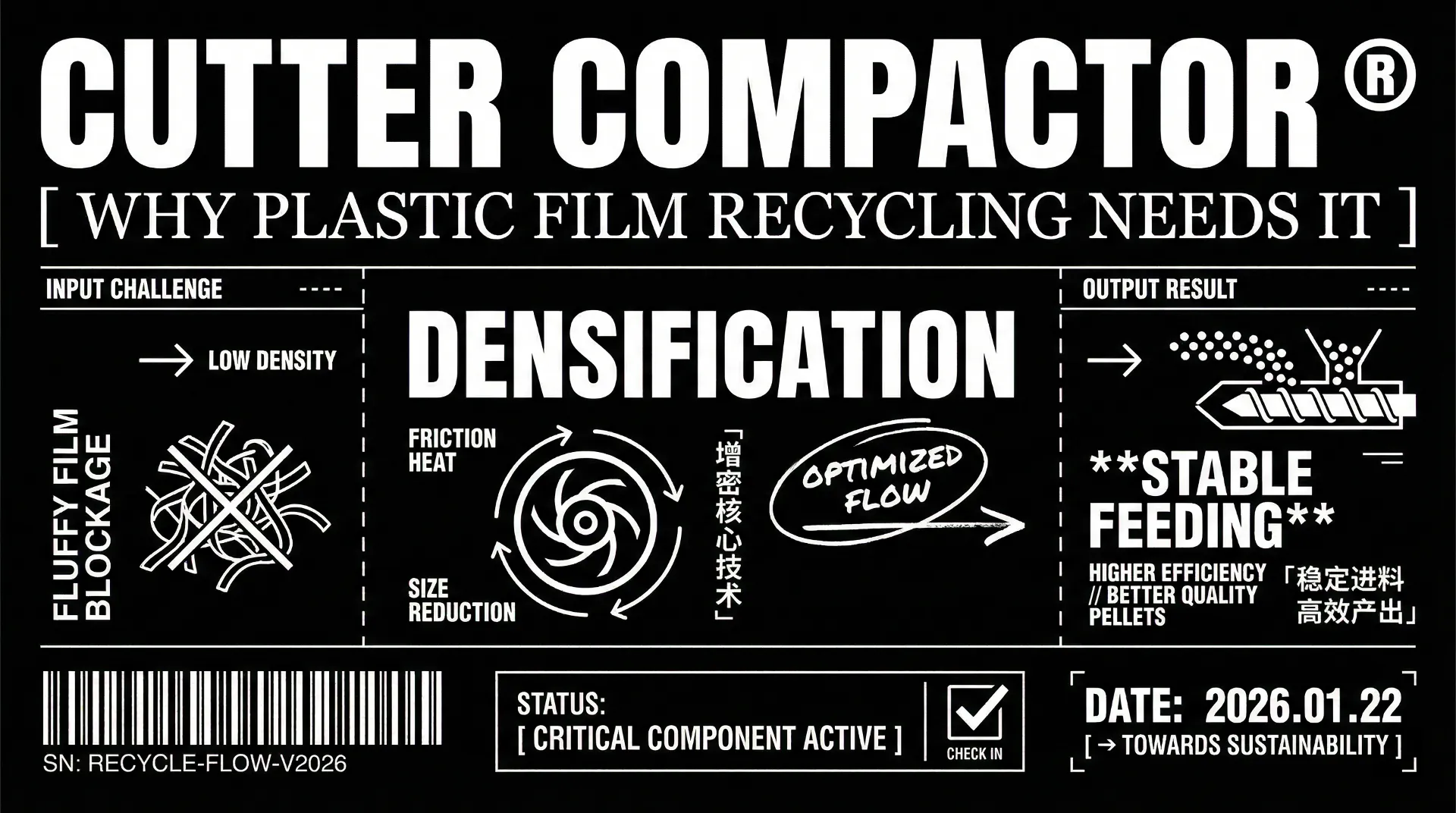
Clean, dry film is still too light and fluffy to feed directly into a standard pelletizing extruder. A densifier (also called a compactor or agglomerator) heats the film with friction until it semi-melts and collapses into dense, irregular granules with a bulk density of 250–400 kg/m³.
From the densifier, the material feeds directly into a pelletizing extruder that melts, filters, degasses, and cuts the polymer into uniform pellets. For film recycling, dual-stage vacuum degassing is particularly important because agricultural films often contain printing inks and other volatile compounds that must be extracted before the die head.
Water Loop Management: The Hidden Cost Driver
A film washing line consumes significant water. Without a properly designed closed-loop water system, fresh water costs and wastewater disposal fees can erase your profit margin.
Water balance for a typical 1,000 kg/hr film line:
| Parameter | Typical Value |
|---|---|
| Total water circulation | 30–50 m³/hr |
| Fresh water makeup | 2–4 m³/hr |
| Wastewater discharge | 2–4 m³/hr |
| Sludge production (wet) | 80–150 kg/hr |
Key design principles for the water system:
- Cascade reuse: Use the cleanest water for the final rinse, then reuse that water for the pre-wash. This halves your fresh water demand.
- Continuous filtration: A vibrating screen + settling tank + DAF system removes suspended solids and oils continuously, extending the water loop life.
- Sludge handling: Dirty water produces sludge. A dewatering press reduces sludge volume by 60–70%, cutting disposal costs dramatically.
Frequently Asked Questions
What is the minimum viable line for film recycling?
For a commercially viable operation, we recommend a minimum capacity of 500 kg/hr infeed. Below this, the fixed costs (labor, water treatment, overhead) make the economics very difficult. Lines in the 1,000–2,000 kg/hr range offer significantly better cost-per-ton performance due to scale efficiencies.
Can I process mixed PE and PP film together?
Yes, and most operators do. PE and PP have very similar densities (0.91–0.96 g/cm³) and melt temperature ranges, so they process well together through washing and are often pelletized as a PE/PP blend. However, if your buyer requires pure PE or pure PP pellets, you will need an additional near-infrared (NIR) sorting stage after shredding to separate the two polymers.
How do I handle printed and multi-layer films?
Printed films introduce ink contamination that discolors the final pellet. A combination of hot caustic washing (to dissolve surface inks) and dual-stage vacuum degassing in the extruder (to extract volatile ink solvents) handles most cases. True multi-layer barrier films (e.g., PE/EVOH/PE for food packaging) are extremely difficult to recycle into high-quality pellets and are best avoided unless you have a specific downstream buyer willing to accept the quality limitations.
What is the expected payback period for a film washing line?
Payback depends heavily on feedstock cost and local market pricing for clean pellets. In regions with strong film collection infrastructure (e.g., agricultural film programs in Europe), typical payback is 18–24 months. In markets where film is available cheaply but pellet prices are also lower, expect 24–36 months. Model conservatively and include a 15% contingency on capital cost.
How does a film line differ from a rigid plastic line?
Every stage is different. Film needs low-speed shredders (not high-speed crushers), more aggressive washing stages, float-based separation (instead of sink-based for PET), specialized mechanical dewatering, and a densifier before extrusion. You cannot simply “run film through a PET line” — the physics of flexible, low-density material demand purpose-built equipment at every stage.
Next Steps
If you’re evaluating a PP/PE film recycling project, start with your feedstock analysis. Contact the Rumtoo process team for a detailed discussion of your material stream, capacity goals, and site conditions. We provide process flow design, layout drawings, and utility specifications as part of every project consultation.
References
- plastic film recycling machine
- PP-PE film recycling
- film washing line
- agricultural film recycling
- process engineering