· Rumtoo Engineering Team · Process Engineering · 4 min read
Plastic Film Squeezer Technology: Why It Matters in Modern Film Recycling
Plastic film squeezer technology reduces moisture, increases bulk density, and stabilizes downstream extrusion. This guide explains how squeeze dryers work, where they fit in a recycling line, and how to evaluate them before buying.
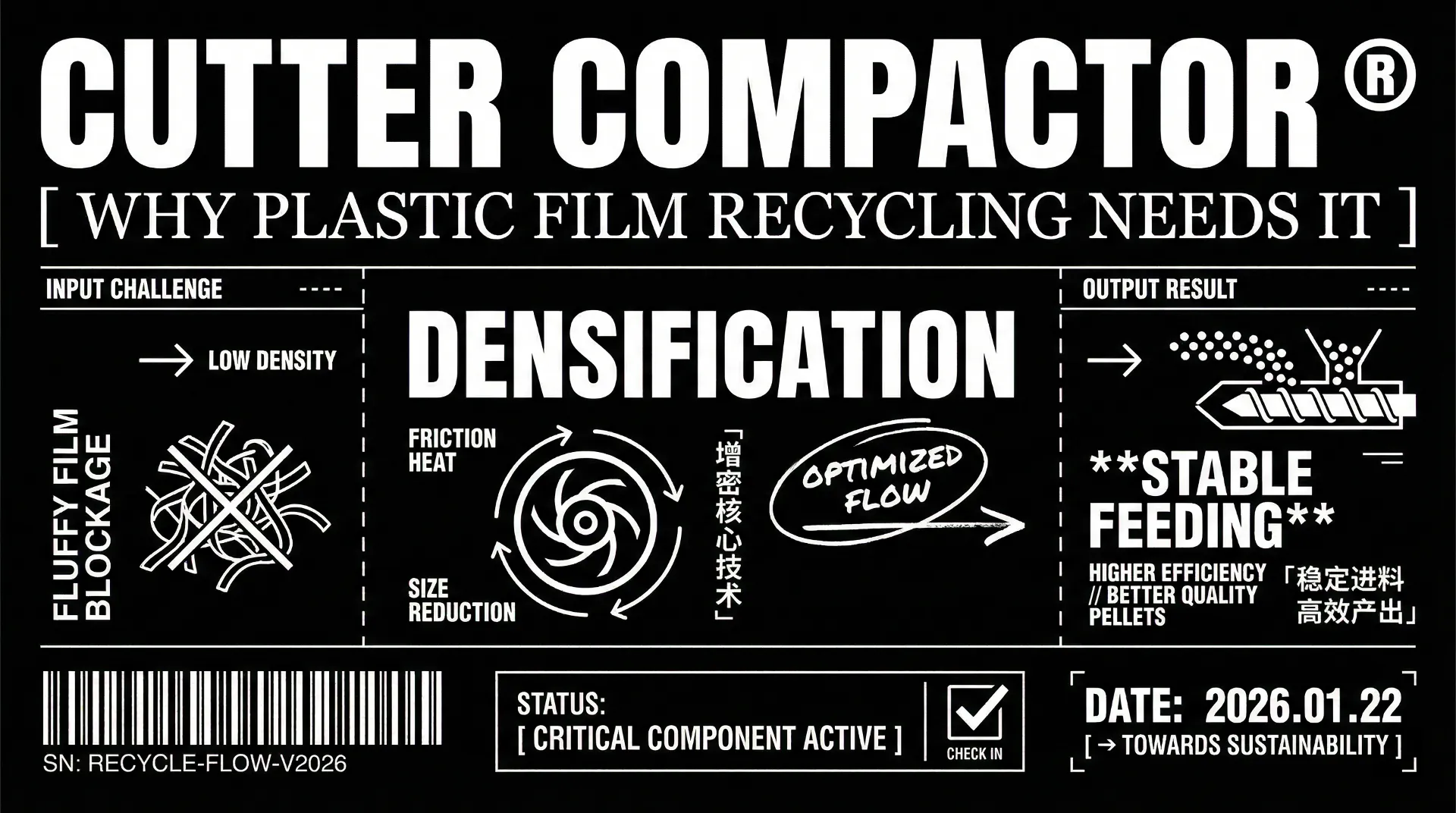
Plastic film squeezer technology has become one of the most important process upgrades in PP and PE film recycling because it solves two problems at the same time: high residual moisture and low bulk density. For washed film, that combination is exactly what makes extrusion difficult.
Rumtoo customers usually look at a squeezer when a line is already washing film successfully but still struggles with one of these issues:
- unstable extruder feeding
- too much steam or gas at the vent
- poor pellet density
- high thermal-drying cost
If that sounds familiar, start with Rumtoo’s film densifier and squeezer, then compare how it fits with your film compacting pelletizing line.
What a plastic film squeezer does
A film squeezer uses mechanical compression to force water out of washed film while simultaneously compacting the material into a denser, more manageable form. Unlike a simple centrifugal dryer, it does not just remove free water from the surface. It also attacks the moisture trapped inside folds, tangles, and layered film structures.
That matters because lightweight film often leaves a wash line looking dry enough, while still carrying enough moisture to hurt pelletizing performance.
Why squeeze drying is so effective for film
Film is different from rigid plastic in three ways:
- it floats
- it folds over itself
- it traps water in layers
A squeeze dryer works well because compression breaks that structure down. Once the material is compacted, it feeds more like a densified flake than a loose sheet or strip.
This creates three direct process benefits:
- lower residual moisture
- higher bulk density
- better feeding into downstream extrusion
Where the squeezer sits in the line
In most projects, the squeezer sits after washing and before pelletizing. A typical sequence is:
- washing and separation
- centrifugal removal of free water
- squeeze drying and densifying
- extrusion and pelletizing
That is why it fits naturally into a plastic film and bag recovery line and supports the performance of the downstream film compacting pelletizing line.
When a squeezer adds the most value
Squeezer technology is most valuable when:
- the material is PE or PP film
- upstream washing leaves the film fluffy and wet
- pelletizing output is limited by feed instability
- a thermal dryer alone would consume too much energy
It is especially useful for:
- post-consumer film
- agricultural film
- printed flexible packaging
- woven bags and raffia
Squeezer vs. centrifugal dryer
A centrifugal dryer and a squeezer are not direct substitutes.
- A film centrifugal dryer is excellent for removing free surface water.
- A squeezer is better when the remaining challenge is trapped water and low density.
Many well-designed lines use both. The centrifugal unit does the fast first-stage work, and the squeezer creates the final conditioning needed for stable extrusion.
What to evaluate before buying
When comparing squeeze dryers, do not stop at motor size or rated kg/h. Ask about:
- Moisture in and moisture out.
- Bulk-density increase after squeezing.
- Screw design and wear protection.
- Stability with mixed or dirty post-consumer film.
- How the machine discharges material into the next stage.
The discharge form matters. A good squeezer should deliver material that the next machine can actually handle consistently.
Common mistake: treating the squeezer as optional
For rigid plastic, you may be able to keep a line simple. For washed film, skipping the squeezer often just pushes the process problem downstream. The extruder, venting section, and pelletizer then carry a burden they were not meant to carry.
That usually shows up as:
- more downtime
- lower output
- higher energy cost
- more operator intervention
Signs your line probably needs a squeezer
If your current line shows any of these symptoms, a squeezer should move higher on the upgrade list:
- film exits washing still fluffy and difficult to convey
- the extruder feed throat bridges or starves
- venting load remains high even after centrifugal drying
- pellets show bubbles, voids, or unstable density
- thermal drying cost is climbing faster than throughput
Frequently asked questions
What moisture level can a film squeezer usually achieve?
That depends on material type, contamination, and upstream preparation, but the main value is not a single brochure number. The real benefit is bringing moisture down while also increasing density and stabilizing feeding.
Is a squeezer only for PE film?
No. Squeeze dryers are also widely used for PP film, woven bags, raffia, and mixed soft-plastic streams that remain difficult to feed after washing.
Can a squeezer improve pellet quality directly?
Yes. By sending denser and drier material into extrusion, it reduces gas load, improves feed consistency, and helps the pelletizer operate in a narrower and more stable process window.
Final takeaway
Plastic film squeezer technology matters because it turns washed film from a difficult, unstable feedstock into something a pelletizing line can run predictably. In other words, it is one of the most practical ways to improve both throughput and pellet quality without redesigning the entire plant.
If you want to check whether a squeezer is the missing step in your line, contact Rumtoo. We can help compare centrifugal, squeeze, and thermal drying routes based on your actual material and target output.
- plastic film squeezer
- squeeze dryer
- film densifier
- film recycling line
- pelletizing line