
· Rumtoo Engineering Team · Process Engineering · 14 min read
Plastic Washing Line Selection Guide: Film vs Bottles vs Rigid Plastics
A practical guide to choosing the right plastic washing line for PP/PE film, PET bottles, and rigid plastics. Learn why washing systems are not universal, how process layouts differ, and what data suppliers need before quoting a line.
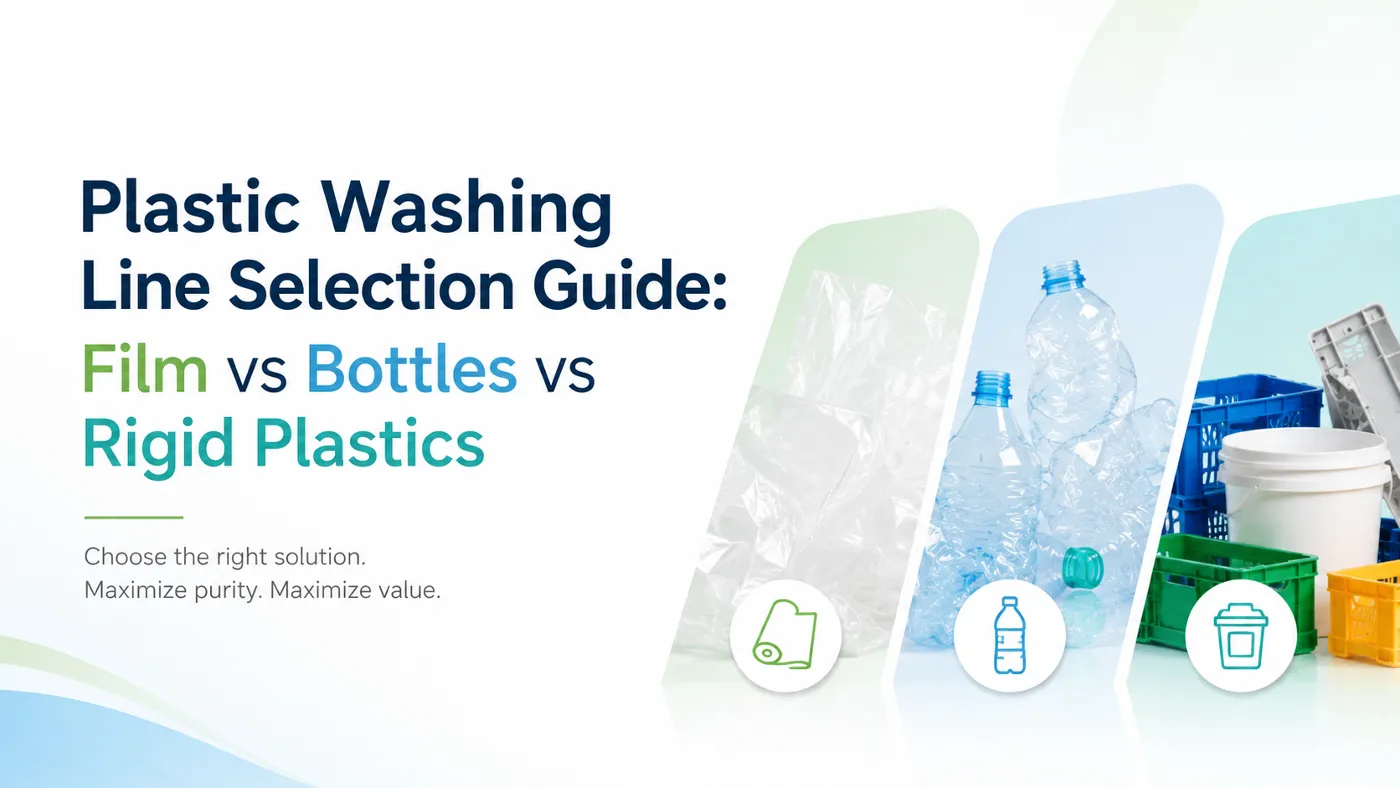
A plastic washing line is not a universal machine that can process every plastic material with the same layout. Film, PET bottles, and rigid plastics behave differently in water, cutting equipment, separation tanks, dryers, and downstream pelletizing systems. A line that works well for PET bottle flakes can fail quickly when fed agricultural film. A film washing line may not provide the hot-wash intensity or label-removal control required for bottle-grade PET.
For recycling plant buyers, this matters because the washing line determines the value of the final output. Clean flakes and pellet-ready material can sell into higher-grade applications, while poorly washed material carries odor, moisture, labels, sand, glue, and polymer contamination into the next process.
This guide explains how to choose the right washing system for PP/PE film, PET bottles, and rigid plastics. It also shows what information to prepare before requesting a proposal from an equipment supplier.
If you are still planning the overall plant, start with Rumtoo’s plastic recycling machine overview. For dedicated process details, see the PP/PE film washing line guide, PET bottle recycling line project planning, and hot wash system guide.
There is no universal plastic washing line
The phrase “plastic washing line” sounds simple, but in industrial recycling it usually means a customized process system. The correct layout depends on the input material, contamination profile, target output, and downstream use.
Three questions should come before equipment selection:
- What plastic form are you processing? Film, bottles, rigid regrind, pipes, drums, buckets, crates, and lumps all need different feeding and size-reduction methods.
- What contamination must be removed? Soil, labels, glue, caps, food residue, oil, metals, paper, rubber, and mixed polymers require different washing and separation stages.
- What output are you selling or using? Washed flakes, extrusion feedstock, and final pellets each have different moisture, purity, and particle-size requirements.
A washing line should be designed around these answers. Buying a generic layout first and trying to force all materials through it often creates low throughput, poor cleaning, high water cost, and unstable pellet quality.
Why film, bottles, and rigid plastics need different washing systems
Each material group has different physical behavior. The washing process must match that behavior.
| Material stream | Key behavior | Main design challenge |
|---|---|---|
| PP/PE film | low bulk density, flexible, floats, wraps easily | feeding, anti-wrapping, dewatering, densifying |
| PET bottles | rigid, high bulk density after crushing, PET sinks while caps float | label removal, hot washing, PVC/polyolefin separation, flake purity |
| Rigid plastics | bulky, variable wall thickness, mixed shapes, may contain metal | heavy-duty size reduction, sink-float logic, drying, stable regrind size |
Because the material behavior is different, the process flow cannot be copied directly from one application to another. A recycler should compare complete system design, not only machine names.
PP/PE film washing line configuration
A PP/PE film washing line is designed for lightweight flexible materials such as agricultural film, greenhouse film, stretch wrap, LDPE packaging film, PP woven bags, and post-consumer film.
Film recycling is difficult because the material has low bulk density, carries a large amount of water after washing, and tends to wrap around shafts, screws, and rotors. For this reason, film lines usually require feeding, washing, dewatering, and densifying equipment designed specifically for flexible material.
A typical film washing process includes:
Bale breaking or feeding → Manual sorting / metal removal → Shredding → Wet granulation if needed → Friction washing → Float-sink or rinsing tank → Mechanical dewatering → Squeeze drying or thermal drying → Densifying or pelletizing
Important design points include:
- Feeding and shredding: Film bales need controlled feeding because loose film bridges easily. A single-shaft shredder with hydraulic pushing is often used before wet granulation.
- Friction washing: Mechanical scrubbing removes dirt, sand, organic residue, and loose labels from film surfaces.
- Water separation: PP and PE float, so the sink-float tank is mainly used to remove heavier contaminants such as sand, glass, metal fines, PET, rubber, and stones.
- Dewatering: Film holds water on a large surface area. A squeeze dryer or mechanical dewatering system is often needed before pelletizing.
- Densifying: Clean film may still be too fluffy for stable extrusion. A densifier, cutter compactor, or squeeze dryer can increase bulk density before the recycling pelletizing line.
For heavily contaminated agricultural film, the line may also need hot washing, additional rinsing, and stronger water treatment. However, the equipment must still be film-friendly; using a rigid-flake layout can cause wrapping and unstable flow.
PET bottle washing line configuration
A PET bottle washing line is designed to convert baled post-consumer bottles into clean PET flakes. The main process goal is not only washing dirt away; it is also separating PET from caps, labels, glue, PVC, paper, and other contaminants.
A typical PET bottle washing process includes:
Bale opening → Pre-sorting → Label removal → Metal detection → Crushing / granulation → Pre-washing → Hot washing → Friction washing → Sink-float separation → Rinsing → Centrifugal drying → Air classification → Flake packing or pelletizing
Important design points include:
- Label control: Labels and glue are major quality risks. Depending on the bottle stream, dry label removal, hot washing, friction washing, and air classification may all be needed.
- Hot washing: PET bottle flakes often require a hot wash system to remove glue, beverage residue, oil, and fine paper contamination.
- Density separation: PET sinks in water, while PP/PE caps and many label fragments float. The sink-float stage is central to PET bottle recycling.
- PVC risk: Even a small amount of PVC contamination can cause major downstream quality issues during extrusion or sheet production. Sorting before and after crushing should be considered for high-grade applications.
- Moisture target: Washed PET flakes must be dried according to buyer requirements or downstream extrusion needs.
Compared with film, PET flakes are easier to convey and centrifugally dry. However, PET washing lines usually need stricter contamination control, especially when the final market requires fiber-grade, sheet-grade, or bottle-grade flakes.
Rigid plastic washing line configuration
A rigid plastic washing line handles materials such as HDPE drums, PP crates, buckets, injection molded parts, pipe sections, profiles, automotive parts, and thick regrind. These materials are usually heavier and easier to convey than film, but they create other challenges: large dimensions, thick walls, metal inserts, labels, dirt pockets, and mixed polymer streams.
A typical rigid plastic washing process includes:
Pre-sorting → Metal detection → Shredding or crushing → Friction washing → Sink-float separation → Rinsing → Centrifugal drying → Storage silo → Optional pelletizing
Important design points include:
- Size reduction: Thick-walled drums, lumps, pipes, and crates may need a shredder before a crusher. For equipment selection, see Rumtoo’s crusher vs shredder configuration guide.
- Metal protection: Rigid plastic scrap can contain screws, handles, rings, mesh, wire, or embedded metal parts. Metal detection and manual sorting protect knives, rotors, and screens.
- Sink-float separation: Density separation depends on the target polymer. HDPE and PP float, while PET, PVC, metals, glass, and mineral-filled materials may sink.
- Friction washing: Rigid flakes can tolerate stronger mechanical action than film, making friction washing effective for removing dirt, labels, and residue.
- Drying: Rigid flakes are usually easier to dry than film, but moisture trapped in thick or irregular pieces can still affect pelletizing quality.
Rigid plastic lines are often more tolerant than film lines, but they still require the correct cutting chamber, rotor design, screen size, and separation strategy for the feedstock.
Cold washing vs hot washing
Not every plastic washing line needs hot washing. Clean post-industrial scrap may only require size reduction, cold washing, rinsing, and drying. Post-consumer material usually needs a more complete process.
Hot washing becomes important when the contamination includes:
- label glue
- food residue
- oil or grease
- odor sources
- organic contamination
- sticky packaging residue
- buyer-critical surface contamination
Cold washing and friction washing remove loose dirt and mechanically attached contamination. Hot washing adds temperature, chemistry, and residence time to loosen contaminants that cold water cannot remove reliably.
The decision should be based on feedstock testing and output requirements. Adding a hot wash tank increases energy use, chemical control, rinsing demand, and wastewater treatment load. Skipping it when it is needed can make the final flakes unsellable for higher-grade use.
Separation logic: float, sink, and remove the right material
Washing lines are also separation systems. Water is used not only to clean plastic, but also to separate materials by density.
The basic logic is:
- PET sinks in water.
- PP and PE float in water.
- PVC usually sinks and must be controlled carefully in PET streams.
- Sand, glass, metal, rubber, and stones usually sink.
- Paper and label fragments may need friction washing, rinsing, and air classification after drying.
This is why one tank design does not solve every recycling problem. In PET bottle recycling, the goal may be to keep the sinking PET and remove floating caps. In PP/PE film recycling, the goal may be to keep the floating film and remove sinking contaminants. In rigid mixed-plastic recycling, the goal depends on whether the target material is HDPE, PP, PET, PVC, ABS, or another polymer.
For dry downstream purification, a zig-zag air classifier can help remove light paper, labels, dust, and film fragments from dried flakes.
Dewatering and drying: the bottleneck many buyers underestimate
A washing line is only useful if the output can be dried to the level required by the next process. Moisture affects storage, pelletizing, odor, melt stability, and buyer acceptance.
Typical drying challenges differ by material:
| Material | Drying challenge | Common solution |
|---|---|---|
| PP/PE film | holds water, low bulk density, difficult to centrifuge | squeeze dryer, mechanical dewatering, thermal drying, densifying |
| PET bottle flakes | surface moisture must be reduced for flake sale or extrusion | centrifugal dryer, thermal dryer if needed |
| Rigid plastic flakes | irregular shapes may trap water | centrifugal drying, air conveying, storage silo ventilation |
Film is usually the most difficult material to dewater. If a buyer plans to pelletize washed film, the drying and densifying system should be considered part of the washing line design, not an optional accessory.
How to choose the right plastic washing line
When comparing proposals, avoid choosing only by motor power, line length, or quoted capacity. The right washing line is the one that matches your real feedstock and output requirement.
Use this selection sequence:
- Define the feedstock. Identify polymer type, form, contamination, bale density, moisture, labels, metals, and seasonal variation.
- Define the target output. Decide whether you need washed flakes, pelletizing feedstock, final pellets, or high-purity flakes for direct sale.
- Choose the size-reduction method. Film, bottles, pipes, lumps, and crates require different shredders, crushers, or two-stage systems.
- Design washing intensity. Select cold washing, friction washing, hot washing, and rinsing based on contamination and buyer specs.
- Design separation stages. Match sink-float, screening, air classification, and sorting to the target polymer and contaminants.
- Design drying and water treatment. Confirm moisture targets, water circulation, sludge handling, filtration, and wastewater limits.
- Check integration with pelletizing. If the output goes to extrusion, confirm bulk density, moisture, feeding stability, melt filtration, and degassing needs.
A good supplier should ask for material photos, samples, contamination data, and output requirements before recommending a layout.
Match contamination to equipment, not just plastic type
Many competitor product pages list a crusher, washer, tank, and dryer as if the same equipment list solves every problem. In real projects, the contamination profile is often more important than the material name. A clean HDPE drum line and a muddy post-consumer HDPE bottle line may both process HDPE, but they do not need the same washing intensity.
Use contamination as a second design filter:
| Contamination problem | Equipment or process usually considered | Why it matters |
|---|---|---|
| Sand, soil, stones | pre-wash, friction washer, sediment removal, water filtration | protects blades, pumps, screws, and downstream extrusion |
| Paper labels | label remover, friction washer, rinsing, air classification | prevents fiber residue in flakes or pellets |
| Glue and adhesive | hot washer, caustic or detergent dosing, controlled residence time | cold washing often leaves sticky residue on flakes |
| Oil, grease, food residue | hot washing, detergent, stronger rinsing, wastewater planning | reduces odor and improves pellet quality |
| Metal pieces | manual sorting, magnetic separator, metal detector | prevents cutter damage and unplanned downtime |
| PVC in PET stream | manual sorting, optical sorting, strict process control | small PVC contamination can damage PET extrusion quality |
| High moisture in film | squeeze dryer, mechanical dewatering, thermal dryer | wet film creates unstable densifying and pelletizing |
| Mixed polymers | sink-float separation, sorting, material testing | wrong density logic can remove the target plastic instead of the contaminant |
This is one of the main reasons a quotation should be based on feedstock photos, samples, and buyer specifications rather than only a target capacity.
Final application determines washing line design
Another common gap in plastic washing line pages is that they describe the final output as simply “clean flakes.” For industrial buyers, the required output quality depends on the next application.
Typical examples:
- PET fiber-grade flakes: need stable washing, cap separation, label removal, and controlled moisture. Requirements are serious, but usually different from bottle-to-bottle rPET.
- PET sheet, strapping, or higher-grade extrusion: needs better glue removal, lower PVC risk, consistent flake size, and more stable drying.
- Bottle-to-bottle PET: may require food-grade process design, stricter sorting, hot washing control, and much tighter contamination limits.
- PP/PE film pelletizing: requires strong dewatering, densifying, stable feeding, melt filtration, and degassing compatibility.
- Rigid HDPE/PP regrind or pellets: relies on metal removal, sink-float separation, correct flake size, and drying before extrusion.
In other words, the washing line should be designed backward from the buyer’s end market. A plant selling low-grade washed regrind does not need the same configuration as a plant producing pelletizing feedstock for demanding extrusion customers.
Water treatment and operating cost considerations
A plastic recycling washing line is not only a mechanical system. It is also a water, sludge, energy, labor, and maintenance system. This is where many low-cost proposals look attractive on paper but become expensive in operation.
Key operating cost factors include:
- Water consumption: affected by contamination level, number of washing stages, rinse quality, and whether the line uses closed-loop circulation.
- Wastewater and sludge: sand, paper fibers, organic residue, labels, and chemicals must be removed from the water loop or discharged according to local rules.
- Electricity: shredders, crushers, friction washers, pumps, dryers, and thermal systems all affect cost per ton.
- Chemicals: hot washing may require caustic soda, detergent, surfactant, defoamer, and pH control.
- Blade and screen wear: dirty rigid plastics, sand-heavy film, and metal contamination increase replacement frequency.
- Labor and automation: manual sorting may be cheaper initially, but automation can improve consistency when labor cost or quality requirements are high.
- Downtime risk: poor pre-sorting, weak metal protection, undersized water treatment, or insufficient drying can reduce real throughput below the quoted capacity.
A realistic proposal should explain not only the machine list, but also the water loop, sludge handling, installed power, labor requirement, and maintenance access.
Frequently asked questions
Can one plastic washing line process film, PET bottles, and rigid plastics?
Not as a high-performance production line. Some modules may be shared in a customized plant, but film, PET bottles, and rigid plastics need different feeding, size reduction, separation, drying, and contamination-control designs. A universal line usually means compromises in throughput or output quality.
What is the difference between a PET bottle washing line and a PP/PE film washing line?
A PET bottle washing line focuses on label removal, hot washing, cap separation, PVC control, and clean PET flakes. A PP/PE film washing line focuses on anti-wrapping design, sand removal, low-bulk-density handling, strong dewatering, and densifying before pelletizing.
Do I need hot washing?
You need hot washing when the feedstock contains glue, oil, food residue, odor sources, organic contamination, or buyer-critical surface residue. Clean post-industrial scrap may not need it, while PET bottles and contaminated post-consumer packaging often do.
How much capacity should I choose?
Capacity should be selected from available feedstock volume, realistic operating hours, expected yield, drying capacity, water treatment capacity, and downstream pelletizing or flake-sale requirements. Do not size the line only from the crusher nameplate capacity.
How dry will the final flakes be?
It depends on material and drying configuration. PET and rigid flakes are generally easier to centrifugally dry than film. PP/PE film often needs mechanical squeezing, thermal drying, or densifying to reach a stable moisture level for extrusion.
What information is needed for a quotation?
Send material type, form, contamination, photos or samples, target capacity, required output, final moisture target, available utilities, factory layout, and downstream use. This allows the supplier to design a line instead of sending a generic equipment list.
RFQ checklist for a plastic washing line
Before requesting a quotation, prepare the following information. This will help the supplier design a realistic system instead of sending a generic price.
- material type: PP, PE, PET, PVC, HDPE, LDPE, mixed rigid plastics, or mixed film
- material form: film, bottles, crates, drums, pipes, buckets, purgings, lumps, or flakes
- input condition: loose, baled, wet, dirty, sorted, or mixed
- contamination type: sand, soil, oil, food residue, labels, glue, caps, metal, paper, rubber, or wood
- expected input capacity in kg/h
- target output: washed flakes, pellet-ready material, or pellets
- required final moisture level
- required purity or buyer specification
- available water, electricity, steam, compressed air, and wastewater treatment capacity
- available floor space and ceiling height
- downstream process: flake sale, pelletizing, sheet extrusion, fiber production, or injection molding
If possible, send representative samples from different suppliers or seasons. A washing line designed only around the cleanest sample may underperform when real production starts.
Summary
A plastic washing line should be selected by material type, contamination profile, and output requirement. PP/PE film, PET bottles, and rigid plastics cannot be treated as the same process. Film needs anti-wrapping design, strong dewatering, and often densifying. PET bottle lines need label control, hot washing, density separation, and strict flake purity. Rigid plastic lines need heavy-duty size reduction, metal protection, and the right sink-float strategy.
Rumtoo designs plastic recycling washing systems for film, PET bottles, and rigid plastic streams. To plan the correct line, send your feedstock photos, target capacity, contamination profile, available utilities, and final output requirement.
- plastic washing line
- plastic recycling washing line
- PET bottle washing line
- PP PE film washing line
- rigid plastic recycling
- washing line selection