
· Rumtoo Engineering Team · Process Engineering · 5 min read
Why Plastic Film Recycling Lines Need a Cutter Compactor
Soft film does not feed like rigid flake. This guide explains why plastic film recycling lines need a cutter compactor, how densified feeding improves pellet quality, and when an integrated film compacting pelletizing line is the right investment.
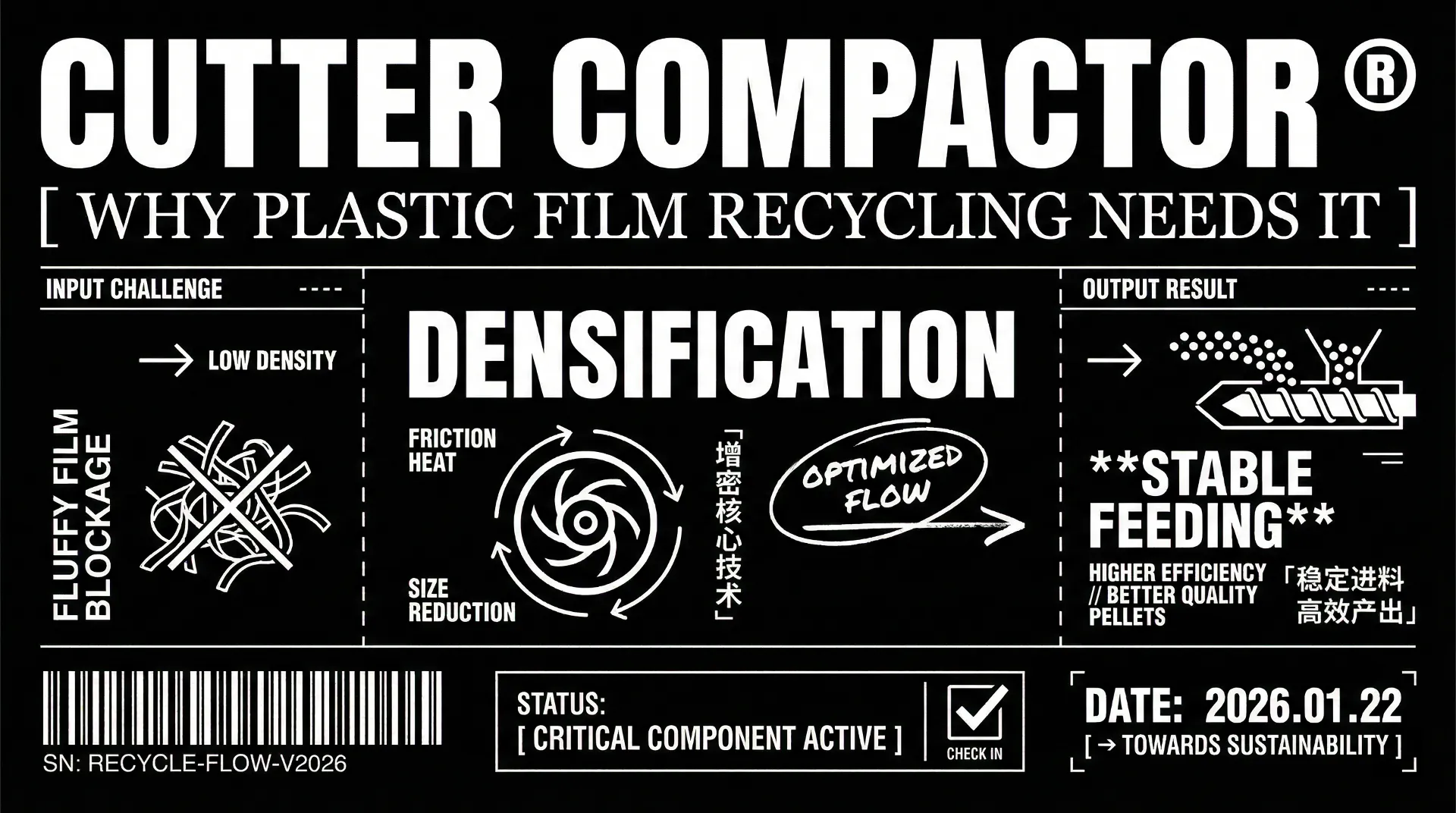
Every plastic film recycling line eventually runs into the same problem: soft film will not feed into an extruder like rigid flake. LDPE bags, LLDPE stretch film, greenhouse film, and woven PP scrap all have low bulk density, unstable flow, and a strong tendency to bridge at the feed throat. That is why a cutter compactor is not just an accessory on many film lines. It is the part that makes continuous pelletizing possible.
If your plant mainly handles washed film, start with Rumtoo’s film compacting pelletizing line. If you are still evaluating the full film process, review our plastic film and bag recovery line first.
Why soft film feeds so badly
Rigid regrind and clean flakes drop into a screw channel with relatively predictable flow. Film behaves differently because it is:
- light
- springy
- easy to entangle
- full of trapped air
That creates three operating problems:
1. Hopper bridging
Loose film forms arches above the feed throat. The screw then alternates between starvation and surge feeding, which causes unstable melt pressure and poor pellet consistency.
2. Low screw filling
Even when film reaches the throat, it does not pack efficiently into the screw flights. The extruder cannot build pressure the same way it does with dense flake or pellets.
3. Air and moisture carryover
Folded film traps air and often carries residual moisture from the washing stage. That leads to bubbles, surface defects, and inconsistent pellet density.
What a cutter compactor actually does
A cutter compactor solves the feeding problem before the material reaches the main extruder. Inside the compactor, rotating blades cut and mix the film while frictional heat and controlled compression increase bulk density and condition the feedstock.
The result is material that is:
- denser
- more uniform
- easier to meter
- easier to degas
That is why an integrated film compacting pelletizing line usually performs better than a hopper-fed extruder when the feedstock is film or raffia.
Why pellet quality improves after compaction
Compaction does more than stabilize feeding. It also improves downstream pellet quality:
- fewer voids caused by entrapped air
- better melt-pressure stability
- lower risk of die-face fluctuation
- more consistent pellet size
If your line is selling pellets into film blowing, injection molding, or compounding, that consistency matters. A line that looks acceptable on hourly output can still lose margin if the pellet quality is unstable.
When a cutter compactor is the right choice
You should strongly consider a cutter compactor when most of your feedstock is:
- washed PE film
- printed LDPE or LLDPE packaging film
- PP raffia or woven bags
- post-industrial soft trim and rolls
It is especially useful when upstream material remains fluffy after drying or when the line must run with limited operator intervention.
When you may not need one
A cutter compactor is usually unnecessary when you are pelletizing:
- dense rigid flakes
- clean hard-plastic regrind
- already densified feedstock with stable screw filling
In those cases, Rumtoo’s hard plastic pelletizing line may be the better path.
Cutter compactor vs. squeezer
These machines are related, but they do not solve exactly the same problem.
- A film densifier and squeezer is usually installed after washing to reduce moisture and increase density.
- A cutter compactor is usually integrated with pelletizing to create stable extruder feeding.
In some projects, both are needed. The squeezer brings moisture down to a workable level, and the cutter compactor creates the final stable feed for extrusion.
If you are comparing this machine against foam cold pressing, film squeezing, or agglomeration, use the wider densifier guide before narrowing the pelletizing layout.
What to ask a supplier before buying
Do not evaluate a cutter compactor on motor size alone. Ask for:
- The expected bulk-density increase after compaction.
- The real feedstock range the compactor can handle.
- The residence time inside the chamber.
- The temperature-control method.
- The interface between the compactor and the extruder.
Poor integration between these sections can erase the whole benefit of the system.
Quick decision matrix
| Your situation | Cutter compactor recommendation |
|---|---|
| Mostly washed PE film or LLDPE stretch film | Strongly recommended |
| Mostly PP raffia or woven bags | Usually recommended |
| Mostly rigid flakes or dense regrind | Often unnecessary |
| Line suffers from hopper bridging and surging | High-priority upgrade |
| Material is already dense and dry | Lower priority |
Frequently asked questions
Does every film recycling line need a cutter compactor?
Not every line does, but many do. If your main feedstock is fluffy PE or PP film and you need stable pelletizing, a cutter compactor is often the difference between a line that runs continuously and a line that constantly fights feed instability.
Can a cutter compactor replace a film squeezer?
Usually no. A film densifier and squeezer mainly reduces moisture and increases density after washing, while a cutter compactor mainly conditions and force-feeds material into the extrusion stage. Some projects need both.
What is the main buying mistake with cutter compactors?
The most common mistake is buying based on motor size alone. Residence time, chamber volume, temperature control, and extruder integration often matter more to long-term line stability than nameplate power.
Final takeaway
Film recycling lines need a cutter compactor because film is not a free-flowing feedstock. Without densification and conditioning, the extruder is forced to solve a feeding problem it was not designed to solve. With the right cutter compactor, the line runs more steadily, pellets become more consistent, and operators spend less time fighting bridges, surges, and downtime.
If you are planning a PE or PP film project and want to confirm whether a cutter compactor should be part of the line, contact Rumtoo. We can help match the feed system, extrusion section, and pelletizing method to your actual waste stream.
- cutter compactor
- plastic film recycling machine
- film compacting pelletizing line
- PE film recycling
- PP woven bag recycling