
· Rumtoo Engineering Team · Buying Guides · 14 min read
Zig-zag air classifier for plastic recycling: how wind sifting removes labels, film & fines from flake streams
A zig-zag air classifier uses a rising air column in a multi-stage angular channel to separate lightweight contaminants from heavier plastic flakes. This guide covers the separation principle, where to place the classifier in the recycling line, how to size it correctly, and the common mistakes that reduce purity or waste good flakes.
After washing and drying, recycled plastic flakes often still carry lightweight contaminants—paper label fragments, thin PE film scraps, fiber, and fine dust. These materials are too light and aerodynamically different from the target flakes to be caught reliably by screens or float-sink tanks. They end up in the extruder, causing pressure fluctuations, pellet defects, and downgraded output value.
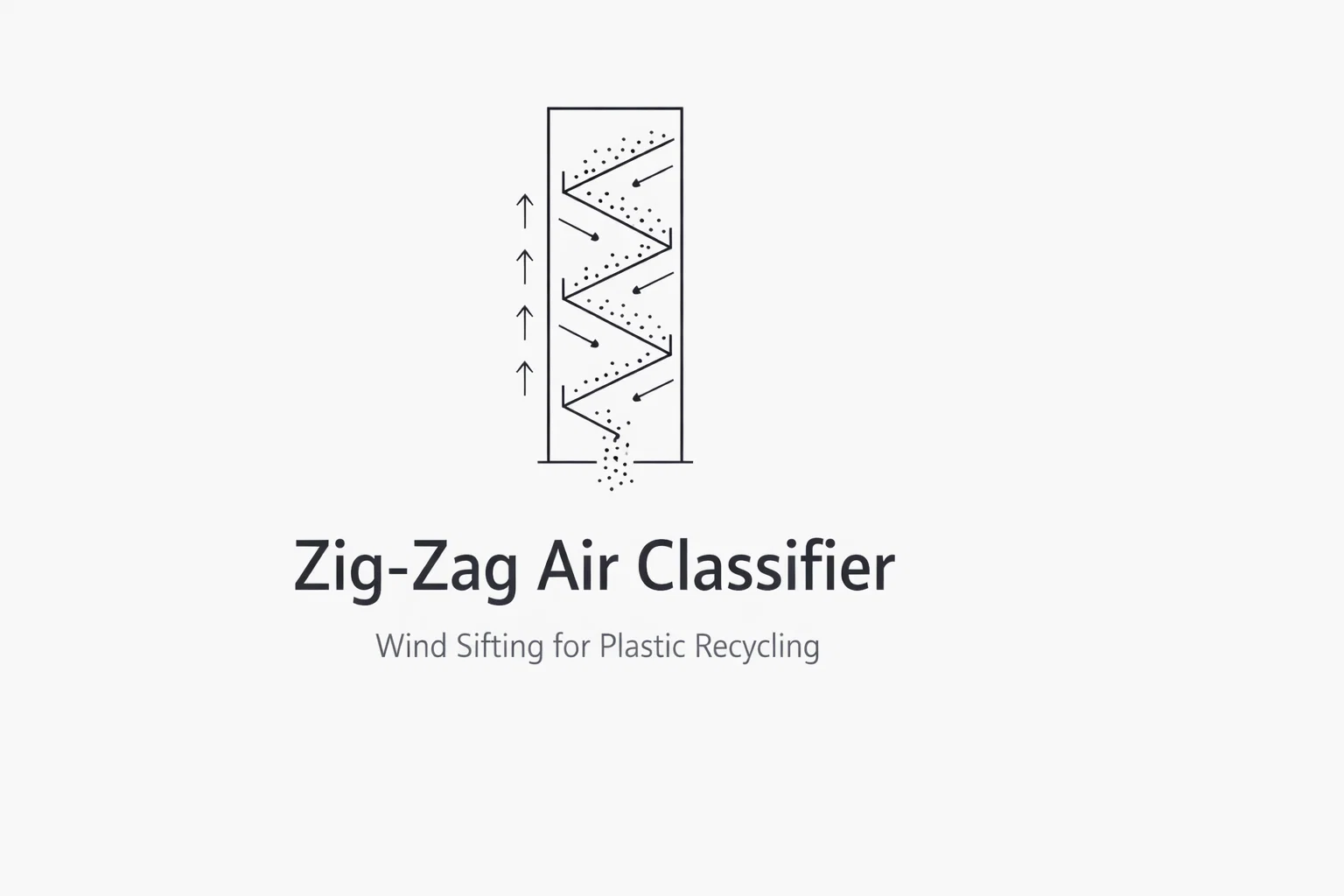
A zig-zag air classifier solves this problem using a simple physical principle: rising air in a vertical channel lifts light particles upward while heavier flakes fall downward through gravity. The “zig-zag” refers to the angled internal baffles that create multiple direction changes, forcing the material through several separation stages in a single pass. Each stage gives light contaminants another chance to be captured, which is why a zig-zag design outperforms a single-pass air separator on near-density materials like thin paper labels on PET flakes.
Before reading this guide, you may want to review our Zig-Zag Air Classifier product page for Rumtoo’s specific models and specifications, or our Ancillary Equipment overview for the full range of supporting machines in a recycling line.
What a zig-zag air classifier actually does
A zig-zag air classifier is a dry, density-based separation device. It does not wash, melt, or mechanically filter material. It separates particles by their aerodynamic behavior—specifically, by the difference in terminal velocity between light contaminants and heavy target flakes.
The machine consists of a vertical column with internal angled baffles (the “zig-zag” channel), a blower that generates upward airflow, a feed inlet in the middle section, a heavy fraction discharge at the bottom, and a light fraction outlet at the top connected to a cyclone separator.
Material enters the column at the feed point. Flakes and contaminants fall through the rising air stream. At each zig-zag stage, the airflow forces particles to change direction. Heavy flakes have enough momentum to continue falling; light particles get caught by the airflow and are carried upward. After passing through multiple stages, the heavy clean flakes exit at the bottom and the light contaminants exit at the top into a cyclone for collection.
The key difference from a simple air separator: a single-pass air stream gives the material only one chance to separate. A zig-zag channel with 4–10 stages gives it multiple chances. This matters when the density gap between the contaminant and the product is small—for example, paper labels (density ~0.7–1.2 g/cm³) on PET flakes (density ~1.35 g/cm³). A single-pass separator often misses a significant fraction of these labels; a zig-zag classifier catches them because each stage adds another separation opportunity.
Where the air classifier fits in a recycling line
The air classifier is not a standalone machine. Its performance depends entirely on what happens upstream and what follows downstream. Getting the placement wrong is the most common reason air classifiers underperform.
The correct position: after drying, before extrusion or packing
In a typical PET bottle washing line, the process flow is:
Shredding → Washing → Float-sink separation → Centrifugal drying → (Thermal drying) → Air classification → Extrusion or flake packing
The air classifier works on dry material. Wet or damp flakes clump together, and moisture changes the aerodynamic behavior of particles. If the feed is above roughly 2–3% moisture, the zig-zag channel will clog, separation sharpness drops, and good flakes stick to wet contaminants and get carried out with the light fraction.
This means the classifier must sit after the mechanical dryer (centrifugal dryer) or after a thermal dryer if one is used. It should never be placed directly after a washer or float-sink tank without a drying stage in between.
Why placement after a label remover matters
Many PET washing lines include a hot-wash or friction label remover that strips most labels from bottle flakes. But “most” is not “all.” A label remover operating at 95% efficiency on a line processing 2,000 kg/h of PET bottles with 5% label content still passes through about 5 kg/h of label material into the downstream flake stream. Over a 10-hour shift, that is 50 kg of label contamination reaching the extrusion stage—enough to degrade pellet quality noticeably.
The air classifier serves as the final polishing step that catches what the label remover misses. It is not a replacement for the label remover; it is the safety net after it.
Lines that skip the air classifier—and the problems they get
Some recyclers omit the air classifier to save cost or floor space. The consequences typically show up in three places:
- At the extruder: Residual labels and film scraps create gas pockets during melting, causing die pressure variation and pellet voids. Paper labels char at extrusion temperatures, producing black specks in the pellet
- At the flake sale point: Buyers of clean PET flake test for label contamination. Failing the purity threshold means accepting a lower price per kg—often a price reduction far exceeding the monthly operating cost of an air classifier
- At the melt filter: Label and fiber contaminants clog melt filtration screens faster, increasing filter change frequency and reducing extruder uptime
How zig-zag separation works—the physics
Terminal velocity is the key variable
Every particle falling through air reaches a terminal velocity—the speed at which gravity pulling it down equals air drag pushing it up. Terminal velocity depends on particle density, size, shape, and surface roughness.
For air classification to work, the target flakes must have a meaningfully higher terminal velocity than the contaminants. The blower is set to generate an upward air velocity between the two terminal velocities. Particles with terminal velocity below the airspeed get carried up (light fraction); particles with terminal velocity above the airspeed fall through (heavy fraction).
| Material | Approximate Density (g/cm³) | Relative Terminal Velocity |
|---|---|---|
| PET flake (6–12 mm) | 1.33–1.38 | High |
| HDPE flake (6–12 mm) | 0.94–0.97 | Medium-high |
| PP flake (6–12 mm) | 0.90–0.92 | Medium |
| Paper label fragment | 0.70–1.20 | Low |
| PE film scrap (thin) | 0.91–0.94 | Very low (high drag) |
| Fiber / dust | Variable | Very low |
Note that thin PE film has a very low terminal velocity not because of its density (which is close to PP) but because of its large surface area relative to mass. The film acts like a parachute—air drag dominates gravity. This is why air classification is particularly effective at removing film contamination even when the density difference between film and target flakes is small.
Why multiple zig-zag stages improve separation
In a single air stream, a particle either gets lifted or falls through in one interaction. If a PET flake momentarily tumbles flat-side to the airflow, it may get lifted; if a label fragment momentarily falls edge-on, it may drop through. A single-pass separator cannot recover from these random orientation effects.
In a zig-zag channel, each baffle forces the particle to change direction. At every direction change, the particle re-enters the air stream at a new orientation and velocity. Over 4–10 stages, random orientation effects average out. The light particles get repeated chances to be captured, and any heavy flakes that were momentarily lifted get repeated chances to fall back down.
More stages generally means sharper separation, but also more pressure drop and potentially more flake residence time. The practical optimum for most plastic recycling applications is 4–8 stages.
How to size a zig-zag air classifier for your line
Sizing an air classifier correctly requires four inputs. Getting any one of them wrong leads to either poor separation or excessive flake loss.
1. Material type and contaminant definition
Start by identifying what you need to remove. The separation task is fundamentally different for:
- Paper labels from PET flakes: Large density gap, relatively easy—but label fragments vary in size and wetness
- PE film scraps from rigid HDPE or PP regrind: Small density gap but large shape difference—film has high drag
- Dust and fines from any flake stream: Very light particles, easy to separate but require good dust collection
- Mixed contaminants (labels + film + dust): Need to set the air velocity for the hardest-to-separate fraction
2. Particle size range of the feed
The flake or granule size coming from the upstream crusher, granulator, or dryer directly determines the correct channel geometry. Larger flakes need a wider channel to avoid bridging. Smaller flakes allow a narrower channel with tighter airflow control.
If the particle size distribution is very wide (e.g., 3–25 mm), the classifier has a harder job because the terminal velocity of a small heavy flake may overlap with that of a large light contaminant. In these cases, improving the upstream sizing (tighter screen on the granulator) is more effective than adding classifier stages.
3. Throughput requirement
The classifier must handle the actual line throughput with margin. Overloading the feed rate—pushing more material through the channel than the air can separate cleanly—is the fastest way to reduce separation efficiency. The material curtain becomes too thick for air to penetrate, and contaminants get shielded by heavy flakes and dragged down into the clean fraction.
Plan for 15–20% capacity margin above the nominal line throughput. Account for peak throughput periods, not just average rates.
4. Moisture content at the feed point
Air classification works best on dry material. Above 2–3% moisture, wet particles stick together and aerodynamic behavior becomes unpredictable. The classifier should be placed after the drying stage, and the dryer should be verified to consistently deliver material below the target moisture level.
If your line does not have a dryer, or if the dryer output moisture is variable, adding an air classifier will give inconsistent results. Fix the drying step first.
Common mistakes and how to avoid them
Mistake 1: setting air velocity too high
If air velocity is set above the terminal velocity of the target flakes, good flakes get carried out with the light fraction. Yield drops. The operator may not notice immediately because the clean output looks pure—but the production numbers don’t add up at the end of the shift.
Fix: Start with air volume on the low side during commissioning and increase gradually. Monitor both the clean fraction (purity) and the light fraction (to check how many good flakes are being lost). The optimal setting is the highest air velocity that still keeps flake loss below an acceptable threshold—typically below 1–2% of total throughput.
Mistake 2: placing the classifier before the dryer
Wet material clumps, blocks the zig-zag channel, and separates poorly. Some operators place the classifier directly after the washing stage to “save one machine.” This never works. The cost of poor separation (downgraded output, extruder problems) always exceeds the cost of a dryer.
Fix: Always dry first, classify second. If a thermal dryer is too expensive, at minimum use a centrifugal dryer to bring the moisture below 3–5% before the classifier. For details on drying options, see our Drying & Densifying Units page.
Mistake 3: ignoring the light fraction outlet
The light fraction carried out the top of the classifier must go somewhere. If the outlet is undersized, backpressure builds up in the column and separation sharpness drops. If the cyclone is missing or incorrectly sized, fine dust blows into the workshop.
Fix: Always include a correctly sized cyclone separator on the light fraction outlet. For fine dust (common with paper labels), add a bag filter after the cyclone. Design the ductwork with as few bends as possible to minimize pressure losses. For enclosed workshops or food-grade recycling facilities, a fully sealed dust collection system is recommended.
Mistake 4: feeding material with too wide a size range
If the upstream granulator or crusher produces flakes ranging from 3 mm to 30 mm, the smallest heavy flakes may have the same terminal velocity as the largest light contaminants. The classifier cannot separate what physics cannot distinguish.
Fix: Tighten the particle size range before classification. Use a screen on the granulator to set a maximum flake size, and consider a vibrating screen after the dryer to remove fines below a minimum threshold before the air classifier sees the material.
Zig-zag vs. other air separation technologies
Air classification is not the only technology for removing light fractions. Here is how the zig-zag design compares to the alternatives.
| Technology | Principle | Strengths | Limitations |
|---|---|---|---|
| Zig-zag air classifier | Multi-stage rising air in vertical column | Sharp separation, compact footprint, adjustable cut point | Requires dry feed; limited throughput per channel width |
| Single-pass air separator | One-time air stream crossing | Simple, low cost, high throughput | Poor separation of near-density materials; misses many labels |
| Air table (density table) | Vibrating deck with cross-flow air | Can separate by both density and size simultaneously | Large footprint; lower throughput; more maintenance |
| Ballistic separator | Inclined vibrating screen with air | Good for mixed waste (MSW) pre-sorting | Too coarse for clean flake purification |
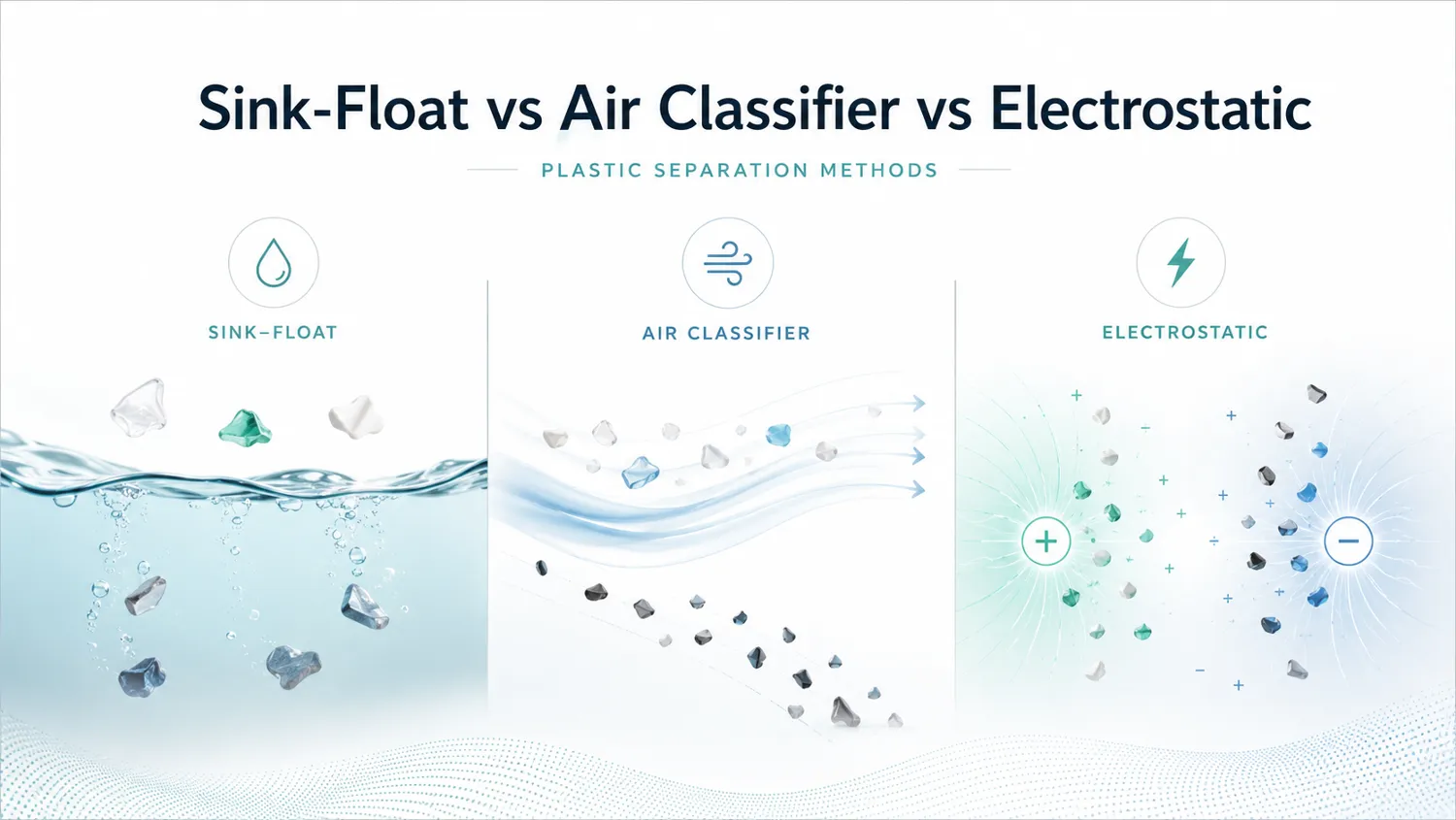
| Electrostatic separator | Charge-based separation | Effective for metal/plastic separation | Not effective for plastic/paper or plastic/film separation |
For most plastic recycling applications where the goal is removing labels, film, and fines from washed and dried flakes, the zig-zag air classifier offers the best balance of separation sharpness, footprint, and operating cost.
Integration with dust collection
Any air classifier generates a stream of airborne light material at the top outlet. Without proper collection, this material becomes a dust and fiber emission problem in the workshop.
The standard setup is:
- Classifier top outlet → Duct → Cyclone separator: The cyclone captures most of the light fraction (labels, film pieces, coarse dust) and discharges it into a collection bin
- Cyclone air outlet → Duct → Bag filter: The bag filter captures fine dust that the cyclone doesn’t catch—typically particles below 10–20 microns
- Bag filter clean air outlet → Atmosphere or recirculation: If dust levels are low enough, the filtered air can be returned to the building; otherwise, it vents outside
For food-grade or pharmaceutical-grade recycling lines, the entire classifier-to-filter system should be enclosed and sealed with pressure-monitored connections.
The blower that drives the classifier airflow is typically sized to also pull air through the cyclone and bag filter. This means the ductwork, cyclone, and filter must be included in the blower sizing calculation—not added as an afterthought after the classifier is already installed.
Practical checklist before issuing an RFQ
Before contacting Rumtoo or any supplier for an air classifier quotation, prepare these data points:
- Material type: PET flake, HDPE regrind, PP flake, mixed, other
- Contaminant to remove: Paper labels, PE/PP film, fiber, dust, or combination
- Particle size range: Typical flake size from the upstream granulator/crusher (e.g., 8–14 mm)
- Throughput: Required kg/h and peak demand
- Moisture at feed point: Expected % moisture after the drying stage
- Line position: What machine comes before and after the classifier
- Workshop constraints: Available headroom (the classifier is vertical), floor space, dust emission rules
- Purity target: What level of label/film contamination is acceptable in the final output
With these inputs, Rumtoo can recommend the right channel width, number of zig-zag stages, blower specification, and cyclone/filter sizing—and confirm whether the air classifier alone will meet the target or if additional separation steps are needed.
Frequently asked questions
Can I use an air classifier on wet material? No. Material above 2–3% moisture clumps together, clogs the channel, and separates poorly. Always dry the material first—at minimum with a centrifugal dryer, ideally with a thermal dryer if the application demands very low moisture.
How much good product will I lose in the light fraction? With correct air velocity tuning, typical flake loss is 0.5–2% of feed throughput. If loss exceeds 3%, the air velocity is likely too high or the feed particle size distribution is too wide.
How often does the machine need maintenance? Zig-zag air classifiers have no cutting tools, no screens, and no high-wear rotating parts in the material path. Maintenance is mainly blower inspection (bearings, belts), duct cleaning, and bag filter replacement. Typical intervals are monthly for inspection, quarterly for bag filters depending on dust load.
Can the classifier separate different types of plastic from each other? Not reliably. The density and shape differences between most commodity plastics (PET, HDPE, PP) are not large enough for air classification to achieve clean polymer-to-polymer separation. Air classifiers separate light contaminants from heavy product—not polymer A from polymer B. For polymer sorting, use NIR (near-infrared) optical sorters or float-sink tanks.
What is the energy consumption? The main energy consumer is the blower. Typical power consumption is 3–15 kW depending on channel size and airflow volume. This is low compared to other machines in the recycling line (a shredder may use 30–130 kW; an extruder 50–200 kW). The air classifier is one of the most energy-efficient separation stages in the line.
Ready to add a zig-zag air classifier to your recycling line? Contact Rumtoo with your material data and throughput requirements—we’ll recommend the right model and integration plan for your specific line.
- zig-zag air classifier
- air classification
- label separator
- plastic flake purification
- ancillary equipment
- PET recycling
- light fraction removal