
· Rumtoo Engineering Team · Buying Guides · 4 min read
Plastic Pelletizer Price: Water Ring vs. Strand Systems
Compare plastic pelletizer price for water ring and strand systems by capital cost, operating cost, labor, footprint, and feedstock fit. A practical guide for recycling-line buyers preparing RFQs.
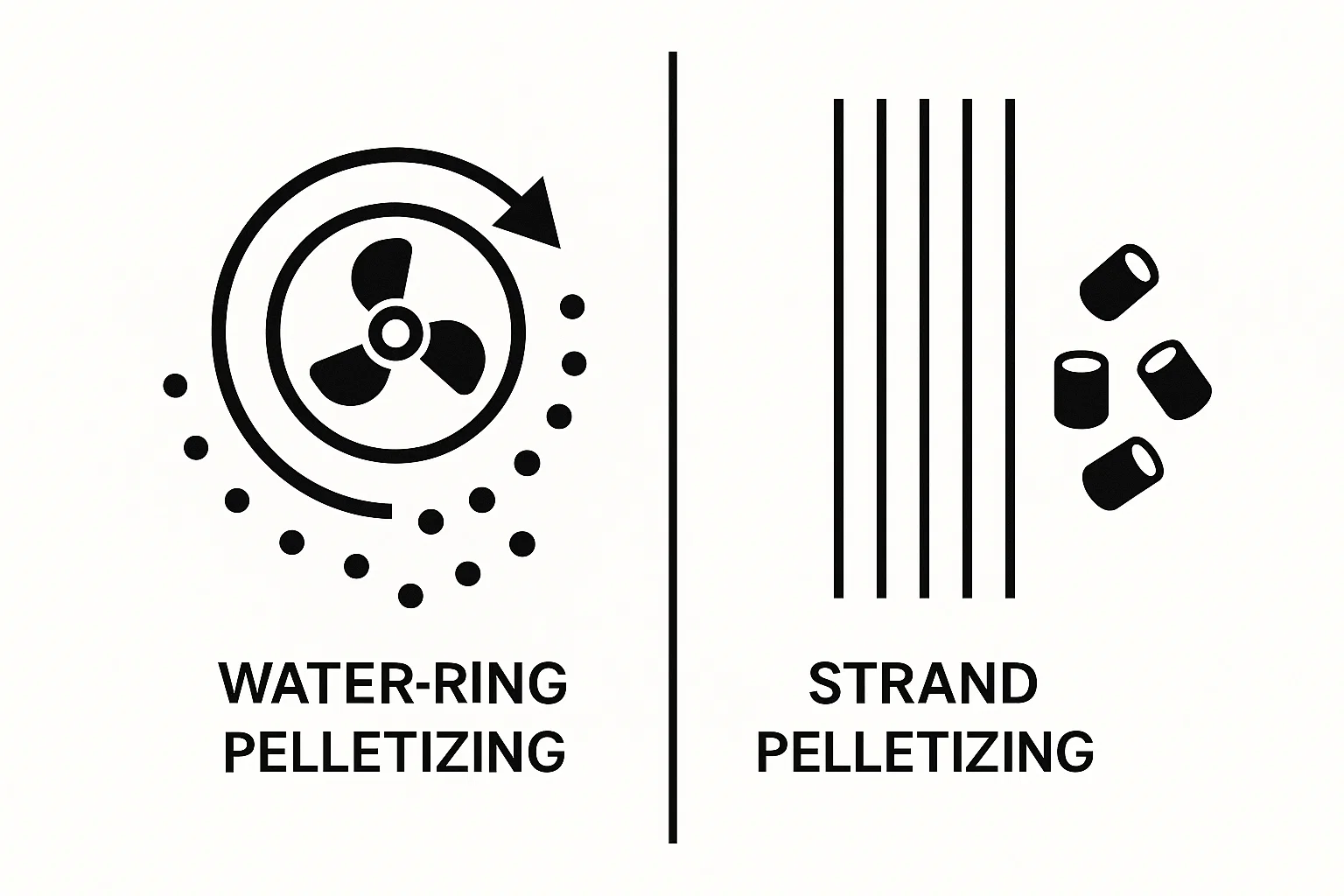
When buyers compare plastic pelletizer price, the most common mistake is looking only at the machine quote. The real decision between water ring and strand systems should include capital cost, labor, changeover difficulty, feedstock compatibility, and the cost of unstable production.
Rumtoo usually sees this question at the RFQ stage, after the buyer already knows the target throughput. At that point, the better question is not “Which machine is cheaper?” but “Which pelletizing route gives the lowest total cost for my material?”
To compare complete line architectures, review Rumtoo’s recycling pelletizing lines, film compacting pelletizing line, and hard plastic pelletizing line.
Why water ring systems usually cost more upfront
Water ring systems are generally more integrated and more automated. The cutting, water circulation, and pellet handling sections are packaged more tightly, which raises initial equipment cost.
That higher upfront price is usually justified when:
- the material is PE or PP film
- line footprint is limited
- the plant wants simpler day-to-day operation
- labor cost is meaningful
Why strand systems often look cheaper first
A strand system is usually simpler in layout and easier to understand from a basic equipment list. For that reason, the initial quote can look more attractive.
Strand systems can be a good economic choice when:
- the material runs well as stable strands
- the plant needs more flexibility for product changeovers
- the feedstock is rigid or easier to cool
- operators are comfortable handling strand behavior during startup and adjustment
The cost categories that matter most
1. Capital cost
Strand systems often win on initial purchase price. Water ring systems often cost more at the start.
2. Operating labor
Water ring systems often reduce operator intervention because there is less strand management. That matters in continuous film recycling lines.
3. Downtime risk
If your material frequently breaks, sags, or misbehaves as strands, the “cheaper” strand line can become more expensive in lost production.
4. Footprint and layout cost
Water ring systems usually save space. In a retrofit project, that can translate into real installation savings.
5. Pellet suitability
The cheaper machine is not cheaper if the pellets are a poor fit for your customer’s process.
Water ring vs. strand by feedstock
As a practical rule:
- choose water ring first for PE film, PP film, raffia, and woven bags
- compare both options for softer polyolefins with moderate-to-high throughput
- choose strand more often for stable rigid or engineering-style applications
That is why Rumtoo’s film compacting pelletizing line is closely associated with water ring-style processing, while harder and more stable materials may align better with the hard plastic pelletizing line.
The hidden cost of a wrong match
The most expensive pelletizer is often the one that is technically capable but poorly matched to the material. A mismatch can create:
- unstable startup
- more scrap during changeover
- more labor on the line
- lower usable output
- lower pellet consistency
Those losses are rarely obvious in the first quotation round, but they show up fast after commissioning.
What to ask suppliers when comparing quotes
To compare price fairly, ask each supplier for:
- The recommended feedstock range.
- The realistic throughput range for your resin.
- The required labor and startup routine.
- The footprint and utility requirements.
- The expected pellet form and downstream application fit.
If those five points are missing, you are not comparing total cost. You are comparing incomplete documents.
Water ring vs. strand: practical TCO view
| Cost factor | Water ring system | Strand system |
|---|---|---|
| Upfront price | Often higher | Often lower |
| Labor requirement | Usually lower | Usually higher |
| Soft-plastic handling risk | Lower | Higher |
| Changeover flexibility | Moderate | Often better |
| Space requirement | Lower | Higher |
| Best fit | Film-focused lines | Flexible or rigid-material lines |
Frequently asked questions
Why is a water ring pelletizer often priced higher?
Because it is usually a more integrated and automated package. Buyers are often paying for easier daily operation, a smaller footprint, and better suitability for soft plastics like PE and PP film.
Does a lower strand pelletizer quote always mean lower total cost?
No. If your material is difficult to run as stable strands, the savings on the first quotation can disappear quickly through downtime, labor, scrap, and inconsistent pellet output.
Which system is usually better for PE film recycling?
Water ring systems are usually the safer starting point for PE film and PP soft-plastic recycling, especially when the project prioritizes steady operation over broad material flexibility.
Final takeaway
Water ring and strand systems each have a place. Strand often wins on lower upfront price. Water ring often wins on soft-plastic handling, automation, and operating stability. The right economic decision depends on your material and operating model, not on the headline equipment quote alone.
If you want a side-by-side comparison for your own project, contact Rumtoo. We can help evaluate the price difference in the context of your actual feedstock, line layout, and production target.
- plastic pelletizer price
- water ring pelletizer
- strand pelletizer
- pelletizing line cost
- recycling equipment buyer guide