
· Rumtoo Engineering Team · Buying Guides · 4 min read
What Is a Single-Screw Pelletizer for PET Flakes?
A practical guide to single-screw pelletizers for PET flakes. Learn where single-screw PET pelletizing works well, where it falls short, and how to evaluate filtration, drying, and line configuration before investing.
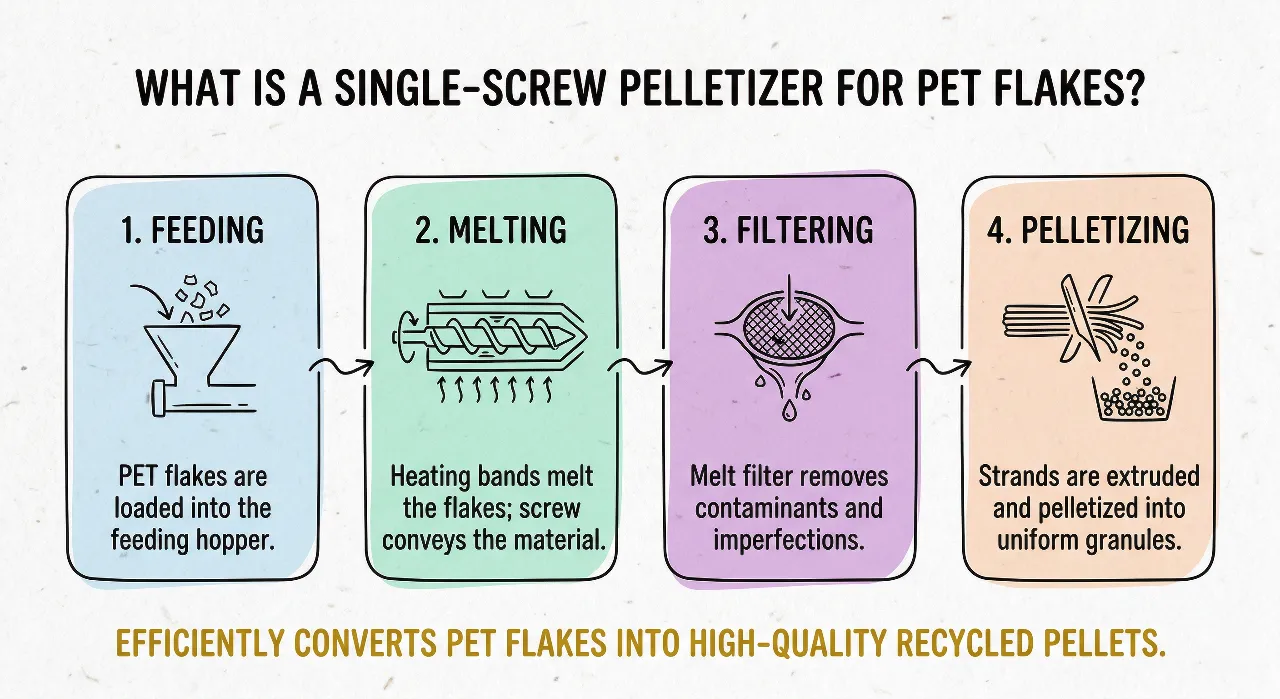
A single-screw pelletizer for PET flakes is a pelletizing system built to melt, filter, degas, and cut washed PET material into uniform pellets using one main extrusion screw. For the right feedstock, it can be a cost-effective solution. For the wrong feedstock, it becomes an expensive source of instability.
Before choosing the pelletizing section, make sure the upstream PET preparation is already under control. Rumtoo’s PET bottle recycling line covers the washing and flake-preparation side, while our hard plastic pelletizing line shows how pelletizing fits into the downstream process.
When single-screw PET pelletizing makes sense
Single-screw PET pelletizing usually works best when:
- the PET flakes are already clean and well sorted
- residual moisture is tightly controlled
- contamination is low and stable
- the application does not require intensive compounding
In those cases, a single-screw system can offer a simpler operating structure and lower capital cost than more complex alternatives.
Why PET preparation matters more than buyers expect
PET is far less forgiving than PE or PP when moisture control slips. If wet PET enters the extruder, hydrolytic degradation can reduce material quality quickly. That is why buyers should never evaluate the pelletizer in isolation.
Before PET flakes reach the pelletizer, the line should already be controlling:
- moisture
- PVC contamination
- fines and labels
- metal contamination
- flake-size consistency
If those variables are unstable, the pelletizer will not rescue the process.
What a single-screw PET pelletizer must do well
Stable melting
The screw and barrel must melt PET evenly without creating unnecessary residence-time stress.
Reliable degassing
PET pelletizing depends on strong venting and stable vacuum performance. Weak degassing shows up as quality loss, not just process inconvenience.
Effective melt filtration
Contaminants that pass the wash line still need to be trapped before pellet formation. Filtration design matters as much as screw design for final pellet quality.
Consistent pellet formation
The cutting and cooling method must match your pellet geometry target and downstream use.
Where single-screw systems fall short
A single-screw pelletizer is usually not the best option when:
- the flakes are heavily contaminated
- moisture control is inconsistent
- the line must handle mixed polymers
- the process requires strong homogenization or additive loading
In those cases, the project may need a different line configuration or a higher-complexity extrusion setup. Buyers often save money by fixing feedstock preparation first instead of over-specifying the pelletizer later.
How to evaluate a supplier
Ask for these five things before comparing quotes:
- The acceptable moisture window at the pelletizer inlet.
- The filtration setup and screen-change method.
- The expected output range for your real PET flake quality.
- The degassing configuration.
- The target end-use the supplier is designing for.
If the supplier cannot connect machine design to flake condition and final application, the quote is incomplete.
Single-screw vs. other PET pelletizing routes
For clean and consistent PET flakes, single-screw systems can be a good fit because they are simpler and easier to maintain. But simplicity only helps when the upstream process is already disciplined.
If your PET line is still struggling with contamination, unstable moisture, or mixed feedstock, upgrading the PET bottle recycling line may improve economics more than changing the pelletizer alone.
PET pelletizing project checklist
Before investing in a single-screw PET pelletizer, confirm these project basics:
- Your PET flake line has stable sorting and washing quality.
- Moisture control before extrusion is consistently within target.
- The intended pellet application is clearly defined.
- Melt filtration is sized for real contamination levels.
- The business case compares pellet value against flake value honestly.
If one of those points is still uncertain, the project may need upstream work before pelletizing will deliver its full return.
Frequently asked questions
Is a single-screw pelletizer good for all PET recycling projects?
No. It works best when the flakes are already clean, dry, and stable. It is not the ideal solution for every PET project, especially when contamination or process variability is still high.
What is the biggest risk in PET pelletizing?
Poor moisture control is one of the biggest risks because PET is sensitive to degradation during processing. That is why drying and degassing deserve as much attention as screw diameter or motor size.
Should buyers upgrade washing first or pelletizing first?
If flake quality is unstable, improving the PET bottle recycling line usually creates a better return than upgrading the pelletizer alone. Stable pelletizing starts with stable flakes.
Final takeaway
A single-screw pelletizer for PET flakes can be the right solution when the feedstock is already clean, dry, and stable. It is not a shortcut around poor flake preparation. Buyers get the best results when they treat PET washing, drying, filtration, and pelletizing as one connected process.
If you want to review whether single-screw PET pelletizing fits your project, contact Rumtoo. We can help compare the pelletizing section against your actual flake quality, throughput goal, and target pellet application.
- single-screw pelletizer
- PET flakes pelletizing
- PET recycling
- hard plastic pelletizing line
- recycling pelletizing