· Rumtoo Engineering Team · Buying Guides · 8 min read
OEM/ODM Filament Shredder Solutions for Recycling Companies
Find custom OEM/ODM filament shredder solutions built for recycling companies. Compare specs, branding options, and material compatibility before sourcing your next machine.
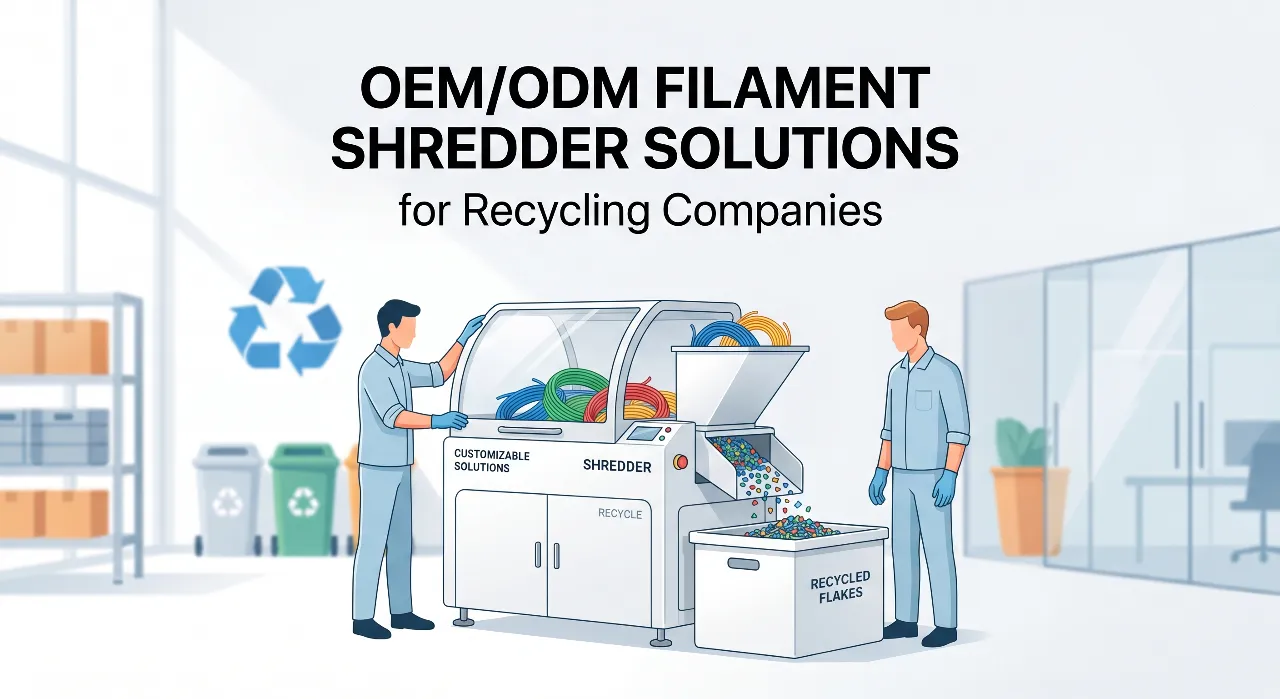
Recycling companies sourcing plastic size-reduction equipment face a clear decision: buy a generic machine off the shelf, or commission a custom filament shredder that fits your exact throughput, material type, and brand requirements. This guide explains how OEM and ODM filament shredder programs work, what specifications to demand, and how to qualify the right manufacturer for your recycling operation.
What OEM and ODM Mean for Filament Shredders
OEM (Original Equipment Manufacturer) means the manufacturer builds a shredder to your design specifications, which you then sell or deploy under your own brand. ODM (Original Design Manufacturer) means the manufacturer supplies a pre-engineered shredder design that you rebrand and distribute without modifying the core engineering.
For recycling companies, the practical difference is this: OEM gives you full control over knife geometry, feed throat dimensions, motor rating, and housing design — but it requires your own engineering input and typically a higher minimum order quantity (MOQ). ODM gets you a proven, field-tested machine faster, with lower upfront engineering cost, and is the right choice when your recycling application falls within standard material ranges such as PLA, ABS, PETG, or HDPE.
Who Should Use an OEM/ODM Filament Shredder Program
Not every recycling company needs a custom machine. OEM/ODM programs deliver the clearest value in these situations:
- Filament manufacturers recovering failed spools and print scrap who need consistent 3–6 mm regrind for re-extrusion
- Recycling companies building private-label equipment lines for resale to labs, universities, or makerspaces
- Industrial R&D departments piloting closed-loop recycling before scaling to production-line shredders
- Sustainability-focused brands who want shredder hardware bearing their own logo and color scheme
- Contract recyclers processing specific polymer streams (e.g., PETG medical waste or ABS automotive scrap) requiring non-standard knife configurations
If your operation processes more than 500 kg/day, you likely need an industrial twin-shaft or single-shaft shredder rather than a desktop OEM/ODM unit. For lab-scale and small-batch recycling up to 5 kg/h, a mini desktop shredder is the practical starting point for most custom programs.
Key Specifications to Define Before Sourcing
Entering an OEM/ODM negotiation without clear technical requirements wastes time and inflates sample costs. Define these parameters before contacting any manufacturer:
Throughput and Feed Size
Specify your target throughput in kg/h and your maximum input piece size. Rumtoo’s mini desktop shredder, for example, accepts input pieces up to 120 × 200 mm and delivers 1–5 kg/h depending on polymer type and feed preparation. Locking in these numbers prevents suppliers from quoting machines that cannot handle your actual waste stream.
Knife Configuration and Material
The two most impactful variables in shredder performance are knife count and steel grade. A 22-rotating + 22-fixed knife set produces a general-purpose 3–6 mm output. A 36-rotating + 36-fixed configuration targets finer 3 mm output for direct extruder feeding. H13 tool steel knives are the industry standard for hard polymers; in controlled lab environments with clean feedstock, H13 blades reach 300+ service hours before requiring resharpening.
Motor Power and Electrical Configuration
For desktop and pilot-scale units, a 1.5 kW geared motor with forward/reverse control covers most rigid plastic streams. Confirm voltage options (110V vs. 220V) early — a configurable electrical setup eliminates expensive transformer requirements for international deployments.
Target Output Particle Size
| Blade Set | Knife Count | Target Output | Best For |
|---|---|---|---|
| Set A | 22R + 22F | 3–6 mm | General regrind, extrusion prep |
| Set B | 36R + 36F | ~3 mm | Fine regrind, direct filament feeding |
Material Compatibility: What a Filament Shredder Can Process
A filament shredder built for recycling applications must handle the full range of common 3D printing and packaging polymers. Verified compatible materials for desktop OEM/ODM units include:
- PLA — The most common 3D print scrap; low abrasion, ideal for knife longevity
- PETG — Moderate toughness; confirm feed rate to prevent heat buildup at the cutting chamber
- ABS — Higher impact resistance; reverse-jog clearing is frequently needed for irregular geometries
- PP/HDPE caps and rigid samples — Suitable for bottle cap streams and material validation workflows
- PC (Polycarbonate) — Hard and abrasive; specify premium knife steel grade and expect shorter service intervals
Input material must be clean, dry, and free of metal contamination. Mixed or contaminated feedstock accelerates knife wear and reduces output consistency — both of which increase your total cost of ownership in a recycling operation.
The OEM/ODM Customization Process: From Sample to Production
A well-structured OEM/ODM program moves through four stages. Understanding each stage helps you set realistic timelines and avoid cost overruns.
Stage 1 — Requirements Specification (1–2 weeks) Submit your material type, throughput target, output particle size, voltage requirement, and any branding specifications (logo, color, labeling). The manufacturer returns a configuration recommendation and preliminary BOM.
Stage 2 — Sample Production and Testing (3–6 weeks) The manufacturer produces a prototype or pre-production sample. In our experience, this stage is where most technical mismatches surface — particularly around jam recovery behavior with irregular scrap shapes. A forward/reverse jog control mechanism, like that built into Rumtoo’s desktop shredder, resolves most bridging issues in under 30 seconds without tools.
Stage 3 — Approval and MOQ Confirmation After sample sign-off, confirm your MOQ and production lead time. Desktop OEM/ODM shredder programs typically start at MOQs of 5–20 units, depending on the degree of customization.
Stage 4 — Production, QC, and Shipping Production runs include incoming material inspection, in-process knife fit checks, and a final operational test before packaging. Confirm CE and RoHS certification requirements for your target market before this stage, as adding certification post-production significantly increases cost.
OEM vs. ODM: Which Model Fits Your Recycling Business
| Criteria | OEM Program | ODM Program |
|---|---|---|
| Design ownership | Yours (custom engineering) | Manufacturer’s (proven design) |
| Time to market | Longer (8–16 weeks typical) | Faster (4–8 weeks typical) |
| MOQ | Higher (engineering amortization) | Lower (existing tooling) |
| Engineering input required | High | Low |
| Best for | Unique material streams, proprietary designs | Standard recycling apps, private-label resale |
| Branding flexibility | Full (housing, color, UI) | Partial (logo, color, labeling) |
For most recycling companies entering the private-label equipment market, ODM is the faster and lower-risk starting point. Once you validate market demand, you can transition to a full OEM program with custom specifications.
Why Compact Desktop Shredders Are the Right OEM/ODM Entry Point
Large industrial shredders carry six-figure price tags and multi-month lead times that make OEM/ODM customization impractical for most small and mid-size recycling companies. Desktop shredders — with machine weights around 101 kg, footprints of 650 × 300 × 780 mm, and sub-55 dB noise profiles — fit lab benches, shared workspaces, and pilot recycling lines without electrical upgrades or structural floor reinforcement.
According to the recycling equipment market, demand for compact, lab-scale plastic size-reduction units has grown sharply as universities, filament brands, and contract recyclers build in-house closed-loop programs rather than outsourcing waste streams. A desktop OEM/ODM shredder is often the first physical piece of equipment in a new recycling program — which means your brand appears at the start of the customer’s recycling journey, not at the end.
Certifications and Compliance for OEM/ODM Shredder Export
If you plan to resell or deploy OEM/ODM shredders outside your home country, confirm these certifications with your manufacturer before production begins:
- CE marking — Required for EU market entry; covers electrical safety and mechanical guarding
- RoHS compliance — Restricts hazardous substances in electrical and electronic equipment; mandatory for EU, UK, and increasingly required in Asian markets
- UL/ETL listing — Required or preferred for North American commercial deployments
- ISO 9001 — Confirms the manufacturer’s quality management system; reduces risk of production inconsistencies across batches
Request certification documentation before signing an OEM/ODM agreement. Retrofitting compliance after production is expensive and can delay your launch by 8–12 weeks.
Frequently Asked Questions
What is the minimum order quantity for a custom OEM filament shredder? MOQ varies by manufacturer and customization depth. For desktop-scale units with logo and color customization only (ODM), MOQs of 5–10 units are common. Full OEM programs with custom knife geometry or motor configurations typically start at 10–20 units to amortize tooling costs.
Can a desktop filament shredder feed directly into an extruder? A desktop shredder produces regrind at 3–6 mm particle size, which is compatible with most small extruders. However, the regrind must be dried (typically at 60–80°C for PLA, longer for hygroscopic polymers like PETG) and may require screening to remove fines before extrusion feeding.
How long do OEM/ODM shredder knives last? In controlled lab environments with clean, dry feedstock, H13 tool steel knives last 300+ hours before resharpening is required. Contaminated or abrasive materials (e.g., glass-filled nylons, metal-contaminated waste) significantly reduce service intervals.
What is the lead time for an ODM filament shredder with private-label branding? ODM programs with logo and color customization typically run 4–8 weeks from sample approval to first production shipment, assuming no structural engineering changes.
Start Your OEM/ODM Filament Shredder Project
Choosing the right OEM/ODM program comes down to three factors: your target material stream, your throughput requirement, and whether you need custom engineering or a proven design you can brand and deploy quickly. For most recycling companies, an ODM desktop unit is the fastest path to market.
Explore the Rumtoo Mini Desktop Plastic Shredder — a lab-proven, configurable platform built for small-batch regrind, pilot recycling lines, and OEM/ODM customization programs. Submit your material type, target output size, and throughput expectations to receive a recommended configuration.
- filament shredder
- OEM/ODM shredder
- plastic recycling equipment
- custom shredder solutions