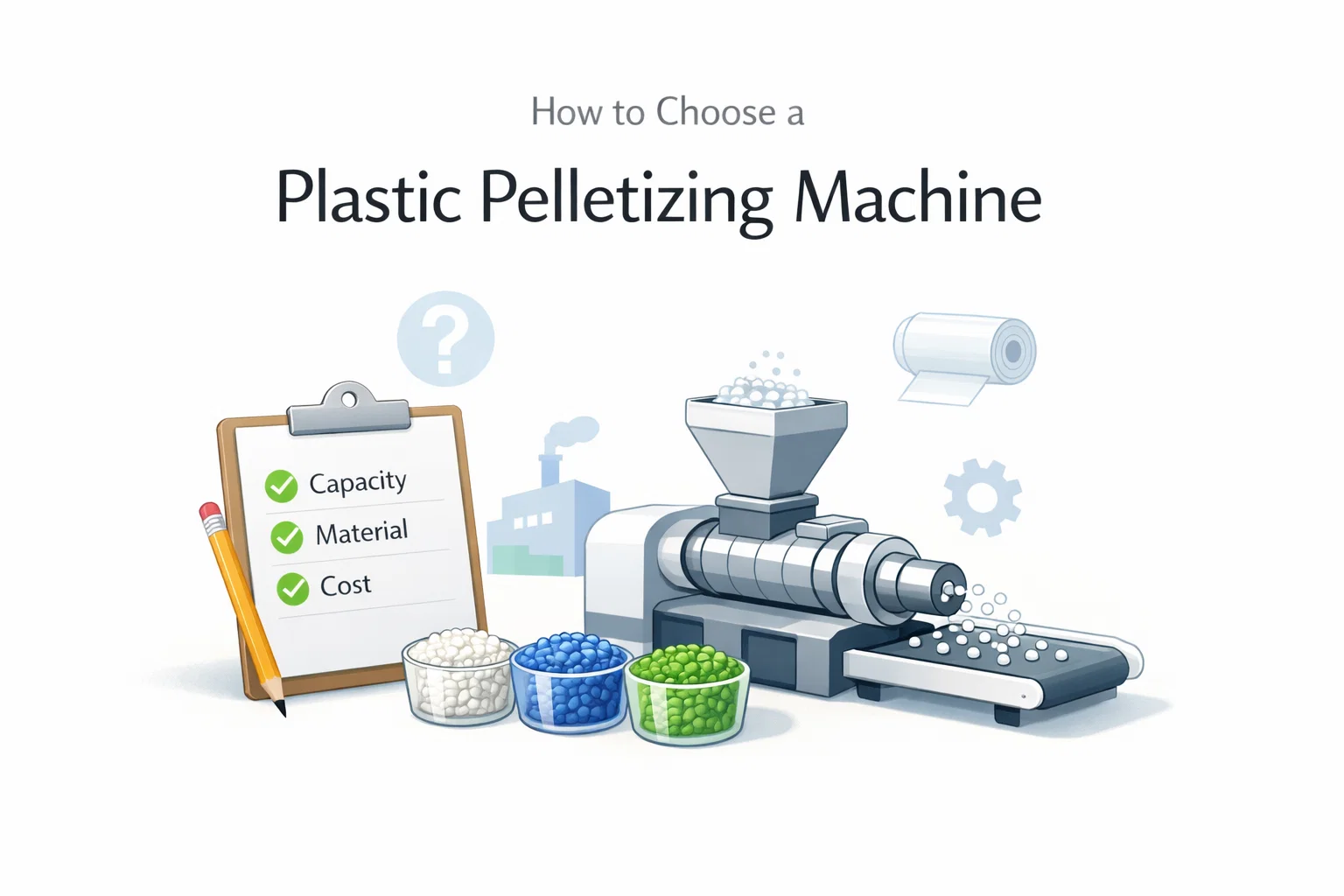

· Rumtoo Engineering Team · Buying Guides · 15 min read
Pelletizing Plastic: Complete Process Guide with Material Adaptation Matrix
A practical pillar guide to pelletizing plastic—the full six-stage process, how strand, water-ring, and underwater systems differ, and a material-by-material adaptation matrix covering PE film, PP raffia, HDPE rigid, PET, PVC, PS, EPS, and ABS. Built for recycling plant decision-makers who need to validate scope before issuing an RFQ.
Pelletizing plastic is the step that decides whether a recycling plant sells a commodity flake at scrap prices or a specification-grade pellet at near-virgin prices. Every upstream investment—shredding, washing, drying, separation—ultimately gets monetized or wasted at the pelletizing stage. Getting this stage right means matching the process to the material, not buying a line because a competitor bought the same one.
This guide walks through the full six-stage pelletizing process, then provides a material-by-material adaptation matrix covering the seven feedstocks that account for nearly all post-consumer and post-industrial recycling volume in 2026: PE film, PP raffia, HDPE rigid, PET, PVC, PS/EPS, and ABS. It is built for plant managers, technical buyers, and procurement teams who need to validate the technical scope of a project before issuing any RFQ.
If you are still comparing complete line layouts, start with our recycling pelletizing lines overview. If you have already settled on a feedstock and want to skip to equipment selection, jump to how to choose a plastic pelletizing machine.
What pelletizing plastic actually means—and what it doesn’t
Pelletizing plastic is the process of converting cleaned, sorted plastic waste into uniform pellets of 3–5 mm that downstream converters can feed into injection molding, extrusion, or blow molding equipment exactly like virgin resin. The pellet is the saleable output of a recycling plant. Everything before it is preparation.
Pelletizing is not a cleaning step. It cannot remove paper contamination, metal fines, incompatible polymers, or excess moisture beyond what a vent zone can pull off. Buyers who treat the extruder as a “last chance” to recover poor feedstock consistently underestimate the cost of downgraded pellets, plugged screen changers, and rejected loads.
By the time material enters the pelletizing section, it should already meet these conditions:
- Moisture content: Below 1% for most rigid flake, below 0.5% for PET and other hygroscopic resins, below 3–5% for densified film entering a vented extruder
- Bulk contamination: Metals, paper, and incompatible polymers removed by magnetic separation, sink-float tanks, and air classification
- Particle size: Within the range the feed section is designed for—typically 8–25 mm for rigid flake, densified pellet for film
According to the Ellen MacArthur Foundation, more than 80% of packaging design issues that prevent recyclability also create downstream pellet quality problems. The pelletizer cannot correct what the bottle, film, or label was never designed to allow.
The six-stage pelletizing plastic process, end to end
Most online guides describe pelletizing as a seven-step process from collection to pellet bagging. That framing mixes the recycling plant’s responsibility with the upstream supply chain. For an operator specifying a line, the relevant scope is six engineering stages, all under one roof.
Stage 1 — Sorting and size reduction
Inbound bales or loose scrap are debaled, then run through a shredder or granulator to reach a feedable particle size. Rigid material is typically shredded to 30–80 mm, then granulated to 8–15 mm flake. Film material is shredded to 50–150 mm strips before washing.
For PVC pipe, profile offcuts, and other rigid products, a crusher and a shredder serve different roles—see crusher vs shredder for PVC pipe recycling for the configuration logic. For mixed rigid and film, how to choose a crusher-shredder configuration covers the trade-offs.
Stage 2 — Washing and drying: the prerequisite buyers underspend on
This is the stage that decides pellet quality. A washing line removes labels, adhesives, sand, dust, and food residue using friction washers, sink-float tanks, and hot wash reactors. Drying then brings moisture down to the level the extruder can handle.
Three failure modes consistently show up in plants that rushed this stage:
- Black specks in the pellet: Almost always trace contamination that survived washing
- Gel and unmelt: Often moisture-driven hydrolysis in the extruder, not a melt-mixing failure
- Off-spec MFI batch to batch: Inconsistent feedstock cleaning, not extruder drift
A correctly specified hot wash system costs 30–40% of the total line and earns it back through pellet price tier, not throughput.
Stage 3 — Feeding and densifying low-bulk-density feedstock
Rigid flake feeds directly into the extruder hopper by gravity. Film and fiber feedstock will not. PE film typically has a bulk density of 30–60 kg/m³—too light and too unstable to feed evenly into a screw. The line must densify it first.
A cutter-compactor or film densifier converts loose film into a dense agglomerate that flows into the extruder at a consistent rate. Without this stage, a film line surges, throughput drops 30–50%, and pellet color becomes uneven. This is the single most common mistake in PE film pelletizing scope.
If the project includes foam, wet film, dry film trim, or mixed low-density waste, check the densifier selection guide before fixing the pelletizing feed system.
Stage 4 — Melting, degassing, and melt filtration
Inside the extruder, the screw melts and homogenizes the polymer through shear and barrel heat. Vent ports pull moisture and volatiles out of the melt under vacuum. A melt pump stabilizes pressure before the melt reaches the screen changer, which filters out remaining contamination through a screen pack typically rated at 60–200 mesh depending on the polymer and application.
Screen changer choice—manual, hydraulic plate, or continuous belt—is driven by the contamination level of the feedstock and the tolerance of the end application. Post-consumer film with high paper content needs a continuous filter; post-industrial PP regrind often runs on a plate changer.
For single-screw vs twin-screw extruder selection, the rule of thumb: single-screw for clean, stable feedstock; twin-screw for high contamination, multiple input streams, or compounding with additives.
Stage 5 — Pellet formation: strand, water-ring, or underwater
This is where the three main pelletizing technologies diverge:
| Pelletizing method | What happens | Best fit |
|---|---|---|
| Strand pelletizing | Melt extrudes as continuous strands through a die, cools in a water bath, is air-dried, then cut into pellets | Clean rigid PE, PP, ABS, PS regrind; stable melts |
| Water-ring pelletizing | Rotating knives cut the melt at the die face inside a water ring that cools and conveys pellets | PE film, PP raffia, soft polyolefins that sag or break as strands |
| Underwater pelletizing | The die face is submerged in tempered water; pellets are cut, cooled, and conveyed in a single closed loop | High-output PET, engineering plastics, masterbatch, and compounds requiring tight size control |
For a deeper comparison of the two most common configurations for recyclers, see water-ring vs strand pelletizer price and selection. For PE film and PP woven bag projects, the water-ring plastic pelletizers guide covers sizing and feeding decisions.
Stage 6 — Cooling, dewatering, and classification
After cutting, pellets are dewatered in a centrifugal dryer and conveyed to a vibrating classifier that screens out fines and oversize. Pellets at the correct size and moisture are then conveyed to a silo or bagging station. A magnetic separator and metal detector at this stage catch trace metal contamination one last time before the pellet leaves the plant.
Final pellet moisture should be below 0.2% for most polyolefins and below 0.05% for PET destined for fiber or bottle reprocessing.
Key takeaway: Pelletizing plastic is six engineering stages, not one machine. The stages most often underspecified are washing/drying (Stage 2) and densifying (Stage 3). Both decide pellet price tier more than the extruder itself.
Pelletizing plastic by material: the adaptation matrix
The same line cannot pelletize every plastic well. The seven feedstocks below cover most recycling project scopes. Each section names the recommended pelletizing method, screw type, throughput band, and the quality defects to watch for.
PE film and LDPE
PE film—shopping bags, agricultural mulch, stretch wrap, industrial liner—is the highest-volume recycling feedstock by tonnage in many markets and the most demanding to pelletize.
- Recommended pelletizing method: Water-ring pelletizing with a cutter-compactor or film densifier feeding the extruder
- Screw: Single-screw extruder with vacuum vent zone; twin-screw only if heavy contamination is expected
- Throughput band: 200–1,500 kg/h per line is typical for post-consumer film
- Common defects: Gels (moisture-driven), color shift (inconsistent feed rate), strand break (wrong cooling for soft melt)
The non-negotiable upstream investment is densifying. A film compacting pelletizing line integrates the cutter-compactor directly with the extruder feed so the densified material enters at consistent temperature and bulk density.
PP raffia and woven bags
PP raffia, woven bags, FIBC bulk bags, and similar fiber-form PP behave like film during pelletizing—light, unstable, easy to scorch.
- Recommended pelletizing method: Water-ring pelletizing
- Screw: Single-screw extruder, often with two-stage vent
- Throughput band: 300–1,200 kg/h
- Common defects: Yellowing (over-temperature), uneven pellet size (feed surge), brittle pellets (filler contamination from printed bags)
Bulk bag and FIBC scrap usually needs a dedicated shredder upstream—see bulk bag shredder vs film shredder for the configuration.
HDPE rigid (bottles, containers, regrind)
Post-consumer HDPE bottle flake and post-industrial HDPE regrind are the easiest polyolefin to pelletize and produce the highest-tier recycled polyolefin pellet.
- Recommended pelletizing method: Strand pelletizing for clean post-industrial regrind; water-ring or underwater for post-consumer bottle flake
- Screw: Single-screw with melt filter; twin-screw if compounding with additives or running mixed-color streams
- Throughput band: 500–2,500 kg/h
- Common defects: Black specks (label glue residue), high MFI variance (mixed bottle resin grades)
For dedicated rigid lines, see the hard plastic pelletizing line reference layout.
PET flakes
PET is the most quality-sensitive polymer in the recycling stream because the end markets—bottle-to-bottle, fiber, sheet—each have strict intrinsic viscosity (IV) and color targets.
- Recommended pelletizing method: Underwater pelletizing for bottle-grade output; strand pelletizing for fiber and lower-tier sheet markets
- Screw: Single-screw with crystallizer pre-dryer; twin-screw with high vacuum if running flake direct without crystallization
- Throughput band: 300–2,000 kg/h
- Common defects: IV drop (insufficient drying, hydrolysis), yellowing (over-temperature in vent zone), opaque pellets (incomplete melting)
A single-screw pelletizer for PET flakes is the standard for fiber-grade output. Bottle-to-bottle requires a separate solid-state polycondensation stage after pelletizing to recover IV.
PVC pipe and profile regrind
PVC is the most heat-sensitive commodity polymer. Residence time in the extruder must be minimized because PVC degrades rapidly above 200 °C, releasing HCl that attacks the screw and barrel.
- Recommended pelletizing method: Cold cut after pulverizing—most PVC recyclers do not melt-pelletize at all. They sell pulverized PVC powder, not pellets
- Screw: If pelletizing is required, single-screw with a forced-feed conical section, short L/D, and corrosion-resistant bimetallic barrel
- Throughput band: 200–800 kg/h
- Common defects: Black scorch streaks (residence time too long), HCl corrosion (wrong barrel metallurgy), brittle output (overshear)
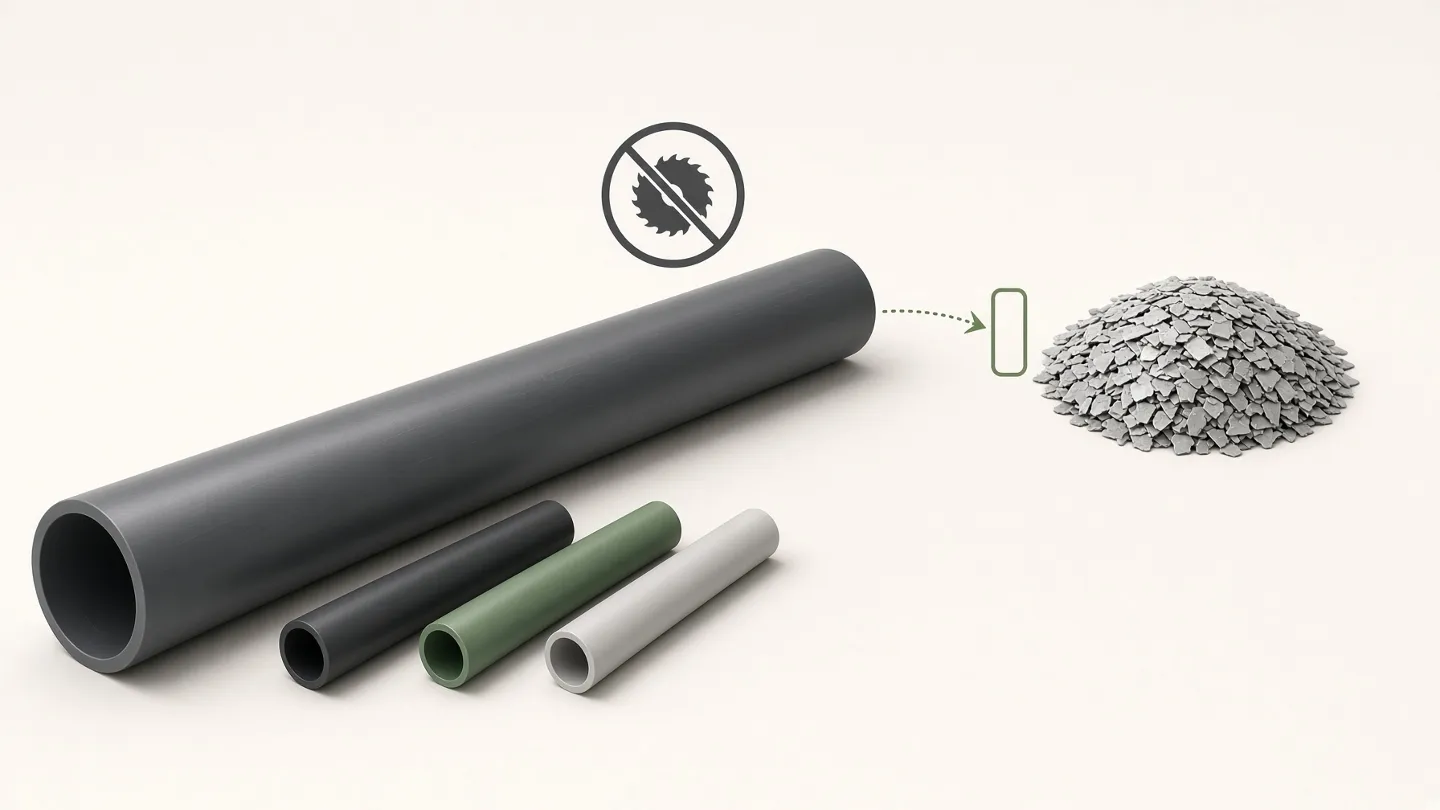
For most PVC pipe and profile recyclers, the right answer is not pelletizing at all. See PVC pipe recycling process, crushing PVC pipes and window profiles, and PVC pulverizer guide for 20–120 mesh output for the pulverizing route.
PS, EPS, and ABS
Polystyrene rigid scrap, EPS foam, and ABS regrind each behave differently:
- PS rigid: Strand pelletizing, single-screw, 300–1,500 kg/h. Defects: yellowing, brittleness from residual styrene monomer
- EPS foam: Requires cold-press densification before pelletizing—an EPS foam cold-press machine converts 30 kg/m³ foam blocks into 600–900 kg/m³ ingots that feed a standard pelletizer
- ABS: Strand pelletizing or underwater, single-screw with thorough drying (ABS absorbs moisture and surface-bubbles in the pellet)
Quick-reference adaptation table
| Material | Pelletizing method | Screw | Throughput band | Critical defect to control |
|---|---|---|---|---|
| PE film / LDPE | Water-ring | Single, vented | 200–1,500 kg/h | Gel, color shift |
| PP raffia / woven | Water-ring | Single, two-stage vent | 300–1,200 kg/h | Yellowing, brittleness |
| HDPE rigid | Strand or water-ring | Single (clean) / Twin (mixed) | 500–2,500 kg/h | Black specks, MFI variance |
| PET flake | Underwater or strand | Single + crystallizer | 300–2,000 kg/h | IV drop, yellowing |
| PVC | Cold cut / pulverize | Single, bimetallic, short L/D | 200–800 kg/h | Scorch, HCl corrosion |
| PS / ABS | Strand or underwater | Single, with drying | 300–1,500 kg/h | Brittleness, surface bubbles |
| EPS | Strand (after cold press) | Single | 200–800 kg/h | Density variance |
How to choose the right pelletizing configuration
Once the material is fixed, three sizing questions decide the line.
Throughput sizing formula
Required throughput (kg/h) = Total daily feedstock (kg) ÷ Operating hours per day
A plant processing 12,000 kg/day over 20 operating hours per day needs a nominal 600 kg/h line. Before specifying to a supplier, add a 20–25% buffer for planned maintenance, seasonal volume peaks, and unplanned downtime. The same plant should specify a 720–750 kg/h line.
Typical capacity bands:
- Small (100–500 kg/h): Post-industrial scrap recovery, R&D, pilot operations
- Medium (500–1,500 kg/h): Regional recyclers with established off-take contracts
- Large (above 1,500 kg/h): Industrial-scale post-consumer bale processing
If expansion is likely within five years, pre-rate electrical service and structural footprint at construction. Retrofitting the shell after commissioning costs significantly more than planning for it upfront.
Decision tree: which cutting method fits your feedstock
- Is the feedstock film, raffia, or other soft polyolefin? → Water-ring pelletizing
- Is it PET, engineering plastic, or compounded material requiring tight size control? → Underwater pelletizing
- Is it clean rigid HDPE, PP, ABS, or PS regrind? → Strand pelletizing
- Is it PVC? → Pulverize, do not melt-pelletize unless the end application requires pellets
- Is it EPS foam? → Cold-press densify first, then strand pelletize
Single-screw vs twin-screw, briefly
Single-screw is the default for recycling—simpler, less expensive, easier to maintain, lower energy per ton. Twin-screw is justified when one of these applies:
- Feedstock contamination is high and variable
- Multiple input streams need compounding into one pellet
- Additives, fillers, or compatibilizers are added at the extruder
- The end application requires tightly controlled MFI or melt homogeneity
For most post-consumer recyclers running a single resin stream, single-screw is the right answer.
Quality defects and what they tell you about your pelletizing line
The fastest way to diagnose a pelletizing line is to read the pellet. Each defect points to a specific stage. Use this table during commissioning and quarterly QA reviews.
| Defect observed in pellet | Likely root cause | Stage to investigate |
|---|---|---|
| Black specks | Label glue, paper char, or contamination | Stage 2 (washing) and Stage 4 (screen changer) |
| Yellowing | Over-temperature or excess residence time | Stage 4 (extruder profile) |
| Gels and unmelt | Moisture-driven hydrolysis or insufficient melt mixing | Stage 2 (drying) and Stage 4 (screw design) |
| Uneven pellet size | Feed surge or knife wear | Stage 3 (densifier feed rate) and Stage 5 (pelletizer knives) |
| Strand breakage | Soft melt cooled wrong for strand method | Stage 5 (switch to water-ring) |
| High MFI variance | Mixed resin grades or inconsistent feed | Stage 1 (sorting) and Stage 3 (feed stability) |
| Surface bubbles | Residual moisture or trapped volatiles | Stage 2 (drying) and Stage 4 (vent zone) |
| Brittleness | Filler contamination or overshear | Stage 1 (sorting) and Stage 4 (screw speed) |
For a hands-on QA workflow, see how to improve recycled flake quality control.
Cost and ROI snapshot for a pelletizing plastic line
Pelletizing line investment scales with throughput, feedstock complexity, and pellet specification. Typical 2026 ranges for a complete line (excluding building, utilities, and freight):
| Line size | Feedstock | Approximate investment | Payback range |
|---|---|---|---|
| 300–500 kg/h film | PE film, post-industrial | $80,000–$180,000 | 18–30 months |
| 500–1,000 kg/h rigid | HDPE/PP post-consumer | $180,000–$400,000 | 24–36 months |
| 1,000–2,000 kg/h PET | Bottle flake, fiber-grade | $400,000–$1,200,000 | 30–48 months |
Payback ranges assume stable off-take pricing and 75–85% line uptime. Plants that underinvest in pelletizer maintenance typically see uptime drop below 70% within 18 months and payback extend by 6–12 months.
The single largest variable that buyers underestimate is feedstock quality. A line designed for clean post-industrial regrind running post-consumer mixed bottle bale will not hit nameplate throughput and will produce off-spec pellet. Match the line to the feedstock you actually have, not the feedstock you wish you had.
Frequently asked questions
What is pelletizing in plastic recycling?
Pelletizing in plastic recycling is the process of melting cleaned, sorted plastic waste and forming it into uniform 3–5 mm pellets that downstream converters can use as a direct substitute for virgin resin. It is the final stage of a recycling line and the stage where pellet quality—and pellet price—is decided.
What are the three main types of plastic pelletizing?
The three main types are strand pelletizing (extruded strands cooled in water, then cut), water-ring pelletizing (knives cut at the die face inside a circulating water ring), and underwater pelletizing (die face submerged in tempered water). Strand is most common for clean rigid regrind, water-ring is preferred for film and soft polyolefins, and underwater is standard for PET and engineering plastics.
Can the same line pelletize PE, PP, and PET?
No. PE and PP share similar processing windows and can sometimes run on the same water-ring line with screw and die changes. PET requires fundamentally different temperature control, drying (crystallizer pre-heating), and typically underwater pelletizing. PVC should not share a line with any other polymer because residual chlorine corrodes downstream barrels.
How much does a plastic pelletizing line cost?
A 300–500 kg/h film pelletizing line is typically $80,000–$180,000. A 500–1,000 kg/h rigid line is $180,000–$400,000. A 1,000–2,000 kg/h PET line is $400,000–$1,200,000. These figures are for the pelletizing line only and exclude washing, drying, building, and utilities.
Is pelletizing the same as granulating?
No. Granulating produces irregular flake by mechanical size reduction with no melting—it is a Stage 1 process. Pelletizing produces uniform melt-formed pellets and is a Stage 5 process. Some manufacturers use “granulator” loosely to describe a pelletizer; verify by asking whether the machine melts the polymer.
Why is densifying important before pelletizing PE film?
PE film has a bulk density of 30–60 kg/m³—too low for an extruder screw to feed evenly. A cutter-compactor or film densifier compacts the film into a 300–500 kg/m³ agglomerate that feeds at consistent rate, eliminating the throughput surges and color shifts that otherwise plague film pelletizing lines.
Can you pelletize PVC?
Technically yes, but most PVC recyclers do not. PVC degrades above 200 °C, releasing HCl that corrodes the extruder. The dominant route for PVC pipe and profile recycling is pulverizing to powder, not pelletizing. Where pellets are required, use a short L/D single-screw with bimetallic barrel and minimize residence time.
What pellet moisture is acceptable?
Final pellet moisture should be below 0.2% for polyolefins (PE, PP) and below 0.05% for PET intended for fiber or bottle reprocessing. Higher moisture causes gel formation during downstream conversion and downgrades the pellet’s market price.
Next steps
Pelletizing plastic profitably comes down to three decisions made in order: confirm the feedstock and its realistic quality, match the pelletizing method and screw to that material, and size the line to actual daily volume plus a 20–25% buffer. Skip any of these and the line will run, but it will not earn back its investment on schedule.
When you are ready to scope a line for a specific feedstock, our engineering team can review your material, throughput target, and pellet spec and return a configuration with cost ranges before you issue any RFQ. Start with the recycling pelletizing lines overview, or contact us directly with your feedstock and target throughput.
- pelletizing plastic
- plastic pelletizing process
- plastic pelletizing line
- pelletizing machine types
- recycled plastic pellets
- PE film pelletizing
- PET pelletizing
- PVC pelletizing