· Rumtoo Process Team · Technical Guide · 13 min read
PVC Pipe Crusher vs. Shredder: Which Machine Is Better for Pipe Recycling?
Compare PVC pipe crushers and shredders for pipe recycling. Learn when to use a crusher, when a shredder is better, and when a two-stage shredder-plus-crusher system gives the best output quality, feeding stability, and recycling efficiency.
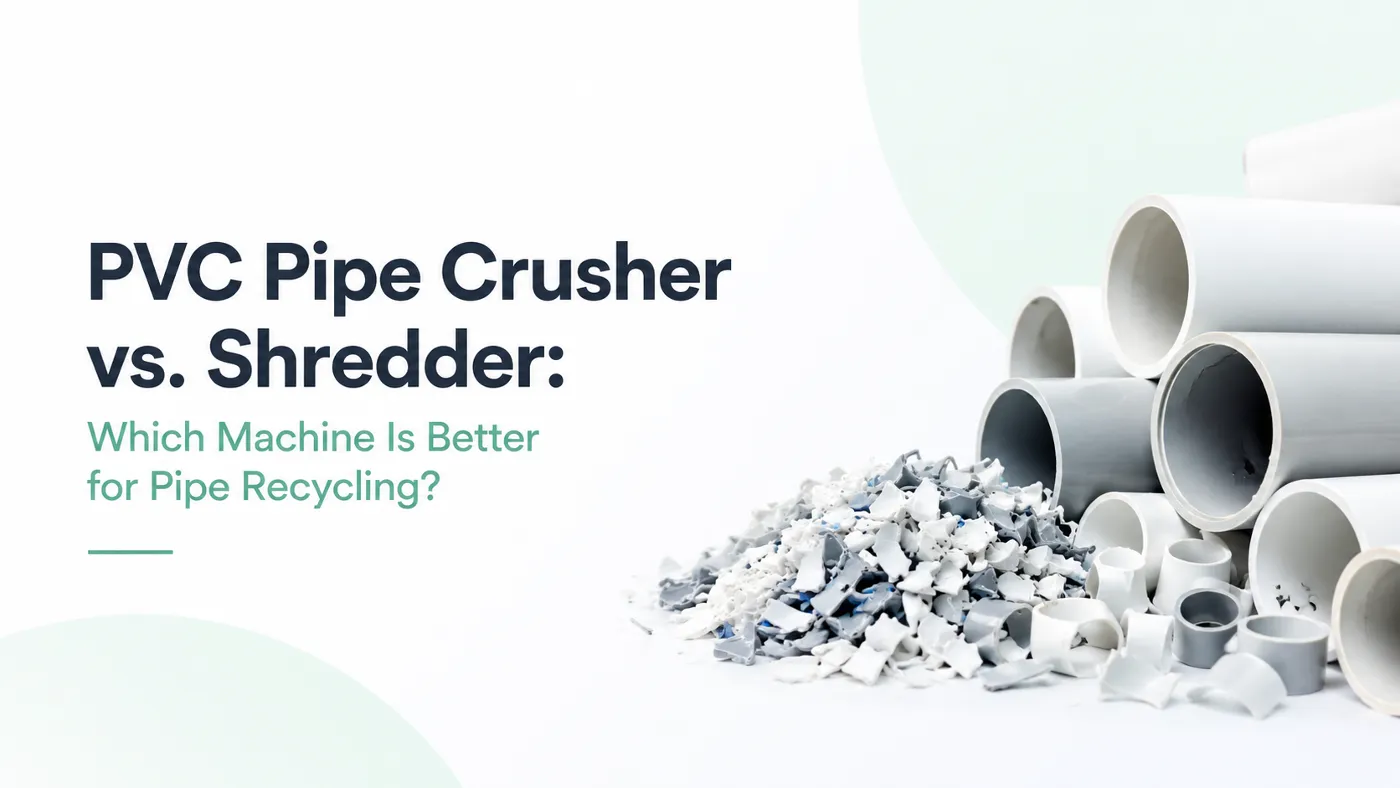
When recycling rigid PVC pipes, one common question is whether you need a PVC pipe crusher or a PVC pipe shredder. Both machines reduce pipe scrap into smaller pieces, but they are not designed for the same job.
A crusher is usually better for shorter pipe sections, thinner-wall pipes, and applications where you need smaller, more uniform flakes. A shredder is better for long pipes, large-diameter pipes, thick-wall pipes, and bulky scrap that is difficult to feed directly into a crusher.
For many pipe recycling plants, the best solution is not simply “crusher or shredder”. It is often a combined system: shredder first, crusher second. This guide explains the differences, use cases, and selection criteria so you can choose the right machine for a PVC pipe recycling line.
If your main challenge is long PVC pipes and window profiles, Rumtoo’s vertical crusher for PVC pipe and profiles is designed to reduce pre-cutting labor while producing stable chips for downstream recycling.
Quick answer: crusher or shredder for PVC pipe recycling?
Choose a PVC pipe crusher if your material is already cut into manageable lengths and you need smaller flakes for washing, storage, pulverizing, extrusion, or pelletizing.
Choose a PVC pipe shredder if you process long pipes, large-diameter pipes, heavy-wall pipes, pipe bundles, post-consumer scrap, or bulky material that cannot be fed safely into a crusher.
Choose a shredder + crusher system if you need stable feeding, high throughput, and controlled final particle size for an industrial pipe recycling line.
In simple terms:
- Crusher: better for final size control and smaller output
- Shredder: better for bulky pipe reduction and difficult feeding
- Shredder + crusher: better for high-volume or variable pipe recycling
If you are comparing machine types across broader plastic recycling streams, see our guide on crusher vs. shredder configuration for plastic recycling.
What is a PVC pipe crusher?
A PVC pipe crusher is a high-speed size reduction machine used to cut rigid plastic pipes into smaller chips or flakes. It typically uses rotating blades and fixed blades inside a cutting chamber. Material is cut repeatedly until it passes through a screen with the required hole size.
PVC pipe crushers are commonly used for:
- PVC water supply pipes
- Drainage pipes
- Electrical conduit pipes
- Cable trunking
- Window and door profiles
- Pipe extrusion offcuts
- Rejected production pieces
- Clean post-industrial PVC scrap
A crusher is best when the pipe scrap can be fed into the cutting chamber safely and consistently. For long pipes, many plants either cut the pipe into shorter sections or use a dedicated pipe/profile crusher with a special feeding design.
Main advantages of a PVC pipe crusher
A crusher is useful when the recycling process requires smaller and more consistent output.
Key advantages include:
- Produces smaller flakes than a shredder
- Uses a screen to control final chip size
- Works well for clean factory scrap
- Supports washing, storage, pulverizing, or re-extrusion
- Can be integrated with conveyors, dust collection, and metal detection
- Often has a smaller footprint than a heavy-duty shredder line
Main limitations of a PVC pipe crusher
A crusher is not always ideal for bulky or oversized pipes.
Common limitations include:
- Long pipes may require pre-cutting
- Large-diameter pipes can be difficult to feed
- Heavy-wall pipes may overload the cutting chamber
- Feeding can become unstable if pipe sizes vary greatly
- Blade wear increases when processing dirty or contaminated scrap
For this reason, crushers work best when the feed material is controlled, relatively clean, and not too large for the machine opening.
What is a PVC pipe shredder?
A PVC pipe shredder is a low-speed, high-torque machine designed to tear and cut bulky plastic pipes into rough strips or chunks. Compared with a crusher, a shredder usually has a slower rotor speed but much higher torque.
PVC pipe shredders are commonly used for:
- Long PVC pipes
- Large-diameter pipe scrap
- Thick-wall pipes
- Pipe bundles
- Post-consumer pipe recycling
- Mixed rigid plastic scrap
- Primary size reduction before granulation
A shredder is often the first machine in a recycling line when the raw material is too large, heavy, or irregular for direct crushing.
Main advantages of a PVC pipe shredder
The biggest advantage of a shredder is feeding capability. It can accept bulky pipe scrap that would be difficult or unsafe to feed into a crusher.
Key advantages include:
- Handles long and large-diameter pipes
- Works better with thick-wall PVC scrap
- Reduces manual pre-cutting labor
- Uses high torque for difficult primary reduction
- Performs well as the first stage of a recycling line
- Can process more variable feedstock than a standard crusher
Main limitations of a PVC pipe shredder
A shredder is strong, but it does not usually produce final-size flakes.
Common limitations include:
- Output size is larger and less uniform
- A second crusher or granulator is often needed
- Initial equipment cost is usually higher
- Machine footprint is larger than many crushers
- Final particle size control is weaker than a screen-controlled crusher
In short, a shredder is excellent for primary size reduction, but it may not be enough if your downstream process requires small, uniform PVC regrind.
PVC pipe crusher vs. shredder: key differences
| Comparison point | PVC pipe crusher | PVC pipe shredder |
|---|---|---|
| Best role | Secondary or final size reduction | Primary size reduction |
| Cutting style | High-speed cutting with rotating and fixed blades | Low-speed, high-torque tearing and cutting |
| Best material | Short pipes, moderate wall thickness, clean production scrap | Long pipes, large-diameter pipes, thick-wall pipes, bulky scrap |
| Output size | Smaller and more uniform chips | Larger and rougher pieces |
| Feeding requirement | Material should fit the cutting chamber | Can accept larger and more irregular material |
| Downstream use | Washing, storage, pulverizing, extrusion, pelletizing | Pre-processing before crushing or granulation |
| Typical line position | After cutting or shredding | Before crusher or granulator |
| Best for | Controlled particle size | Bulky pipe reduction |
When a PVC pipe crusher is the better choice
A PVC pipe crusher is the better machine when the pipe scrap is not too large and your main goal is to produce smaller, controlled chips.
You should consider a crusher if:
- Your PVC pipes are already cut into short sections
- The pipe diameter fits the crusher inlet
- The wall thickness is moderate
- The material is clean production scrap
- You need small regrind for washing, pulverizing, or extrusion
- You want a simpler machine layout
- You do not need heavy-duty pre-shredding
For example, a PVC pipe extrusion factory may produce regular offcuts, rejected pipes, or start-up scrap. If the pieces are short enough, a crusher can reduce them directly into reusable regrind.
This is often the most efficient choice for in-house recycling because the material source is stable and contamination is low.
When a PVC pipe shredder is the better choice
A PVC pipe shredder is the better choice when the pipe scrap is large, long, heavy, or difficult to feed.
You should consider a shredder if:
- You process full-length pipes
- Pipe diameter is large
- Wall thickness is high
- Material arrives in mixed sizes
- You want to reduce manual pre-cutting
- You process post-consumer or demolition pipe scrap
- You need a strong first-stage machine before crushing
For example, a recycling plant that receives used PVC drainage pipes from construction or demolition sites may face inconsistent pipe lengths, dirt, fittings, and mixed shapes. Feeding this material directly into a crusher can be inefficient and risky. A shredder can first reduce the bulky material into manageable pieces.
After shredding, the material can be conveyed into a crusher or granulator for final size reduction.
Why many pipe recycling lines use both machines
In industrial PVC pipe recycling, the most reliable setup is often a two-stage system:
- Shredder for primary reduction
- Crusher or granulator for final size control
This system is especially useful for large-diameter pipes, thick-wall pipes, mixed feedstock, and high-volume recycling operations.
Stage 1: shredding
The shredder accepts the long or bulky pipe material and breaks it into rough pieces. This reduces the physical size and makes the material easier to transport, separate, and feed.
Stage 2: crushing or granulation
The crusher then cuts the shredded material into smaller, more uniform flakes. This improves downstream washing, drying, storage, pulverizing, extrusion, and pelletizing performance.
Benefits of a two-stage system
A shredder + crusher system can provide:
- More stable feeding
- Lower manual labor
- Better final particle size control
- Reduced risk of crusher overload
- Higher line efficiency
- Better suitability for mixed pipe scrap
Although the initial investment is higher, this setup may reduce downtime and improve long-term productivity.
Output size: which machine gives better PVC regrind?
If your main goal is fine and consistent PVC regrind, a crusher usually gives better final output than a shredder.
A shredder is designed to reduce bulk size, not necessarily to produce uniform granules. Its output may include strips, chunks, and irregular pieces. This is acceptable for pre-processing but may not be ideal for extrusion or pelletizing.
A crusher or granulator can produce smaller and more consistent particles, depending on:
- Screen hole size
- Rotor design
- Blade sharpness
- Feeding rate
- Pipe wall thickness
- Material temperature and brittleness
For final regrind production, you normally need a crusher after shredding unless the downstream process can accept coarse output.
Capacity and efficiency: what affects machine selection?
The capacity of a PVC pipe crusher or shredder depends on more than motor power. Buyers should evaluate the complete application.
Important factors include:
- Pipe diameter
- Pipe wall thickness
- Pipe length
- PVC formulation
- Contamination level
- Required output size
- Feeding method
- Blade material
- Screen size
- Downstream equipment capacity
A machine with a large motor is not always the best choice if the feeding system, cutting chamber, or discharge system is not matched to the pipe size.
For long pipes, the feeding design can be more important than simply increasing motor power. For thick-wall pipes, rotor strength, torque, blade design, gearbox quality, and frame rigidity become critical.
Cost comparison: crusher vs. shredder
A PVC pipe crusher is usually less expensive than a heavy-duty shredder, but the correct choice depends on the total recycling process.
Crusher cost drivers
Crusher pricing is affected by:
- Cutting chamber size
- Motor power
- Rotor design
- Blade material
- Screen configuration
- Soundproofing
- Dust collection
- Conveyor integration
Shredder cost drivers
Shredder pricing is affected by:
- Single-shaft or double-shaft design
- Rotor diameter
- Torque and gearbox quality
- Hydraulic ram or feeding system
- Pipe feeding length
- Cutter material
- Discharge control
- Automation level
Do not compare machine price alone
A lower machine price does not always mean lower operating cost. If a crusher requires manual pre-cutting, frequent feeding adjustments, or repeated stoppages, the total cost may become higher than using a shredder first.
The better question is:
Which machine reduces labor, downtime, blade wear, and processing bottlenecks for your actual pipe scrap?
How to choose the right machine for PVC pipe recycling
Before selecting a PVC pipe crusher or shredder, answer these questions.
1. What is the maximum pipe diameter?
Small-diameter pipes may be easy to crush directly. Large-diameter pipes often need a shredder or a specially designed pipe crusher.
2. What is the pipe wall thickness?
Thin-wall pipe is easier to process. Thick-wall PVC pipe requires stronger torque, heavier blades, and more stable feeding.
3. What is the pipe length?
Short offcuts can often go directly into a crusher. Long pipes usually need a shredder, automatic feeding system, or a dedicated pipe/profile crusher design.
4. What final particle size do you need?
If you need uniform flakes for re-extrusion, pulverizing, washing, or pelletizing, a crusher or granulator is usually necessary.
5. Is the material clean or contaminated?
Clean factory scrap is easier to crush. Post-consumer pipe scrap may contain dirt, metal, rubber seals, or fittings, so pre-sorting and metal detection may be required.
6. What is your target capacity?
A small in-house recycling system may only need a crusher. A large recycling plant may require a shredder, crusher, conveyor, magnetic separator, dust collector, and storage silo.
7. What is the downstream process?
If the material will go to washing, drying, pulverizing, extrusion, or pelletizing, the output size and consistency must match the next machine.
Recommended machine selection by application
For PVC pipe extrusion factories
Recommended option: PVC pipe crusher
If your factory mainly handles clean production scrap, short pipe offcuts, and rejected pipe sections, a crusher is usually enough. It provides efficient regrind production and can return material to the extrusion process when quality control allows.
For long PVC pipes and profiles
Recommended option: vertical PVC pipe and profile crusher
If the material is long but not extremely thick or oversized, a vertical or dedicated pipe/profile crusher can reduce pre-cutting labor while producing controlled chip size. This is often a better fit than a general-purpose top-feed crusher.
For large-diameter pipe recycling
Recommended option: PVC pipe shredder + crusher
Large-diameter pipes are difficult to feed directly into a standard crusher. A shredder can reduce the pipe first, while the crusher produces the final chips.
For post-consumer PVC pipe scrap
Recommended option: shredder + sorting + crusher
Post-consumer pipe scrap is less predictable. It may include soil, metal, fittings, labels, rubber seals, or mixed plastics. A robust first-stage shredder, followed by sorting and crushing, is usually safer and more efficient.
For high-capacity recycling plants
Recommended option: automated shredder-crusher line
For continuous operation, choose an integrated system with conveyor feeding, metal detection, size reduction, dust control, and downstream material handling.
Common mistakes when choosing pipe recycling equipment
Avoid these mistakes when comparing a PVC pipe crusher and shredder.
Mistake 1: buying a crusher for long pipes without considering feeding
A crusher may have enough motor power, but long pipes can still be difficult to feed safely and continuously.
Mistake 2: expecting a shredder to produce final regrind
A shredder reduces bulk size, but its output may be too large for extrusion, pulverizing, or pelletizing. A second crushing stage may be required.
Mistake 3: ignoring pipe wall thickness
Two pipes with the same diameter can require very different cutting force if the wall thickness is different.
Mistake 4: choosing only by motor power
Motor power matters, but rotor design, blade geometry, gearbox strength, feeding system, and machine structure are just as important.
Mistake 5: forgetting metal and contamination control
Pipe scrap may contain screws, metal fittings, clamps, rubber seals, or other contaminants. Metal separation can protect blades and reduce downtime.
Final recommendation: which machine is better?
There is no single winner in the PVC pipe crusher vs. shredder comparison. The better machine depends on your pipe size, material condition, final output requirement, and recycling capacity.
Choose a PVC pipe crusher if you mainly process short, clean, manageable PVC pipe scrap and need smaller chips.
Choose a PVC pipe shredder if you process long pipes, large-diameter pipes, thick-wall pipes, or bulky post-consumer scrap.
Choose a shredder + crusher system if you want a complete industrial pipe recycling line with stable feeding and controlled final particle size.
For most serious pipe recycling operations, the shredder handles the difficult first step, while the crusher produces the final recyclable material. This combination usually gives the best balance of productivity, safety, and output quality.
If you are not sure which configuration fits your material, prepare the pipe diameter, wall thickness, pipe length, target capacity, and required final size before contacting a machine supplier. These details will help determine whether you need a crusher, a shredder, or a complete PVC pipe recycling line.
FAQ
Is a PVC pipe crusher the same as a shredder?
No. A PVC pipe crusher is usually a high-speed cutting machine that produces smaller chips or flakes. A shredder is a low-speed, high-torque machine used to reduce bulky pipes into rough pieces before further processing.
Which machine is better for long PVC pipes?
A shredder is usually better for very long, bulky, or thick-wall PVC pipes. For long pipes with moderate wall thickness, a dedicated vertical PVC pipe crusher may also be suitable because it reduces pre-cutting and still produces controlled chips.
Can a crusher process large-diameter PVC pipes?
Some specialized pipe crushers can process larger pipes, but standard crushers may require the pipe to be cut into shorter or smaller pieces first. For very large or thick-wall pipes, a shredder is often the better first-stage machine.
Do I need both a shredder and a crusher?
You may need both if you process large, long, thick-wall, or mixed pipe scrap and require small final flakes. The shredder performs primary reduction, and the crusher controls final particle size.
Which machine gives smaller PVC flakes?
A crusher usually gives smaller and more uniform flakes than a shredder, especially when equipped with the correct screen size.
What information should I provide before buying a pipe crusher or shredder?
Provide pipe diameter, wall thickness, pipe length, material type, contamination level, target capacity, required output size, and downstream process. These details help the supplier recommend the correct machine configuration.
- PVC pipe crusher
- PVC pipe shredder
- PVC pipe recycling
- pipe recycling machine
- plastic crusher
- plastic shredder