· Rumtoo Process Team · Technical Guide · 11 min read
PVC Window Profile Recycling: From Offcuts to Regrind
PVC window profile recycling turns extrusion offcuts, uPVC frame scrap, and rejected profiles into reusable regrind. This guide explains sorting, crushing, chip size control, contamination management, and how to choose a PVC profile crusher for stable downstream processing.

PVC window profile recycling is a practical way to turn extrusion offcuts, rejected uPVC profiles, and frame fabrication scrap into reusable regrind. For window and door profile manufacturers, this material stream is often clean, consistent, and valuable — but only if it is sorted, crushed, and controlled correctly.
Unlike small injection-molding runners or thin trim waste, PVC window profiles are long, rigid, and shaped with multiple hollow chambers. They may include co-extruded seals, laminated film, reinforcement residue, gaskets, labels, or dust from cutting and fabrication. These details affect how the material should be prepared before it becomes stable PVC regrind.
This guide explains the complete workflow from profile offcuts to regrind, including sorting, size reduction, chip size control, dust management, and equipment selection. If you need a machine designed for long rigid profiles, Rumtoo’s vertical crusher for PVC pipe and profiles is built to reduce pre-cutting labor and produce controlled chips for downstream PVC recycling.
Why PVC window profile recycling matters
PVC window and door profiles generate scrap at several stages of production and installation. Extrusion plants produce start-up waste, trim scrap, rejected profiles, color-change material, and quality-control rejects. Fabricators generate miter-cut offcuts, drilling scrap, and damaged frame pieces. Installers and recyclers may also collect used uPVC frames from renovation or demolition projects.
For manufacturers, post-industrial profile scrap is often the easiest material to recycle because it is usually known, dry, and relatively clean. When processed correctly, it can be converted into regrind for internal reuse, sold as secondary raw material, or prepared for further pulverizing and compounding.
The challenge is not whether PVC profiles can be recycled. The challenge is how to produce consistent regrind without excessive labor, dust, contamination, or machine downtime.
Common sources of PVC profile scrap
PVC window profile recycling normally starts with one or more of these material streams:
- Window and door profile extrusion offcuts
- Start-up and shutdown extrusion scrap
- Rejected profiles from quality control
- Color-change or formulation-change waste
- Miter-cut frame fabrication offcuts
- Cable trunking and rigid building profiles
- uPVC frame scrap from window replacement
- Damaged or obsolete profile inventory
These materials may look similar, but their recycling requirements can be different. Clean in-house extrusion scrap can often move directly to crushing. Used window frames may require more inspection, separation, and contamination control before size reduction.
From offcuts to regrind: the typical workflow
A well-designed PVC profile recycling process usually follows a simple sequence:
- Collect and separate profile scrap by source
- Remove obvious contamination
- Sort by color, formulation, or application when needed
- Feed the profiles into a dedicated crusher
- Control chip size through screen selection
- Remove dust, fines, and metal risk
- Store, blend, pulverize, or re-extrude the regrind
The exact workflow depends on whether the material is clean post-industrial scrap or mixed post-consumer uPVC frames.
Clean production offcuts
Clean production offcuts are the best candidate for direct recycling. They usually come from known PVC formulations and have limited contamination. In many plants, the key task is simply to reduce long profile sections into consistent chips for storage or reprocessing.
Fabrication scrap
Fabrication scrap may include small hardware, screws, rubber seals, protective film, labels, and cutting dust. It can still be recycled, but the line should include better inspection and possibly metal detection before or after crushing.
Post-consumer uPVC frames
Post-consumer uPVC frame scrap is more variable. It may contain glass residue, metal reinforcement, rubber gaskets, silicone sealant, coatings, dirt, or mixed polymers. This material often requires manual dismantling, metal removal, sorting, and washing before high-quality regrind can be produced.
What makes PVC window profiles difficult to crush?
PVC window profiles are not flat sheets or small molded parts. Their geometry creates several size-reduction challenges.
Long and rigid shape
Window profiles are often long, narrow, and stiff. A standard top-feed crusher may require operators to cut them into short pieces before feeding. This extra preparation increases labor cost and reduces recycling efficiency.
Hollow chamber structure
Most uPVC profiles have hollow chambers, ribs, and complex cross-sections. These shapes can bounce, bridge, or feed unevenly if the crusher opening and rotor design are not matched to the material.
Mixed profile details
Window and door profiles may contain co-extruded soft seals, laminated surfaces, protective film, color layers, or reinforcement residue. These details affect chip quality and may require sorting if the regrind will be reused in a controlled production process.
Dust and fines
Rigid PVC can generate dust during cutting, especially when profiles are brittle, aged, filled, or processed with dull blades. Excessive fines reduce yield and may cause housekeeping or handling problems.
Why a dedicated PVC profile crusher is usually better
A general-purpose crusher may work for short pieces of profile scrap, but a dedicated PVC profile crusher is usually better when the material is long, rigid, and produced continuously.
The main advantages are:
- Less manual pre-cutting
- More stable feeding of long profiles
- Better grip on hollow profile geometry
- More predictable chip size
- Lower risk of bridging at the hopper
- Easier integration with conveyors and dust collection
For pipe and profile applications, the machine should be selected around feed geometry, not just motor power. A larger motor will not solve unstable feeding if the hopper, rotor, and cutting chamber are not designed for long rigid extrusions.
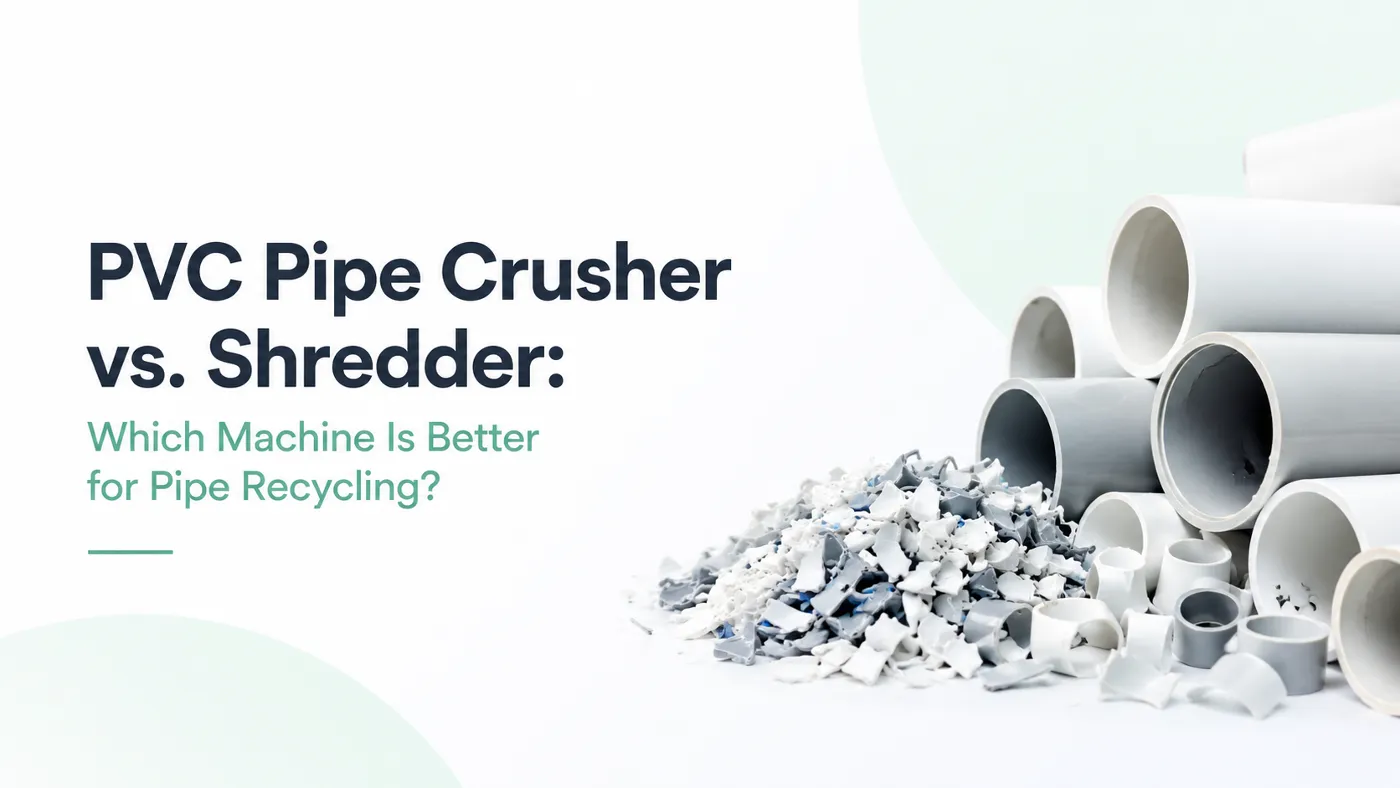
For a broader comparison of machine types, see our article on PVC pipe crusher vs. shredder selection.
Key equipment requirements for PVC window profile recycling
When choosing equipment for PVC window profile recycling, focus on the complete process instead of only the crusher model.
1. Feed opening and profile length
The feed opening must match the profile width, height, and typical scrap length. If operators still need to cut every profile into short sections, the recycling system may not deliver the expected labor savings.
Ask these questions:
- What is the maximum profile width?
- What is the maximum profile length?
- Can long offcuts be fed directly?
- Does the feed design reduce slipping, bouncing, and bridging?
2. Rotor and blade design
The rotor should grip hollow profiles consistently and cut them cleanly. Blade geometry affects throughput, dust generation, energy use, chip shape, and wear.
For PVC profiles, look for:
- Strong rotor engagement with hollow sections
- Durable blade material
- Easy blade access and replacement
- Stable cutting clearance
- Low dust generation when properly maintained
3. Screen size and chip control
The screen controls the final chip size. Smaller screen openings produce finer chips but can reduce throughput and increase dust if the machine is overloaded.
Common target chip ranges for PVC profile regrind include:
- 10-12 mm: finer regrind for controlled downstream handling
- 12-14 mm: general-purpose profile recycling
- 14-18 mm: higher-throughput size reduction before further processing
The best size depends on whether the material will be stored, washed, pulverized, blended, or returned to extrusion.
4. Dust and fines management
PVC profile crushing can create dust if blades are dull, screen size is too small, or feed rate is unstable. A good system should consider dust collection, regular blade maintenance, and proper screen selection.
To reduce fines:
- Keep blades sharp
- Avoid excessive rotor speed for brittle material
- Do not use an unnecessarily small screen
- Maintain correct blade clearance
- Feed material at a steady rate
5. Metal and contamination protection
Even clean-looking window profile scrap can contain screws, staples, reinforcement pieces, or other hard contaminants. Metal can damage blades and screens, so inspection and metal detection are important when processing fabrication scrap or post-consumer frames.
Sorting: how clean does PVC profile scrap need to be?
The required sorting level depends on the final use of the regrind.
If the regrind will be reused in controlled profile extrusion, the material should usually be separated by:
- PVC formulation
- Color
- Source stream
- Presence of seals or laminated film
- Contamination level
- Post-industrial vs. post-consumer origin
If the regrind will be sold, compounded, or used in less demanding applications, the sorting rules may be more flexible. However, better sorting usually improves consistency, buyer confidence, and downstream processing stability.
White profile scrap
White uPVC profile scrap is often more valuable when kept separate because it can be easier to reuse in light-colored products or controlled blends.
Colored or laminated profiles
Colored and laminated profiles may need separate handling if the final product has strict color or surface requirements.
Profiles with rubber seals
Co-extruded seals or inserted gaskets can affect regrind quality. Some applications tolerate small amounts of seal material, while others require removal or separation.
Regrind quality: what to control after crushing
PVC window profile regrind quality is determined by more than particle size. A practical quality-control checklist should include:
- Chip size distribution
- Dust and fines content
- Color consistency
- Moisture level
- Metal contamination
- Rubber or seal content
- Mixed polymer contamination
- Bulk density and flowability
- Traceability by material source
For in-house recycling, traceability is especially important. If a batch of regrind causes extrusion instability, the plant should be able to identify where the scrap came from and how it was processed.
How PVC profile regrind can be used
After crushing, PVC profile regrind may be used in several ways.
Direct reuse in extrusion
Clean in-house scrap can often be blended back into extrusion after crushing, screening, and quality checks. The exact regrind percentage depends on formulation, product requirements, color control, and internal quality standards.
Pulverizing into finer powder
Some profile manufacturers crush PVC scrap first, then pulverize it into finer powder for easier blending and extrusion. In this case, the crusher output should be consistent enough to feed the pulverizer smoothly.
Sale as secondary raw material
If a plant does not reuse all its profile scrap internally, consistent regrind can be sold to recyclers or compounders. Cleaner, better-sorted regrind usually has stronger market value.
Use in lower-spec rigid PVC products
Mixed or lower-grade PVC profile scrap may be used in applications where color and formulation consistency are less demanding, provided contamination is controlled.
In-house recycling vs. external recycling
Window profile manufacturers often face a decision: process scrap internally or send it to an outside recycler.
In-house recycling is usually attractive when:
- Scrap volume is steady
- Material formulation is known
- The plant wants better control over regrind quality
- Labor and space are available
- Regrind can be reused in production or sold consistently
External recycling may be better when:
- Scrap volume is low or irregular
- Material is highly mixed or contaminated
- The plant lacks space for equipment
- Post-consumer frames require dismantling and washing
- Internal quality standards do not allow regrind reuse
Many operations use both approaches: clean production scrap is recycled internally, while mixed or contaminated material is sent to specialized recyclers.
Common mistakes in PVC window profile recycling
Avoid these mistakes when designing a profile recycling process.
Mistake 1: treating profiles like ordinary rigid plastic scrap
Window profiles have long, hollow, and complex geometry. A crusher that works for short molded parts may not feed profiles efficiently.
Mistake 2: ignoring color and formulation separation
Mixing white, colored, laminated, and unknown-source PVC can reduce regrind value and limit reuse options.
Mistake 3: using dull blades too long
Dull blades increase dust, heat, energy consumption, and irregular chip shape. Blade maintenance is a direct part of regrind quality control.
Mistake 4: choosing the smallest screen for “better” regrind
A smaller screen is not always better. If it reduces throughput or creates excessive fines, a slightly larger chip size may be more practical.
Mistake 5: skipping metal protection
Screws, reinforcement fragments, and hardware can damage cutting tools. Metal detection or careful inspection is especially important for fabrication scrap and used frames.
Practical selection checklist for a PVC profile crusher
Before choosing a PVC profile crusher, prepare these details for the equipment supplier:
- Profile type and dimensions
- Typical and maximum profile length
- Scrap source: extrusion, fabrication, or post-consumer
- Expected hourly or daily volume
- Target chip size
- Required regrind use: storage, extrusion, pulverizing, or sale
- Color and formulation sorting needs
- Presence of rubber seals, film, labels, metal, or dust
- Available space and feeding method
- Downstream equipment requirements
With this information, the supplier can recommend the right feed design, rotor configuration, screen size, motor power, and material handling layout.
Final recommendation
PVC window profile recycling works best when the process is designed around the shape and quality requirements of the material. Clean extrusion offcuts may only need sorting, crushing, and storage. Fabrication scrap may require inspection and metal protection. Post-consumer uPVC frames may need dismantling, separation, and washing before high-quality regrind can be produced.
For long rigid profiles, a dedicated PVC profile crusher is usually a better fit than a general-purpose crusher because it reduces pre-cutting labor and improves feeding stability. If your plant handles both PVC pipes and window profiles, a machine designed for both applications can simplify the recycling workflow and improve regrind consistency.
The goal is not just to make the scrap smaller. The goal is to produce clean, predictable PVC regrind that can be stored, sold, pulverized, or returned to production with fewer problems.
FAQ
Can PVC window profiles be recycled?
Yes. PVC window profiles can be recycled into regrind when they are properly sorted, cleaned if necessary, and reduced to a controlled chip size. Clean post-industrial offcuts are usually the easiest to recycle.
What machine is used for PVC window profile recycling?
A dedicated PVC profile crusher is commonly used to reduce long, rigid window and door profiles into chips or regrind. For very bulky or contaminated material, a shredder may be used before crushing.
What is PVC profile regrind?
PVC profile regrind is crushed PVC profile scrap, usually in chip form, that can be stored, sold, pulverized, blended, or reused in suitable rigid PVC applications.
Do window profiles need to be sorted before crushing?
Yes, sorting is recommended. Separating by color, formulation, source, and contamination level improves regrind consistency and helps determine whether the material can be reused internally.
What chip size is best for PVC window profile regrind?
Many PVC profile recycling applications use chips around 10-18 mm, depending on screen size and downstream requirements. The best size depends on whether the material will be washed, stored, pulverized, or re-extruded.
Can old uPVC window frames be recycled the same way as factory offcuts?
Old uPVC frames can be recycled, but they usually require more preparation. Hardware, metal reinforcement, gaskets, glass residue, dirt, and mixed materials should be removed or controlled before crushing.
- PVC window profile recycling
- PVC profile crusher
- uPVC recycling
- window profile regrind
- PVC regrind
- plastic crusher