
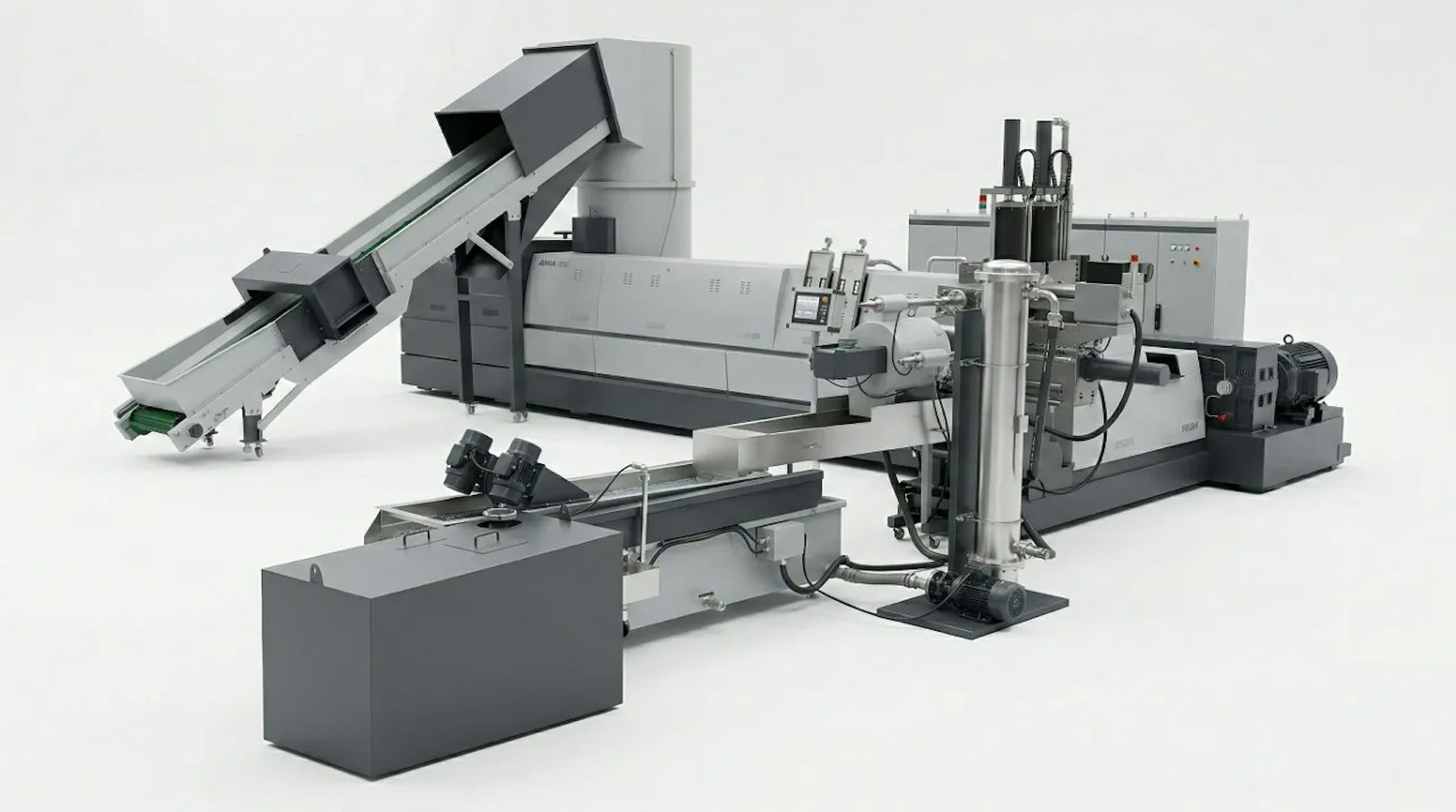
Linha de Granulação de Plástico Rígido
Para HDPE, PP, ABS, PS e moagem rígida mista que exige alimentação estável, filtragem da massa, desgasificação e qualidade constante do granulado para reutilização interna ou venda.

Produtos e soluções
Apenas produtos e soluçõesNenhum produto ou solução correspondente foi encontrado.
Recycling Pelletizing Hub
A configuracao final e adaptada ao material, capacidade alvo, contaminacao e requisitos do processo a jusante. A Rumtoo verifica alimentacao, tamanho de saida, automacao, seguranca e manutencao antes de definir o modelo.
Escolha uma rota focada para moídos densos, resíduos de filme de embalagem PE ou projetos sob medida.
Para HDPE, PP, ABS, PS e moagem rígida mista que exige alimentação estável, filtragem da massa, desgasificação e qualidade constante do granulado para reutilização interna ou venda.
Para filme estirável LLDPE, aparas de embalagem LDPE e rebordos de corte. Ajuste preparação, compactação e filtragem a aparas de fábrica ou filme de paletes usado.
Para projetos que precisam de engenharia sobre número de estágios, desgasificação, tipo de troca-filtros, método de corte, layout da linha e futura expansão de capacidade antes da escolha do modelo.
A Rumtoo valida os parametros com amostras reais para recomendar uma solucao realista de producao. A selecao nao depende apenas de kW, mas do comportamento do material, turnos, meta de qualidade e restricoes do local.
Transporte, controlo e acesso de manutencao sao definidos conforme o layout e restricoes do local, mantendo a linha segura para inspecao e menos sujeita a paragens nao planeadas.
A configuracao final e adaptada ao material, capacidade alvo, contaminacao e requisitos do processo a jusante. A Rumtoo verifica alimentacao, tamanho de saida, automacao, seguranca e manutencao antes de definir o modelo.
Esta etapa ajuda a estabilizar o fluxo, reduzir intervencoes do operador e proteger a qualidade de saida. Quando necessario, inclui separacao, controlo de poeira, tratamento de agua ou integracao com equipamentos a jusante.
A Rumtoo valida os parametros com amostras reais para recomendar uma solucao realista de producao. A selecao nao depende apenas de kW, mas do comportamento do material, turnos, meta de qualidade e restricoes do local.
Transporte, controlo e acesso de manutencao sao definidos conforme o layout e restricoes do local, mantendo a linha segura para inspecao e menos sujeita a paragens nao planeadas.
A configuracao final e adaptada ao material, capacidade alvo, contaminacao e requisitos do processo a jusante. A Rumtoo verifica alimentacao, tamanho de saida, automacao, seguranca e manutencao antes de definir o modelo.
Esta etapa ajuda a estabilizar o fluxo, reduzir intervencoes do operador e proteger a qualidade de saida. Quando necessario, inclui separacao, controlo de poeira, tratamento de agua ou integracao com equipamentos a jusante.
A Rumtoo valida os parametros com amostras reais para recomendar uma solucao realista de producao. A selecao nao depende apenas de kW, mas do comportamento do material, turnos, meta de qualidade e restricoes do local.
Transporte, controlo e acesso de manutencao sao definidos conforme o layout e restricoes do local, mantendo a linha segura para inspecao e menos sujeita a paragens nao planeadas.
A configuracao final e adaptada ao material, capacidade alvo, contaminacao e requisitos do processo a jusante. A Rumtoo verifica alimentacao, tamanho de saida, automacao, seguranca e manutencao antes de definir o modelo.
Esta etapa ajuda a estabilizar o fluxo, reduzir intervencoes do operador e proteger a qualidade de saida. Quando necessario, inclui separacao, controlo de poeira, tratamento de agua ou integracao com equipamentos a jusante.
Transporte, controlo e acesso de manutencao sao definidos conforme o layout e restricoes do local, mantendo a linha segura para inspecao e menos sujeita a paragens nao planeadas.
A configuracao final e adaptada ao material, capacidade alvo, contaminacao e requisitos do processo a jusante. A Rumtoo verifica alimentacao, tamanho de saida, automacao, seguranca e manutencao antes de definir o modelo.
Esta etapa ajuda a estabilizar o fluxo, reduzir intervencoes do operador e proteger a qualidade de saida. Quando necessario, inclui separacao, controlo de poeira, tratamento de agua ou integracao com equipamentos a jusante.
A Rumtoo valida os parametros com amostras reais para recomendar uma solucao realista de producao. A selecao nao depende apenas de kW, mas do comportamento do material, turnos, meta de qualidade e restricoes do local.
Transporte, controlo e acesso de manutencao sao definidos conforme o layout e restricoes do local, mantendo a linha segura para inspecao e menos sujeita a paragens nao planeadas.
A configuracao final e adaptada ao material, capacidade alvo, contaminacao e requisitos do processo a jusante. A Rumtoo verifica alimentacao, tamanho de saida, automacao, seguranca e manutencao antes de definir o modelo.
Esta etapa ajuda a estabilizar o fluxo, reduzir intervencoes do operador e proteger a qualidade de saida. Quando necessario, inclui separacao, controlo de poeira, tratamento de agua ou integracao com equipamentos a jusante.
A Rumtoo valida os parametros com amostras reais para recomendar uma solucao realista de producao. A selecao nao depende apenas de kW, mas do comportamento do material, turnos, meta de qualidade e restricoes do local.
Transporte, controlo e acesso de manutencao sao definidos conforme o layout e restricoes do local, mantendo a linha segura para inspecao e menos sujeita a paragens nao planeadas.
A configuracao final e adaptada ao material, capacidade alvo, contaminacao e requisitos do processo a jusante. A Rumtoo verifica alimentacao, tamanho de saida, automacao, seguranca e manutencao antes de definir o modelo.
Esta etapa ajuda a estabilizar o fluxo, reduzir intervencoes do operador e proteger a qualidade de saida. Quando necessario, inclui separacao, controlo de poeira, tratamento de agua ou integracao com equipamentos a jusante.
A Rumtoo valida os parametros com amostras reais para recomendar uma solucao realista de producao. A selecao nao depende apenas de kW, mas do comportamento do material, turnos, meta de qualidade e restricoes do local.
A Rumtoo valida os parametros com amostras reais para recomendar uma solucao realista de producao. A selecao nao depende apenas de kW, mas do comportamento do material, turnos, meta de qualidade e restricoes do local.
| Decision Input | Route Signal | Confirm Before Quotation |
|---|---|---|
| Material form | Transporte, controlo e acesso de manutencao sao definidos conforme o layout e restricoes do local, mantendo a linha segura para inspecao e menos sujeita a paragens nao planeadas. | A configuracao final e adaptada ao material, capacidade alvo, contaminacao e requisitos do processo a jusante. A Rumtoo verifica alimentacao, tamanho de saida, automacao, seguranca e manutencao antes de definir o modelo. |
| Moisture and volatiles | Higher load points to stronger vacuum or a second extrusion stage | Esta etapa ajuda a estabilizar o fluxo, reduzir intervencoes do operador e proteger a qualidade de saida. Quando necessario, inclui separacao, controlo de poeira, tratamento de agua ou integracao com equipamentos a jusante. |
| Melt contamination | A Rumtoo valida os parametros com amostras reais para recomendar uma solucao realista de producao. A selecao nao depende apenas de kW, mas do comportamento do material, turnos, meta de qualidade e restricoes do local. | Transporte, controlo e acesso de manutencao sao definidos conforme o layout e restricoes do local, mantendo a linha segura para inspecao e menos sujeita a paragens nao planeadas. |
| Pellet specification | A configuracao final e adaptada ao material, capacidade alvo, contaminacao e requisitos do processo a jusante. A Rumtoo verifica alimentacao, tamanho de saida, automacao, seguranca e manutencao antes de definir o modelo. | Pellet geometry, MFI, cooling duty, and buyer specification |
A selecao depende do tipo de material, capacidade alvo, contaminacao, tamanho de saida e processo a jusante. A Rumtoo tambem avalia humidade, densidade aparente, forma de alimentacao, desgaste previsto e nivel de automacao.
Sim. Interfaces de transporte, sensores, protecoes e sinais de controlo podem ser adaptados a sua instalacao. Para evitar gargalos, tambem se verificam alturas de descarga, espaco de manutencao e ligacao com maquinas existentes.
Envie fotos do material, capacidade alvo, humidade, contaminantes, espaco disponivel e objetivo de qualidade. Com estes dados definimos modelo, opcoes, tamanho de saida, potencia instalada e testes de amostra recomendados.
A selecao depende do tipo de material, capacidade alvo, contaminacao, tamanho de saida e processo a jusante. A Rumtoo tambem avalia humidade, densidade aparente, forma de alimentacao, desgaste previsto e nivel de automacao.
Sim. Interfaces de transporte, sensores, protecoes e sinais de controlo podem ser adaptados a sua instalacao. Para evitar gargalos, tambem se verificam alturas de descarga, espaco de manutencao e ligacao com maquinas existentes.
Envie fotos do material, capacidade alvo, humidade, contaminantes, espaco disponivel e objetivo de qualidade. Com estes dados definimos modelo, opcoes, tamanho de saida, potencia instalada e testes de amostra recomendados.
Partilhe material, humidade, contaminação, objetivo do granulado e capacidade. A Rumtoo recomenda a rota de granulação antes da seleção do modelo.