
· Rumtoo Process Team · Process Engineering · 14 min read
How to Prepare Waste Textiles for Pyrolysis: Shredding, Sizing and Screw Feeding
Learn how to prepare waste textiles for pyrolysis with controlled shredding, particle-shape checks, metal removal, dust control, and stable screw feeding.
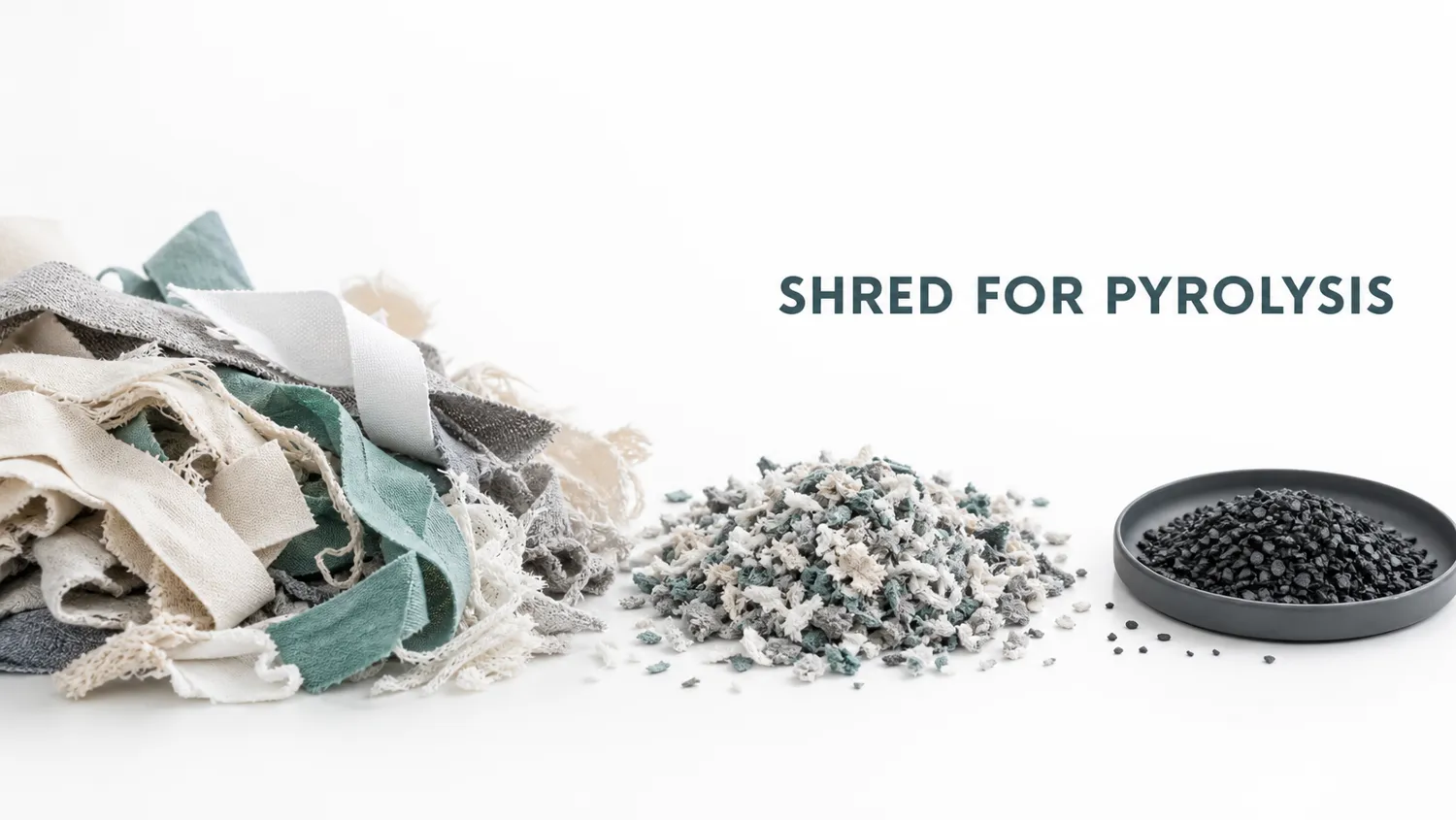
Waste textiles cannot enter a continuous pyrolysis process in the same form in which they arrive. Whole garments, long offcuts, tangled fabric, and compressed bales bridge inside hoppers, wrap around rotating parts, and produce an unstable load at the screw feeder. Effective textile waste shredding for pyrolysis must therefore control more than nominal particle size: it must also control strip length, shape, bulk density, metal contamination, moisture, dust, and the rate at which material reaches the reactor interface.
This guide explains how to prepare textile waste for a screw-fed pyrolysis system with a maximum accepted feed size of 50 mm. It treats 20–30 mm as a possible trial target, not a universal specification, and shows how to decide between single-stage and two-stage size reduction without assuming that smaller material is always better.
Why Waste Textiles Need Pre-Shredding Before Pyrolysis
Waste textiles need pre-shredding because their original geometry is incompatible with controlled reactor feeding. A shirt, a carpet strip, a roll end, and a bale of mixed garments may share a waste code, but they do not behave the same way in a hopper or screw auger.
Untreated textiles create six common process problems:
- Irregular dimensions: Whole garments and offcuts can be much longer than the feeder opening.
- Entanglement: Sleeves, hems, yarn, and long strips can knot together or wrap around shafts.
- Low and variable bulk density: A hopper may look full while containing little mass, causing the feed rate to change as the material settles.
- Hidden hardware: Zippers, hooks, rivets, buckles, underwires, and metal fasteners can damage cutting equipment or contaminate char.
- Variable moisture: Wet textiles consume heat before thermal decomposition begins and may cut differently from dry material.
- Mixed fiber composition: Cotton, polyester, nylon, elastane, coatings, and backing materials do not respond identically to cutting or pyrolysis.
The purpose of pretreatment is not to make the textile as fine as mechanically possible. It is to create a feedstock window that the hopper, metering system, screw, reactor, gas handling, and char discharge can process consistently.
For broader textile shredder selection outside thermal processing, use our textile shredder guide for garment waste. The present article focuses only on pyrolysis feed preparation and the interface with continuous screw feeding.
What Feed Size Should Enter a Pyrolysis Screw Auger?
The correct textile feed size is the size range that passes through the complete feeding system without bridging, wrapping, surging, or creating excessive fines. A reactor supplier’s maximum dimension—such as 50 mm—is a rejection limit, not proof that every flexible piece below that number will feed reliably.
A working target around 20–30 mm may be a sensible starting point when the downstream screw accepts no material above 50 mm. However, it should be confirmed through a shredding trial followed by a screw-feeding test using the actual textile mix. Screw diameter, pitch, shaft design, inlet geometry, rotational speed, hopper wall angle, and the required pressure seal all affect the result.
Define more than one dimension
A textile feed specification should include several measurable properties:
| Feed property | Why it matters | How to verify it |
|---|---|---|
| Screen aperture | Controls recirculation inside a screened shredder | Record the installed screen |
| Maximum unfolded length | Identifies strips that can wrap or bridge | Straighten and measure the longest pieces |
| Width and thickness | Affects screw clearance and compaction | Measure representative samples |
| Oversize fraction by mass | Shows how much material misses the target | Sort and weigh a test sample |
| Bulk density | Connects hopper volume to mass feed | Measure a known container volume |
| Moisture content | Affects cutting, storage, heat demand, and product balance | Test representative samples |
| Fines fraction | Indicates dust and entrainment risk | Screen and weigh the fine fraction |
This is why a supplier should not describe the output only as “from a 30 mm screen.” The screen is one machine setting. The downstream process receives real pieces with length, width, thickness, elasticity, and surface friction.
Smaller is not automatically better
Reducing characteristic particle size can shorten the heat-transfer path inside a textile piece and may help material heat more evenly. But excessive size reduction can also create more lint and dust, increase cutter energy, reduce throughput, encourage hopper compaction, and raise the amount of fine material carried with the vapor or gas stream.
The engineering objective is therefore a controlled feed shape with limited oversize and limited fines, not the smallest achievable particle.
Why Screen Size Does Not Guarantee Textile Particle Size
Screen size does not guarantee the maximum dimensions of shredded textile because flexible material bends, stretches, and folds. A long fabric strip can present its narrow edge to a screen opening and pass through even when its unfolded length exceeds the nominal aperture.
Rigid plastic flakes usually maintain their shape as they approach a screen. Textiles do not. Knit fabric can stretch, thin woven material can fold, and yarn bundles can pull through a hole while the trailing material remains much longer. A screen still improves output control, but it must be combined with cutter geometry and a physical inspection method.
Primary research on woody biomass screw feeding has also found that particle size and particle shape affect screw-feeder performance. That material is not textile, so the study does not establish a universal textile target; it does support the engineering principle that one nominal dimension cannot describe screw-feeding behavior. See the U.S. Department of Energy study on particle size, shape, and screw-feeder performance.
In project specifications, Rumtoo treats the following statements differently:
- Machine setting: “The shredder uses a 30 mm screen.”
- Output claim: “The tested output meets the agreed oversize and maximum-strip criteria.”
- Process result: “The tested output feeds through the customer’s hopper and screw without unacceptable bridging or wrapping.”
Only the final two statements describe whether the material is ready for the pyrolysis feeding system.
Single-Stage vs. Two-Stage Textile Shredding
Single-stage shredding may be sufficient when the input is clean, uniform, pre-cut, and the reactor feeder tolerates a wider particle distribution. Two-stage shredding becomes more attractive when the feed contains whole garments, long strips, mixed constructions, or a strict maximum-length requirement.
| Configuration | Best fit | Output control | Main limitation |
|---|---|---|---|
| Single-shaft shredder with screen | Cleaner offcuts and controlled textile feed | Better aperture-based control | Flexible strips may fold through the screen |
| Dual-shaft primary shredder | Bulky garments, bales, carpet, and difficult mixed feed | Coarse and irregular | Usually weak control of final strip length |
| Primary shredder + secondary textile cutter | Mixed feed requiring tighter final geometry | Better control of long strips and oversize | Higher equipment, energy, and maintenance demand |
| Secondary cutting mill only | Pre-shredded, metered material | Fine and more uniform output | Poor fit for whole garments or unstable bulky feed |
A generic rotary crusher should not be selected automatically for the second stage. Textile can wrap around machines designed for brittle plastic or rigid regrind. The secondary machine may be a textile cutter, cutting mill, fine shredder, or another screened cutting system, depending on fiber type and the result of a material trial.
Our single-shaft vs. double-shaft shredder comparison explains the basic machine difference. For pyrolysis, the final choice must also account for strip geometry, dust generation, metal liberation, and screw-feeding behavior.
Recommended Textile Pyrolysis Pretreatment Process
A complete pretreatment line should separate contamination, reduce material in controlled stages, remove liberated metal, classify the output, manage dust, and buffer material before the reactor feed interface.
Receiving and bale opening → pre-sorting → primary shredding → ferrous and metal control → screening and oversize return → optional secondary cutting → dust extraction → buffer hopper → metered feeder → sealed screw interface → pyrolysis reactor
1. Receiving, bale opening, and pre-sorting
The receiving stage defines what the line will accept. Operators should separate shoes, hangers, batteries, electronics, large buckles, stones, and other hard objects before shredding. If material arrives baled, the opening method must release the textiles without feeding binding wire into the shredder.
The project should also record fiber composition, source, moisture, contamination, and input form. “Mixed textile waste” is not a complete equipment specification.
2. Controlled primary feeding
A chain-belt or cleated conveyor meters bulky material into the primary shredder. The conveyor should respond to shredder load rather than delivering an uncontrolled pile. Feed-chute geometry, sidewalls, and anti-bridging devices matter because light garments can accumulate above the cutting chamber.
3. Primary size reduction
The primary shredder opens garments and reduces bulky textile into a form that can be inspected and separated. The correct textile waste shredder depends on whether the feed is loose, baled, rolled, carpet-backed, wet, or heavily fitted with hardware.
Knife profile, shaft clearance, cleaning fingers, automatic reverse logic, and low-speed torque all affect wrapping resistance. Motor power alone does not establish suitability for textile.
4. Metal control after liberation
Pre-sorting removes visible hardware, but shredding exposes fasteners that were trapped inside seams and waistbands. A suspended magnet or magnetic head pulley can remove liberated ferrous items. A metal detector can identify remaining metal before the secondary cutter or reactor feed system.
Non-ferrous hardware requires a separate decision. Eddy-current separation, detection with reject, or manual inspection may be justified when the feed contains enough brass, aluminum, or other non-ferrous parts to threaten equipment or char quality. The correct method depends on particle size and contamination value.
5. Screening and oversize return
A vibrating screen can divide the output into acceptable material, oversize, and fines. Oversize returns to the cutting stage instead of being sent forward. Fines may need separate handling if they increase dust load or behave differently in the feeder.
Screening rigid particles is straightforward; textile classification is more difficult because strips can fold. The acceptance method should therefore include manual measurement of unfolded pieces as well as screening.
6. Secondary cutting when required
The secondary stage receives a metered, opened, and metal-controlled feed. It cuts persistent long strips and narrows the particle distribution. This stage should be included only when trials show that primary output does not meet the downstream feed specification.
Two stages should solve a measured problem. Adding a second machine without test evidence increases capital cost, wear parts, energy use, controls, and floor-space demand.
7. Buffering and metered discharge
The shredder and pyrolysis reactor do not operate with identical short-term flow. A buffer hopper with level sensors separates the two processes so a brief upstream interruption does not immediately starve the reactor, while a downstream slowdown does not fill every conveyor.
Textile can bridge in a conventional steep hopper. The buffer may need live-bottom extraction, agitators, twin screws, or another anti-bridging device selected from bulk-density and flow tests.
8. Sealed screw-to-reactor interface
The final conveying screw is not automatically the reactor feeding system. The interface may also need metering, compaction, purge gas, an airlock, or another pressure and oxygen-control arrangement defined by the pyrolysis technology provider.
Shredder suppliers and reactor suppliers should agree on a written interface specification covering particle geometry, bulk density, moisture, temperature, feed-rate control, pressure boundary, acceptable air ingress, start-stop logic, and emergency shutdown behavior.
How Fiber Composition Changes Pyrolysis Feed Preparation
Fiber composition changes both cutting behavior and thermal conversion. Cotton-rich textiles cut differently from elastic knitwear, while polyester and coated fabrics may generate more heat or fused buildup if cutting speed and knife condition are poorly controlled.
A 2024 peer-reviewed study compared pure cotton, pure polyester, and a 55% polyester/45% cotton blend in a tubular reactor at 425 °C, 500 °C, and 575 °C. The reported oil, gas, and char distributions differed by fiber composition and temperature. The study supports separating or at least characterizing feedstock families; it does not define an industrial screw-feeder particle size. See Pyrolysis of textile waste: A sustainable approach to waste management and resource recovery.
For pretreatment design, record at least:
- Approximate cotton, polyester, nylon, wool, and elastane content
- Coatings, foam, rubber backing, adhesives, or flame retardants
- Garment hardware and non-textile components
- Post-consumer dirt, oils, water, and cleaning chemicals
- Whether different feedstock groups will be blended before or after shredding
Keeping particle geometry consistent removes one source of process variability, but it does not make different polymer compositions thermally identical.
How to Match the Shredding Line to Pyrolysis Feed Demand
A shredding line should be sized around continuous accepted output, not a catalogue peak rate. Textile throughput changes with bulk density, moisture, feed form, garment construction, screen selection, knife condition, metal stops, and the percentage of oversize that returns for another pass.
The design calculation should distinguish:
- Incoming wet mass from dry feed mass
- Peak shredder output from continuous accepted output
- Primary discharge from final material that passes the feed specification
- Operating time from scheduled cleaning, knife service, and screen access
- Instantaneous production from the average demand of the reactor
- Buffer capacity from long-term storage capacity
Expansion planning does not require publishing a plant’s production number. Conveyors, electrical distribution, controls, floor layout, dust extraction, and buffer connections can be designed with modular interfaces while individual shredder modules remain matched to the actual material test.
Dust, Fire, and International Compliance
Textile shredding creates lint and fine particles at cutters, screens, transfer points, and hopper filling positions. Dust extraction should be part of the line design, not an accessory added after commissioning.
The U.S. Occupational Safety and Health Administration notes that finely divided combustible material can become explosible when suspended in air under the right conditions, and it lists textiles and recycling among the relevant industries. A project in the United States should therefore assess the actual dust, ignition sources, housekeeping, extraction, grounding, isolation, and fire-protection requirements. See OSHA’s combustible dust guidance.
European installations require their own assessment. The European Commission states that ATEX Directive 2014/34/EU covers equipment and protective systems intended for potentially explosive atmospheres, while Directive 1999/92/EC addresses workplace responsibilities. Applicability depends on the dust characteristics and hazardous-area assessment. See the European Commission ATEX equipment guidance.
Projects in other regions need local electrical, machinery, fire, environmental, and occupational-safety review. One machine label cannot replace a site-specific hazard assessment.
Material Trial and Acceptance Criteria
A material trial should reproduce the proposed feed, machine settings, separation stages, and downstream handling conditions closely enough to answer the project’s real risks. A short video showing fabric entering a shredder is not a performance acceptance test.
Agree on the test method before the trial. Useful acceptance criteria include:
- Material definition: Fiber mix, input form, moisture, hardware, and contamination match the agreed sample.
- Continuous accepted output: Measure only material that meets the final feed specification, not all primary shredder discharge.
- Maximum unfolded dimensions: Measure long flexible pieces after straightening them.
- Oversize fraction by mass: Sort and weigh material outside the agreed window.
- Fines fraction by mass: Quantify fine output instead of describing dust visually.
- Bulk-density range: Test the material after settling conditions are defined.
- Metal carryover: Inspect the accepted fraction after magnetic and detection stages.
- Feeding performance: Run the material through representative hopper and screw geometry and record bridging, wrapping, surging, and motor load.
- Dust capture: Inspect transfer points and confirm the extraction design with the site’s safety engineer.
- Control response: Verify upstream stop, downstream stop, high-level, overload, and emergency-shutdown logic.
In our project workflow, “material passed through the screen” is not the final acceptance statement. The useful result is that the accepted material meets a written geometry specification and passes a representative feeding test.
Frequently Asked Questions
Does every textile piece need to be below 50 mm?
If 50 mm is the downstream equipment’s stated maximum, the accepted feed should comply with the agreed maximum-dimension method. For flexible textile, define whether that means screen aperture, unfolded length, width, or a combination. A folded strip passing through a 50 mm screen may still exceed the maximum length.
Is 20–30 mm always the best size for textile pyrolysis?
No. It is a reasonable trial range for some screw-fed systems with a 50 mm ceiling, but the optimum depends on the hopper, screw geometry, reactor design, textile composition, moisture, bulk density, fines tolerance, and pressure-sealing method. Confirm it with both the shredder and reactor suppliers.
Can one textile shredder produce reactor-ready feed?
Sometimes. Clean, uniform offcuts may meet the specification with a screened single-shaft shredder. Whole garments, bales, long strips, carpet, or mixed textiles may need primary opening followed by secondary cutting. A material trial should decide the number of stages.
How can a line prevent textile from wrapping around the screw auger?
Control maximum strip length and aspect ratio, limit elastic strands, maintain stable hopper discharge, meter the feed, and test the actual screw inlet. Reducing nominal screen size alone does not eliminate wrapping.
Where should metal separation occur?
Remove large visible objects before shredding, then separate liberated ferrous metal after the primary shredder. Use metal detection or another suitable method before sensitive secondary cutting and reactor feeding. Non-ferrous hardware needs a separate assessment.
Should textile waste be dried before pyrolysis?
Moisture should be measured and compared with the reactor supplier’s accepted feed specification. Drying may improve process consistency, but the economic and safety case depends on incoming moisture, available heat, storage conditions, and product targets.
Prepare the Feed System, Not Just the Shredder
Successful textile pyrolysis pretreatment connects size reduction to the full feeding problem. The line must control long strips, oversize, fines, metal, dust, bulk density, moisture, buffering, and the sealed reactor interface—not simply install a shredder with a smaller screen.
Start with representative material and a written downstream feed specification. Rumtoo can then evaluate whether the project needs one shredding stage or two, identify the required metal and dust controls, and prepare an acceptance test around the actual hopper and screw-feeding risks.
Contact the Rumtoo process team with textile samples, material composition, input form, maximum accepted dimensions, moisture range, and reactor-feeder details to receive a project-specific pretreatment recommendation.
- textile waste shredding for pyrolysis
- textile shredder for pyrolysis
- pyrolysis feedstock preparation
- textile size reduction
- screw feeding