
· Rumtoo Engineering Team · Process Engineering · 12 min read
Why Efficient Debaling Is the Critical First Step in PET Bottle Recycling Lines
Learn how efficient debaling improves PET line safety, stabilizes bottle flow, protects crushers, and helps you select the right automatic bale opener.
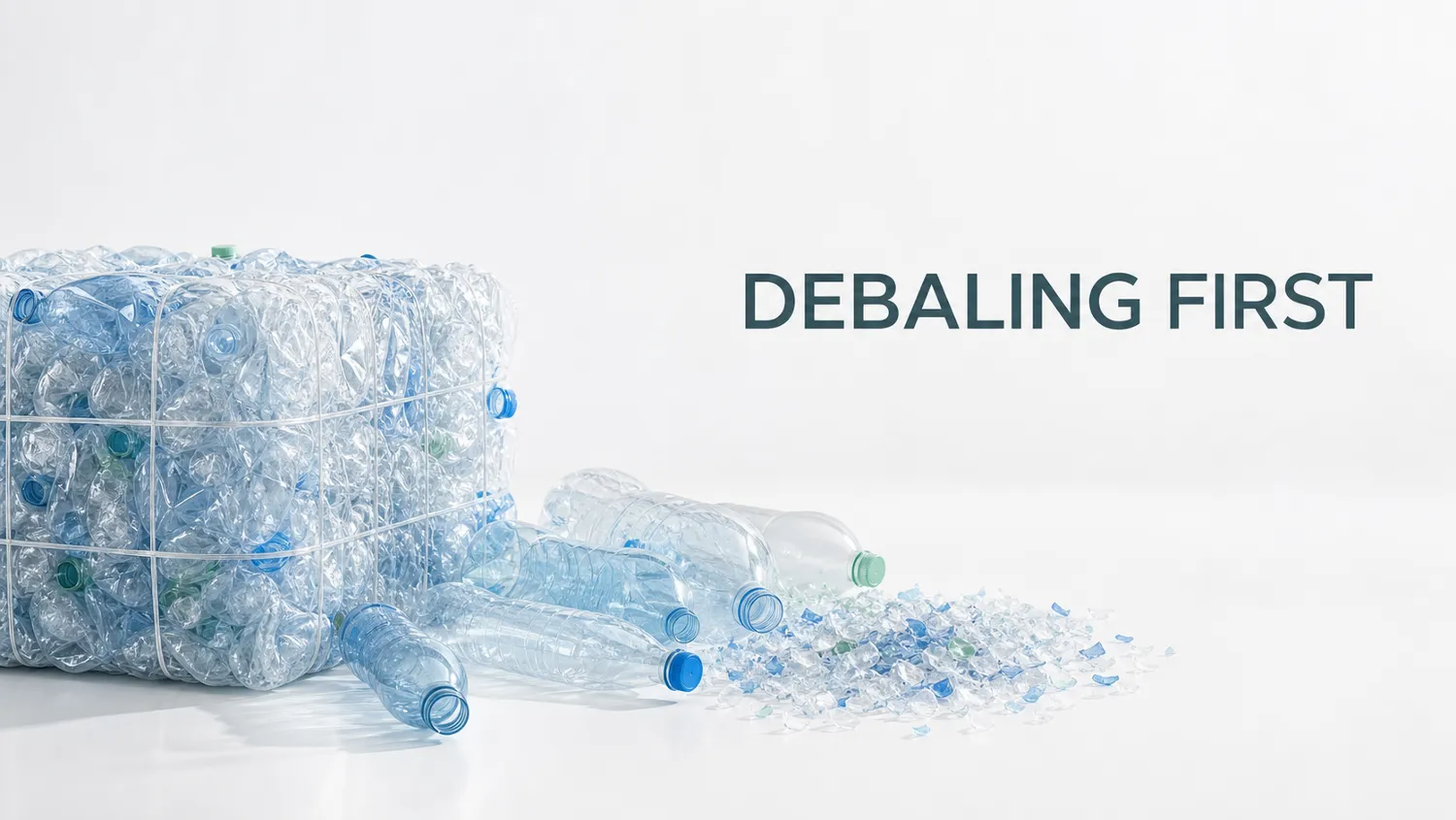
Compressed PET bottle bales are economical to store and transport, but they are a poor direct feed for a PET bottle recycling line. Bottles remain locked together by compaction, strapping wire, friction, and crushed geometry. If that dense mass reaches sorting or size-reduction equipment without controlled debaling, the whole line receives material in surges instead of a steady stream.
An efficient debaling stage opens each bale, separates the bottles, manages the binding wire, and meters loose material onto the next conveyor. That simple change improves worker safety, gives sorting equipment a visible monolayer, and helps protect the crusher from metal and shock loading. For high-volume PET projects, the debaler is not an optional accessory. It is the machine that makes the designed line capacity achievable.
The Importance of Efficient Debaling in PET Recycling
Efficient debaling converts a compressed logistics unit into a process-ready material stream. A PET bottle washing line cannot sort, detect, remove labels from, or crush a solid block effectively. Each downstream machine needs separated bottles delivered within a controlled feed range.
The front end of a typical line follows this sequence:
Bale loading → wire removal and bale opening → metered discharge → metal inspection → manual or optical sorting → label removal → crushing → washing and separation
Every arrow depends on the stage before it. When a poorly opened bale releases suddenly, the conveyor becomes overloaded, operators lose visibility of contaminants, and the crusher hopper can bridge. When the debaler discharges evenly, each stage receives the feed condition it was designed to handle.
Bale density also varies by supplier, bottle mix, and baling pressure. A practical planning range for post-consumer PET bales is 200–400 kg/m³, but the real project should use samples from the buyer’s suppliers. Our PET bottle recycling line project planning guide explains how bale density, wire condition, moisture, and contamination affect front-end equipment selection.
Key takeaway: Debaling does more than open a bale. It controls the transition from batch handling to continuous processing.
What Is a Debaler Machine and Why Do You Need It?
A debaler machine is an automatic bale opener that pulls apart compressed material and releases individual bottles at a controlled rate. Depending on the design, shafts, drums, hooks, teeth, or grappling elements engage the bale while a conveyor moves material through the opening chamber.
The machine sits at the beginning of the PET recycling line. A forklift or feed conveyor loads a complete bale into the infeed chamber. The opening mechanism breaks the compacted structure, separates or exposes the binding wire, and lets loose bottles fall onto a discharge conveyor. The result should be a consistent bed of material rather than one intact block followed by an uncontrolled avalanche.
Buyers sometimes confuse a debaler with a hydraulic bale cutter. Our plastic bale cutter guide covers that pre-cutting process in detail; the two machines solve different problems:
| Machine | Primary action | Typical output | Best use in a PET line |
|---|---|---|---|
| Debaler / automatic bale opener | Pulls and separates a bale | Loose, individual bottles | Continuous feeding, sorting, label removal, and washing |
| Hydraulic bale cutter | Slices a bale with a guillotine blade | Large compressed sections | Pre-cutting oversized or difficult bales before another size-reduction stage |
| Shredder or crusher | Cuts material with rotating knives | Strips, chips, or flakes | Size reduction after the feed is opened and inspected |
For standard baled PET bottles, the goal is usually to preserve whole bottles long enough for sorting and label-removal steps. That makes an automatic bale opener the more suitable first machine. A cutter may still be useful for unusually large, tightly bound, or mixed-material bales, but it does not create the same loose, meterable bottle stream.
The correct debaler also removes a hidden capacity limit. A washing line may be sized for a target hourly rate, yet its real output falls if operators cannot open and feed bales fast enough. A mechanical opener matches the infeed process to the continuous duty of the machines downstream.
For a working equipment example, review this industrial debaler machine for PET bottle recycling. Its process shows the four functions buyers should look for: complete-bale loading, controlled wire engagement, bale separation, and conveyor discharge.
The Challenges of Manual Debaling vs. Automatic Bale Openers
Manual debaling asks workers to cut wire around a compressed, spring-loaded mass and then pull apart bottles by hand or with improvised tools. The task is slow, physically demanding, and difficult to synchronize with a continuous washing line. It also places workers next to binding wire and unstable material when stored energy is released.
An automatic bale opener moves the repetitive work into an enclosed mechanical process. Operators still need a documented method for loading, wire handling, jam clearing, guarding, and lockout, but they spend less time cutting and pulling bales beside a live conveyor.
| Operating factor | Manual debaling | Automatic bale opener |
|---|---|---|
| Feed rate | Changes with operator pace and bale condition | Set by conveyor speed and opening mechanism |
| Material distribution | Bottles often arrive in piles | Loose bottles can be metered across the belt |
| Wire exposure | Workers handle wire close to the compressed bale | Wire can be exposed or captured in a defined machine zone |
| Labor demand | Requires repeated cutting, pulling, and cleanup | Focus shifts to loading, inspection, and supervision |
| Line response | Batch surges and empty gaps | More consistent loading of sorting and crushing stages |
| Scale | May suit trials or very low-volume operation | Better fit for continuous industrial production |
Manual opening can still make sense for a pilot line, occasional bales, or a facility where feed arrives mostly loose. It becomes a false economy when two or more operators must keep pace with a line throughout every shift. At that point, labor cost is only one part of the decision. Buyers should also count lost output, downstream stops, wire cleanup, and the cost of exposing operators to a repetitive high-risk task.
Automation does not remove the need for safe procedures. A debaler should have interlocked guards, accessible emergency stops, overload protection, and a lockable energy-isolation point. Operators must never enter the opening chamber or reach into a jam before all energy sources are isolated. The OSHA machine-guarding guidance and hazardous-energy control standard provide a useful baseline; the final system must also meet local regulations at the installation site.
How a Bottle Debaling System Prevents Downstream Equipment Damage
A bottle debaling system protects downstream equipment by separating the bale before inspection and by creating enough spacing for metal-control equipment to work. The debaler itself is not a substitute for a magnet, metal detector, or operator inspection. Its job is to make contaminants visible and detectable before they reach rotating knives.
It prevents shock loading and hopper bridging
A whole or partly opened bale can drop into the crusher or granulator hopper as one dense mass. The rotor then sees a sudden torque demand instead of a stable cutting load. The result can be an overload trip, stalled rotor, blocked hopper, accelerated belt wear, or damage to knives and bearings.
Loose-bottle discharge spreads the load over time. A variable-speed conveyor can meter the flow according to crusher motor current, hopper level, or the capacity of the sorting section. If the downstream line stops, the infeed logic should stop the debaler before material accumulates between machines.
It gives metal controls a chance to reject contaminants
Binding wire, steel strapping, cans, tools, and other metal pieces can enter PET bales. If metal reaches a high-speed crusher, it may chip a knife, damage the screen, or create a long shutdown for inspection and repair.
A safer front-end layout uses more than one control:
- Wire capture or a defined wire-removal point at the debaler contains the primary binding material.
- An overband magnet or magnetic head pulley removes exposed ferrous metal from the loose bottle stream.
- A metal detector with a reject device identifies metal that the magnet cannot capture or that remains hidden among bottles.
- An inspection conveyor gives operators or optical sorters enough material spacing to remove bulky contaminants before crushing.
Detection performance depends on belt depth. A deep pile can shield a contaminant or make the reject zone remove too much good PET. This is another reason to specify discharge control, not only maximum opening force.
It improves sorting and label-removal performance
Sorting systems need bottle separation. Optical sensors cannot identify bottles buried under a dense pile, and manual sorters cannot reach contaminants when the belt carries clumps. Dry label removers also perform more consistently when bottles enter as individual pieces rather than compacted nests.
The business result appears downstream: fewer interruptions, more stable motor load, better contaminant removal, and a more predictable mass balance. These gains often matter more than the debaler’s standalone nameplate capacity.
Key Features of an Industrial-Grade Debaler Machine
An industrial-grade debaler should be selected as part of the full infeed system, not from a motor-power figure alone. The most useful specification sheet connects bale properties, required output, wire handling, discharge control, and service access.
1. Bale envelope and feed geometry
Record the maximum bale length, width, height, weight, density, and wire pattern from actual suppliers. The infeed opening must accept the worst-case bale with safe clearance, while the feed conveyor or chamber must prevent the bale from rotating into a jammed position.
As a reference, the linked PET debaler configuration lists a 1,450 × 1,650 mm feeder, a 5.5 kW main motor, and a 7.5 kW conveyor motor. These numbers describe one machine, not a universal standard. Your project may need different dimensions, power, or opening geometry based on bale size and target rate.
2. Controlled opening without excessive bottle damage
The opener must separate compacted bottles without turning the debaling zone into an uncontrolled size-reduction stage. Excessive tearing creates fines and loose label fragments before the line is ready to manage them. Insufficient opening leaves bottle clusters that pass the problem downstream.
Ask the supplier to run a material trial with your bales. Inspect the discharge for unopened clusters, crushed bottle nests, free wire, and the distribution depth on the conveyor. A short empty-machine video cannot answer those questions.
3. Wire-management design
Wire handling should be defined before purchase. Ask where the wire goes, how operators remove it, whether the machine detects an unremoved strand, and how cleanup occurs without entry into a hazard zone. The proposal should show the wire path and collection point, not simply state that the machine “handles wire.”
4. Metered discharge and line controls
A variable-speed discharge conveyor lets the debaler act as a buffer between bale loading and continuous processing. The control system should exchange run, stop, fault, and permissive signals with the downstream conveyor or crusher. Hopper-level sensing or motor-load feedback can reduce surges further.
5. Protection, access, and maintenance
Look for enclosed transmission parts, interlocked access doors, emergency stops at loading and service positions, overload protection, replaceable wear parts, and safe access to hooks or opening elements. Maintenance points should be reachable without dismantling major guards or climbing into the chamber.
Before approving the machine, request a wear-parts list, lubrication schedule, electrical drawing, control narrative, and recommended spare-parts package. A machine that is easy to buy but difficult to clear or maintain will become the next bottleneck.
6. Capacity proven with real feedstock
Ask the supplier to define capacity using bale weight, bale density, PET content, and discharge condition. “Bales per hour” means little when one supplier ships 250 kg bales and another ships 500 kg bales. The acceptance test should measure tonnes per hour of your material, percentage of unopened clusters, wire carryover, and stability of the downstream feed.
Debaler Machine Selection Checklist
Send these details with your request for quotation:
- Bale dimensions, weight, density, and wire or strap type
- Photos and videos of typical and worst-case incoming bales
- Required average and peak throughput in kg/h
- PET bottle composition, moisture, and contamination profile
- Available floor area, loading height, and forklift approach
- Downstream conveyor width, speed, and control signals
- Planned magnet, metal detector, sorting, and crusher positions
- Local electrical supply and safety-standard requirements
- Shift pattern, target uptime, and maintenance staffing
- Required factory acceptance test and performance criteria
This information lets the equipment supplier size the full feed path. It also makes competing quotations easier to compare because every vendor answers the same operating case.
Frequently Asked Questions About Debaling
What is debaling in PET bottle recycling?
Debaling is the controlled opening of compressed PET bottle bales into a loose, continuous material stream. The process separates bottles, manages binding wire, and meters material for inspection, label removal, crushing, and washing.
Is a debaler the same as a bale cutter?
No. A debaler pulls a bale apart and releases individual bottles. A hydraulic bale cutter slices the compressed bale into sections. PET washing lines usually need loose bottles for sorting and label removal, while cutters suit oversized or unusually difficult feeds.
Where should a metal detector go in a PET recycling line?
The metal detector normally belongs on a conveyor after the bale has been opened and before the crusher. At that point, bottles are spread out enough for inspection and rejection. A magnet should also remove ferrous metal, while the detector covers the remaining metal risk.
Can an automatic bale opener remove every binding wire?
No machine should be assumed to remove every wire under every bale condition. Wire type, tension, breakage, and entanglement vary. Specify a defined wire-capture method, follow it with magnetic and detection controls, and verify performance during the material acceptance test.
How do you compare debaler machine quotations?
Compare verified throughput on your bale type, discharge consistency, wire carryover, safety controls, wear parts, service access, and integration with downstream equipment. Motor power and purchase price alone do not show whether the machine will keep the full line running.
Contact Us for Custom Debaling Solutions
Efficient debaling gives the entire PET bottle recycling line a stable start. It replaces unpredictable batch opening with controlled material flow, reduces direct manual handling, exposes metal before crushing, and allows sorting and label-removal equipment to work on separated bottles.
To configure the right system, send Rumtoo your bale dimensions, weight range, photos, binding method, contamination profile, and required hourly rate. Our engineering team can match the opening mechanism, conveyor layout, wire controls, metal-detection stage, and downstream interlocks to your project.
Contact Rumtoo for a debaling proposal, or review the PET bottle debaler machine and its technical configuration before submitting your material data.
- debaling
- debaler machine
- automatic bale opener
- PET bottle recycling
- bale breaker