
· Rumtoo Process Team · Buying Guides · 11 min read
3D Printer Filament Recycler: How It Works, What It Costs, and How to Choose
A 3D printer filament recycler is a two-stage system — a shredder that turns failed prints into regrind, and an extruder that turns regrind into new filament. This guide explains how the system works, realistic costs from DIY to lab-grade, what output quality to expect from PLA, PETG, and ABS, and how to match a setup to your monthly waste volume.
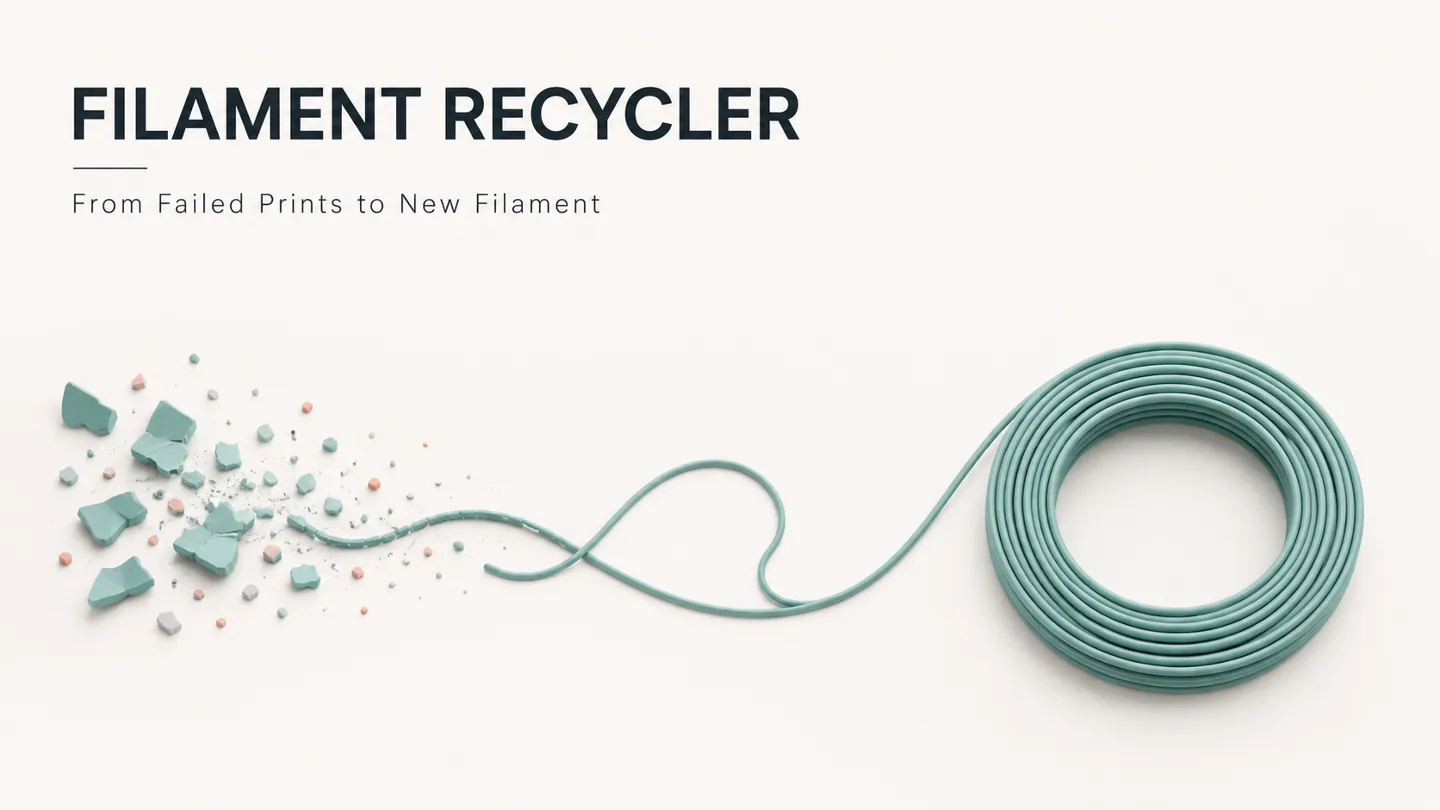
A print farm manager once showed us a storage room with 340 kg of failed prints, purge towers, and support material — two years of PLA and PETG waste he could not bring himself to throw away. His question was the same one behind most searches for a 3D printer filament recycler: is there a machine that turns this pile back into filament I can actually print with?
The short answer: yes, but it is not one machine. A working filament recycler is a two-stage system — a shredder that reduces prints to uniform regrind, and a filament extruder that melts the regrind into new filament. Marketing pages often show a single box; the engineering underneath is always these two stages, plus drying in between. This guide explains how the system works, what each tier realistically costs in 2026, what output quality you can expect per material, and how to decide whether your waste volume justifies the purchase.
Table of Contents
- What a 3D Printer Filament Recycler Actually Is
- Stage 1: Shredding Failed Prints into Regrind
- Stage 2: Extruding Regrind into New Filament
- The Step Everyone Skips: Drying
- What a Filament Recycler Costs in 2026
- Output Quality by Material: PLA, PETG, ABS
- When Recycling Pays Off: A Break-Even Table
- How to Choose Your Setup
- Frequently Asked Questions
What a 3D Printer Filament Recycler Actually Is
A 3D printer filament recycler is a system that converts printed plastic waste — failed prints, supports, brims, purge material — back into printable filament. Every working system, from a DIY build to a laboratory line, performs the same three operations in the same order:
- Shred the waste into regrind of a consistent particle size (typically 3–8 mm)
- Dry the regrind to remove absorbed moisture
- Extrude the regrind through a heated screw and die into filament, with diameter control
No desktop machine skips any of these steps and still produces filament a printer will accept. Products sold as all-in-one recyclers — such as the Creality Filament Maker M1 paired with its Shredder R1, or the Felfil system — package the same two stages into matched units. Understanding this structure is the single most useful thing a buyer can do, because it lets you evaluate any product by asking: which stage is this, and what is it paired with?
We cover the full workflow in step-by-step detail in our guide to the filament recycling workflow from scrap to spool.
Key Takeaway: A filament recycler is not one machine. It is a shredder plus an extruder, with drying in between — evaluate every product against those three stages.
Stage 1: Shredding Failed Prints into Regrind
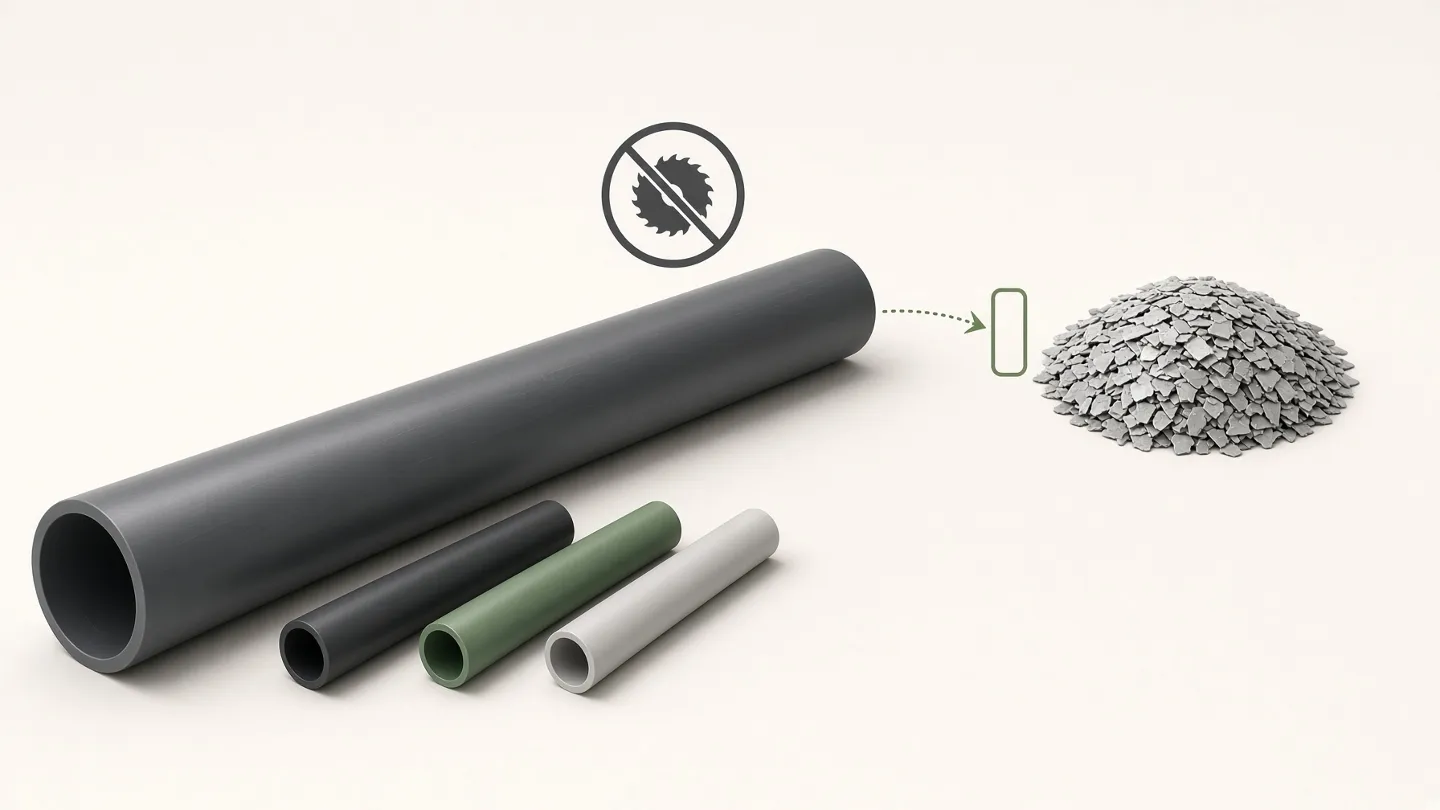
The shredder determines the quality ceiling of the whole system. Filament extruders need feed particles of a consistent size — usually 3–8 mm — to maintain stable melt pressure. Irregular regrind causes diameter fluctuation in the output filament, and oversized chunks jam the screw feed throat.
Three shredding requirements matter for 3D printing waste specifically:
- Cutting geometry for solid parts. Failed prints are rigid, sometimes 100% infill. Blade-and-screen designs built for rigid plastic handle them; blender-style choppers produce dust and shards that extrude poorly.
- Screen size selection. A 5 mm screen is the practical default for feeding desktop extruders. Finer screens (3–4 mm) improve melt stability at the cost of throughput.
- Low cross-contamination. A shredder that is easy to open and clean matters more than throughput at desktop scale, because mixing even a few percent of PETG regrind into PLA ruins the batch.
A mini desktop shredder in the 0.5–2 kW class processes 5–20 kg/h of printed waste — far more than any desktop extruder consumes, which is why one shredder typically serves a whole lab or print farm. For a broader comparison of desktop-class machines, see our guide to recycling 3D printing waste with a desktop shredder.
Stage 2: Extruding Regrind into New Filament
The filament extruder is where regrind becomes usable filament — or doesn’t. The extruder melts the regrind, pushes it through a die (1.75 mm is the standard target), then cools and winds it. Three specifications separate machines that produce printable filament from machines that produce plastic string:
| Specification | Why It Matters | What to Look For |
|---|---|---|
| Diameter control | Printers tolerate roughly ±0.05 mm | Closed-loop measurement with a sensor, not open-loop speed setting |
| Screw design | Regrind feeds less consistently than pellets | A screw and feed throat specified for regrind, not pellet-only |
| Cooling and winding | Filament ovality and spool tension | Water or multi-fan cooling plus a tension-controlled winder |
Open-loop DIY extruders can hold about ±0.10 mm on a good day, which prints — with visible surface variation. Closed-loop desktop machines hold ±0.03–0.05 mm, which is comparable to budget commercial filament. According to CNC Kitchen’s recycling tests, diameter consistency — not material degradation — is the first quality problem hobbyist recyclers hit.
Our filament extruders page covers the desktop and laboratory models we build, including regrind-capable screw configurations.
The Step Everyone Skips: Drying
Wet regrind is the most common reason recycled filament fails, and drying is the step most first-time buyers do not budget for. PLA absorbs moisture from ambient air within days; PETG within hours. When wet regrind hits the extruder barrel, the moisture flashes to steam and leaves bubbles in the filament — weak, brittle, inconsistent in diameter.
Practical drying targets before extrusion:
- PLA: 4–6 hours at 50–60 °C
- PETG: 4–6 hours at 65 °C
- ABS: 2–4 hours at 75–80 °C
At desktop scale, a filament dryer box or a modified food dehydrator handles small batches. Labs running daily cycles should treat a dedicated drying oven as part of the system cost, not an accessory.
Key Takeaway: Budget for drying from day one. Bubbled, brittle filament is almost always a moisture problem, not a machine problem.
What a Filament Recycler Costs in 2026
Filament recycling setups fall into three price tiers. The numbers below reflect the 2026 market across published products and our own equipment range:
| Tier | Typical Cost (Full System) | What You Get | Realistic User |
|---|---|---|---|
| DIY / kit | $300–800 | Self-built extruder (e.g. ExtrudeX-class, ~$300), improvised shredding, open-loop diameter | Tinkerers; the build is the hobby |
| Consumer desktop | $1,500–3,500 | Matched shredder + extruder (Creality M1 + R1 class, LOOP at $2,499), closed-loop diameter | Print farms, makerspaces |
| Lab / R&D grade | $5,000–20,000+ | Industrial-duty shredder, regrind-specified extruder, precision winding, material flexibility | Universities, material developers, OEM filament producers |
Two cost notes buyers consistently miss:
- The advertised price is usually one stage. A $2,000 extruder still needs a shredder and a dryer. Price the system, not the box.
- Consumables are real. Nozzles, screens, drive belts, and blade sharpening add $100–300 per year at regular use.
For a wider look at how waste volume maps to machine class — including when to step up from desktop to industrial equipment — see our guide to plastic recycling machines for 3D printers.
Output Quality by Material: PLA, PETG, ABS
Recycled filament is not identical to virgin filament, and the gap differs by material. These are the realistic expectations we give customers running our desktop equipment:
PLA is the easiest and most forgiving material to recycle. Expect roughly 5–15% loss in tensile strength per recycling cycle from thermal degradation, slightly increased brittleness, and color drift toward grey unless you sort by color. Blending 30–50% regrind with virgin pellets keeps mechanical properties close to virgin performance while still consuming your waste stream.
PETG recycles well mechanically but punishes poor drying. Fully dried PETG regrind extrudes into filament with strength retention typically above 85–90%; damp regrind produces visible bubbles and stringing. If your team will not maintain drying discipline, PETG will disappoint.
ABS loses less strength per cycle than PLA but demands higher extrusion temperatures and produces styrene fumes — ventilation is mandatory, not optional. Small labs generally recycle ABS last, if at all.
A practical rule that holds across all three: 100% recycled filament is for non-critical parts — jigs, drafts, prototypes. For functional parts, run a regrind/virgin blend and re-test your print profiles, because recycled filament typically wants a 5–10 °C higher nozzle temperature.
When Recycling Pays Off: A Break-Even Table
Whether a filament recycler makes financial sense comes down to one number: your monthly waste in kilograms. Taking $20/kg as a reference filament price and realistic system costs, the payback math looks like this:
| Monthly Waste | Annual Waste Value | DIY ($600) Pays Back In | Desktop ($2,500) Pays Back In | Verdict |
|---|---|---|---|---|
| 1 kg | ~$240 | ~2.5 years | ~10 years | Recycle via a service, not a machine |
| 5 kg | ~$1,200 | ~6 months | ~2 years | Desktop system defensible |
| 15 kg | ~$3,600 | — | ~8 months | Desktop system clearly justified |
| 40 kg+ | ~$9,600+ | — | ~3 months | Consider lab-grade throughput |
The table assumes your time is free, which for a hobbyist it may be — and for a business it is not. Add roughly 2–4 hours of labor per 5 kg batch for sorting, shredding, drying, extruding, and spooling. This is why our honest advice to single-printer hobbyists is that a drop-off service beats a machine, while for print farms, universities, and schools the system pays for itself inside a year and doubles as a teaching platform. That institutional use case — closing the material loop on campus — is exactly what our 3D printing waste circularity program and desktop R&D units are built around.
Key Takeaway: Below ~3 kg of waste per month, buy recycled filament instead of a recycler. Above 5 kg, the system typically pays back within two years.
How to Choose Your Setup
Five questions determine the right filament recycler configuration. Answer them before comparing any product pages:
- How many kilograms of waste per month? This sets the tier — service, desktop, or lab-grade — before any other spec matters.
- Which materials, and how disciplined is your sorting? PLA-only operations can run simpler setups. Mixed PLA/PETG streams need strict sorting and an easy-clean shredder.
- Who operates it? A print farm wants closed-loop automation and minimal fiddling. A university lab may prefer adjustable parameters students can experiment with.
- What diameter tolerance do your printers need? Bowden-tube printers are less forgiving of oversize filament than direct-drive; if your fleet is Bowden, prioritize closed-loop diameter control.
- What happens to the filament? Prototypes and jigs tolerate 100% regrind. Parts for customers need blend ratios, documentation, and batch testing.
Send us these five answers and your material list, and we will recommend a shredder screen size, extruder configuration, and drying setup as a complete system — contact our process team to start.
Frequently Asked Questions
Can you really turn failed prints back into usable filament?
Yes. Shred the prints into 3–8 mm regrind, dry it, and extrude it through a filament extruder with diameter control. Desktop systems produce filament that prints reliably, with roughly 5–15% strength loss for PLA per cycle. The result suits prototypes and non-critical parts at 100% regrind, and functional parts when blended with virgin material.
Is a 3D printer filament recycler one machine or two?
Functionally always two: a shredder and a filament extruder, plus drying in between. Some brands sell them as a matched pair, others as a single enclosure, but every working system performs shred, dry, and extrude as separate stages — and you should price all three.
How much does a filament recycler cost?
DIY builds start around $300–800 for the extruder stage. Complete consumer desktop systems run $1,500–3,500 — the LOOP recycler lists at $2,499, and the Creality Filament Maker M1 with Shredder R1 lands in the same band. Laboratory-grade systems with industrial shredding and precision winding run $5,000–20,000+.
How many times can filament be recycled?
PLA remains printable for roughly 2–3 recycling cycles before brittleness becomes limiting; blending with virgin material extends this indefinitely at the batch level. PETG and ABS degrade more slowly per cycle but demand stricter drying and ventilation respectively. Color also darkens each cycle unless sorted.
Is recycling filament worth it for a hobbyist with one printer?
Usually not on economics alone. One printer generates 0.5–2 kg of waste per month — against a $2,500 system, payback runs close to a decade. A recycling drop-off service or community makerspace machine handles that volume better. The math changes fast above 5 kg/month, which is where print farms and school labs sit.
Summary
A 3D printer filament recycler is a two-stage system — shredder plus extruder, with drying in between — and every buying decision gets easier once you evaluate products against those stages instead of marketing photos. Desktop systems in the $1,500–3,500 range produce genuinely printable filament with closed-loop diameter control; DIY builds trade tolerance for price; lab-grade systems add throughput, material range, and repeatability.
The purchase decision itself reduces to monthly waste volume: below ~3 kg, use a service; above 5 kg, a desktop system pays back within two years; above 40 kg, look at lab-grade equipment. Whatever tier you choose, budget for drying and sorting discipline — they decide output quality more than the machines do.
If you are sizing a filament recycling setup for a print farm, university, or school lab, contact our process team with your monthly waste volume and material mix. We will configure the shredder, extruder, and drying stages as one system.
Related pages:
- filament recycler
- 3D printing
- desktop shredder
- filament extruder
- recycling