Linie do Regranulacji Tworzyw
Powrót do głównego centrum regranulacji, aby porównać linie do sztywnych tworzyw, folii i PET.

Linie do Regranulacji Tworzyw
Seria 6 modeli (SJ85–SJ180, 100–1200 kg/h) z wytłaczaniem jednoślimakowym, progresywną filtracją i granulacją strunową lub pierścieniową.
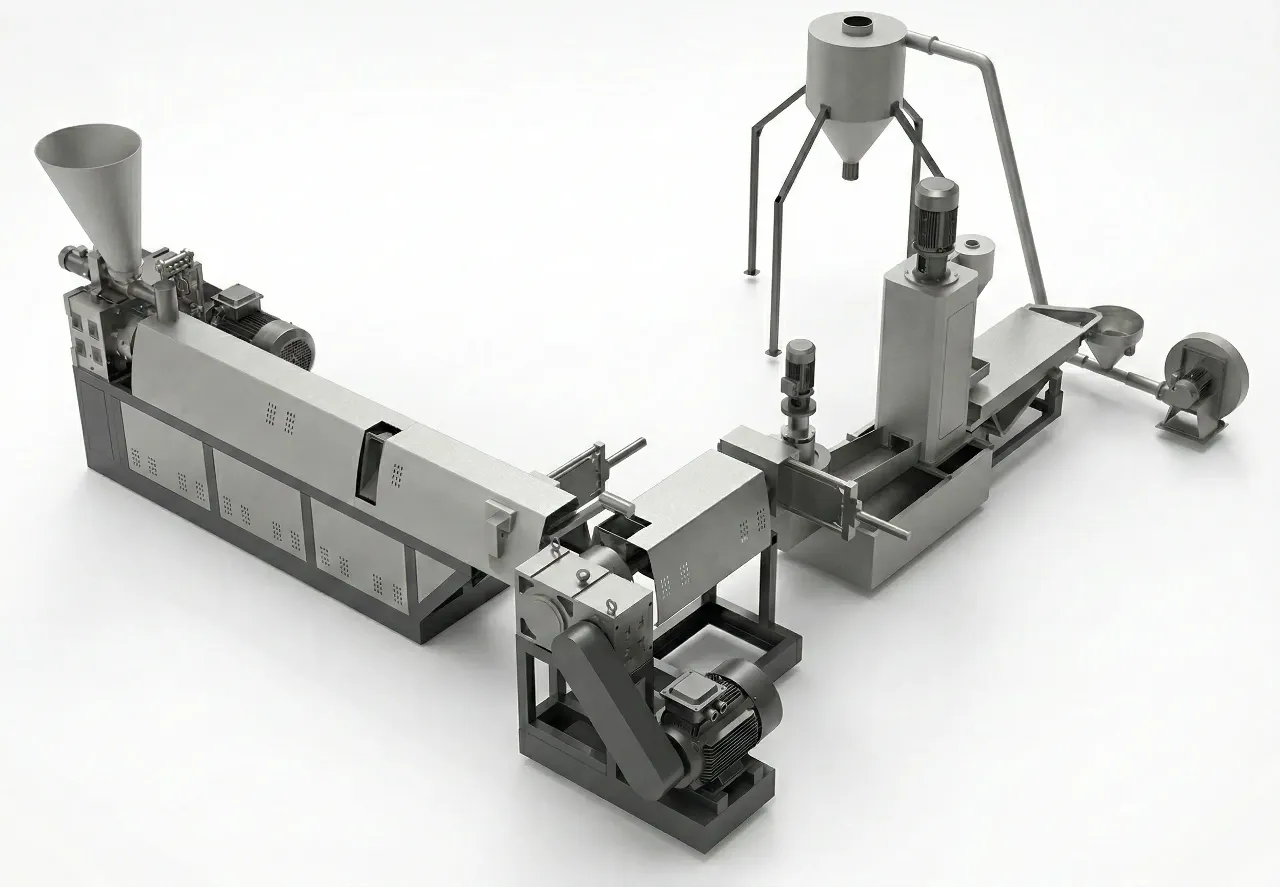
Nabywcy przemiału sztywnego zazwyczaj porównują ścieżkę dla twardych tworzyw z liniami do folii przed ofertą.
Powrót do głównego centrum regranulacji, aby porównać linie do sztywnych tworzyw, folii i PET.
Wybierz tę stronę, jeśli surowcem jest umyta folia PP/PE, rafia lub worki tkane.
Istotne dla opracowywania receptur lub compoundingu przed skalą przemysłową.
Wybierz linię na podstawie zachowania płatków, obciążenia filtracji i celu granulatu, nie tylko wielkości wytłaczarki.
Określ, czy linia będzie przetwarzać płatki HDPE, przemiał PP, ABS, PS, wlewki czy mieszane strumienie recyklingu.
Gęste płatki wymagają wymuszonego podawania; wilgoć lub zapachy mogą wymagać mocniejszego odgazowania lub drugiego stopnia.
Zmieniacz sit i sposób cięcia powinny być dobrane do czystości stopu i końcowego zastosowania granulatu.
Linia powinna być dobrana pod kątem tego, czy granulat trafi do wtrysku własnego, wytłaczania czy na odsprzedaż.
Six model sizes from 100 to 1,200 kg/h covering small-workshop to large-factory capacity, all with matched screw, filtration, and pelletizing configuration.
Six standard models from SJ85 to SJ180 cover 100–1,200 kg/h. Choose the right model for your resin type, flake size, and production target without over-specifying.
Water-strand pelletizing for standard resins, water-ring pelletizing for higher throughput and softer materials — matched to your resin and pellet quality target.
Plate, column, or automatic screen changers selected by contamination level. Higher-contamination feeds use auto screen changers for continuous operation without shutdown.
Most pellet quality issues in rigid recycling come from mismatched feeding, filtration, or pelletizing method — not from extruder size alone.
Rigid flakes bridge and starve the extruder, causing uneven melt and pellet size variation.
Force-feeding systems with stirring or cramming hoppers ensure consistent flake intake, especially for low-bulk-density materials like HDPE and PP regrind.
Residual labels, fines, and dirt pass through filtration and contaminate the pellet.
Three screen changer options (plate, column, automatic) are matched to contamination load. Auto screen changers allow continuous filtration without stopping the line.
Moisture and volatiles in washed flakes cause bubbles, voids, or odor in pellets.
Atmospheric or vacuum venting removes moisture and gas before the die. Double-stage configurations provide additional degassing capacity for heavily washed or damp material.
Pellet shape, size, or surface quality is inconsistent and causes downstream feeding problems.
Strand pelletizing delivers uniform cylindrical pellets; water-ring pelletizing produces rounded pellets at higher throughput. Both methods are selected to match the target resin and reuse route.
Projekty regranulacji sztywnych tworzyw są zwykle oceniane zarówno na podstawie konfiguracji maszyny, jak i zdolności linii do produkcji stabilnego granulatu.

Linie do sztywnych tworzyw są projektowane wokół średnicy ślimaka, siły odgazowania, strategii zmiany filtrów i metody granulacji.
Celem jest strumień granulatu o powtarzalnej jakości stopu, stabilnym ciśnieniu i geometrii ułatwiającej ponowne użycie.

Zobacz, jak sztywne płatki są przetwarzane przez system podawania, wytłaczanie i filtrację w wysokiej jakości regranulat.
Regranulacja sztywnych płatków HDPE, PP, ABS i PS ze strumieni przemysłowych lub umytych pokonsumpcyjnych.
Stabilizacja jakości stopu i filtracja resztkowych etykiet, drobinek lub brudu przed formowaniem granulatu.
Dopasowanie jakości granulatu do wymogów formowania, wytłaczania lub komercyjnej sprzedaży regranulatu.
| Parameter | Specification | Notes | |||
|---|---|---|---|---|---|
| SJ85-100 | Water strands pelletizing | Plate screen changer | 85 mm (L/D 28-33:1) / 100 mm (L/D 10:1) | 55-75 kW | 100-200 kg/h |
| SJ100-120 | Water strands pelletizing | Plate screen changer | 100 mm (L/D 28-33:1) / 120 mm (L/D 10:1) | 90-110 kW | 200-350 kg/h |
| SJ130-150 | Water strands pelletizing | Column screen changer | 130 mm (L/D 28-33:1) / 150 mm (L/D 10-12:1) | 132-160 kW | 400-550 kg/h |
| SJ150-160 | Water strands / Water ring | Column screen changer | 150 mm (L/D 28-33:1) / 160 mm (L/D 12:1) | 185-200 kW | 500-650 kg/h |
| SJ160-180 | Water ring pelletizing | Automatic screen changer | 160 mm (L/D 28-33:1) / 180 mm (L/D 12:1) | 220-250 kW | 700-900 kg/h |
| SJ180-200 | Water ring pelletizing | Automatic screen changer | 180 mm (L/D 28-33:1) / 200 mm (L/D 12:1) | 280-315 kW | 900-1200 kg/h |
Powyższe parametry to standardowe konfiguracje. Wszystkie specyfikacje — w tym średnica ślimaka, stosunek L/D, metoda granulacji, typ zmieniacza sit i moc silnika — mogą być dostosowane do Twoich potrzeb.
| Czynnik decyzyjny | Linia do twardych tworzyw | Linia do folii (z zagęszczarką) |
|---|---|---|
| Materiał | Sztywne płatki, przemiał, wlewki (HDPE, PP, ABS, PS) | Folia, rafia, worki tkane, stretch |
| Gęstość podawania | Wysoka gęstość nasypowa — podawanie wymuszone lub grawitacyjne | Bardzo niska gęstość — wymaga zagęszczarki |
| Typowa wydajność | 100–1200 kg/h | 200–800 kg/h |
| Metoda granulacji | Strunowa lub w pierścieniu wodnym | Strunowa, pierścień wodny lub przy głowicy |
| Główne wyzwanie | Filtracja stopu i usuwanie zanieczyszczeń | Redukcja objętości i usuwanie powietrza |
Strand pelletizing extrudes melt into strands cooled in a water bath, then cut into cylindrical pellets — best for standard resins like HDPE and PP. Water-ring pelletizing cuts at the die face and cools pellets in a water ring, producing rounded pellets and suited for higher-throughput models (SJ150 and above) and softer materials.
Plate screen changers are the most economical for clean, post-industrial regrind. Column screen changers suit moderate contamination levels. Automatic screen changers are recommended for post-consumer streams with labels, fines, and residual dirt — they allow continuous filtration without stopping the line.
Yes. The line handles washed HDPE, PP, ABS, and PS flakes. For post-consumer material with higher moisture or residual contamination, a double-stage layout with enhanced venting and automatic screen changer is recommended.
Model selection depends on resin type, flake bulk density, contamination level, and target pellet quality — not just kg/h alone. The SJ85 suits 100–200 kg/h for lighter operations; the SJ180 handles 900–1,200 kg/h for large-scale production. Contact Rumtoo with your material details for a matched recommendation.
Wyślij typ materiału, wielkość płatków, zabrudzenie, wydajność i zastosowanie dla dopasowanej rekomendacji.
Go to Contact Form