
· Rumtoo Engineering Team · Buying Guides · 7 min read
Removing Rubber and Silicone from Plastic: Friction vs Electrostatic vs Density
Three separation methods can pull rubber and silicone out of plastic regrind — density sorting, electrostatic separation, and friction-elasticity separation. They are not interchangeable. This guide compares what each one actually removes, where each fails, and how recyclers combine them to hit a clean single-resin flake.
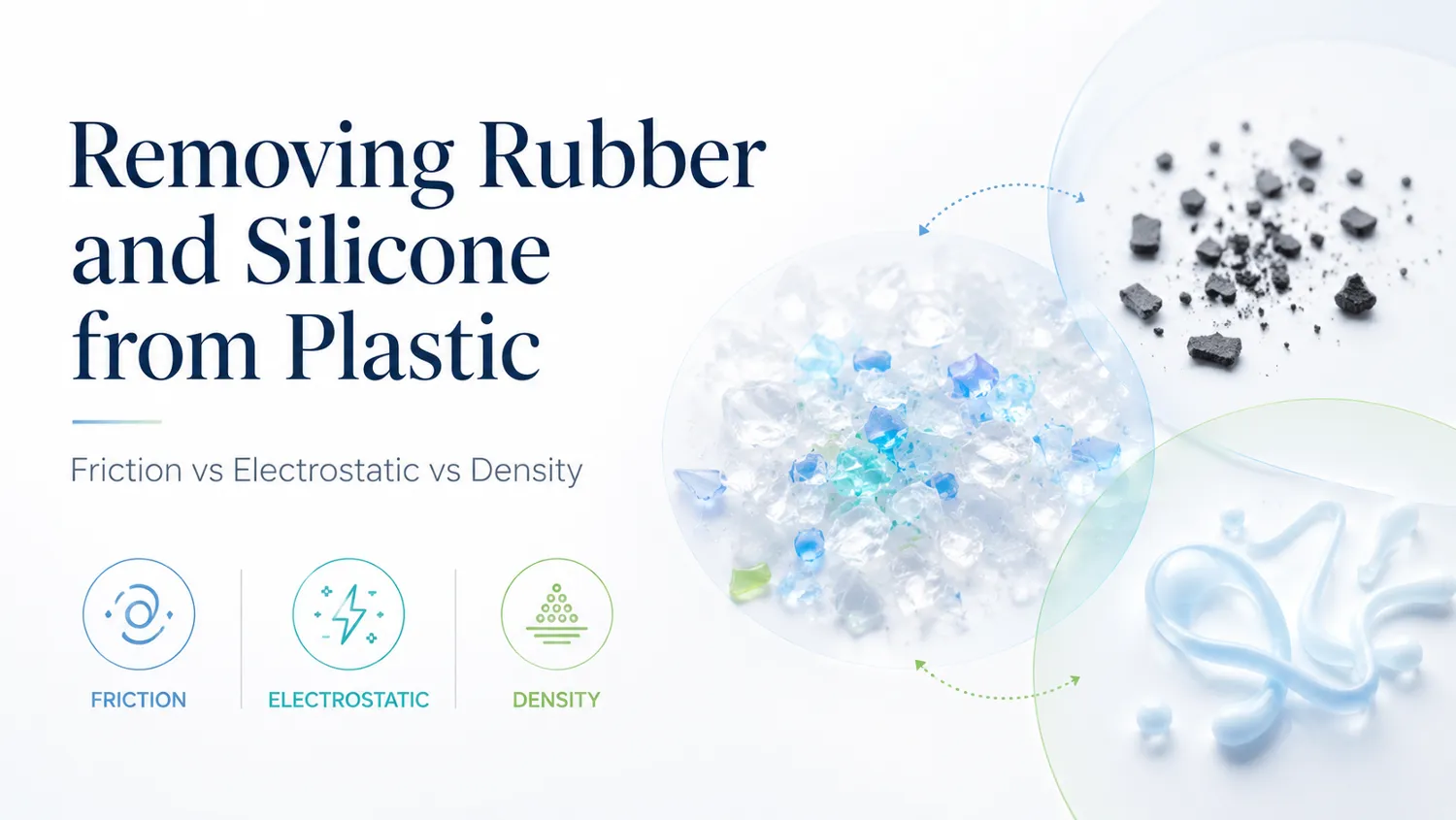
When rubber or silicone contaminates a plastic regrind stream, three separation methods can remove it: density sorting, electrostatic separation, and friction-elasticity separation. They are not interchangeable. Each sorts on a different physical property, each clears a different contaminant, and each fails on a stream another one handles easily. Choosing the wrong one is the most common reason a recycler keeps seeing rubber in flake that should be prime. This guide compares the three for the specific job of pulling soft, elastic contamination — rubber, silicone, EPDM — out of rigid plastic.
For the material science behind why these contaminants are so hard to remove, see the companion silicone vs rubber vs plastic separation guide; this page is about choosing the equipment.
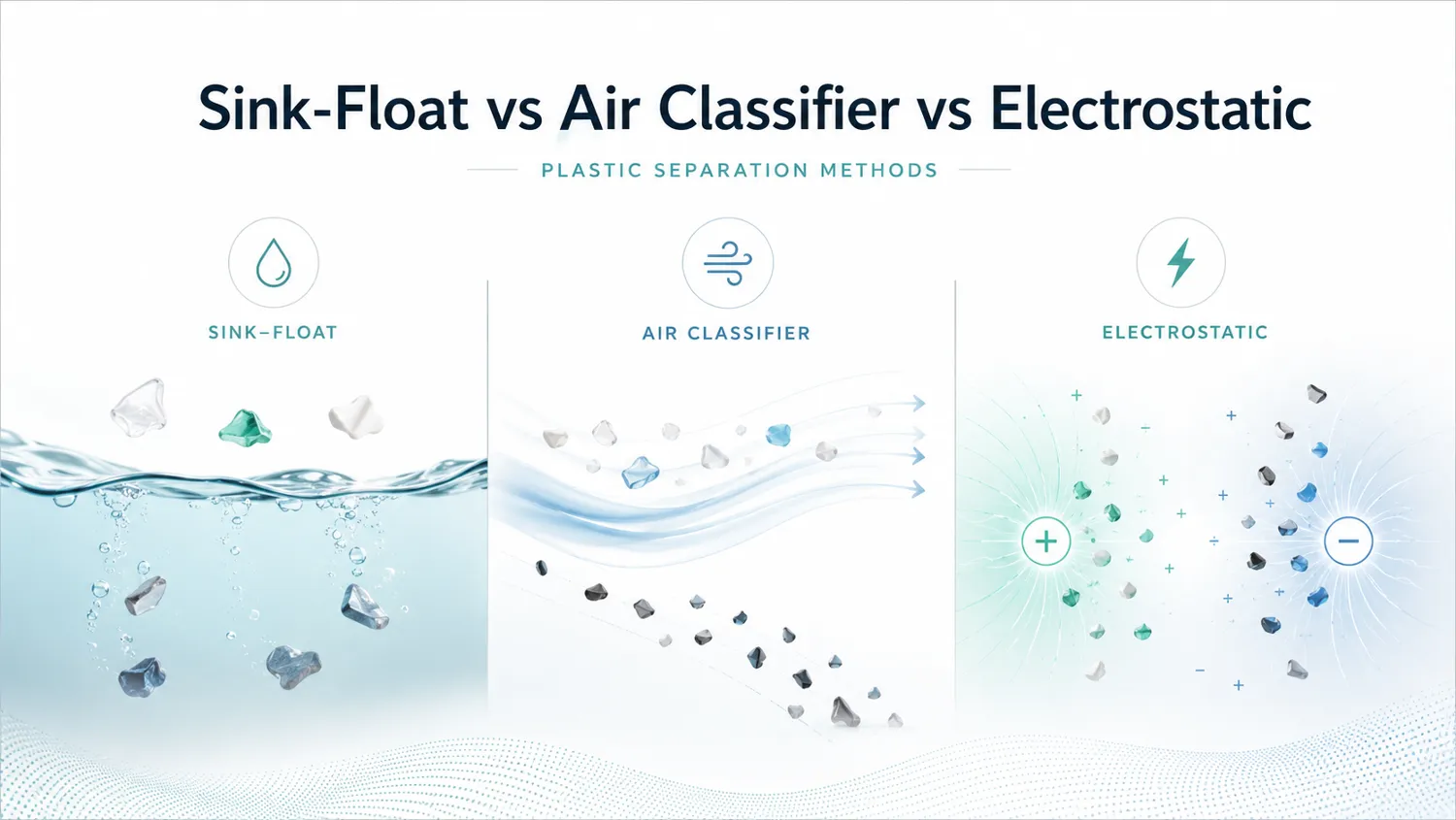
The Three Methods at a Glance
| Method | Sorts on | Best at | Fails on |
|---|---|---|---|
| Density (sink-float) | Weight in water | Splitting bulk resins — PP/PE (float) vs ABS/PS/PET (sink) | Silicone and rubber whose density overlaps the plastic |
| Electrostatic | Surface charge | Dry plastic-vs-plastic pairs of similar density (ABS/PS) | Wet, dusty, or coarse feed; coated particles |
| Friction-elasticity | Grip and rebound | Removing elastic rubber, silicone, and elastomers from rigid flake | Bulk resin-to-resin splits between rigid plastics |
The short version: density splits the bulk resin families, electrostatic separates rigid plastics that density cannot, and friction-elasticity is the one built specifically to pull elastic contaminants out. Most real purification lines use more than one.
Density Separation (Sink-Float): Cheap, but Blind to Elastomers
A sink-float tank drops flake into water and sorts by what floats and what sinks. It is the cheapest, highest-throughput sorting step on a washing line, and it does one job well: separating the light polyolefins (PP and PE, which float) from the heavier engineering plastics (ABS, PS, PET, which sink).
Where it fails is exactly the rubber-and-silicone problem. Cured silicone sits around 1.1–1.2 g/cm³, and many rubbers land in the same band as the plastics you are trying to clean. In water, a silicone fragment and an ABS flake can both sink — so a sink-float tank leaves the contaminant mixed into the very fraction you wanted clean. Density sorting is essential for the bulk split, but it cannot tell an elastomer from a rigid plastic of similar weight.
Key takeaway: Use sink-float to separate resin families by weight, not to remove rubber or silicone — their density overlaps the plastics, so flotation leaves them behind.
Electrostatic Separation: Powerful for Plastic-vs-Plastic, Demanding on Feed
An electrostatic (triboelectric) separator charges particles by contact friction, then drops them through a strong electric field where opposite charges deflect to opposite sides. It is genuinely powerful for separating two rigid plastics that have nearly the same density — the classic case being ABS from PS, where sink-float is useless because both sink.
Its limits are about feed condition, not capability. Electrostatic separation needs flake that is dry, clean, finely and evenly sized, and free of surface coatings; moisture, dust, labels, or additives mask the charge difference and collapse the separation. It is a polishing step for prepared single-resin-pair streams, not a front-line cleaner for mixed, dirty regrind. For rubber and silicone specifically, electrostatic sorting can play a role on some dry polymer pairs, but elastomers do not charge and behave like the rigid plastics it was tuned for — so it is rarely the tool that makes the rubber cut on its own.
Friction-Elasticity Separation: Built for the Rubber and Silicone Cut
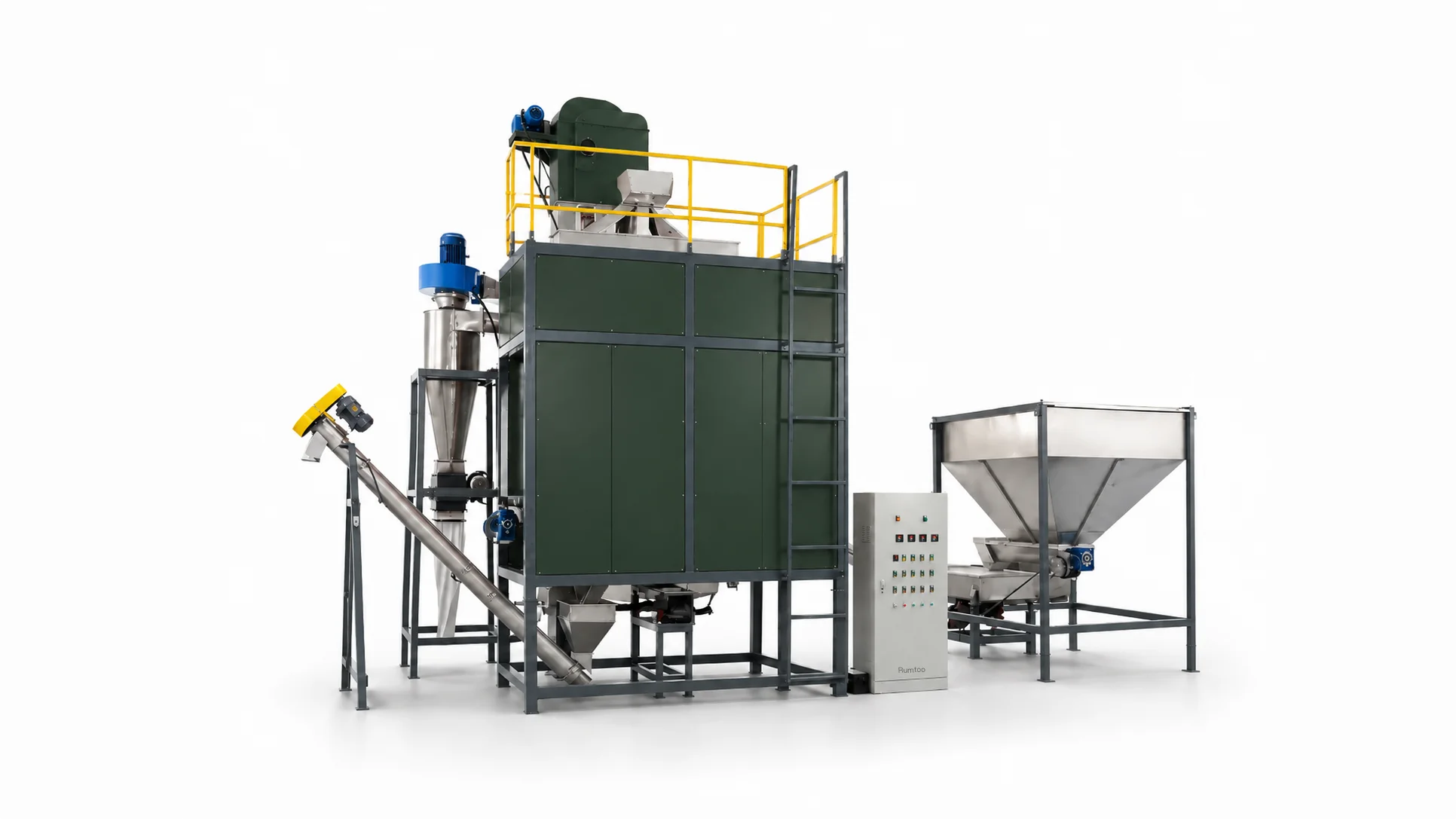
A friction-elasticity separator sorts on the two properties that actually distinguish rubber and silicone from rigid plastic: surface friction and rebound. Dry flake is spread thin across a deck of rotating spindles. Rigid plastic flakes are hard and low-friction, so they slide and bounce forward to a clean discharge. Elastic silicone and rubber grip the spindle surface and are carried off to a separate, rubber-rich outlet. The separation is purely mechanical — no water, no chemicals, no heat.
This is the method that targets the contaminant the other two miss. Density can’t see it because the weight overlaps; electrostatic isn’t built for elastics. Friction-elasticity sorts on the one thing rubber and silicone always have that rigid plastic does not — they grip and they bounce differently. On dry, pre-screened, single-resin flake, it typically brings rubber residue below 2% (roughly 98% plastic purity), and a second pass pushes it lower. This is the job a dedicated silicone rubber separator is designed for.
Which Method for Which Problem
Match the method to the contaminant and the stream, not to a brand:
Use density (sink-float) when your first task is splitting bulk resin families — separating PP/PE from ABS/PS/PET in a mixed wash stream. It is the cheapest way to do that and belongs early in the line.
Use electrostatic when you need to separate two rigid plastics of similar density — ABS from PS, for example — and your flake is already dry, clean, and well-sized. It is a precision plastic-to-plastic step, not a rubber remover.
Use friction-elasticity when the contaminant is elastic — rubber, silicone, EPDM, NBR, foam — and it is dragging an otherwise clean plastic down from prime to mixed scrap. This is the only one of the three built to make that cut reliably.
Use them in sequence when the stream is complex. A common purification train is: sink-float (bulk resin split) → friction-elasticity (remove elastics) → electrostatic (final plastic-to-plastic polish). The methods are complementary, not competing — each clears what the next cannot.
How They Fit a Real Line
On a typical recycling line the separators sit after granulation and washing, on dry flake, before pelletizing. Density sorting runs as part of the wash stage. The friction-elasticity separator is placed on clean, dry flake — wet or dusty material masks the friction difference and ruins the cut. Electrostatic, if used, comes last, polishing a prepared single-resin-pair fraction.
The practical mistake recyclers make is expecting one machine to do all three jobs. A sink-float tank will never remove silicone; an electrostatic separator will not clean dirty mixed regrind; a friction separator is not meant to split ABS from PS. Knowing which property each one sorts on is what tells you how many stages your stream actually needs. For the step-by-step plant workflow of making the rubber cut, see how to separate silicone and rubber from plastic regrind.
Frequently Asked Questions
Can a sink-float tank remove rubber or silicone from plastic?
Not reliably. Sink-float sorts by density, and cured silicone (~1.1–1.2 g/cm³) and many rubbers overlap the density of common plastics like ABS, PS, and PET. They sink together, so the contaminant stays in the fraction you wanted clean. Sink-float is for splitting resin families, not removing elastomers.
Is electrostatic separation good for removing rubber from plastic?
Electrostatic separation is strongest for separating two rigid plastics of similar density, such as ABS from PS, on dry and clean flake. Rubber and silicone are elastic and do not charge the way those plastics do, so electrostatic is rarely the tool that makes the rubber cut on its own. A friction-elasticity separator is built for that job.
What is the best way to remove silicone and rubber from plastic regrind?
For elastic contaminants — rubber, silicone, EPDM, foam — a friction-elasticity separator is the most direct method, because it sorts on grip and rebound, the properties that distinguish elastomers from rigid plastic. On dry, single-resin flake it typically leaves rubber residue below 2%. Density and electrostatic separation handle different jobs in the same line.
Do I need more than one separation method?
Often yes. A complex stream usually runs sink-float to split bulk resins, then friction-elasticity to remove rubber and silicone, then electrostatic for a final plastic-to-plastic polish. Each method clears a contaminant the others cannot, so they are combined rather than chosen one against another.
Summary
Density, electrostatic, and friction-elasticity separation solve three different problems. Density splits resin families by weight but is blind to elastomers that overlap the plastic’s density. Electrostatic precisely separates rigid plastics of similar density but needs clean, dry, prepared feed and is not built for elastics. Friction-elasticity is the method designed to pull rubber and silicone out of rigid flake, sorting on grip and rebound to reach prime purity. The strongest lines use them in sequence, not in competition.
If rubber or silicone is holding back the value of otherwise clean plastic, send Rumtoo a sample. We will run it on a silicone rubber separator, measure the achievable rubber residue, and quote against a tested result.
- silicone rubber separator
- rubber removal
- plastic separation methods
- electrostatic separation
- plastic regrind purity