
· Rumtoo Engineering Team · Buying Guides · 13 min read
Industrial plastic shredder machine guide: single shaft vs. double shaft for film, rigid plastic & pipe
Choosing the wrong industrial plastic shredder creates downstream problems that no washing line or extruder can fix. This guide covers single-shaft, double-shaft, and four-shaft configurations—with specific guidance on film wrapping prevention, pipe feeding, rigid plastic throughput, and blade selection—so you can specify the right machine before issuing an RFQ.
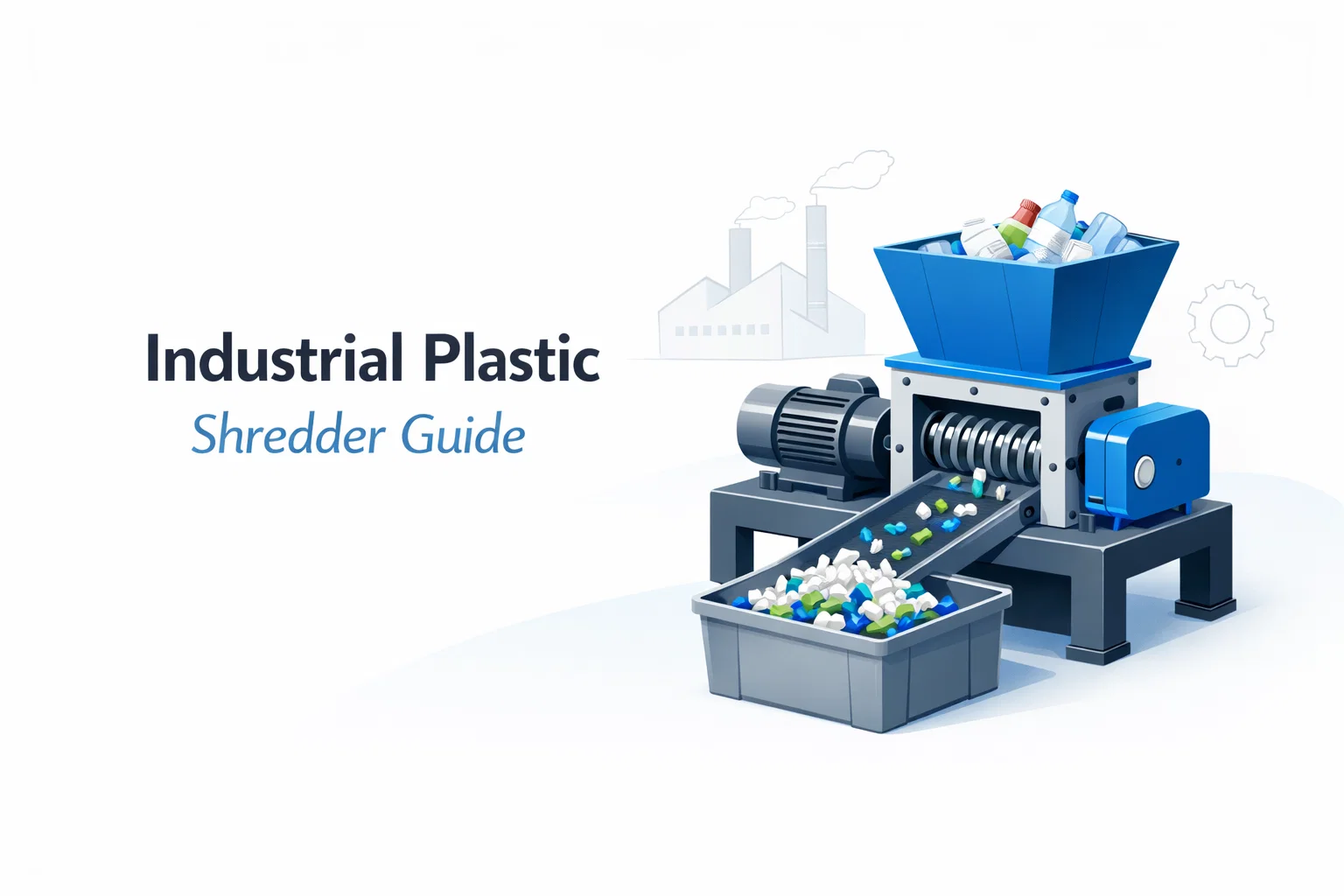
The shredder is usually the first machine in a plastic recycling line. If it’s wrong for the feedstock, every stage downstream inherits the problem—oversized particles cause granulator jams, irregular output disrupts washing line feeding, and inconsistent particle size raises pellet defect rates in the extruder.
This guide covers the three main industrial plastic shredder configurations used in recycling: single-shaft, double-shaft, and four-shaft machines. For each type, we explain the feedstock it handles well, the output it produces, the throughput ranges to expect, and the situations where it becomes the wrong choice. We also cover blade steel selection, film wrapping prevention, and pipe feeding design—topics most buying guides skip that determine whether a shredder lasts three years or three months on your specific material.
Before this guide, you may want to review our industrial shredders overview for Rumtoo’s specific models and throughput specifications.
What an industrial plastic shredder actually does—and what it doesn’t
An industrial shredder reduces bulk plastic to a manageable particle size for downstream processing—typically 30–150 mm for coarse shredding, or 10–50 mm when a sizing screen is used. It is not a granulator. A granulator produces tightly controlled 6–20 mm flake using high-speed rotating knives against a fixed screen. A shredder uses mechanical force (tearing, shearing, or compression) and operates at low rotor speed and high torque.
Most plastic recycling lines use shredder → granulator in sequence, or shredder alone if the downstream process (a washing line, for example) can accept coarser input. If your line goes directly from shredder to extruder, the shredder output particle size matters more than in a two-stage size reduction setup.
The shredder does not remove contamination. Metal pieces, stones, and incompatible polymers pass through or jam the cutting chamber. Metal detection upstream of the shredder is essential for post-consumer feedstock. A metal piece that enters the cutting chamber at full rotor speed destroys blades and can crack the rotor—a repair that costs more than a standalone metal detector.
How to calculate the shredder throughput you need
Use the same formula as for pelletizing:
Required throughput (kg/h) = Daily feedstock volume (kg) ÷ Operating hours per day
Add 20–25% buffer for maintenance windows and peak volume periods. Industrial plastic shredders for recycling generally operate in three capacity bands:
| Capacity Band | Throughput Range | Typical Application |
|---|---|---|
| Small/inline | 200–800 kg/h | In-plant scrap recovery, R&D |
| Medium industrial | 800–2,500 kg/h | Regional recyclers, film bale processing |
| Heavy-duty | 2,500–10,000+ kg/h | Industrial-scale post-consumer lines |
Note that throughput varies significantly by material. A 500 kg/h rated shredder on low-density PE film may achieve 400 kg/h actual throughput; the same machine on rigid HDPE drums may achieve only 200–280 kg/h. Always specify throughput requirements by material type, not as a single number.
Single-shaft plastic shredder: precise output for film, purges, and inline applications
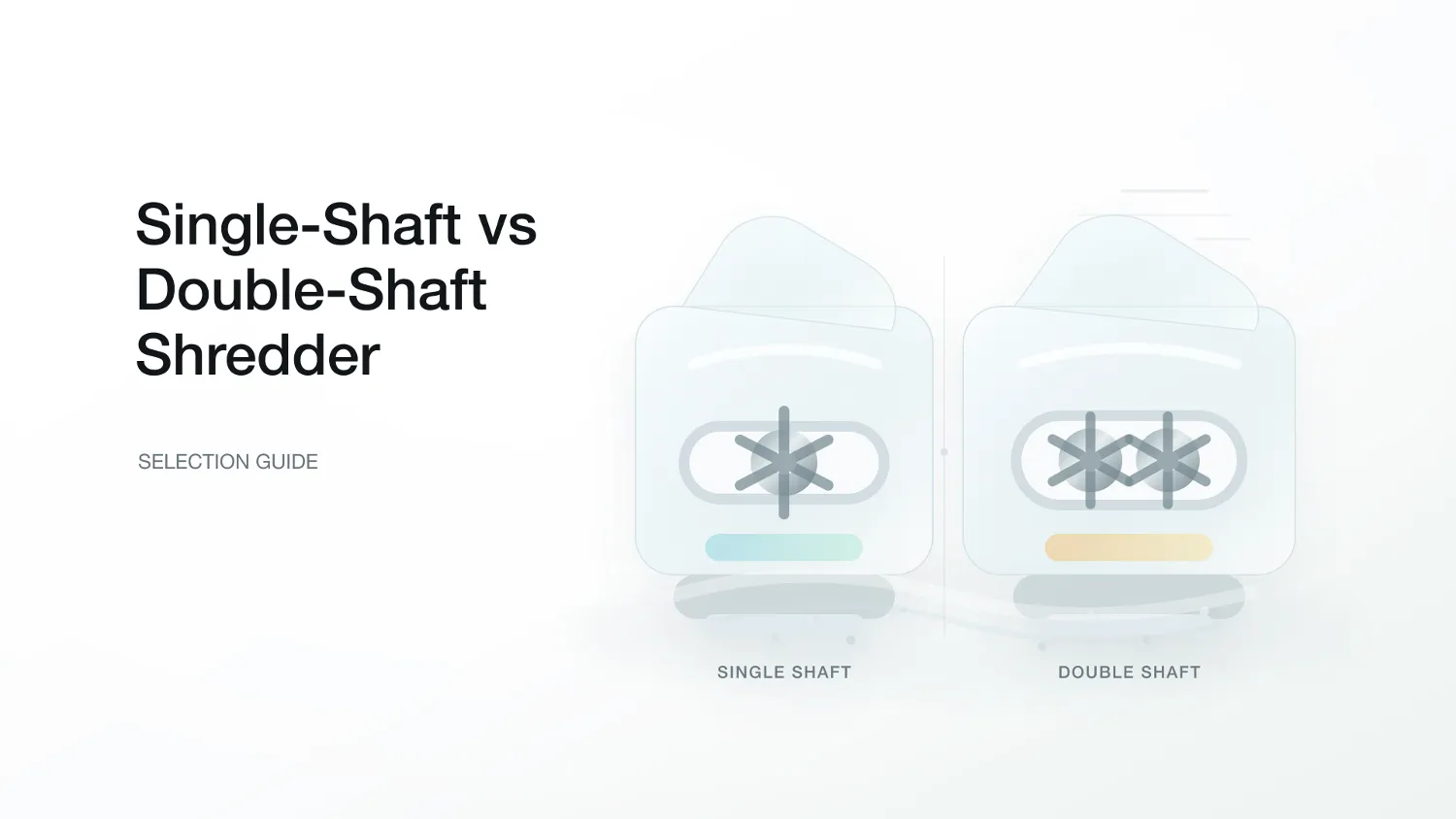
A single-shaft shredder uses one rotating rotor equipped with interchangeable cutting blades working against fixed counter-knives. A sizing screen below the rotor recirculates material until it passes through the screen opening, producing a consistently sized output. A hydraulic ram or pusher feeds material against the rotor under controlled pressure.
When single-shaft is the right choice
Single-shaft shredders are the correct specification when:
- Output particle size consistency matters: Because material recirculates until it passes through the screen, a single-shaft shredder produces significantly more uniform output than a double-shaft machine. This matters when feeding a granulator, an extruder, or a washing line with defined particle size limits
- Feedstock is relatively uniform: Film bales, purges and runners, plastic sheets, lumps from extrusion startup, and in-plant scrap are all well-matched to single-shaft shredding
- In-line recycling applications: Single-shaft shredders are commonly installed inline next to injection molding or extrusion presses, using a conveyor or manual feeding system to return scrap directly
- Operating throughput is below 2,500 kg/h: At lower throughput requirements, single-shaft machines offer better value and simpler maintenance than double-shaft configurations
The film wrapping problem—and how to control it
Film and woven bags are the most problematic feedstock for standard single-shaft shredders. Flexible material that doesn’t break cleanly under blade impact wraps around the rotor shaft instead, building up until the machine stalls or overheats.
Solutions to specify when processing film:
- Rotor geometry: A staggered or spiral blade arrangement on the rotor pulls film through the cutting zone instead of allowing it to wrap. Confirm spiral rotor design before buying for film applications
- Variable frequency drive (VFD): VFD control allows rotor speed adjustment when the load spikes, reducing stall risk and energy peaks when processing heterogeneous bales
- Automatic reverse function: When rotor load exceeds a set threshold, the machine briefly reverses direction to release wrapped material before resuming forward rotation. This is nearly mandatory for unsupervised film shredding operations
- Feed rate control: Hydraulic ram speed set conservatively for film prevents overfeeding the rotor before material can escape through the screen
Blade steel for single-shaft shredders
Blade life depends more on material choice and heat treatment than on machine brand. Common blade steels and their applications:
| Steel Grade | Hardness (HRC) | Best For |
|---|---|---|
| D2 tool steel | 58–62 | General plastics, purges, film |
| SKD-11 (Cr12MoV) | 58–62 | High-wear applications, post-consumer film with sand |
| H13 hot work steel | 48–52 | High-impact applications with intermittent thermal load |
| Bi-metal (HSS face) | 62–65 | Contaminated streams with occasional metal contact |
For clean post-industrial film, D2 blades typically last 800–1,500 operating hours before requiring regrinding. For post-consumer agricultural film with soil and sand contamination, expect 300–600 hours. Track blade wear intervals from the first replacement—it tells you more about your feedstock abrasivity than any specification sheet.
Typical specifications for single-shaft shredders
| Parameter | Typical Range |
|---|---|
| Throughput | 200–3,000 kg/h (material-dependent) |
| Rotor diameter | 300–800 mm |
| Screen opening | 20–80 mm |
| Motor rating | 22–315 kW |
| Best-fit feedstock | Film, purges, runners, plastic sheet, small rigid parts |
| Output particle size | Controlled by screen; typically 20–80 mm |
Double-shaft plastic shredder: high torque for bulky, tough, and mixed feedstock
A double-shaft shredder uses two parallel, counter-rotating shafts with interlocking blade discs. The shafts rotate inward, pulling material down into the cutting zone where it is torn, sheared, and compressed. Unlike a single-shaft machine, double-shaft shredders typically operate without a sizing screen—material passes through in one cut, producing a coarser and less uniform output.
When double-shaft is the right choice
Double-shaft shredders are the correct specification when:
- Feedstock is bulky, tough, or irregular: Large drums, crates, thick-walled containers, plastic pallets, and whole baled product—forms that would jam or overload a single-shaft machine—are handled efficiently by the low-speed, high-torque double-shaft design
- Volume reduction is the primary goal: When you need to reduce a large volume of plastic waste to manageable size for subsequent processing or transport, and particle size uniformity is not critical
- Mixed or contaminated streams: Double-shaft machines are more tolerant of heterogeneous input including mixed resin types, irregular shapes, and partially contaminated feedstock
- High throughput is required at low cost: At equivalent throughput, double-shaft machines generally cost less per ton than single-shaft machines with screens, though output quality is lower
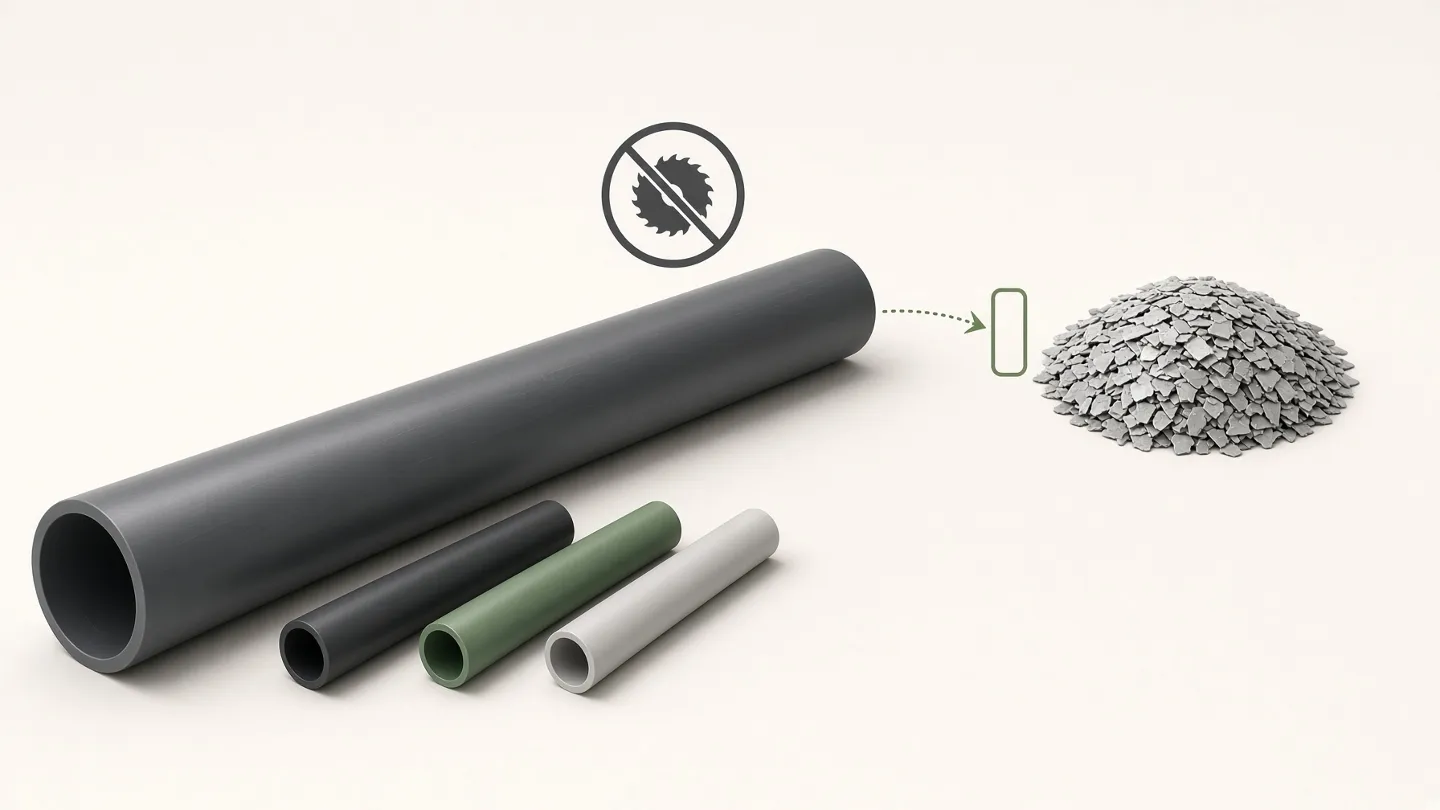
- Pipe recycling: Standard vertical or general-purpose hoppers often require pre-cutting. Dedicated horizontal single-shaft, dual-shaft, or multi-shaft systems can accept long pipe when the feed envelope and gripping design are sized for the real material
Pipe shredding: feeding design is everything
Pipe recycling is a specialized application where feeding system design determines whether the shredder actually works at scale. Key considerations:
Use the large-diameter plastic pipe shredder selection guide when the project must compare complete horizontal single-shaft, dual-shaft, and multi-shaft routes from the same pipe schedule.
- Throat opening dimensions: The shredder must accept your maximum pipe diameter without pre-cutting. Industrial models handle pipes up to 400–600 mm diameter; some heavy-duty configurations go to 1,000 mm
- Feeding orientation: Horizontal feeders with hydraulic pushers manage very large pipes. Vertical drop-in designs work for shorter sections up to 2 m without pre-cutting
- Pipe wall thickness: HDPE pipe schedule 160 or larger requires significantly more motor torque than SDR 11 at the same diameter. Specify your largest-diameter, thickest-wall pipe combination—not your average feedstock
- Output from pipe shredding: Double-shaft output from thick-walled pipe is typically strips and irregular pieces, 50–200 mm. A secondary granulator is usually required before washing or extrusion
Double-shaft shredder throughput and specifications
| Parameter | Typical Range |
|---|---|
| Throughput | 500–10,000+ kg/h (material-dependent) |
| Shaft diameter | 200–600 mm |
| Rotor speed | 15–80 rpm (low-speed, high-torque design) |
| Motor rating | 37–500 kW per shaft |
| Best-fit feedstock | Large drums, crates, pipes, pallets, mixed rigid, baled product |
| Output particle size | Uncontrolled; typically 50–200 mm without screen |
Four-shaft plastic shredder: fine output in a single pass
A four-shaft shredder uses two pairs of counter-rotating shafts stacked vertically. The upper shaft pair performs primary size reduction; the lower pair reduces material further. The result is a finer, more uniform output than a double-shaft machine can achieve—approaching single-shaft screen output for some materials—without requiring a separate granulator stage.
When four-shaft is the right choice
- Tough, fibrous plastics requiring fine output: Carpet backing, fiber-reinforced materials, and thick-walled composites that resist clean cutting respond better to the four-shaft progressive shearing action
- Demanding output uniformity from a double-shaft-type machine: If you need the bulk handling capacity of a double-shaft machine but require controlled output closer to 30–60 mm, a four-shaft configuration achieves this in one pass
- Reducing the number of processing stages: In some line configurations, replacing a double-shaft shredder + granulator with a four-shaft shredder reduces equipment count and footprint
The capital cost of four-shaft machines is significantly higher than either single or double shaft configurations. They are typically specified for high-volume industrial applications where downstream process requirements demand consistent particle size from a bulk-feeding machine.
Shredder selection by feedstock: decision routing table
| Feedstock | Form | Recommended Shredder Type |
|---|---|---|
| PE / PP film bales | Loose, baled | Single-shaft with spiral rotor + VFD + auto-reverse |
| Agricultural film | Baled, dirty | Single-shaft with spiral rotor; expect higher blade wear |
| Woven PP bags | Loose or baled | Single-shaft (spiral) or double-shaft |
| Extrusion purges / lumps | Solid, irregular | Single-shaft |
| HDPE / PP rigid containers | < 50 L volume | Single-shaft or double-shaft |
| Large drums, crates, pallets | Bulky, > 50 L | Double-shaft |
| Plastic pipes (HDPE, PVC, PP) | Long sections | Double-shaft with pipe throat |
| Mixed industrial rigid plastic | Heterogeneous | Double-shaft |
| Fiber-reinforced or thick composites | Tough, fibrous | Four-shaft |
| Post-consumer mixed bales | Various | Double-shaft (primary); single-shaft (after sorting) |
Upstream metal detection: the non-negotiable prerequisite
Post-consumer plastic waste—particularly from municipalities, collection programs, or construction and demolition streams—contains metal at unpredictable rates. A single piece of steel rod, pipe fitting, or wire bundle entering a shredder at operating speed will:
- Destroy one or more blades immediately
- Potentially crack a blade disc or counter-knife
- In severe cases, damage the rotor or shaft
- Require 2–5 days downtime for emergency repair
Metal detector options in order of effectiveness:
- Overhead belt magnet: Removes ferrous metal from a conveyor feed; inexpensive but misses non-ferrous metal
- Magnetic head pulley: Integrated into the conveyor; catches ferrous metal at the point of transfer
- Eddy-current separator: Removes non-ferrous aluminum, copper, and brass in addition to ferrous metals; recommended for post-consumer streams
- Metal detector with reject gate: Full-width detection with automatic conveyor stop or diverter gate; highest protection, highest cost
For post-industrial clean scrap, overhead magnets are often sufficient. For post-consumer streams where aluminum or copper contamination is possible, specify an eddy-current separator before the shredder.
Key maintenance intervals that affect shredder total cost of ownership
The purchase price of an industrial plastic shredder is typically 30–50% of the true 5-year ownership cost for post-consumer film operations. Maintenance planning items that affect this calculation:
| Component | Maintenance Interval | Note |
|---|---|---|
| Cutting blades | Every 300–1,500 hours | Depends on material and steel grade; track from day one |
| Counter-knives | Every 500–2,000 hours | Often last longer than cutting blades |
| Screen inspection | Weekly | Cracks propagate; a cracked screen allows oversized material through |
| Bearing regreasing | Monthly or per OEM | Missed lubrication is the leading cause of premature bearing failure |
| Rotor shaft seal | Annually or per wear | Film dust infiltrating shaft seals causes accelerated shaft wear |
| Hydraulic system (ram shredders) | Per OEM schedule | Seal leaks create downtime; plan for periodic hydraulic fluid change |
Before purchasing, request the supplier’s recommended maintenance schedule and spare blade pricing. Some manufacturers price blades and consumables aggressively after the initial sale. Clarify:
- What steel grade are the blades?
- Can blades be reground, and how many regrind cycles?
- Are blades available from third-party suppliers or only from the OEM?
Frequently asked questions about industrial plastic shredders
What is the difference between a shredder and a granulator?
A shredder operates at low speed and high torque, using tearing and shearing forces to reduce bulk material. Output particle size is coarser and less uniform—typically 30–200 mm. A granulator operates at high speed with rotating and fixed knives, using a sizing screen to produce uniform 6–20 mm flake. Most recycling lines use both: shredder first, granulator second.
Can a single-shaft shredder handle plastic film without wrapping?
Yes, if specified correctly. Specify a spiral rotor design, VFD speed control, and automatic reverse function. Film wrapping in single-shaft shredders is almost always caused by incorrect rotor geometry or insufficient motor protection—not by an inherent limitation of the machine type.
How do I shred large plastic pipes without pre-cutting?
Use a double-shaft shredder with adequate throat opening for your maximum pipe diameter. For pipes exceeding 2 m in length, specify a horizontal hydraulic pushfeeder that advances the pipe section-by-section into the cutting zone. Confirm that the motor torque rating accounts for your maximum pipe wall thickness—not just pipe diameter.
What blade steel should I specify for film recycling?
For clean post-industrial film: D2 tool steel or SKD-11 (equivalent). For contaminated post-consumer agricultural film with soil and sand: SKD-11 or bi-metal blades with a high-speed steel cutting face. For applications involving occasional metal contamination risk, bi-metal blades absorb impact better than through-hardened tool steel and fail progressively rather than catastrophically.
What throughput should I specify for a plastic shredder in a washing line?
Size the shredder to your washing line’s maximum feed rate, not your current feedstock volume. A washing line running at 800 kg/h throughput needs upstream shredder capacity of at least 800–1,000 kg/h (accounting for density differences and material variation). If the shredder becomes the bottleneck, the entire line loses throughput.
How much does metal contamination increase maintenance cost?
Significantly. A post-consumer film line with no upstream metal detection can expect blade life 60–70% shorter than a clean post-industrial film line—reducing blade intervals from 1,200+ hours to 400–500 hours. Eddy-current separator cost typically pays back within 6–18 months purely in reduced blade and counter-knife replacement cost.
Key questions to answer before issuing a shredder RFQ
- What is your feedstock? Resin type, source (post-industrial vs. post-consumer), form (loose film, baled, bulk containers, pipes), and maximum piece size
- What is your target throughput? In kg/h at steady-state, specifying the material you used
- What output size does your downstream process require? Washing line feed size, granulator input size, or baler size
- What contamination is present? Metal type and estimated frequency; paper and organic content
- What is the pipe dimension if processing pipe? Maximum outer diameter and maximum wall thickness
- What are the available utilities? Motor kW limit, compressed air, hydraulics
- What is the operating schedule? Hours per day and days per week—affects blade interval planning and motor duty cycle specification
Conclusion: match the shredder to the feedstock first, then the budget
Plastic shredder selection errors almost always follow the same pattern: a machine is chosen by price or throughput rating without verifying the rotor design, blade steel, screen configuration, or throat opening for the actual feedstock. The result is premature blade wear, chronic wrapping, or an output particle size that disrupts downstream processing.
Key takeaways:
- Single-shaft: Sized output, film wrapping prevention requires spiral rotor + VFD + auto-reverse, ideal for purges/film/sheet at 200–3,000 kg/h
- Double-shaft: Bulk reduction, pipes and large rigid, no screen, coarser output, 500–10,000+ kg/h
- Four-shaft: Fine output from bulk material, fibrous or tough plastics, high capital
- Metal detection upstream is mandatory for post-consumer feedstock before any shredder configuration
- Blade steel and maintenance intervals determine 5-year ownership cost more than purchase price does
To discuss your specific feedstock and line configuration, contact the Rumtoo engineering team. Our industrial shredders page includes motor ratings, screen configurations, and throughput data for single-shaft, double-shaft, and pipe shredder families.
If you’re evaluating size reduction options beyond shredding, our crusher vs. shredder selection guide covers the decision boundary between granulators and shredders for rigid plastic applications.
- industrial plastic shredder
- plastic shredder machine
- single shaft shredder
- double shaft shredder
- plastic shredder for film
- plastic pipe shredder
- rigid plastic shredder